
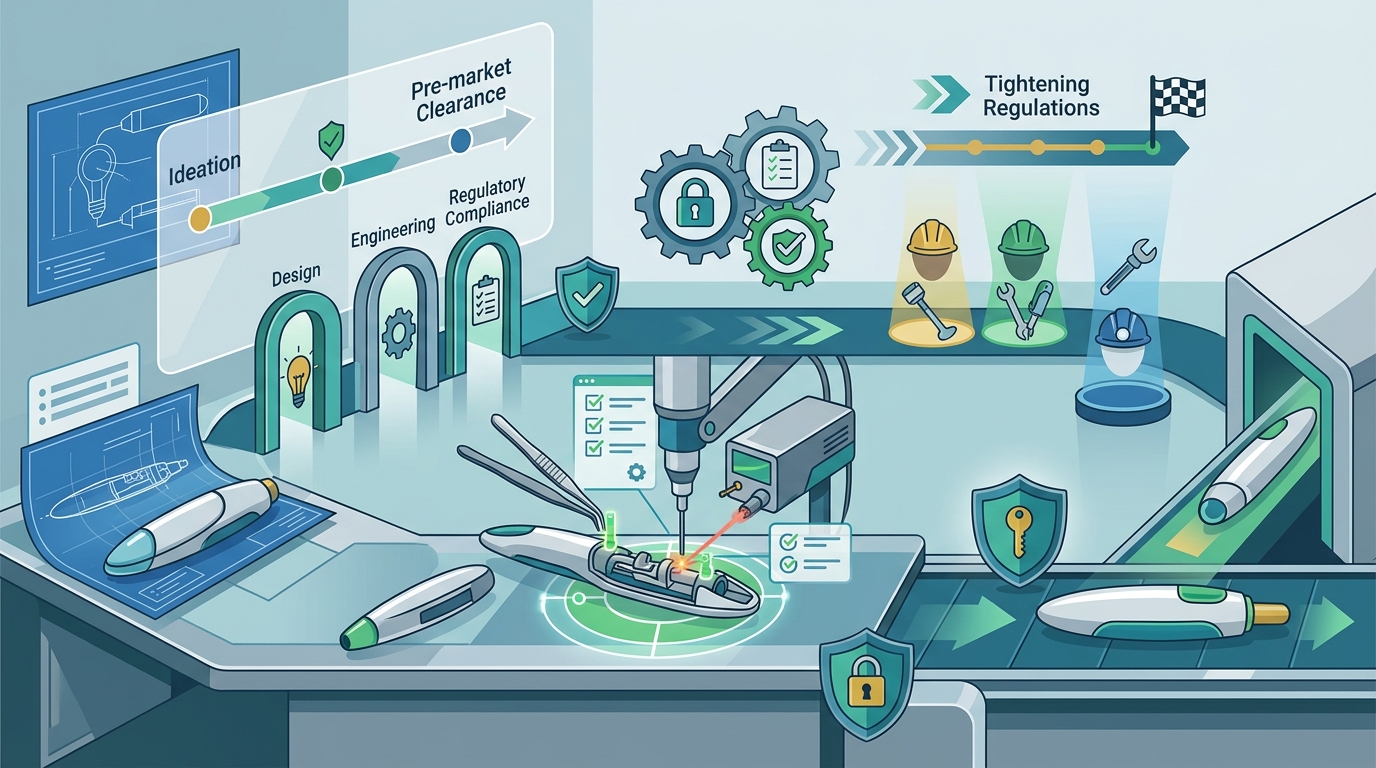
Bringing a medical device from concept to cleared, market-ready product is one of the most resource-intensive endeavors in any regulated industry. Talent scarcity in specialized engineering disciplines, tightening FDA and EU MDR requirements, and relentless speed-to-market pressure are pushing more organizations—from venture-backed startups to established OEMs—to outsource critical phases of product development.
This guide walks you through every consideration: why companies outsource, what engagement models exist, how to evaluate partners, what pitfalls to avoid, and how to structure the relationship so your intellectual property and regulatory standing stay protected.
Why Medical Device Companies Outsource Product Development
The decision to outsource is rarely about cutting corners. It is usually a strategic response to very specific constraints.
1. Specialized Talent Is Hard to Hire Full-Time
Embedded software, biocompatibility testing, human factors engineering, precision mechanism design—these disciplines are difficult and expensive to staff internally on a permanent basis. An outsourcing partner gives you access to those specialists only when you need them, without long-term headcount commitments.
2. Regulatory Complexity Keeps Growing
FDA's evolving guidance on software as a medical device, cybersecurity, and quality system requirements demands dedicated expertise that many companies cannot maintain across every product line. A partner with deep regulatory fluency helps you avoid costly submission delays and warning letters.
3. Speed to Market Is a Competitive Weapon
Competitive dynamics reward organizations that compress development timelines without sacrificing quality or compliance. Outsourcing to a team that is already production-ready with regulatory approval eliminates ramp-up time that would otherwise consume months.
4. Capital Efficiency
Contract manufacturers and CDMOs operate with economies of scale, specialized equipment, and cleanroom facilities that would be prohibitively expensive for many companies to establish independently. Outsourcing converts large fixed costs into variable project costs, preserving cash for clinical studies and commercialization.
5. Focus on Core Competencies
By outsourcing manufacturing and certain engineering functions, OEMs can concentrate resources on what differentiates them—research, clinical strategy, and market development—without diverting attention to intricate manufacturing or testing processes.
What Can You Actually Outsource?
Modern medical device outsourcing extends far beyond manufacturing. Companies today engage external partners across the entire product lifecycle—from early-stage design and feasibility studies through verification, validation, and regulatory submission.
Design and Engineering Services
External partners assist with concept development, industrial design, mechanical and electrical engineering, and software development. These specialists bring deep technical knowledge across multiple device types, helping navigate complex design challenges while maintaining compliance with FDA regulations and international standards.
System Engineering and Risk Management
Comprehensive system engineering covers requirements generation from voice-of-customer needs through detailed engineering requirements, system architecture, hazard analysis, FMEA, and traceability through verification and validation protocols.
Prototyping and Testing
Outsourced teams build and test prototypes at every fidelity level—from proof-of-concept bench models to near-production units. Starting the prototyping process early in development allows teams to find and address design issues before they become expensive to fix downstream.
Manufacturing Transfer and Production
Contract manufacturers handle everything from prototype production to full-scale commercial manufacturing, offering access to specialized equipment, cleanroom environments, and validated quality management systems.
Regulatory and Quality Consulting
Specialized firms manage 510(k) submissions, design history file documentation, post-market surveillance, and audit preparation, allowing your internal team to stay focused on development execution.
Intellectual Property Support
Some engineering consultancies work alongside your legal team to ensure products do not infringe on existing IP and can assist with patent disclosures as a first step in protecting novel ideas.
Three Engagement Models for Outsourcing
Not every outsourcing relationship looks the same. Choose the model that matches your internal capability and project scope.
Model 1: Staff Augmentation
You retain project ownership and management. The external firm provides engineers who integrate directly into your team, filling gaps in specific disciplines—mechanical design, firmware, human factors—without the cost and commitment of hiring full-time employees. This model works well when you have strong project leadership but need more hands.
Model 2: Project-Based Outsourcing
Specific tasks or development stages are contracted to an external partner while your company retains overall program management. For example, you might outsource detailed mechanical design and prototyping while handling software in-house. Clear deliverables, milestones, and acceptance criteria define the engagement.
Model 3: Full-Service / Turnkey Development
An external organization manages the entire development lifecycle from initial concept through design transfer and commercialization. This model suits startups or companies entering a new product category where internal capability is minimal. Working with a single partner from proof of concept through production reduces miscommunication and missed handovers.
How to Evaluate and Select an Outsourcing Partner
Choosing the wrong partner is the single biggest risk in outsourced development. Use this framework to narrow your options systematically.
Certifications and Registrations
At minimum, look for ISO 13485 certification—this indicates the company maintains a third-party-accredited quality management system appropriate for medical devices. Confirm FDA registration if manufacturing is involved. For software-intensive devices, verify that the partner follows IEC 62304 processes.
Domain Experience
A partner who has designed devices similar to yours will understand the clinical context, materials, failure modes, and regulatory pathway. Ask for case studies and references. Broad experience across many device types can also provide valuable cross-domain insight even when direct category experience is limited.
Engineering Depth and Breadth
Evaluate whether the firm can cover the disciplines your project requires: mechanical engineering, electrical engineering, embedded software, systems engineering, human factors, and manufacturing engineering. A firm with a network of specialist engineers it can scale up as needed offers more flexibility than one with a fixed team.
Regulatory Fluency
FDA regulations require deep knowledge of production and validation requirements and a rigorous quality management process. Your partner should understand design controls (21 CFR 820), risk management (ISO 14971), and the specific regulatory pathway—510(k), De Novo, or PMA—that applies to your device.
Communication and Transparency
Agree on a program timeline upfront and schedule periodic meetings for status updates. Expect regular reports comparing current expenditures versus budgeted amounts and milestone progress. A contract with established deadlines and deliverables for each party helps keep projects on schedule.
Cultural Fit and Trust
Ultimately, it comes down to trust. Work with a partner who listens to your unique requirements and demonstrates a customer-first mindset. Arrange site visits or virtual tours of facilities to assess the readiness of their operations.
Structuring the Relationship for Success
Even after selecting the right partner, execution depends on how the engagement is structured.
Define Scope and Ownership Clearly
Document who owns design inputs, design outputs, the design history file, and all intellectual property. Ambiguity here creates legal and regulatory risk that compounds over time.
Establish a Shared Quality System Interface
Your partner's quality system must integrate with yours. Define how design reviews, CAPAs, change orders, and document control will be managed across organizations. Traceability from user needs through verification and validation must be maintained without gaps.
Set Budget Controls at Milestones
At contract signing, set the project budget and allocate resources, with written approval required at milestones and for any changes. Compared with internal development, where it can be difficult to account for time and resources, outsourcing relationships set costs for each project stage, helping prevent costs from spiraling out of control.
Protect Your IP
Use robust confidentiality agreements, invention assignment clauses, and data-handling protocols. If your partner will interact with contract manufacturers or test labs, ensure those third parties are covered by equivalent protections.
Plan the Transition Early
Whether you are bringing manufacturing in-house eventually or transferring to a different contract manufacturer, the design transfer plan should be part of the original engagement scope—not an afterthought.
Common Mistakes That Derail Outsourced Medical Device Projects
- Skipping user input. Developing without involving clinicians or end-users can result in devices that are hard to use or do not meet real clinical needs.
- Inadequate documentation. Failing to record design decisions, test results, and changes makes it impossible to meet regulatory requirements and creates audit risk.
- Choosing on price alone. The cheapest partner often lacks regulatory fluency or quality infrastructure. Rework costs will exceed any savings.
- No single point of accountability. When multiple disconnected vendors handle different development phases, miscommunication multiplies and handover gaps appear.
- Delaying manufacturing input. Design for manufacturability should be addressed in early development, not after the design is complete. Cost, quality, and scalability are shaped long before design transfer.
- Undervaluing prototyping. Cutting prototyping to save time or expense is one of the most reliable ways to lengthen a development program. When prototyping is treated as optional, cost and schedule risk almost always increase.
When Outsourcing Might Not Be the Right Move
Outsourcing is powerful but not universal. Consider keeping development in-house if:
- Your device is so core to your competitive advantage that sharing IP with any external party is unacceptable.
- You already have a fully staffed, experienced engineering team with bandwidth.
- Product volumes are high enough to justify dedicated manufacturing infrastructure with a fast payback period.
- Regulatory strategy is deeply intertwined with clinical development in ways that require constant, real-time coordination across every discipline.
Key Takeaways
- Outsourcing medical device development is a strategic decision driven by talent scarcity, regulatory complexity, speed-to-market pressure, and capital efficiency.
- Modern outsourcing spans the full product lifecycle—design, prototyping, systems engineering, manufacturing, and regulatory support—not just production.
- Three primary engagement models exist: staff augmentation, project-based, and full-service turnkey development.
- Partner selection should prioritize ISO 13485 certification, relevant domain experience, engineering depth, regulatory fluency, and cultural fit.
- Structured budget controls, clear IP ownership, and early design-transfer planning are essential to a successful outsourcing relationship.
- Common pitfalls include skipping user research, inadequate documentation, choosing on price alone, and undervaluing prototyping.
Frequently Asked Questions
What types of medical device development activities can be outsourced?
Nearly every phase can be outsourced: concept development, industrial design, mechanical and electrical engineering, software development, prototyping, verification and validation testing, regulatory submissions, and full-scale manufacturing. Many companies also outsource human factors engineering, risk management, and IP review.
How do I protect my intellectual property when outsourcing?
Use comprehensive confidentiality and invention assignment agreements before any technical information is shared. Clearly define IP ownership in the contract, restrict data access to authorized personnel, and ensure any third parties your partner engages are covered by equivalent protections.
What certifications should a medical device outsourcing partner have?
ISO 13485 certification is the baseline—it confirms a quality management system designed for medical devices. If the partner manufactures, verify FDA registration. For software-focused work, confirm adherence to IEC 62304. Additional certifications like ISO 14971 competence and cleanroom classifications may apply depending on your device.
How much does it cost to outsource medical device development?
Costs vary widely based on device complexity, classification, and scope. Staff augmentation engagements are typically billed as monthly retainers tied to milestones. Turnkey projects may range from low six figures for simple Class I devices to several million dollars for complex Class III systems. Request a detailed proposal with milestone-based pricing for accurate budgeting.
What is the difference between a CDMO and a consulting engineering firm?
A Contract Development and Manufacturing Organization (CDMO) typically offers end-to-end services from design through high-volume production. A consulting engineering firm focuses on design, prototyping, and development support—often integrating with your team—without owning manufacturing infrastructure. Some projects benefit from engaging both: a consulting firm for design excellence and a CDMO for manufacturing scale.
How long does outsourced medical device development typically take?
Timelines depend on device complexity and regulatory pathway. A simple 510(k) device might move from concept to clearance in 12–18 months with an experienced partner. Complex Class III devices requiring PMA submissions, clinical trials, and multi-subsystem integration can take three to five years or more. An experienced outsourcing partner helps compress timelines by avoiding common rework loops.