
Medical Device Engineering Consultant vs. Full-Time Hire for Early-Stage Product Development
Deciding how to staff your early-stage medical device project is one of the most consequential choices you will make before a single prototype ships. Hiring a full-time engineer locks in long-term costs and benefits obligations, while engaging a medical device engineering consultant gives you on-demand expertise without the overhead. Both paths have trade-offs in cost, speed, regulatory know-how, and scalability. This guide breaks down the real numbers, hidden variables, and strategic considerations so you can choose the model that matches your runway, timeline, and product complexity.
The True Cost of a Full-Time Medical Device Engineer
A full-time medical device engineer is a salaried professional responsible for the design, development, and testing of devices that meet regulatory standards. According to the U.S. Bureau of Labor Statistics, the median annual wage for biomedical engineers was $106,950 in May 2024. Senior-level roles routinely exceed $140,000.
But salary is only part of the picture. Benefits, payroll taxes, equipment, and overhead typically add 1.25x to 1.4x on top of base salary according to MIT's analysis of employee costs. For specialized technical roles the multiplier can climb to 1.5x or higher. That means a $120,000 engineer can cost $150,000 to $180,000 per year fully loaded.
Hidden Costs Startups Overlook
Recruiting fees alone run 15 to 25 percent of first-year salary. New hires typically reach full productivity only by month three or four. If the hire does not work out, turnover costs can equal 30 to 200 percent of annual salary. For a seed-stage company burning $50,000 per month, a single bad hire can shave months off your runway.
How the Consultant Model Works
A medical device engineering consultant is an external specialist or firm engaged on a project basis to deliver specific design, prototyping, or verification outcomes. Consultants bring cross-project experience and pre-built workflows, which means faster ramp-up and zero benefits overhead.
Boutique firms like A65 Consulting in Denver specialize in pairing with companies that need expert engineering resources without building a permanent team. This model is especially valuable during the critical phases of medical device design, when requirements shift quickly and multidisciplinary skills are needed.
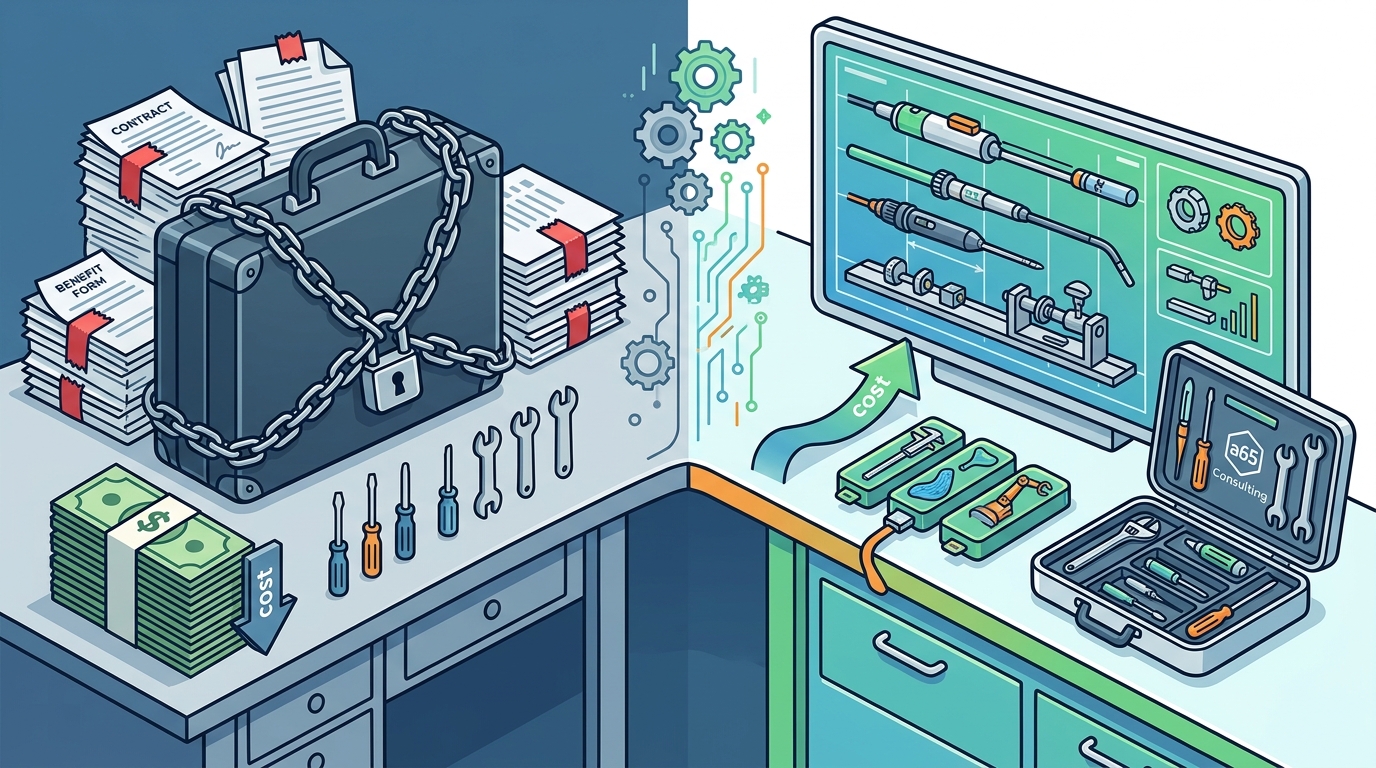
What You Get with a Consultant Engagement
Typical deliverables include concept development, detailed design, medical device prototyping, design verification, and transfer-to-manufacturing documentation. You pay for outcomes, not idle capacity.
Side-by-Side Cost Comparison
The table below illustrates a 12-month early-stage project comparing a full-time hire to a consultant engagement.
| Cost Factor | Full-Time Engineer | Engineering Consultant |
|---|---|---|
| Base compensation | $120,000 | Included in project fee |
| Benefits & taxes (30%) | $36,000 | $0 |
| Recruiting (20% of salary) | $24,000 | $0 |
| Equipment & software | $5,000 - $10,000 | Firm-provided |
| Ramp-up productivity loss | ~$15,000 | Minimal |
| Management overhead | $10,000 - $20,000 | Self-managed |
| Estimated 12-month total | $210,000 - $225,000 | $150,000 - $200,000* |
*Consultant range varies by scope, complexity, and firm. Actual quotes should be requested for your specific project.
Speed and Depth of Expertise
Time-to-market is a defining metric for early-stage medical device companies. A consultant team that has already navigated dozens of medical device compliance pathways can compress your development timeline significantly.
Cross-Disciplinary Teams on Day One
Full-time hiring means sequentially recruiting mechanical, electrical, and software engineers. A consultancy provides an integrated team from the start, covering disciplines like human factors and usability engineering alongside core design work.
Institutional Knowledge
One advantage of full-time hires is long-term institutional knowledge. If your product roadmap spans five or more years, retaining in-house engineers builds continuity. For projects with a defined endpoint, consultants deliver equivalent quality without the long tail of employment costs.
Regulatory and Compliance Considerations
Design controls under FDA 21 CFR 820 require documented engineering processes from concept through validation. A design control gap is a regulatory gap that does not care whether your team is full-time or outsourced.
Experienced consultants often maintain quality management systems that align with ISO 13485, meaning your project inherits a compliant framework from day one. Learn more about building strong engineering milestones that satisfy both internal goals and regulatory expectations.
When to Choose Each Model
Choose a Consultant When:
You need to move fast with limited capital. Your project requires specialized skills for a defined phase. You lack in-house regulatory or manufacturing transfer expertise. A65 Consulting, for example, also designs manufacturing systems alongside the device itself, covering both sides of the development equation.
Choose a Full-Time Hire When:
You have a multi-year product pipeline and stable funding. The role requires daily cross-functional collaboration that is difficult to outsource. You are building a core competency you want to own permanently.
Consider a Hybrid Approach
Many successful med-tech companies blend both models. They hire a small core team for continuity and engage consultants for surge capacity or niche expertise like designing both the product and the manufacturing process.
Key Takeaways
- The fully loaded cost of a full-time medical device engineer typically reaches 1.25x to 1.5x the base salary, often exceeding $180,000 annually.
- Consultant engagements eliminate recruiting fees, benefits overhead, and ramp-up productivity loss.
- Speed-to-market favors consultants who bring pre-built regulatory and design workflows.
- Full-time hires are stronger for multi-year product roadmaps where institutional knowledge matters.
- A hybrid model lets early-stage companies stay lean while accessing deep domain expertise.
- Regulatory compliance requirements are identical regardless of staffing model; experienced consultants often bring ISO 13485-aligned systems.
- Always compare total cost of ownership, not just hourly or salary rates.
Frequently Asked Questions
What is a medical device engineering consultant?
A medical device engineering consultant is an external expert or firm hired on a project basis to perform design, prototyping, verification, or regulatory support for medical device development.
How much does it cost to hire a full-time medical device engineer?
The median base salary is approximately $107,000 per year according to BLS data. With benefits, taxes, and overhead, the fully loaded annual cost typically ranges from $135,000 to $185,000.
Is outsourcing medical device engineering safe from a regulatory perspective?
Yes, as long as the consultant follows FDA design controls and works within a quality management system. Many firms maintain ISO 13485 certification. Read more about medical device engineering outsourcing best practices.
When should a startup hire full-time engineers instead of consultants?
Full-time hires make sense when you have stable multi-year funding, a broad product pipeline, and the need for daily in-house collaboration that is hard to replicate externally.
Can I switch from a consultant to an in-house team later?
Absolutely. Many companies start with a consultant to reach design freeze or first production and then hire internally for sustaining engineering. A good consultant will build documentation that makes this transition smooth.
What disciplines should a medical device consultant cover?
Look for mechanical, electrical, and software engineering, plus human factors, risk analysis, and manufacturing process design. Firms that cover the full stack reduce coordination risk.
How do I evaluate a medical device engineering firm?
Assess their portfolio of cleared or approved devices, quality system maturity, team depth, and whether they can support both engineering outsourcing and manufacturing transfer.
What is the biggest risk of hiring full-time too early?
Overcommitting fixed costs before product-market fit is validated. If the project pivots or funding stalls, you carry salary and benefits obligations that drain runway.
Ready to Explore the Right Staffing Model for Your Device?
A65 Consulting partners with medical device companies, from startups to industry leaders, to provide the engineering resources you need without the overhead you do not. Contact A65 Consulting to discuss your project scope and get a tailored engagement plan.