
Choosing the right medical device design partner can determine whether your product reaches the market on schedule or stalls in development limbo. With FDA 510(k) review times averaging 140 to 175 days in 2025 and regulatory complexity rising, the engineering team behind your device matters more than ever. A design partner is an external engineering firm that collaborates with your organization to develop, prototype, and prepare a medical device for regulatory submission and manufacturing. This guide walks you through a practical, step-by-step process for evaluating and selecting a partner that fits your technical needs, timeline, and budget.
Why You Need a Medical Device Design Partner
Medical device startups rarely fail because of insufficient engineering effort. They fail because scarce resources like capital, time, and attention are misallocated. Outsourcing engineering is a strategic business decision that allows you to bring in the right specialists without the cost and commitment of hiring them full-time.
The FDA reviews roughly 3,100 to 3,300 510(k) devices per year, and submission quality directly impacts clearance timelines. A qualified design partner ensures your documentation, prototyping, and verification strategies are airtight before you ever reach the FDA's desk.
Key Criteria for Evaluating Design Partners
Domain Expertise
Not all engineering firms understand the unique demands of medical devices. Look for teams with direct experience in medical device compliance, hazard analysis, and FMEA. Regulatory literacy is a non-negotiable qualification that separates generalist shops from true medical device specialists.
Proven Development Process
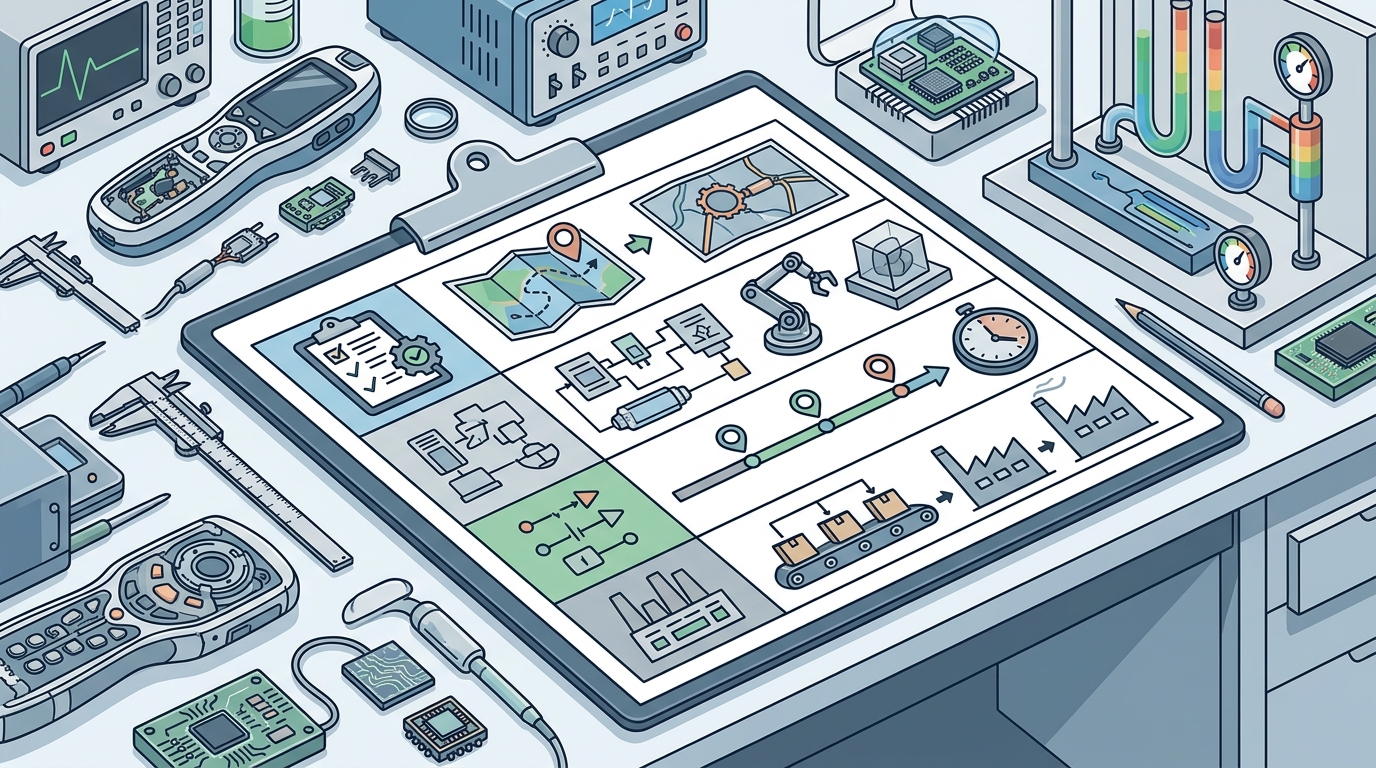
A credible partner should follow a structured product development lifecycle: requirements generation from voice-of-customer inputs, system architecture development, risk mitigation, and verification and validation protocols. Ask to see how they handle engineering milestones and design reviews.
Cultural Fit and Communication
Regular client meetings, transparent project tracking, and cross-functional leadership are signs of a well-run engagement. Your partner should feel like an extension of your own team, not a vendor operating in a silo.
Essential Services to Look For
A full-service medical device design partner should cover the entire product lifecycle. The table below outlines the core capabilities to evaluate.
| Service Area | What to Expect | Why It Matters |
|---|---|---|
| Mechanical Engineering | Concept generation, detailed design, prototyping | Forms the physical backbone of your device |
| Systems Engineering | Requirements traceability, V&V protocols | Ensures regulatory alignment from day one |
| Manufacturing Engineering | DFM/DFA, fixture development, line layout | Reduces cost of goods and speeds design transfer |
| Human Factors | Usability studies, VOC surveys | Prevents use-related failures in clinical settings |
| Program Management | Schedule tracking, budget oversight, status reporting | Keeps your project on time and within budget |
Firms like A65 Consulting cover all of these disciplines under one roof, from precision mechanism design and electromechanical systems to manufacturing system design and production line balancing.
Red Flags to Avoid
Watch out for partners who skip prototyping to save time. Cutting prototyping is one of the most reliable ways to lengthen a medical device development program, because cost and schedule risk almost always increase when it is treated as optional.
Other warning signs include vague project plans with no defined milestones, no experience with human factors engineering, and an inability to articulate how they handle design for manufacturing. If a firm cannot explain their approach to designing both the product and the process, look elsewhere.
Comparing Partner Models: Boutique vs. Large Firm
A boutique medical device consultancy is a smaller, specialized firm that focuses exclusively on medical device engineering rather than serving dozens of industries. A large contract engineering firm is a multi-industry organization with broad capabilities but potentially less focus on your specific regulatory environment.
| Factor | Boutique Firm | Large Firm |
|---|---|---|
| Industry Focus | Medical devices only | Multi-industry |
| Team Access | Senior engineers on your project | May assign junior staff |
| Flexibility | High, adapts to your workflow | Standardized processes |
| Regulatory Depth | Deep FDA/ISO expertise | Varies by division |
| Cost Structure | Competitive, lower overhead | Higher overhead, volume pricing |
| Scalability | Best for targeted projects | Better for very large programs |
Denver-based A65 Consulting exemplifies the boutique model: a team of engineering specialists who integrate directly with client teams and are passionate about creating high-performing designs for companies ranging from startups to top-tier medical device organizations.
Step-by-Step Selection Process
Step 1: Define Your Needs
Clarify the scope of work. Do you need end-to-end development, or targeted support for a specific phase like prototyping or design transfer? Document your timeline, budget, and regulatory pathway before approaching any firm.
Step 2: Build a Short List
Identify three to five firms with demonstrated medical device experience. Review case studies, check references, and confirm their familiarity with your device classification and applicable FDA pathway.
Step 3: Evaluate Proposals
Request detailed proposals that include resource allocation, project milestones, and cost breakdowns. A strong proposal should reflect a clear understanding of your product development roles and deliverables, not just a generic hourly rate.
Key Takeaways
- A medical device design partner is a strategic investment, not a commodity purchase. Choose based on domain expertise, not just price.
- Regulatory literacy, including familiarity with FDA 510(k), De Novo, and ISO 13485, is essential in any partner you consider.
- Evaluate the full service offering: mechanical, systems, manufacturing, human factors, and program management.
- Boutique firms often provide deeper specialization and senior-level attention for medical device projects.
- Avoid firms that skip prototyping, lack defined milestones, or cannot articulate a design-for-manufacturing strategy.
- A structured selection process with defined criteria prevents costly mismatches later in development.
- Look for partners who can design both the device and the manufacturing systems to assemble it.
Frequently Asked Questions
What is a medical device design partner?
A medical device design partner is an external engineering firm that collaborates with device companies to develop products from concept through regulatory submission and manufacturing transfer. They supplement your internal team with specialized expertise.
How much does it cost to hire a medical device design firm?
Costs vary widely based on device complexity, regulatory pathway, and project scope. Simple Class II devices may cost $200,000 to $500,000 for full development, while complex electromechanical systems can exceed $1 million. Always request a detailed proposal with milestone-based pricing.
How long does medical device development typically take?
A typical Class II device takes 12 to 24 months from concept to 510(k) submission. FDA review itself averages 140 to 175 days according to 2025 industry data. Timelines depend heavily on the quality of engineering work completed before submission.
Should I choose a local or remote design partner?
Proximity can help with hardware-intensive projects where physical prototypes require hands-on iteration. A Denver-based firm like A65 Consulting offers the advantage of in-person collaboration when needed, combined with the flexibility of remote project management.
What regulatory standards should my design partner understand?
At minimum, your partner should be fluent in FDA 21 CFR 820 (transitioning to QMSR in 2026), ISO 13485 for quality management systems, ISO 14971 for risk management, and IEC 62366 for usability engineering. Experience with the specific FDA pathway for your device class is critical.
Can a design partner help with manufacturing too?
Yes. The best partners handle both product design and manufacturing system development. This includes DFM/DFA analysis, fixture and tooling development, production line layout, and supplier selection. Integrating these disciplines early reduces cost and accelerates design transfer.
What is the difference between outsourcing and staff augmentation?
Outsourcing means the partner firm manages the project and delivers defined outcomes. Staff augmentation is when the partner provides individual engineers who work under your direction. Many firms, including A65 Consulting, offer both models depending on client needs.
Get Started Today
Finding the right medical device design partner starts with a conversation about your goals. Contact A65 Consulting to request a proposal and learn how our Denver-based engineering team can help you move from concept to market with confidence.