
Choosing a medical device design partner is one of the most consequential decisions a startup or established manufacturer will make. The wrong fit wastes capital, delays regulatory submissions, and can stall a product indefinitely. The right partner accelerates your path from concept to FDA clearance while keeping costs predictable. With the FDA reviewing roughly 3,000 510(k) submissions every year and review times averaging 140 to 175 days in 2025, engineering execution speed matters more than ever. This guide walks you through a proven process for evaluating, vetting, and selecting a design partner that aligns with your technical needs and business goals.
Why You Need a Specialized Design Partner
A medical device design partner is an external engineering firm that integrates with your team to handle product development tasks you cannot resource internally. Unlike general product design houses, these firms understand FDA design controls, ISO 13485 quality systems, and the clinical context that shapes device requirements.
Medical device startups rarely fail because of insufficient engineering effort. They fail because scarce resources like capital, time, and attention are misallocated. Outsourcing medical device engineering lets you bring in the right specialists without the cost and commitment of hiring them full-time.
The regulatory landscape reinforces this urgency. The FDA processed more than 20,700 submissions of all types in 2024, and 510(k) review times now average 140 to 175 days, according to MDDI Online reporting. Design errors discovered late in development can add months to that timeline.
Key Criteria for Evaluating a Medical Device Design Firm
Regulatory and Quality System Knowledge
Your partner must operate within a quality management system aligned with ISO 13485 and FDA 21 CFR 820 (now transitioning to QMSR). A firm that treats medical device compliance as an afterthought will create documentation gaps that surface during audits or submissions.
End-to-End Engineering Capability
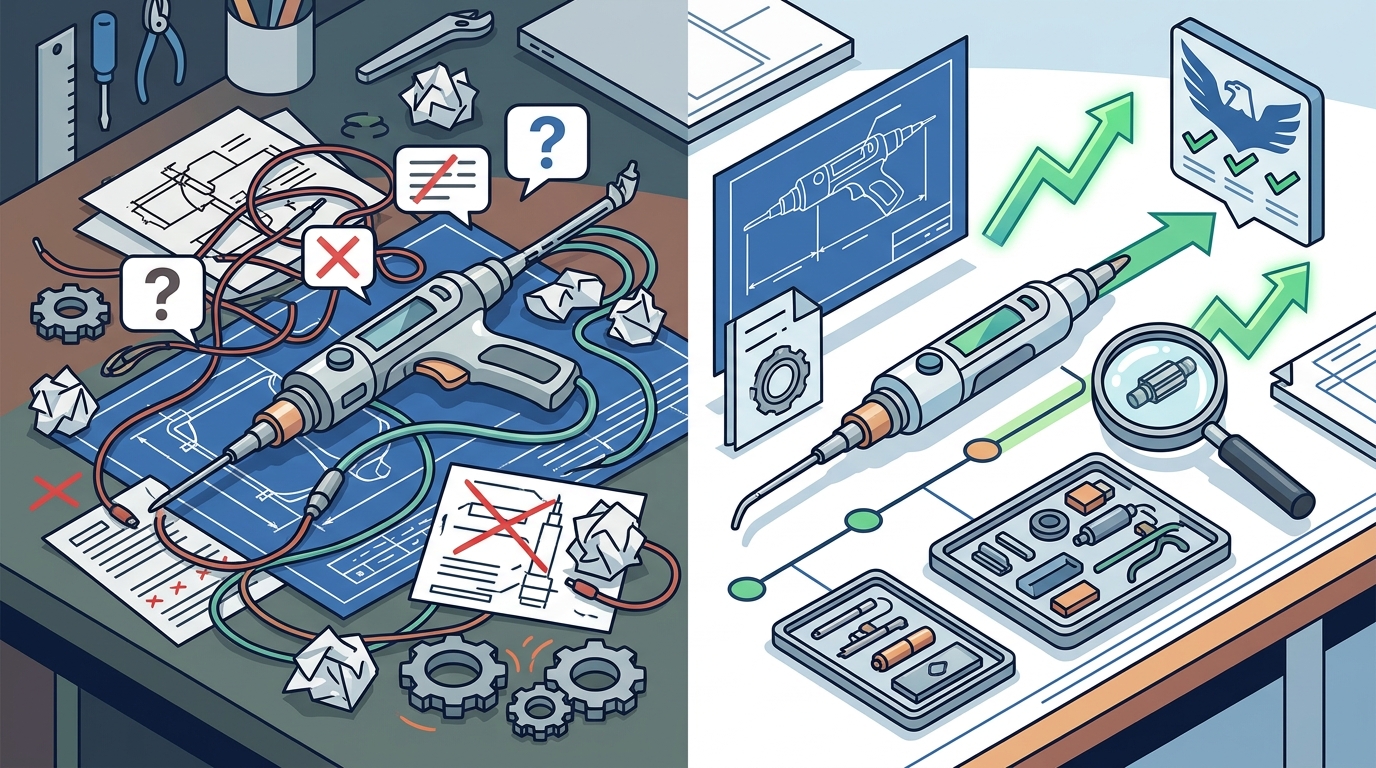
Look for mechanical, electrical, and systems engineering under one roof. A capable firm will brainstorm solutions, generate multiple concepts, build mathematical models, complete detailed designs, and build and test prototypes. Check whether the firm also handles manufacturing system design, which reduces handoff risk during design transfer.
Domain Experience and Portfolio Depth
Ask for case studies in your device class. A firm with experience in precision mechanisms, disposable devices, and electromechanical systems brings pattern recognition that accelerates development. Review their recent project portfolio for evidence of relevant work.
Comparison: In-House Team vs. Outsourced Design Partner
| Factor | In-House Team | Outsourced Design Partner |
|---|---|---|
| Ramp-up time | 3-6 months to hire and onboard | Days to weeks |
| Fixed cost commitment | High (salaries, benefits, equipment) | Variable, project-based |
| Specialized expertise | Limited to current headcount | Access to multi-disciplinary specialists |
| Scalability | Slow to scale up or down | Flexible team sizing per phase |
| Regulatory knowledge | Depends on hires | Built into firm culture and processes |
| IP control | Full ownership | Full ownership (confirm in contract) |
For many companies, especially startups and mid-size manufacturers facing tight timelines, the outsourced model delivers faster results at lower risk. This is particularly true when a firm can seamlessly integrate with your existing team.
How to Vet a Prospective Partner
Step 1: Define Your Project Scope
Before reaching out, document your device concept, target indications, regulatory pathway (510(k), De Novo, or PMA), and timeline. A well-defined scope lets you compare proposals on equal terms.
Step 2: Evaluate Their Design Process
A disciplined design process is the foundation of successful medical device development. Ask how the firm handles the critical phases of medical device design, from user needs through verification and validation. Design for Manufacturing, or DfM, is the practice of optimizing a product's design so it can be manufactured reliably and cost-effectively at scale. Firms that integrate DfM early prevent costly redesigns later.
Step 3: Check References and Cultural Fit
Engineering quality matters, but so does communication. Request references from clients of similar size and ask specifically about responsiveness, milestone adherence, and how the team handled unexpected challenges. Regular client meetings to ensure design alignment should be standard practice.
Red Flags to Watch For
Not every firm that claims medical device expertise can deliver. Watch for these warning signs:
- No documented quality system. If they cannot show ISO 13485 alignment, walk away.
- Vague proposals. A partner that cannot define deliverables, milestones, and acceptance criteria is not ready for regulated product development.
- No verification strategy. Ask how they approach verification as a system. If it is treated as a phase tacked onto the end, expect delays.
- Overreliance on one discipline. Medical devices require mechanical, electrical, software, and human factors expertise. A purely mechanical shop will leave gaps.
- Unclear IP terms. You should own all design outputs. Confirm this before signing.
Structuring the Engagement for Success
A design engagement is a structured collaboration with defined inputs, outputs, and decision points. Design controls are the set of FDA-mandated practices that ensure a device meets user needs and intended uses throughout development.
Start with a discovery phase where you establish design goals and success criteria. Set regular review cadences, ideally weekly or biweekly, to maintain alignment. Define strong engineering milestones that tie deliverables to payments and keep both sides accountable.
The best partnerships treat design transfer as a shared responsibility. Your partner should design both the product and the process, ensuring the device can be manufactured consistently at volume. Denver-based firms like A65 Consulting specialize in this dual approach, designing medical devices and the manufacturing systems to assemble them.
Key Takeaways
- A medical device design partner should have verifiable regulatory knowledge and a quality system aligned with ISO 13485.
- Define your project scope, regulatory pathway, and timeline before evaluating firms.
- Prioritize firms that integrate Design for Manufacturing early in the development process.
- Verify that the partner treats verification as a continuous system, not a final phase.
- Compare in-house hiring costs against the flexible, project-based model of outsourced engineering.
- Check references, review past projects, and confirm IP ownership terms in writing.
- Structure the engagement with clear milestones, regular reviews, and shared accountability for design transfer.
Frequently Asked Questions
What is a medical device design partner?
A medical device design partner is an engineering consultancy that works alongside your internal team to develop regulated medical devices from concept through production. They bring specialized skills in mechanical design, prototyping, compliance, and manufacturing system design.
How much does it cost to hire a medical device design firm?
Costs vary widely based on device complexity, regulatory pathway, and project scope. Simple Class II devices may require $150,000 to $500,000 in engineering services, while complex electromechanical systems can exceed $1 million. A detailed proposal based on your specific requirements is the best way to get an accurate estimate.
How long does medical device development take with an external partner?
Typical timelines range from 12 to 24 months for a Class II device going through the 510(k) pathway. FDA review alone averages 140 to 175 days. A well-resourced partner can compress the design phase by running workstreams in parallel.
Should I choose a local or remote design partner?
Proximity helps during prototyping and testing phases when hands-on collaboration accelerates decisions. However, many firms operate effectively in hybrid models. If you are based in the Denver or Colorado region, working with a local firm simplifies logistics for prototype reviews and design meetings.
What questions should I ask during a partner evaluation?
Ask about their quality system, experience with your device class, design control process, approach to human factors, DfM capabilities, and how they handle design changes. Request references from projects similar in scope and complexity to yours.
Can I retain full IP ownership when working with an external firm?
Yes. Most reputable medical device design firms assign all intellectual property to the client. Confirm IP ownership, work-for-hire terms, and confidentiality provisions in your contract before work begins.
What is the difference between a design consultancy and a contract manufacturer?
A design consultancy focuses on product development: concept generation, detailed design, prototyping, and design verification. A contract manufacturer focuses on producing finished devices at scale. Some firms bridge both functions by designing the product and the manufacturing process together.
Ready to Find Your Medical Device Design Partner?
If you are looking for a boutique engineering firm in Denver that specializes in medical device design and manufacturing system development, contact A65 Consulting to request a proposal. Our engineers integrate with your team to move your device from concept to production on your timeline.