
Choosing the right medical device design partner is one of the most consequential decisions a medtech company can make. Whether you are a startup racing toward a first FDA submission or an established manufacturer scaling a new product line, the engineering firm you select will shape your timeline, your costs, and ultimately whether patients benefit from your device. This guide walks you through a proven, step-by-step process for evaluating and selecting a medical device design and engineering partner that fits your goals, budget, and regulatory requirements.
Why You Need a Medical Device Design Partner
A medical device design partner is an external engineering firm that collaborates with your team to move a device from concept through design, prototyping, and production readiness. Bringing in the right partner lets you access specialized skills without the overhead of full-time hires.
Startups and established companies alike frequently collaborate with external engineering partners to expand resources, access specialized expertise, and accelerate time-to-market. Teams that are overwhelmed by tight deadlines or missing critical knowledge benefit the most from this approach. At A65 Consulting, our Denver-based engineers integrate directly with client teams to fill exactly those gaps.
Step 1: Define Your Project Scope and Objectives
Before reaching out to any firm, document the following:
- Device classification (Class I, II, or III) and intended use
- Current stage: concept, prototype, design transfer, or production
- Internal capabilities you already have vs. what you need
- Target timeline and budget range
A well-defined scope prevents scope creep and helps prospective partners deliver accurate proposals. If you are unsure where your device stands, our complete framework for medical device prototyping can help you map the path forward.
Step 2: Evaluate Technical Expertise and Regulatory Knowledge
Not every engineering consultancy understands the regulatory landscape of medical devices. Following an FDA 21 CFR 820.30-compliant design control process is mandatory for approval of Class I, II, or III devices. Your partner should demonstrate fluency in design controls, risk management (ISO 14971), and quality management systems (ISO 13485).
Core Technical Capabilities to Look For
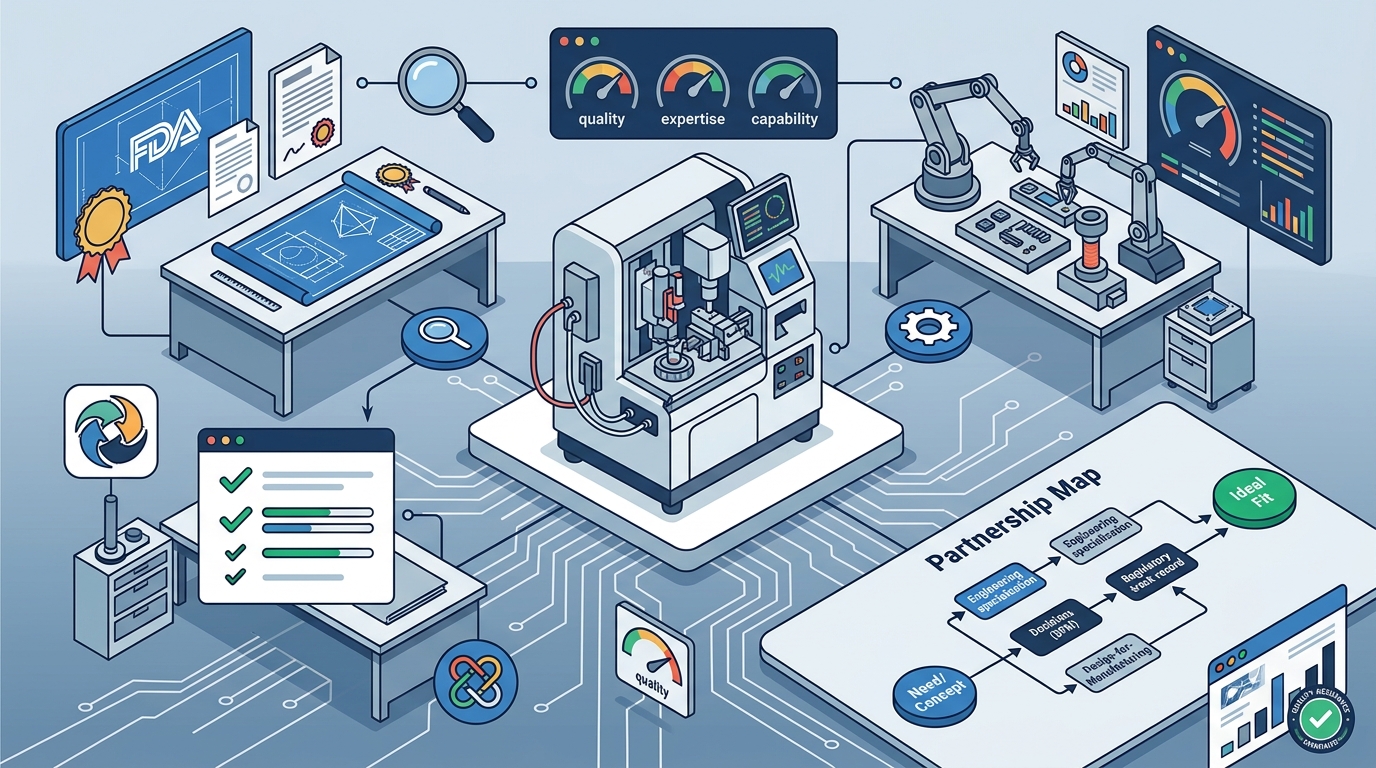
A strong partner should offer end-to-end mechanical engineering services such as precision mechanism design, high-volume disposable device design, electromechanical system design, and complex automated system design. Ask how they handle concept generation, mathematical modeling, detailed design, and prototype build-and-test cycles.
Regulatory Fluency Matters
A development partner that knows the regulatory landscape can save you money by recommending the appropriate level of rigor at each stage of product development. Look for firms that integrate FDA requirements from day one rather than treating compliance as a downstream activity.
Step 3: Assess Communication and Cultural Fit
Poor communication can lead to misunderstandings, missed deadlines, and quality problems. During your evaluation, pay attention to responsiveness, transparency, and whether the firm assigns a dedicated point of contact.
Working with A65 Consulting's engineering services is a straightforward process: we hold regular client meetings and work hand-in-hand with your team to ensure design alignment. Cultural fit is the degree to which a partner's working style, values, and communication habits match your own organization.
Red Flags to Watch For
- Vague or delayed responses to technical questions
- No clear project management methodology
- Reluctance to share references or case studies
Step 4: Compare Engagement Models
An engagement model is the contractual structure that defines how work, risk, and cost are shared between you and your partner. Different firms offer different structures. The table below summarizes common options.
| Engagement Model | Best For | Cost Predictability | Flexibility |
|---|---|---|---|
| Fixed-Price Project | Well-defined scope with clear deliverables | High | Low |
| Time & Materials | Evolving requirements or R&D phases | Medium | High |
| Staff Augmentation | Teams needing extra engineers temporarily | Medium | High |
| End-to-End Partnership | Concept through manufacturing transfer | Variable | Medium |
Staff augmentation is a model where external engineers work under your direction as an extension of your in-house team. Using contract engineers allows you to bring in the right specialists without the cost and commitment of hiring them full-time. Review recent projects from A65 to see how different engagement models play out in practice.
Step 5: Verify Track Record and References
Ask every candidate firm for case studies or instances of prior work that demonstrate their abilities. Reach out to former clients to gather feedback on communication, reliability, and results.
Questions to Ask References
- Did the partner meet agreed timelines and budgets?
- How did they handle unexpected design challenges?
- Would you hire them again for a similar project?
Also confirm that the firm maintains robust intellectual property protections. Contracts should include IP protection clauses, and the partner should have a strong track record of safeguarding client confidentiality.
Key Takeaways
- Define your project scope, device classification, and budget before contacting potential partners.
- Verify that the firm follows FDA 21 CFR 820.30-compliant design controls and holds ISO 13485 certification.
- Evaluate cultural fit and communication practices just as rigorously as technical skills.
- Compare engagement models to find the structure that matches your project stage and risk tolerance.
- Request case studies, client references, and evidence of IP protection policies.
- Prioritize partners who integrate regulatory thinking from day one, not as an afterthought.
- A boutique firm like A65 Consulting can offer specialized medical device expertise with the agility startups and enterprise teams both need.
Frequently Asked Questions
What is a medical device design partner?
A medical device design partner is an external engineering consultancy that works alongside your team to design, prototype, and prepare a medical device for manufacturing and regulatory submission.
How much does it cost to hire a medical device engineering firm?
Costs vary widely based on device complexity, regulatory class, and engagement model. Simple Class I devices may start in the low six figures, while Class III implantable devices can require multimillion-dollar programs. Always request a detailed proposal.
What certifications should a medical device design firm have?
At a minimum, look for familiarity with ISO 13485 (quality management), ISO 14971 (risk management), and FDA 21 CFR Part 820 (Quality System Regulation). Some firms also hold ISO 13485 certification themselves.
Should I choose a large firm or a boutique consultancy?
Boutique firms often provide senior-level engineers on every project and more direct communication with leadership. Larger firms may offer broader service lines. The right choice depends on your project complexity and preferred working relationship.
How long does the medical device design process typically take?
Timelines range from 6 months for simple devices to 3+ years for complex Class III products. A qualified partner helps compress timelines by running design, prototyping, and regulatory preparation in parallel where possible.
What is design for manufacturing in medical devices?
Design for Manufacturing (DfM) is the practice of optimizing a device's design so it can be produced consistently, at scale, and at lower cost. Effective DfM should begin during early product development, not after the design is complete.
Can a design partner also handle manufacturing?
Some partners offer integrated design-to-manufacturing services. A65 Consulting, for example, designs both medical devices and the manufacturing systems used to assemble them, creating a seamless transition from development to production.
Ready to Start Your Search?
Finding the right medical device design partner does not have to be overwhelming. Start by defining your scope, then evaluate candidates against the criteria in this guide. If you want to talk through your project with experienced engineers who specialize in medical device development, contact A65 Consulting today to request a proposal.