
Choosing the wrong engineering partner for your medical device can cost you months of development time, hundreds of thousands of dollars, and possibly your shot at FDA clearance. With the global medical device market projected to reach roughly $720 billion in 2026 and growing at nearly 6% CAGR, competition is fierce and timelines are unforgiving. Whether you are a startup with a breakthrough concept or an established company that needs to supplement its internal team, finding the right design partner is one of the most consequential decisions you will make. This guide walks you through a proven, step-by-step process so you can choose with confidence.
What Is a Medical Device Design Partner?
A medical device design partner is an external engineering firm that collaborates with you to develop, prototype, and prepare your device for regulatory submission and manufacturing. Unlike a staffing agency that simply fills seats, a true design partner brings deep domain knowledge in areas like FDA compliance, mechanical engineering, and design for manufacturing.
The best partners function as an extension of your own team. They participate in design reviews, own deliverables, and share accountability for project milestones. This is especially critical for startups that lack the bandwidth to manage multiple disconnected vendors.
Why the Right Partner Matters More Than Ever
The medical device landscape in 2026 demands speed without sacrificing rigor. Under FDA 21 CFR 820.30, design controls are mandatory for Class I, II, and III devices. A partner who misunderstands these requirements can trigger costly redesigns or submission delays.
Meanwhile, larger companies are increasingly acquiring innovation through buyouts and spin-offs rather than internal R&D. That means mid-market firms and startups must move faster to capture market windows. Having the right engineering partner lets you scale resources up or down without the fixed cost of full-time hires.
Step 1: Define Your Project Scope and Gaps
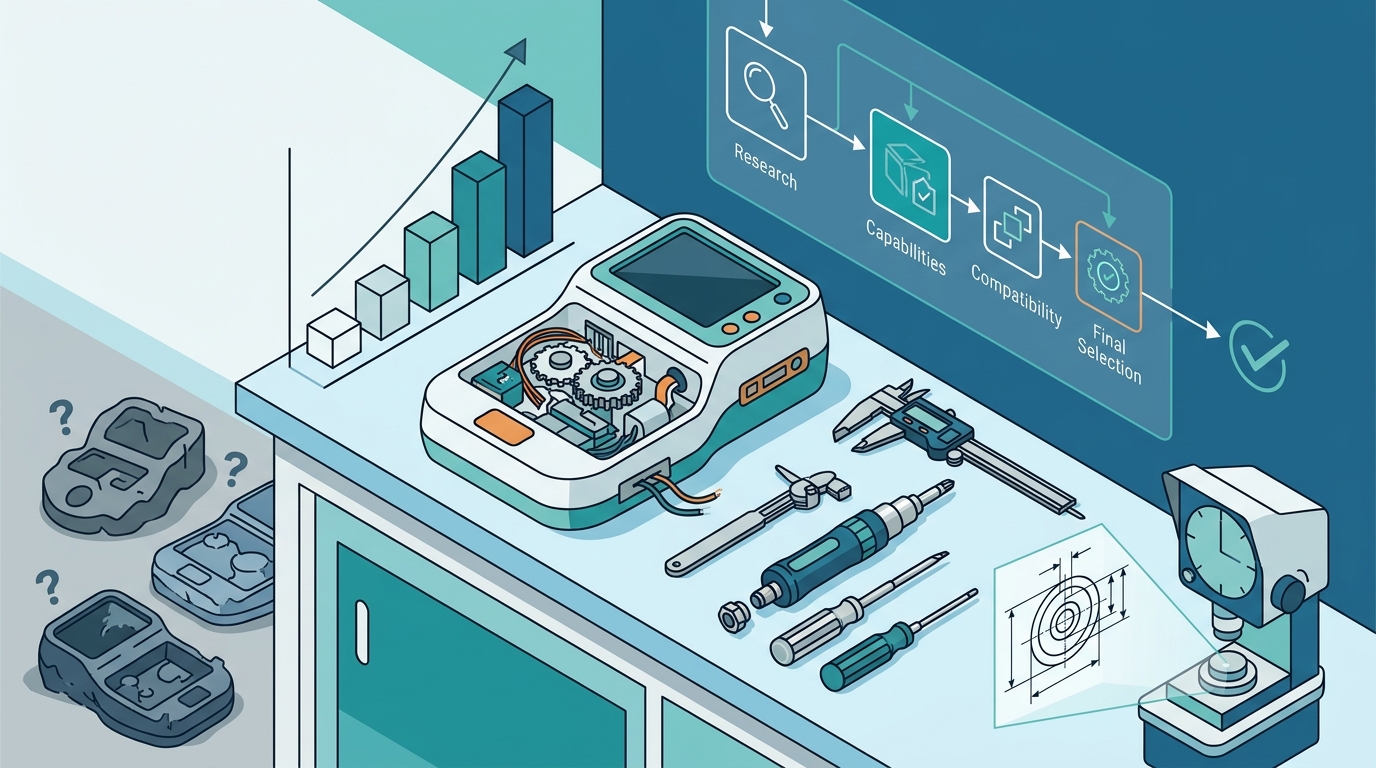
Before you evaluate any firm, document exactly what you need. Are you looking for end-to-end medical device design from concept through verification? Or do you need specialists to fill a gap in mechanical engineering or prototyping?
Identify Your Development Phase
A project in the concept phase has very different needs than one approaching design transfer. Map your current phase and list the engineering disciplines you lack internally.
Set Clear Success Criteria
Define measurable outcomes: prototype delivery date, verification test completion, or design-freeze milestone. These criteria become the foundation of your partnership contract and help you hold any firm accountable.
Step 2: Evaluate Domain Expertise and Regulatory Knowledge
Medical device engineering is not general product development. Your partner must understand regulatory pathways, risk analysis standards like ISO 14971, and quality management systems aligned to ISO 13485.
Look for Regulatory Fluency
A competent partner maps design and development work to both business milestones and regulatory requirements. They should know the appropriate level of rigor required at every stage, saving you time and money by doing exactly what regulators expect, no more and no less.
Verify Industry-Specific Experience
Ask for case studies in your device category, whether that is disposable devices, electromechanical systems, or complex robotic platforms. A firm with a broad project portfolio across device types signals adaptability.
| Criterion | What to Look For | Red Flag |
|---|---|---|
| Regulatory Knowledge | FDA design controls, ISO 13485, risk management | No QMS documentation or audit history |
| Engineering Depth | Mechanical, electrical, software, and systems capabilities | Single-discipline only with no integration plan |
| Prototyping Capability | In-house or managed rapid prototyping and testing | No prototype examples or test data |
| Manufacturing Awareness | DfM embedded early in the design process | Design thrown over the wall at transfer |
| Communication Model | Regular design reviews, dedicated point of contact | Delayed responses, no meeting cadence |
| IP Protection | Robust NDA, clear IP ownership clauses | Vague or absent IP terms |
Step 3: Assess Engineering Depth and Integration Model
A design partner is a specialized engineering firm that supplements your internal resources with focused expertise. The best firms offer multiple disciplines under one roof: mechanical design, electrical engineering, embedded software, and human factors and usability.
Integration model matters, too. Some firms operate as a black box, delivering results with minimal client interaction. Others embed engineers directly into your team cadence with regular client meetings to ensure design alignment. The embedded model tends to produce better outcomes because it preserves institutional knowledge on your side.
Design for Manufacturing from Day One
Design for Manufacturing (DfM) is the practice of designing a product so it can be produced consistently, cost-effectively, and at scale. The best partners incorporate DfM thinking from the earliest design phases rather than treating it as a downstream optimization step. Cost, quality, and scalability are shaped long before design transfer.
Step 4: Compare Communication, Culture, and Track Record
Technical skill means little if communication breaks down. Poor communication leads to misunderstandings, missed deadlines, and quality problems. When evaluating partners, prioritize firms with clear communication processes and a dedicated project contact.
Ask for references and reach out to former clients. Focus on reliability, responsiveness, and whether the firm delivered on schedule. A partner in your time zone, or even your city, can significantly reduce friction. For example, Denver-based med-tech companies benefit from working with local engineering teams who can meet face-to-face for hands-on design reviews.
Step 5: Protect Your IP and Negotiate Clear Terms
Intellectual property protection is non-negotiable. Ensure contracts include robust IP ownership clauses, work-for-hire language, and mutual nondisclosure agreements. Ambiguity here can expose your designs to misuse down the road.
Negotiate milestone-based payment terms tied to the success criteria you defined in Step 1. This structure aligns incentives and gives you natural checkpoints to evaluate fit before committing further budget.
Key Takeaways
- A medical device design partner is an engineering firm that works as an extension of your team to develop and de-risk your product.
- Define your project scope, development phase, and success criteria before contacting any firm.
- Verify regulatory fluency in FDA design controls, ISO 13485, and risk management frameworks.
- Prioritize partners who embed DfM early, not after the design is frozen.
- Evaluate communication cadence, cultural fit, and geographic proximity alongside technical skills.
- Protect your intellectual property with clear contract terms and milestone-based payments.
- Request case studies and client references to validate real-world performance.
Frequently Asked Questions
What should I look for first in a medical device design partner?
Start with regulatory knowledge. A partner who understands FDA 21 CFR 820 design controls and ISO 13485 quality systems will structure your project correctly from the beginning, reducing rework and submission risk.
How much does it cost to hire a medical device engineering firm?
Costs vary widely based on device complexity, regulatory class, and project scope. Simple Class I devices may cost tens of thousands, while complex Class III programs can run into the millions. Request a detailed proposal based on your specific requirements.
Can a design partner help with prototyping and testing?
Yes. Many full-service firms handle concept generation, detailed design, rapid prototyping, and verification testing. An integrated approach avoids handoff delays between separate vendors.
Should I choose a local or remote engineering partner?
Both models can work, but local partners offer advantages for hands-on collaboration, especially during prototyping and design reviews. Proximity reduces travel cost and enables faster iteration cycles.
How do I protect my intellectual property when outsourcing design?
Use detailed NDAs and contracts with explicit IP ownership clauses. Ensure all work product is assigned to you and that the partner has safeguards against sharing your data with other clients.
What is the difference between a contract manufacturer and a design partner?
A contract manufacturer focuses on producing finished devices at scale. A design partner focuses on engineering the device itself, from concept through design verification. Some firms, like those that also design manufacturing systems, bridge both worlds.
How long does a typical medical device design engagement last?
Timelines depend on device complexity and regulatory pathway. A straightforward 510(k) device might take 12 to 18 months from concept to submission, while a Class III PMA device can take three years or more.
When should a startup consider outsourcing engineering?
As soon as the founding team identifies skill gaps that would delay development. Outsourcing engineering is a strategic decision that lets startups allocate capital, time, and attention more effectively instead of hiring full-time specialists they may not need long-term.
Ready to Find Your Medical Device Design Partner?
If your team needs expert engineering support to move a device from concept to clinic, A65 Consulting can help. Based in Denver, Colorado, our engineers specialize in medical device design, prototyping, manufacturing system design, and regulatory-ready development. Request a proposal today and let us show you how a focused engineering partnership accelerates your path to market.