
Medical Device Engineering Consultant vs. Full-Time Hire for Early-Stage Product Development
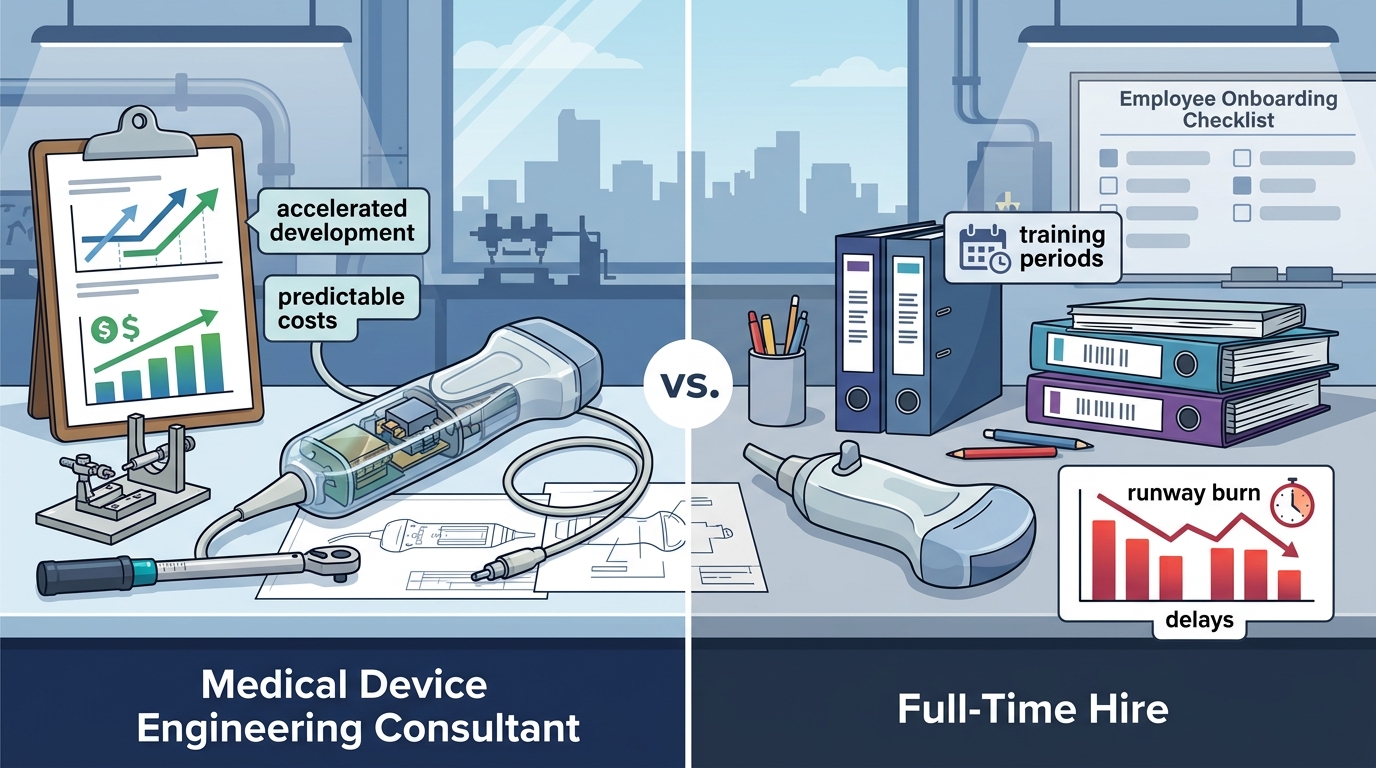
Choosing between a medical device engineering consultant and a full-time hire is one of the most consequential decisions an early-stage medtech company will face. The wrong staffing model can burn through runway, delay FDA submissions, and stall your path to market. The right one accelerates development while keeping costs predictable. In this comparison, we break down costs, flexibility, expertise depth, and speed so you can make a confident decision for your next product development initiative.
What Is a Medical Device Engineering Consultant?
A medical device engineering consultant is a specialized professional or firm that partners with medtech companies on a project or retainer basis to design, develop, and prepare devices for manufacturing and regulatory submission. Unlike a generalist contractor, a consultant in this space brings deep domain expertise in areas like product development, design for manufacturability, and production system engineering.
Consultants work with companies ranging from funded startups to established manufacturers. A boutique firm like A65 Consulting in Denver, Colorado focuses specifically on medical device design and manufacturing system engineering, giving clients access to a full engineering team without the overhead of permanent headcount.
The True Cost of a Full-Time Engineering Hire
Salary is only the starting point. According to Glassdoor data from May 2026, the average medical device engineer salary in the United States is approximately $148,533 per year. Senior-level engineers command even more, with averages around $160,937 annually.
Hidden Costs Beyond Salary
Benefits, payroll taxes, equipment, software licenses, and workspace add 25-40% on top of base salary. A $148K hire can easily cost $185K-$210K in total loaded compensation. On top of that, the average cost to recruit a single employee is roughly $4,129, and the process can span six weeks or longer before productive work begins.
The Ramp-Up Problem
New hires need onboarding, training on your quality management system, and time to understand your device specifications. For early-stage companies that need engineering output immediately, this lag can be devastating to timelines. If the hire turns out to be a poor fit, you restart the entire cycle at additional cost.
What Medical Device Consultants Actually Cost
Hourly rates for medical device engineering consultants typically range from $150 to $500 per hour depending on specialization and project complexity. According to MedEnvoy Global, fixed project fees for well-defined deliverables like 510(k) submissions or quality system implementations can range from $15,000 to $150,000.
While the hourly rate appears higher than a salaried employee's effective rate, consultants eliminate recruiting costs, benefits overhead, and ramp-up time. You pay only for productive engineering hours applied directly to your project. Firms like A65 Consulting scope work with clear deliverables, so your prototyping and development investment is defined from the outset.
Side-by-Side Comparison Table
| Factor | Full-Time Hire | Engineering Consultant |
|---|---|---|
| Annual Cost (Loaded) | $185K-$210K+ | Variable; project-scoped |
| Time to Productivity | 4-8 weeks onboarding | Days to 1-2 weeks |
| Recruiting Effort | ~6 weeks, ~$4,100+ cost | Minimal; evaluate portfolio |
| Expertise Breadth | Single individual's skills | Full team across disciplines |
| Scalability | Requires new hires to scale | Scale up or down per phase |
| IP & Culture Fit | Strong internal alignment | Managed via NDA/contract |
| Regulatory Knowledge | Varies by candidate | Built into firm processes |
| Long-Term Cost (3+ yrs) | Lower per-hour effective rate | Higher if engagement is continuous |
When a Consultant Is the Stronger Choice
Early-Stage and Pre-Revenue Companies
Startups operating on seed or Series A funding rarely have the runway to carry $200K+ in fully loaded engineering salaries. A consultant lets you convert fixed headcount cost into variable project cost, preserving cash for regulatory submissions, testing, and clinical work.
Specialized or Short-Duration Projects
Need a manufacturing system designed for a single product line? Require design-for-manufacturability analysis on an existing prototype? These are finite engagements where a consultant delivers faster results without leaving you with an underutilized employee afterward.
Speed-Critical Timelines
Speed to market is a critical competitive advantage in the medical device vertical. Consultants with established design controls and quality processes can begin contributing within days rather than weeks, compressing your development schedule significantly.
When a Full-Time Hire Makes More Sense
Full-time engineering staff is the better investment when you have a multi-year product roadmap with continuous R&D needs, sufficient revenue or funding to support ongoing salaries, and a need for deep institutional knowledge that compounds over time. Companies past the growth stage with multiple concurrent device programs often benefit from building an internal team supplemented by consultants for peak workloads.
A hybrid model works well here. Many mid-stage medtech companies maintain a lean core team and partner with a firm like A65 Consulting to handle overflow projects, specialized design challenges, or manufacturing engineering that falls outside their internal capabilities.
Key Takeaways
- A medical device engineering consultant is a domain specialist or firm engaged on a project basis to design devices, build manufacturing systems, or support regulatory readiness.
- Full-time medical device engineers cost $185K-$210K+ per year when you factor in benefits, taxes, and overhead beyond the ~$148K average base salary.
- Consultant hourly rates of $150-$500 can be more cost-effective for early-stage companies because you pay only for productive project hours.
- Consultants eliminate recruiting lag and onboarding time, getting expert work started in days rather than weeks.
- Full-time hires make sense for companies with continuous, multi-year R&D needs and stable funding.
- A hybrid staffing model, combining a small internal team with a consulting partner, gives growing medtech companies the best balance of cost, speed, and expertise.
- Choosing the wrong model can delay your path to market and increase regulatory risk.
Frequently Asked Questions
How much does a medical device engineering consultant charge per hour?
Rates typically range from $150 to $500 per hour depending on specialization and project complexity. Fixed project fees for defined deliverables can range from $15,000 to $150,000.
Is it cheaper to hire a full-time engineer or use a consultant?
For short-term or early-stage projects, a consultant is usually cheaper because you avoid recruiting costs, benefits, and onboarding time. For continuous work spanning three or more years, a full-time hire may offer a lower effective hourly rate.
How quickly can a medical device consultant start working on my project?
Most experienced consulting firms can begin productive work within days to two weeks. In contrast, hiring a full-time engineer involves a recruiting cycle of roughly six weeks followed by additional onboarding.
What should I look for in a medical device engineering consultant?
Look for deep experience in your device classification, a portfolio of successfully commercialized products, established quality and design control processes, and the ability to support both product design and manufacturing system development.
Can a consultant handle FDA regulatory requirements?
Yes. Many medical device consulting firms integrate regulatory strategy into their development process. An experienced consultant can create a regulatory pathway from the earliest design stage, covering design controls, risk management, and submission preparation.
What is a hybrid staffing model for medical device development?
A hybrid staffing model is an approach where a company maintains a small internal engineering team for ongoing work and engages an external consulting partner for specialized projects, peak workloads, or capabilities not available in-house.
Does working with a consultant create intellectual property risks?
IP ownership is managed through contracts. Reputable consulting firms operate under non-disclosure agreements and work-for-hire terms that assign all developed IP to the client. Always review IP clauses before engagement.
Get Expert Engineering Support Today
If you are an early-stage medtech company looking to accelerate product development without the overhead of full-time hires, A65 Consulting can help. Our Denver-based team specializes in medical device design and manufacturing system engineering for companies at every stage. Contact A65 Consulting to discuss your project and learn how our engineering team can become an extension of yours.