
Medical Device Engineering Consultant vs. Full-Time Hire for Early-Stage Product Development
Deciding how to staff your early-stage medical device project is one of the most consequential choices a startup or growing company will make. Do you invest months recruiting a full-time engineer, or do you engage a specialized medical device engineering consultant who can start delivering results within days? The answer depends on your timeline, budget, regulatory requirements, and long-term product roadmap. This guide breaks down the real costs, speed advantages, risk factors, and strategic trade-offs so you can make a confident, data-backed decision for your next product development initiative.
The True Cost of a Full-Time Medical Device Engineer
A medical device engineer is a professional who designs, develops, and tests devices used in healthcare settings. Salary alone does not capture the full expense of bringing one on board. According to the U.S. Bureau of Labor Statistics, the median annual wage for biomedical engineers was $106,950 in May 2024. For specialized medical device roles, averages climb to roughly $116,000 per year.
But salary is only the starting point. Benefits, overhead, and administrative costs add substantially to the total. According to a Grant Thornton analysis cited by Gloroots, applying fringe benefits (35%), overhead (25%), and G&A (18%) yields a cost multiplier of roughly 1.99x. That means a $116,000 salary actually costs your company around $231,000 per year.
Hidden Costs Most Startups Overlook
Recruiting fees, onboarding time, and ramp-up periods are easy to underestimate. It can cost over $4,000 just to hire an employee, and the recruiting process alone often takes six weeks. Add in health insurance, 401(k) contributions, paid time off, and equipment, and the financial commitment becomes significant before a single prototype is built.
The Retention Risk
Early-stage companies face elevated turnover risk. If a full-time hire leaves within the first year, you restart the entire cycle of recruiting, onboarding, and training, losing months of momentum on your medical device prototyping timeline.
What a Medical Device Engineering Consultant Actually Costs
A medical device engineering consultant is an external specialist who provides design, development, and regulatory expertise on a project or hourly basis. Hourly rates for medical device consultants typically range from $150 to $500 per hour, depending on specialization and seniority.
While that sounds steep, consultants carry no benefits burden, no overhead allocation, and no recruiting fees. The only indirect cost to your organization is general and administrative expense, typically around 18%. A consultant billed at $200 per hour has a true cost closer to $236 per hour, not the $300+ effective hourly rate of a fully loaded full-time employee.
Pay Only for Productive Hours
With a consultant, you pay for work performed. There are no idle weeks between projects, no paid vacations, and no bench time. For an early-stage company that needs 500 to 1,500 engineering hours to reach a design freeze, this project-based model can deliver substantial savings compared to a 2,080-hour annual salary commitment.
Speed to Productivity: Consultant vs. FTE
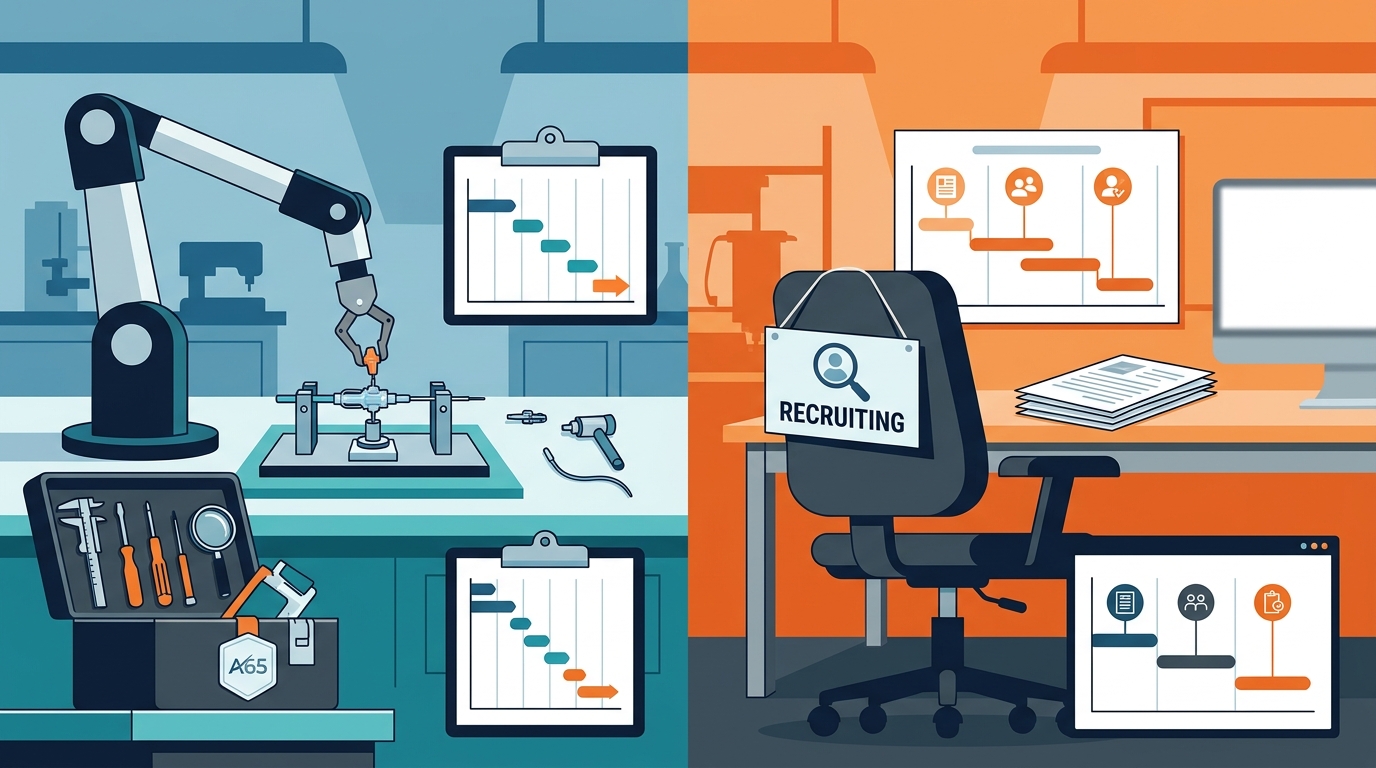
Time-to-productivity is a critical and often overlooked factor. Consultants can typically be acquired in about 7 days and onboarded in 3 days because they do not need full integration into company systems and culture. By contrast, a full-time employee often takes 28 days to acquire and 10 days to onboard.
When you factor in ramp-up time, consultants reach full productivity in approximately 40 days, while full-time employees average 206 days. That gap of roughly 5.5 months can mean the difference between hitting your FDA submission window and missing an entire market cycle. For companies working with medical device design and engineering services, this acceleration is a core value driver.
Side-by-Side Comparison Table
| Factor | Full-Time Engineer | Engineering Consultant |
|---|---|---|
| Base annual cost | ~$116,000 salary | $150 - $500/hr (project-based) |
| True loaded cost | ~$231,000/yr (1.99x multiplier) | Hourly rate + ~18% G&A only |
| Time to acquire | 28+ days | ~7 days |
| Time to full productivity | ~206 days | ~40 days |
| Benefits & overhead | Employer-paid (healthcare, PTO, 401k) | None; handled by consultant |
| Scalability | Fixed headcount | Scale up or down per project phase |
| Regulatory expertise depth | Varies by individual | Cross-client experience in FDA, ISO 13485 |
| Long-term IP continuity | Strong (if retained) | Managed via contracts and documentation |
| Termination complexity | HR processes, potential legal risk | End of contract, minimal friction |
When a Medical Device Consultant Is the Right Choice
Consultants shine in several common early-stage scenarios. If your company needs to move from concept to a working prototype quickly, a consultant with deep medical device project experience can compress timelines dramatically.
Ideal Scenarios for Consulting Engagement
- Pre-funding or seed stage: You need to demonstrate feasibility without committing to permanent headcount.
- Specialized skill gaps: Your team lacks specific expertise in areas like catheter design, electromechanical assemblies, or manufacturing system development.
- Regulatory preparation: You need design controls, risk management files, or verification and validation planning from someone who has done it across dozens of submissions.
A boutique engineering firm like A65 Consulting in Denver partners with companies ranging from startups to top-tier medical device manufacturers, providing the exact engineering resources needed without the overhead of permanent staff.
When a Full-Time Hire Makes More Sense
Full-time hiring is not always the wrong answer. A full-time employee is a permanent team member who builds institutional knowledge, maintains design history files, and contributes to company culture over the long term.
Conditions Favoring a Full-Time Hire
- Sustained, multi-year development: If your product roadmap spans three or more years with continuous engineering demand, a dedicated hire becomes cost-effective.
- Post-market support: Ongoing manufacturing support, CAPAs, and product iterations benefit from an engineer embedded in your quality system.
- Team building: You are scaling to 10+ engineers and need permanent leadership to manage the department.
Many companies find the ideal path is a hybrid approach: engage a consultant to accelerate the early design phases, then hire full-time once the product reaches design transfer. Explore how A65's engineering services can bridge that gap.
Key Takeaways
- A full-time medical device engineer costs roughly 2x their base salary when benefits and overhead are included.
- Consultants reach full productivity about 5x faster than new full-time hires.
- Hourly consulting rates of $150 to $500 often yield lower total project cost than a salaried position for early-stage work.
- Startups and early-stage companies benefit most from consulting engagements that match expertise to project phase.
- A hybrid model, starting with a consultant and transitioning to full-time hires, balances speed with long-term continuity.
- Regulatory depth from cross-client experience is a significant consultant advantage in FDA-regulated industries.
- Evaluate total cost of ownership, not just salary vs. hourly rate, before making your staffing decision.
Frequently Asked Questions
How much does a medical device engineering consultant cost per hour?
Medical device engineering consultants typically charge between $150 and $500 per hour, depending on their specialization, seniority, and the complexity of the project. The true cost to your organization is lower than an equivalent full-time hire when you account for benefits and overhead savings.
Is it cheaper to hire a full-time engineer or a consultant for a medical device project?
For projects under 12 to 18 months, a consultant is usually more cost-effective. Full-time employees carry a cost multiplier of approximately 1.99x their base salary. Consultants eliminate benefits, recruiting fees, and overhead costs, making them the more economical choice for defined-scope work.
How fast can a medical device consultant start working on my project?
Most consultants can be engaged within about 7 days and reach full productivity in roughly 40 days. Compare that to 28+ days to hire and up to 206 days to reach full productivity for a new full-time employee.
What are the risks of using a consultant instead of a full-time hire?
The primary risks involve IP continuity and institutional knowledge retention. These risks are manageable through well-structured contracts, thorough documentation practices, and design history file handoffs. A reputable firm will have processes in place to ensure seamless knowledge transfer.
When should a medical device startup hire full-time engineers?
Consider hiring full-time once you have a sustained, multi-year engineering workload, typically after design transfer or when scaling manufacturing. Before that milestone, consulting engagements offer more flexibility and lower financial risk.
Can a consultant handle FDA regulatory requirements?
Yes. Experienced medical device consultants often bring deeper regulatory expertise than a single in-house hire because they have worked across multiple FDA submissions, 510(k) clearances, and ISO 13485-compliant quality systems. This cross-project experience is a significant advantage during early development.
What should I look for in a medical device engineering consultant?
Look for demonstrated experience in your device category, a track record of FDA submissions, expertise in design controls and risk management, and the ability to also support manufacturing system design. Firms like A65 Consulting offer end-to-end capabilities from concept through production.
Get Expert Medical Device Engineering Support Today
Whether you are at the concept stage or preparing for design transfer, the right engineering partner can save you months and hundreds of thousands of dollars. A65 Consulting is a boutique medical device engineering firm in Denver, Colorado, that helps startups and established companies bring devices to market faster. Contact A65 Consulting to discuss your project and find out how our team can accelerate your product development timeline.