

Medical Device Engineering Consultant vs. Full-Time Hire for Early-Stage Product Development
Bringing a medical device from concept to market demands specialized engineering talent, but early-stage companies face a critical decision: hire a full-time engineer or engage a consulting partner? The answer depends on your timeline, budget, regulatory complexity, and long-term product roadmap. In this comparison, we break down the real costs, capability gaps, and strategic trade-offs so you can choose the path that gets your device to market faster and with less risk. Whether you are a funded startup or an established manufacturer launching a new product line, this guide gives you the data to decide with confidence.
The True Cost of a Full-Time Medical Device Engineer
Salary is only the starting point. According to ZipRecruiter (April 2026), the average annual pay for a medical device engineer in the United States is $103,662. Glassdoor places the figure even higher at roughly $148,533 per year when total compensation is included.
Beyond base pay, employers must budget for benefits, payroll taxes, equipment, software licenses, and ongoing training. A common rule of thumb is that total employer cost runs 1.3 to 1.5 times the base salary. For a mid-level engineer earning $120,000, that translates to $156,000 to $180,000 annually before you factor in recruiting expenses, which average around $4,129 per hire according to industry estimates.
The Hidden Time Cost
Recruiting a qualified medical device engineer can take six weeks or more. Add onboarding and ramp-up time, and you may lose two to three months of productive engineering before meaningful output begins. For an early-stage company racing toward a design freeze or a medical device prototyping milestone, that delay can be extremely costly.
How the Consulting Engagement Model Works
A medical device engineering consultant is a specialized professional or firm that provides product development expertise on a project basis rather than through permanent employment. Hourly rates for engineering consulting in the medical device space typically range from $150 to $500 per hour, depending on the complexity of the work and the seniority of the team involved.
Boutique engineering firms like A65 Consulting offer an alternative to both freelance contractors and large contract design houses. Based in Denver, Colorado, A65 partners with companies ranging from startups to top-tier manufacturers to fill engineering resource gaps and accelerate product development programs. The model lets you scale engineering capacity up or down without long-term headcount commitments.
What a Consulting Partner Typically Delivers
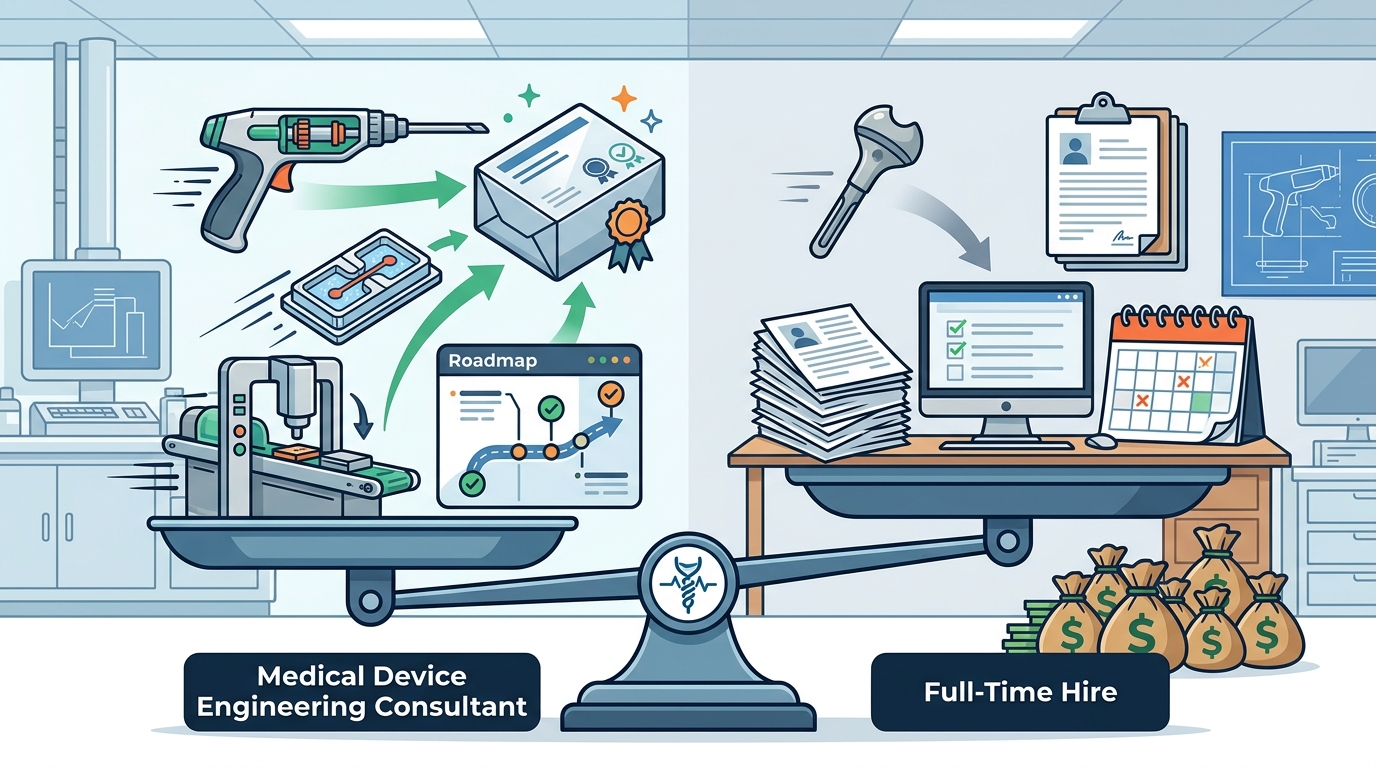
Engagements often include mechanical and electrical design, firmware development, design for manufacturability (DFM), and even the design of custom manufacturing assembly systems. This breadth is difficult to replicate with a single full-time hire.
Side-by-Side Cost and Capability Comparison
| Factor | Full-Time Engineer | Engineering Consultant |
|---|---|---|
| Annual cost (mid-level) | $156,000 - $180,000+ (loaded) | $75,000 - $250,000 (project-dependent) |
| Time to productivity | 6 - 12 weeks (recruit + onboard) | 1 - 2 weeks |
| Skill breadth | One discipline per hire | Cross-functional team access |
| Scalability | Fixed headcount | Flex up or down by project phase |
| Regulatory experience | Varies by candidate | Built into firm processes (ISO 13485, FDA) |
| IP continuity | High (employee retention) | Moderate (contractual IP assignment) |
| Long-term cost at 3+ years | Lower per hour if fully utilized | Higher if engagement is continuous |
The table highlights a key insight: consultants win on speed and breadth, while full-time hires win on long-term cost efficiency when the role is consistently utilized.
Speed to Market: Why Timing Changes Everything
Speed to market is a critical competitive advantage in the medical device vertical. A consulting team that has navigated dozens of development cycles can compress timelines by avoiding common pitfalls around design controls, verification and validation (V&V), and supplier qualification.
Early-stage companies often underestimate the engineering hours required to move from proof-of-concept to a design-verified prototype. A firm like A65 brings a multidisciplinary team from day one, eliminating the serial bottleneck of a single engineer switching between mechanical CAD, electrical layout, and test fixture design.
Risk, Compliance, and Regulatory Readiness
Design control is a set of FDA-mandated practices (21 CFR 820.30) that govern how medical devices are developed and documented. Getting design controls wrong early creates compounding rework later. Quality system non-compliance costs the medical device industry an estimated $36 billion per year.
An experienced consulting firm embeds regulatory thinking into every design phase, from user needs through design transfer. This proactive approach reduces the risk of a 483 observation or a failed audit, issues that can delay your product launch by months or even years.
When to Choose Each Model
Choose a Full-Time Hire When:
You have a multi-year product roadmap with continuous engineering needs. Your device is in sustaining engineering and requires daily iteration. You need someone deeply embedded in your company culture and institutional knowledge.
Choose a Consulting Partner When:
You need to move from concept to prototype quickly but lack in-house engineering depth. Your project requires cross-functional expertise (mechanical, electrical, software, manufacturing) that a single hire cannot cover. You want to control burn rate by paying only for productive engineering hours. Visit our contact page to discuss which model fits your situation.
Consider a Hybrid Approach
Many successful medical device companies start with a consulting partner to establish their design history file and initial prototypes, then bring engineering in-house once the product enters sustaining mode. This phased approach minimizes early risk while building long-term capability. Learn more about the A65 leadership team and how they support this transition.
Key Takeaways
- Total employer cost for a full-time medical device engineer ranges from $156,000 to $180,000+ per year when benefits and overhead are included.
- Engineering consulting rates in the medical device space typically fall between $150 and $500 per hour.
- Consultants dramatically reduce time to productivity, often starting meaningful work within one to two weeks.
- A boutique consulting firm provides cross-functional team access that a single hire cannot match.
- Regulatory expertise built into a consulting firm's processes lowers compliance risk from the start.
- A hybrid model, starting with a consultant and transitioning to in-house, balances speed with long-term cost control.
- The right choice depends on your product stage, budget, timeline, and the breadth of engineering disciplines required.
Frequently Asked Questions
How much does a medical device engineering consultant cost compared to a full-time engineer?
Consulting rates typically range from $150 to $500 per hour, which can translate to $75,000 to $250,000 or more per project. A full-time engineer costs $156,000 to $180,000+ annually when you include salary, benefits, and overhead. The consultant is often more cost-effective for projects under 12 months.
What services does a medical device engineering consultant provide?
A medical device engineering consultant provides product design, prototyping, design for manufacturability, firmware development, test fixture design, and regulatory documentation support. Firms like A65 Consulting also design custom manufacturing assembly systems.
When should a startup hire a full-time medical device engineer instead of a consultant?
A full-time hire makes sense when you have a continuous, multi-year engineering workload, need deep institutional knowledge, and can fully utilize the engineer's time. If your needs are project-based or you require multiple disciplines, a consultant is usually the better fit.
How long does it take to onboard a medical device engineering consultant?
Most consulting engagements begin productive work within one to two weeks of contract signing. By contrast, recruiting and onboarding a full-time engineer can take six to twelve weeks.
Can a consulting firm help with FDA regulatory compliance?
Yes. Experienced medical device consulting firms integrate design controls, risk management, and verification and validation into their development process, helping you build a compliant design history file from the start.
What is the biggest risk of hiring a consultant for medical device development?
The primary risk is IP continuity and knowledge transfer. This is mitigated through strong contractual IP assignment clauses, thorough documentation practices, and structured handoff procedures at project completion.
Is a hybrid model (consultant then full-time hire) a good strategy?
Absolutely. Many companies engage a consulting partner to establish the product architecture and initial prototypes, then hire full-time engineers for sustaining engineering. This approach minimizes burn rate during the high-uncertainty early phase.
How do I evaluate a medical device engineering consulting firm?
Look for demonstrated experience with your device classification, a portfolio of completed projects, ISO 13485 awareness, cross-functional team capability, and clear IP assignment terms. Ask for client references and review their past work.
Ready to Accelerate Your Medical Device Development?
If you are weighing the consultant-versus-hire decision for your next project, the team at A65 Consulting can help you map the most efficient path forward. Schedule a consultation to discuss your product goals, timeline, and engineering resource needs today.