
Medical Device Engineering Consultant vs. Full-Time Hire for Early-Stage Product Development
Deciding how to staff your early-stage medical device project is one of the most consequential choices you will make. Should you recruit a full-time biomedical engineer, or partner with a medical device engineering consultant? The answer depends on your timeline, budget, regulatory exposure, and how quickly you need specialized expertise. This guide breaks down the real costs, trade-offs, and strategic implications of each path so you can move forward with confidence and get your device to market on schedule.
Why Staffing Strategy Matters in Early-Stage Med Device Development
Early-stage product development is the phase where concepts become viable designs, requirements take shape, and regulatory strategy is set. Making the wrong staffing decision here can add months to your timeline and hundreds of thousands of dollars to your budget.
A medical device engineering consultant is a specialized professional or firm that provides on-demand engineering expertise for product development, regulatory compliance, and manufacturing without requiring a long-term employment commitment. For startups and emerging med-tech companies, this model offers access to disciplines like mechanical, systems, and manufacturing engineering from day one.
The True Cost of a Full-Time Engineering Hire
Salary is only the starting point. According to the U.S. Bureau of Labor Statistics, the median annual salary for biomedical engineers in the United States was $106,950 in 2024. When you factor in benefits, the number climbs significantly. The U.S. Department of Labor estimates that benefit-associated costs account for 30 to 45 percent of total compensation.
Hidden Costs Beyond Salary
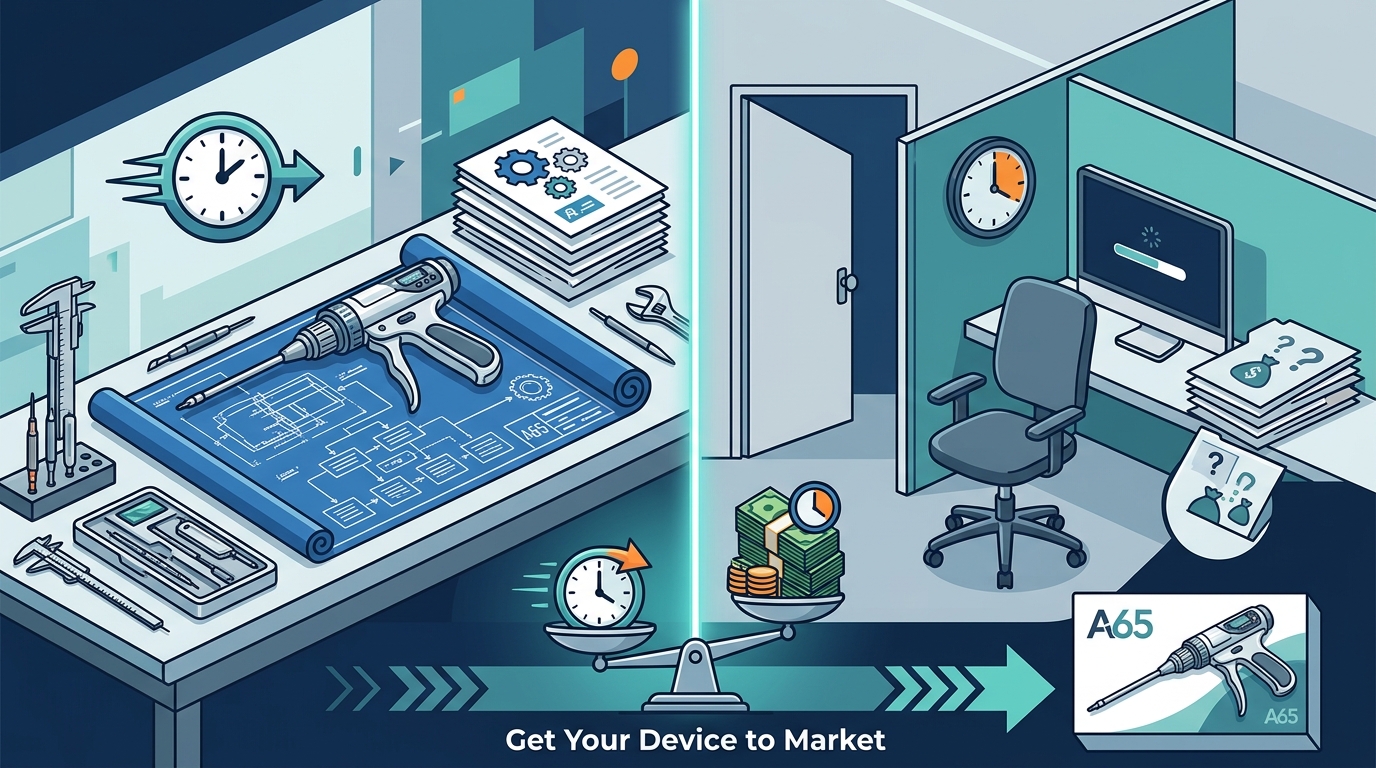
Recruiting alone can cost over $4,000 per hire and take an average of six weeks, according to industry analysis from C3 Medical. Add onboarding, software licenses (SolidWorks, for example), equipment, and management overhead, and the true first-year cost of a single mid-level biomedical engineer can easily exceed $160,000.
The Ramp-Up Delay
A new hire needs time to learn your product architecture, quality management system, and team workflows. In a regulated environment, this ramp-up can take three to six months before the engineer is fully productive. For an early-stage company under tight deadlines, that delay can be critical.
How the Consultant Model Works
A boutique engineering consultancy like A65 Consulting integrates directly with your existing team, bringing decades of medical device expertise on day one. Rather than filling a single role, a consultant partner can provide mechanical engineers, systems engineers, manufacturing engineers, and program managers as your project demands shift.
This model is sometimes called fractional engineering. Fractional engineering is a staffing approach where companies engage experienced engineers on a part-time or project basis instead of hiring them full-time. It lets you scale resources up or down without carrying fixed headcount costs during phases when the workload fluctuates.
Side-by-Side Cost Comparison
| Factor | Full-Time Hire | Engineering Consultant |
|---|---|---|
| Base annual cost (mid-level) | $100,000 - $115,000 salary | $150 - $500/hr (project-scoped) |
| Benefits & overhead (30-45%) | $30,000 - $52,000 | $0 (included in rate) |
| Recruiting & onboarding | $4,000+ and 6 weeks | Days to start |
| Software & tools | Company-funded | Consultant-provided |
| Ramp-up to productivity | 3 - 6 months | Immediate (domain experts) |
| Flexibility to scale | Low (fixed headcount) | High (adjust scope monthly) |
| Breadth of disciplines | One person, one specialty | Full team across disciplines |
| Regulatory experience | Varies by candidate | Built into the firm's practice |
For a 12-month early-stage project requiring roughly 1,500 engineering hours, a consultant engagement often costs 20 to 40 percent less than the fully loaded expense of a new hire, while delivering a broader skill set.
When a Consultant Is the Right Choice
You Need Speed
If your timeline is aggressive, a consulting team that has completed dozens of medical device projects can hit the ground running. There is no job posting, no interview loop, and no onboarding period.
You Need Multiple Disciplines
Early-stage development rarely requires just one type of engineer. You may need mechanical design, systems engineering, and manufacturing support in the same quarter. A consultancy delivers all three without triple the headcount.
You Need Regulatory Confidence
Navigating FDA requirements, design controls, and quality systems demands experience. A firm with embedded regulatory knowledge reduces risk and avoids costly rework later in the development cycle.
When Full-Time Hiring Makes Sense
Full-time hiring is the stronger choice when you have sustained, multi-year engineering needs and enough volume to keep a dedicated engineer fully utilized. It also makes sense when proprietary IP development is core to your strategy and you want every design decision kept in-house.
Companies with established product lines and ongoing sustaining engineering work often benefit from building internal teams. The key is ensuring you have enough work to justify the overhead. Many companies use a hybrid model, maintaining a small core team while engaging a consultancy like A65 for specialized medical device design sprints.
Key Takeaways
- The fully loaded cost of a mid-level biomedical engineer can exceed $160,000 per year once benefits, tools, and recruiting are included.
- Medical device engineering consultants typically charge $150 to $500 per hour but eliminate overhead and ramp-up delays.
- Early-stage projects benefit from consultant flexibility because resource needs shift rapidly between disciplines.
- Regulatory and quality system expertise is often built into a consultancy's practice, reducing compliance risk from day one.
- A consultant engagement for a 12-month project can cost 20 to 40 percent less than a full-time hire while providing broader capabilities.
- Full-time hiring is best suited for sustained, multi-year engineering workloads with consistent utilization.
- Many successful med-tech companies use a hybrid model, combining a lean internal team with a consulting partner.
Frequently Asked Questions
What is a medical device engineering consultant?
A medical device engineering consultant is a specialized engineer or firm that provides on-demand product development, design, and regulatory support to medical device companies without requiring a permanent employment relationship.
How much does it cost to hire a medical device engineering consultant?
Rates typically range from $150 to $500 per hour depending on the complexity of the project and the level of expertise required. Some firms also offer project-based pricing for well-defined scopes of work.
Is it cheaper to use a consultant than to hire full-time?
For early-stage and time-limited projects, yes. When you account for benefits (30 to 45 percent of salary), recruiting costs, software, and ramp-up time, a consultant engagement is frequently 20 to 40 percent less expensive overall.
How quickly can a consultant start on my project?
An experienced consultancy can typically begin within days of signing an engagement. Because their engineers already have domain expertise in medical devices, there is virtually no onboarding delay.
Will a consultant integrate with my existing team?
Yes. Reputable firms like A65 Consulting are built to embed within client organizations, attending your meetings, using your tools, and aligning with your design controls and quality systems.
What disciplines can a medical device consultant cover?
A full-service firm covers mechanical engineering, electrical engineering, systems engineering, manufacturing engineering, program management, quality engineering, and regulatory affairs support.
When should I hire full-time instead?
Consider full-time hiring when you have at least two to three years of continuous engineering work, enough volume to keep the role fully utilized, and proprietary R&D that benefits from deep institutional knowledge.
Can I use both a consultant and full-time engineers at the same time?
Absolutely. A hybrid model is common and often ideal. Your internal team owns long-term product strategy while the consultant handles peak workloads, specialized tasks, or new product introductions.
Ready to Staff Your Next Medical Device Project?
If you are evaluating how to resource your early-stage medical device development, book a free discovery call with A65 Consulting. Based in Denver, Colorado, A65 partners with startups and top-tier medical device companies to provide the engineering expertise you need, exactly when you need it, without the cost and commitment of adding full-time headcount.