
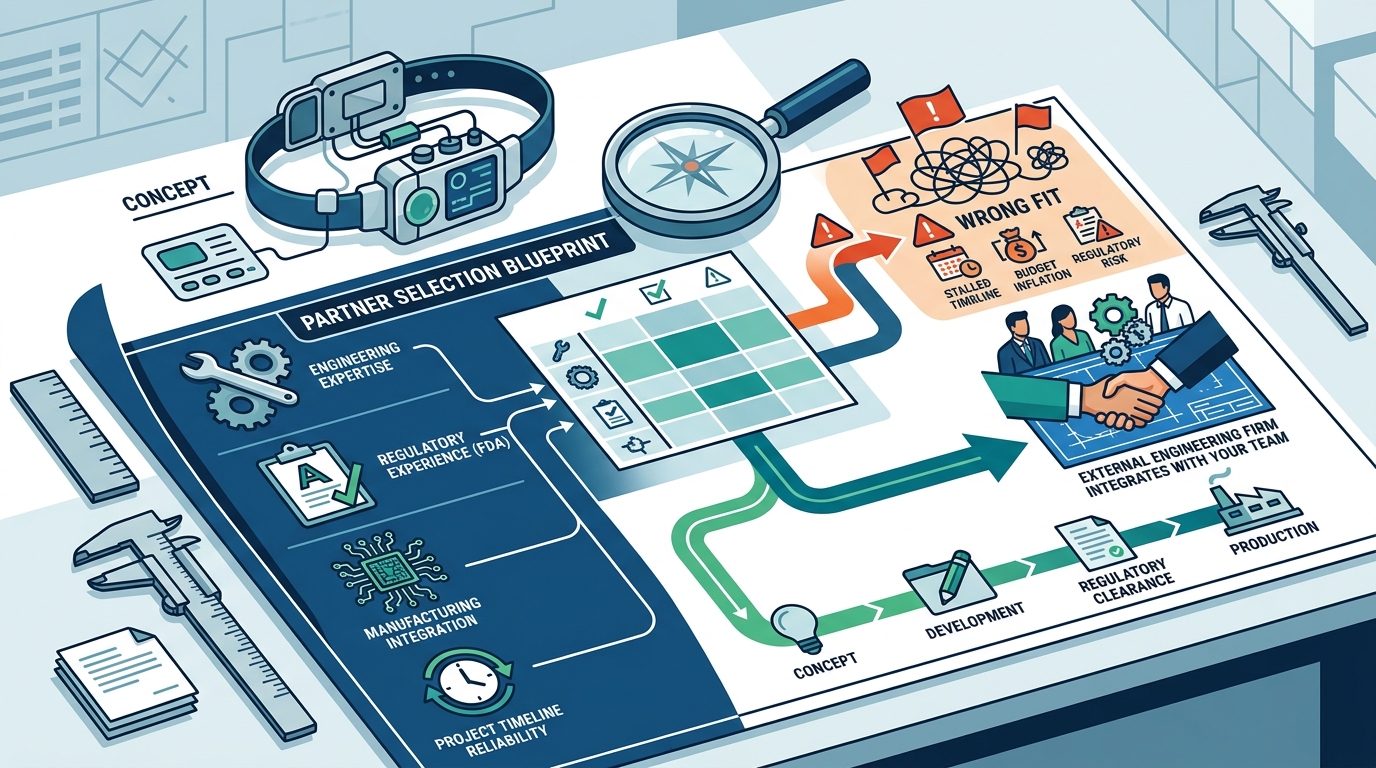
Choosing a medical device design partner is one of the most consequential decisions a medtech company will make. The wrong fit can stall timelines, inflate budgets, and introduce regulatory risk that echoes through the entire product lifecycle. A medical device design partner is an external engineering firm that integrates with your team to move a device from concept through regulatory clearance and into production. Whether you are a startup with a napkin sketch or a top-tier OEM filling a capability gap, the evaluation criteria remain surprisingly consistent. This guide walks you through exactly how to identify, vet, and select a partner that matches your project scope, regulatory pathway, and company culture.
Why Companies Need a Medical Device Design Partner
Internal teams are often stretched thin across multiple programs. Tight deadlines, missing niche expertise, and resource gaps make external engineering support essential rather than optional. According to industry data, startups and veteran industry leaders frequently collaborate with external engineering partners to expand resources, access specialized expertise, and accelerate time-to-market.
A design partner lets you bring in specialists without the cost and commitment of full-time hires. Companies ranging from pre-revenue startups to Fortune 500 medical device manufacturers use this model to keep programs moving forward. If your team is weighing whether outsourcing will accelerate or slow development, the answer depends almost entirely on partner selection.
Key Criteria for Evaluating a Design Partner
Depth and Breadth of Engineering Expertise
Look for a partner that covers the disciplines your project demands. Core capabilities typically include mechanical engineering, systems engineering, electrical design, and manufacturing engineering. A firm like A65 Consulting, for example, offers mechanical, systems, manufacturing, electrical, quality, and regulatory services under one roof.
Relevant Industry Track Record
Ask for case studies in your device class. A partner with experience across disposable devices, electromechanical systems, and robotic platforms will adapt faster than one locked into a single niche. Review their recent project portfolio for evidence of complexity and regulatory rigor.
End-to-End Capabilities
Partners that can carry a device from concept development through design for manufacturing and production transfer eliminate handoff risk between multiple vendors.
| Evaluation Criterion | What to Look For | Why It Matters |
|---|---|---|
| Engineering Disciplines | Mechanical, systems, electrical, manufacturing, quality | Reduces multi-vendor coordination overhead |
| Regulatory Experience | 510(k), De Novo, EU MDR pathway familiarity | Prevents submission delays and rework |
| Team Integration Model | Embedded engineers, shared project tools, regular design reviews | Ensures alignment with internal processes |
| Prototyping Capability | Concept models, functional prototypes, design verification builds | Catches design issues early and lowers cost |
| Program Management | Milestone tracking, risk identification, executive reporting | Keeps timelines and budgets on track |
Regulatory and Quality System Readiness
A quality management system (QMS) is a formalized set of processes and documentation that ensures a medical device meets applicable regulatory requirements. Your design partner should operate within a QMS framework aligned to ISO 13485, the international standard for medical device quality management.
The FDA 510(k) pathway accounts for roughly 85% of device clearances in the United States. A partner that understands predicate device strategies, design history file requirements, and risk management documentation will save months during submission preparation. Explore how regulatory strategy and risk management integrate throughout development to reduce compliance surprises.
Team Integration and Communication
The best partners do not operate as isolated vendors. They embed within your team, attend your stand-ups, and use your project management tools. Seamless integration is the difference between added capacity and added confusion.
Look for firms that hold regular client design reviews, assign dedicated engineering leads, and maintain transparent reporting. Understanding how product management, engineering, and quality roles interact is essential for any external partner joining an existing team.
Communication Checkpoints to Establish Early
- Weekly design alignment meetings with documented action items
- Shared document repositories with version control
- Defined escalation paths for technical or schedule risks
- Milestone-based deliverable reviews tied to design controls
Understanding Costs and Engagement Models
Medical device development costs vary widely depending on complexity and regulatory pathway. Feasibility and concept work typically falls in the $50K to $150K range, while full development through design freeze can reach $500K to $2M or more. An engagement model is the contractual structure defining how work is scoped, priced, and delivered between client and partner.
Common models include fixed-price project scopes, time-and-materials arrangements, and embedded resource contracts. Hidden costs such as usability studies, biocompatibility testing, and software validation can add 20 to 40 percent to the total budget. A transparent partner will flag these line items during the proposal phase, not after the contract is signed.
Red Flags to Watch For
Not every firm that markets medical device design services can actually deliver. Watch for these warning signs during your evaluation:
- No demonstrated regulatory experience. If a firm cannot cite specific 510(k) or EU MDR submissions they supported, proceed with caution.
- Unwillingness to share references. Reputable partners welcome reference calls.
- Vague project scoping. A credible partner will ask detailed questions about your device requirements, intended use environment, and regulatory strategy before quoting.
- No design control process. Design controls are mandatory under FDA 21 CFR 820. A partner that does not follow them introduces significant risk.
- Overpromising timelines. Medical device development has inherent complexity. A partner promising unrealistic speed likely underestimates regulatory and verification demands.
Strong partners invest in the early discovery conversation. Reviewing how to structure your prototyping strategy to reduce development cost and time is one early indicator that a firm thinks beyond just design.
Key Takeaways
- Prioritize partners with multidisciplinary engineering capabilities covering mechanical, systems, electrical, and manufacturing.
- Verify regulatory pathway experience, especially with FDA 510(k) and EU MDR submissions.
- Demand a clear engagement model with transparent cost estimates, including hidden testing expenses.
- Evaluate team integration approach by asking how the partner embeds with your existing workflows.
- Check references and recent project portfolios for evidence of on-time, on-budget delivery.
- Watch for red flags like vague scoping, missing design controls, and no regulatory track record.
- Start the conversation early so the partner can influence architecture decisions, not just execute downstream tasks.
Frequently Asked Questions
What is a medical device design partner?
A medical device design partner is an external engineering firm that provides specialized design, development, and regulatory support to help bring a medical device from concept to market. These firms supplement or replace internal engineering capacity.
How much does it cost to hire a medical device design firm?
Costs depend on project complexity. Feasibility work typically ranges from $50K to $150K, full development can cost $500K to $2M, and regulatory submission support may add $100K to $500K. Usability and biocompatibility testing can increase the total by 20 to 40 percent.
What certifications should a design partner have?
At minimum, look for alignment with ISO 13485 quality management principles. Certification demonstrates formalized processes for design controls, documentation, and traceability that meet FDA and international requirements.
Should I choose a large firm or a boutique consultancy?
Boutique firms often provide senior-level engineers on every project and integrate more closely with your team. Larger firms offer broader infrastructure but may assign junior staff. The right choice depends on your project size, budget, and need for hands-on attention.
How do I evaluate a partner's regulatory experience?
Ask for specific examples of regulatory submissions they have supported, including device class and pathway. Cross-reference claims using the FDA's public device database. A partner with fewer than five cleared submissions in a relevant device class may pose higher risk.
What is the typical timeline for medical device development?
Timelines vary significantly. A simple Class I device might take 6 to 12 months. A Class II device requiring 510(k) clearance often takes 18 to 36 months. More complex Class III devices requiring PMA can take 3 to 7 years including clinical trials.
Can a design partner help with manufacturing too?
Yes. Many partners offer manufacturing engineering services including DFM/DFA optimization, fixture and tooling development, production line layout, and supplier management. Choosing a partner with these capabilities reduces handoff risk during design transfer.
Ready to Start Your Search?
Finding the right medical device design partner starts with a focused conversation about your goals, constraints, and timeline. A65 Consulting is a Denver-based boutique medical device engineering firm that partners with startups and top-tier device companies to close engineering gaps and keep programs on track. Learn more about the A65 team, then book a free design consultation to discuss your project.