
Bringing a medical device from concept to market is one of the most complex engineering challenges in any industry. Between rigorous FDA design controls, tight timelines, and the constant pressure to innovate, most companies reach a point where they need outside engineering expertise. A medical device design partner is an external engineering firm that integrates with your team to fill capability or capacity gaps and accelerate product development. Choosing the right one can mean the difference between a smooth product launch and costly delays. This guide walks you through a proven process for evaluating and selecting a partner that fits.
Why You Need a Medical Device Design Partner
Medical device companies of all sizes face the same core problem: there is more engineering work to do than their internal teams can handle. Startups may lack specialized disciplines entirely, while established companies often hit capacity ceilings during critical program phases.
A design partner solves this by providing on-demand access to experienced engineers who can step into your workflow quickly. The U.S. medical device market exceeds $110 billion annually, and the majority of device companies employ fewer than 50 people. That means most organizations simply cannot staff every discipline they need full-time.
Whether you need mechanical engineering for a complex disposable device or systems-level architecture support, an outside partner lets you scale without the overhead of permanent hires.
Key Criteria for Evaluating a Design Partner
Domain Experience in Medical Devices
General engineering firms may lack the regulatory awareness and risk management mindset that medical device work demands. Look for a partner with a portfolio of regulated device projects. Review their recent project history for evidence of work across device classes and therapeutic areas.
Breadth of Engineering Disciplines
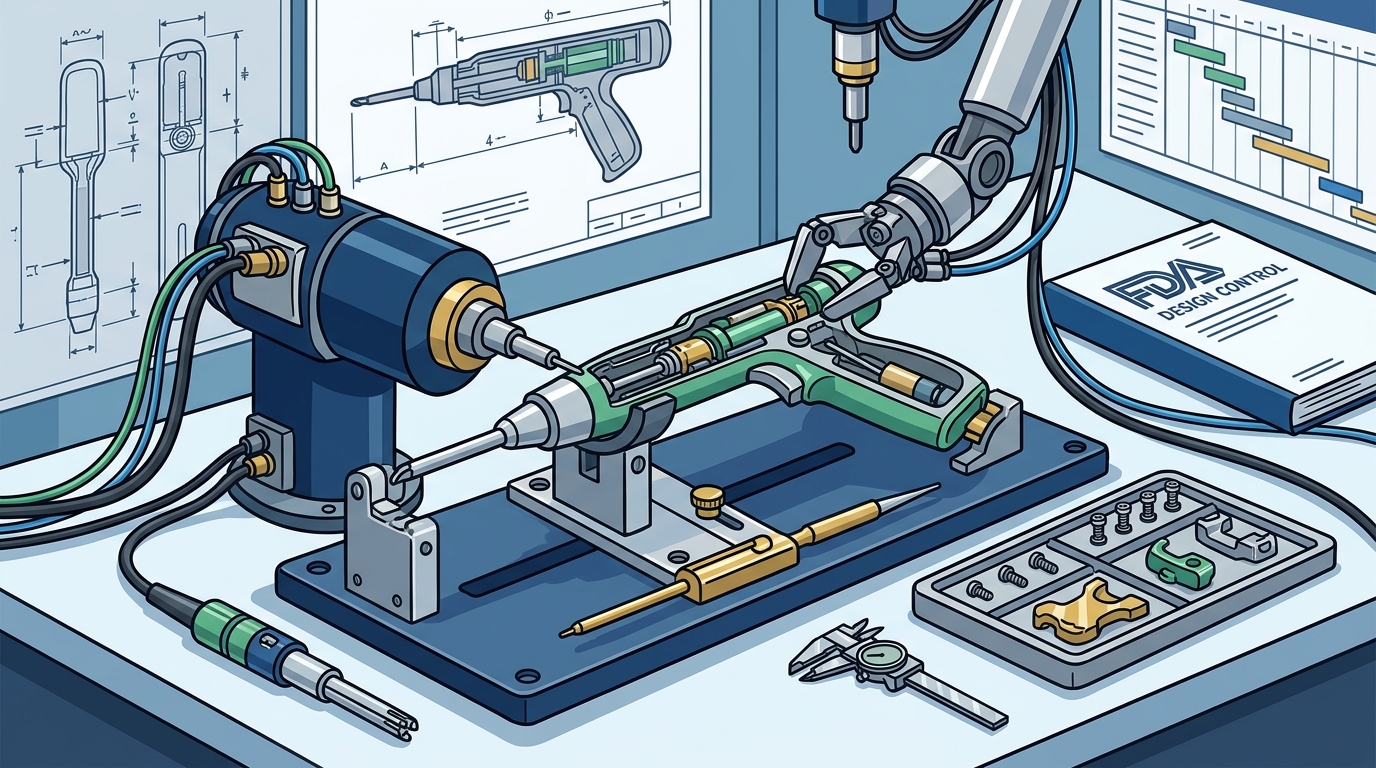
The best partners cover mechanical, electrical, systems, and manufacturing engineering under one roof. A multidisciplinary team is a group of engineers spanning different specialties who collaborate to deliver a complete device design. This breadth reduces handoff risk and keeps accountability clear.
Proven Track Record and References
Ask for client testimonials and case studies. A strong partner will have repeat clients and references from R&D directors and CEOs who can speak to delivery quality and reliability.
Engineering Capabilities That Matter Most
Not every firm offers the same depth. When evaluating candidates, map your project needs against these core capabilities:
- Precision mechanical design for mechanisms, disposables, and electromechanical assemblies
- Electrical and PCB design for embedded medical systems
- Systems engineering including requirements management, architecture, and traceability
- Manufacturing process development including DFM reviews and production transition support
A firm like A65 Consulting covers all four disciplines, which means fewer vendors to manage and tighter design coherence across subsystems.
Regulatory Knowledge and Design Controls
Design controls are an interrelated set of practices and procedures that the FDA requires manufacturers to incorporate into the development process under 21 CFR 820.30. Any credible design partner should understand design inputs, design outputs, verification, validation, and design transfer.
In 2024, the FDA introduced a final rule to harmonize 21 CFR Part 820 with ISO 13485, renaming it the Quality Management System Regulation (QMSR). This change takes effect in 2026, and your partner should already be preparing for it. Ask prospective firms how they handle design history files, risk management documentation, and traceability matrices.
Team Integration and Communication
The most overlooked factor in choosing a design partner is how well their engineers integrate with your existing team. A partner who operates in a silo creates communication gaps and misaligned design decisions.
Look for firms that hold regular client meetings to ensure design alignment, embed their engineers into your workflows, and use your project management tools. Seamless team integration is the practice of external engineers working within a client's existing processes, tools, and culture as though they were internal staff. The best partnerships feel invisible to the rest of your organization.
Geography can also matter. A partner based in your region, such as the Denver, Colorado area, can offer the option of on-site collaboration when projects demand it. Learn more about A65 Consulting's approach to partnership.
In-House vs. Outsourced Engineering: A Quick Comparison
| Factor | In-House Team | Design Partner (Outsourced) |
|---|---|---|
| Upfront Cost | High (salaries, benefits, equipment) | Lower (pay per project or engagement) |
| Time to Ramp Up | Weeks to months (recruiting) | Days to weeks |
| Discipline Coverage | Limited by headcount | Access to multidisciplinary specialists |
| Regulatory Experience | Varies by hire | Built into the firm's DNA |
| Scalability | Difficult to flex up/down | Scale on demand |
| Institutional Knowledge | Retained internally | Requires documentation handoff |
| Long-Term Commitment | Ongoing employment | Project-based flexibility |
Key Takeaways
- Choose a design partner with deep, specific experience in regulated medical devices rather than general product development.
- Prioritize firms that offer mechanical, electrical, systems, and manufacturing engineering to reduce vendor complexity.
- Verify the partner understands FDA design controls, ISO 13485, and the upcoming QMSR harmonization.
- Evaluate how the firm integrates with your team through communication cadence, tool compatibility, and cultural fit.
- Request client references and look for repeat engagements as a signal of trust and delivery quality.
- Consider regional proximity for projects that benefit from on-site collaboration.
- Compare total cost of engagement against hiring full-time to understand the true value of outsourcing.
Frequently Asked Questions
What is a medical device design partner?
A medical device design partner is an external engineering firm that works alongside your internal team to design, develop, and transfer medical devices into production. They fill gaps in expertise or capacity so you can meet program milestones without the overhead of full-time hires.
How much does it cost to hire a medical device design firm?
Costs vary widely depending on project scope, device complexity, and engagement duration. Most firms offer project-based pricing or time-and-materials contracts. Outsourcing is generally more cost-effective than hiring and onboarding multiple full-time engineers for a single program.
What engineering disciplines should a good partner cover?
At minimum, look for mechanical engineering, electrical engineering, systems engineering, and manufacturing support. Firms that offer all four, like A65 Consulting, reduce coordination overhead and design risk.
How do I know if a partner understands FDA regulations?
Ask about their experience with design controls under 21 CFR 820.30, risk management per ISO 14971, and their familiarity with the FDA's upcoming QMSR transition. A knowledgeable partner should be able to discuss design history files, verification and validation strategies, and traceability without hesitation.
Can a design partner work with my existing team?
Yes. The best partners are built around a team-integration model. They join your meetings, use your tools, and align to your development processes. This approach eliminates the friction that comes with traditional outsourcing.
How long does a typical engagement last?
Engagements range from a few weeks for a focused analysis or prototype to 12 months or more for full product development cycles. The timeline depends on device complexity, regulatory pathway, and how much of the design is already defined.
Should I choose a local or remote design partner?
Both models can work. However, a local partner offers the advantage of face-to-face design reviews, on-site prototyping sessions, and faster iteration when hands-on collaboration is needed. Denver-based firms like A65 Consulting serve clients nationwide while offering local presence for Colorado-based companies.
Ready to Find Your Engineering Partner?
If your team is stretched thin and your next medical device program cannot wait, it is time to talk to an experienced design partner. A65 Consulting brings decades of medical device engineering expertise across mechanical, electrical, systems, and manufacturing disciplines. Book a consultation today to discuss your project goals and see how A65 integrates with your team to deliver results.