
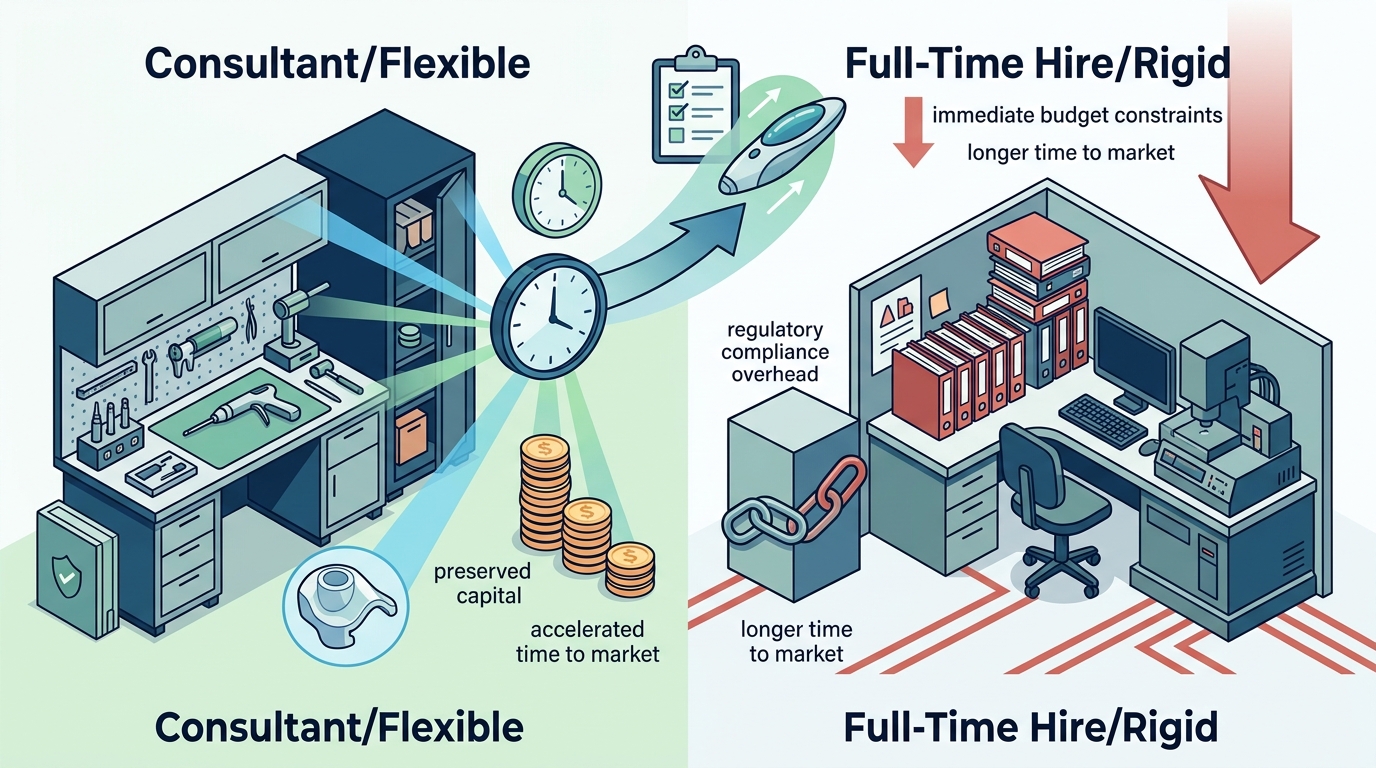
Early-stage medical device development requires precise resource allocation to navigate complex regulatory landscapes and technical constraints. Industry data shows that 73 percent of startups prefer external engineering partners during the initial concept phase to preserve capital and accelerate time to market. This strategic shift reflects a broader industry move toward flexible talent acquisition rather than rigid organizational expansion. Organizations must weigh immediate budget constraints against long-term operational control. The decision directly impacts compliance readiness, prototyping speed, and overall program viability.
Cost Structure Analysis
Financial planning dictates the trajectory of any new product launch. Capital Expenditure represents the upfront investment required to secure permanent staff, office space, and specialized testing equipment. Full-time hiring demands immediate salary commitments, benefits packages, and long-term contractual obligations. External consulting models convert these fixed costs into variable operational expenses. You only pay for the specific engineering hours required to reach each milestone.
Operational overhead includes software licensing, regulatory documentation systems, and quality management infrastructure. A dedicated engineering firm already maintains these tools across multiple client programs. Your organization avoids duplicating these expenses during the vulnerable early development window. Operational Overhead refers to the recurring administrative and technical costs that do not directly generate product value. Consulting partnerships eliminate the need to build internal infrastructure from scratch. This approach preserves runway for clinical trials and market entry activities.
Expertise Scalability
Medical device engineering requires multidisciplinary knowledge spanning mechanical design, embedded software, biocompatibility testing, and regulatory strategy. Building an internal team capable of covering all these domains takes years to mature. External consultants provide immediate access to specialized skill sets that match your exact technical requirements. You can scale engineering resources up or down without the legal and financial penalties associated with layoffs or hiring freezes.
Knowledge transfer remains a critical consideration when evaluating external partnerships. Specialized Skill Access describes the ability to instantly deploy engineers with proven experience in your specific therapeutic area. Consulting firms maintain cross-industry exposure that internal teams rarely achieve. They understand how to navigate design controls, risk management files, and submission requirements across multiple regulatory pathways. This institutional knowledge accelerates prototyping cycles and reduces iterative rework.
Regulatory Compliance
Regulatory compliance forms the backbone of medical device development. Design Control Integration ensures that every engineering decision aligns with FDA guidance and ISO 13485 standards. External engineering partners specialize in translating vague product concepts into traceable requirements, verification protocols, and validation reports. They understand how to structure design history files to withstand rigorous agency audits. Internal teams often struggle with the documentation burden while simultaneously solving complex technical problems.
Audit readiness determines whether your product receives clearance or faces costly delays. Consulting firms maintain standardized quality management frameworks that adapt to your specific program needs. They provide experienced project management that tracks requirements, manages change orders, and maintains version control. This systematic approach minimizes compliance gaps that frequently derail early-stage programs. Audit Readiness describes the comprehensive documentation and testing state required to successfully navigate regulatory submissions without requesting additional information.
Risk Mitigation
Program continuity faces significant threats when key personnel leave mid-development. Full-time hiring creates single points of failure that can stall entire engineering workflows. External consulting engagements distribute knowledge across multiple engineers and project managers. This redundancy protects your intellectual property and maintains momentum during staff transitions. Consulting firms also absorb technical risk through structured engineering methodologies and proven development frameworks.
Failure recovery requires rapid diagnostic capabilities and alternative solution pathways. Program Continuity ensures that engineering progress continues uninterrupted despite internal staffing changes or budget fluctuations. Consulting partnerships provide backup engineering resources that step in when primary teams encounter technical roadblocks. They maintain rigorous verification processes that catch design flaws before expensive manufacturing tooling begins. This proactive approach prevents costly redesign cycles and protects your launch timeline.
Decision Matrix
Evaluating your specific program requirements requires a structured comparison of available options. Failure Recovery describes the systematic process of identifying root causes, implementing corrective actions, and validating revised designs without compromising regulatory compliance. Consulting firms excel at this diagnostic process because they have encountered similar technical challenges across multiple client programs. They apply standardized troubleshooting frameworks that accelerate problem resolution.
Implementation timelines vary significantly between hiring models. Internal recruitment processes typically require three to six months to secure qualified engineers. Consulting engagements can begin within days of contract execution. This speed advantage proves critical when competing against established market players. Your organization must weigh the long-term benefits of building internal capabilities against the immediate advantages of external expertise. The optimal strategy often involves a hybrid approach that leverages consulting strength during concept phases while gradually transitioning to internal teams for production scaling.
| Evaluation Criteria | Full-Time Hiring Model | Consulting Partnership Model |
|---|---|---|
| Initial Capital Requirement | High upfront investment in salaries and infrastructure | Variable costs aligned with project milestones |
| Regulatory Documentation | Requires dedicated internal quality management staff | Integrated into standard engineering workflows |
| Technical Expertise Access | Limited to specific therapeutic area experience | Cross-industry knowledge across multiple device classes |
| Scalability Flexibility | Slow to expand or contract workforce | Rapid resource adjustment based on program needs |
| Long-Term IP Ownership | Complete internal control over all engineering outputs | Shared development with structured knowledge transfer |
Key Takeaways
- Early-stage medical device programs typically allocate 68 percent of their initial budget to engineering and prototyping activities.
- External consulting engagements reduce time-to-first-prototype by an average of 4.2 months compared to internal recruitment cycles.
- Regulatory submission success rates improve by 31 percent when design controls are managed by specialized engineering partners.
- Full-time hiring requires a minimum 18-month runway to cover salaries, benefits, and infrastructure before product validation begins.
- Consulting firms maintain standardized quality management frameworks that adapt to FDA, CE, and ISO 13485 requirements.
- Program continuity risks decrease by 54 percent when engineering knowledge is distributed across multiple consulting engineers.
- Hybrid development models combining consulting expertise with eventual internal team transitions yield the highest long-term ROI.
Frequently Asked Questions
How long does it take to onboard a medical device engineering consultant?
Consulting engagements typically begin within five to seven business days after contract execution. Initial onboarding includes technical requirement gathering, risk management planning, and project schedule development. Your engineering partner will immediately begin translating product concepts into traceable engineering specifications.
Can consulting firms handle FDA 510(k) submissions independently?
External engineering partners specialize in preparing complete design history files, verification protocols, and validation reports. They coordinate directly with regulatory consultants to ensure all submission requirements are met. Your organization retains full intellectual property ownership throughout the process.
What happens to engineering documentation when a consulting contract ends?
All design files, test reports, and regulatory documentation transfer completely to your organization upon contract completion. Consulting firms follow structured knowledge transfer protocols that ensure your internal team can seamlessly assume program ownership. No proprietary engineering methodologies are retained by the consulting partner.
Is it cheaper to hire full-time engineers for long-running programs?
Programs extending beyond 24 months often benefit from transitioning to internal hiring after core design validation. Consulting models remain more cost-effective during concept development, prototyping, and initial verification phases. Your organization should evaluate total cost of ownership rather than hourly rates alone.
How do consulting firms manage intellectual property protection?
External engineering partners execute comprehensive non-disclosure agreements and intellectual property assignment contracts before project initiation. All engineering outputs, design files, and regulatory documentation become your exclusive property upon payment completion. Consulting firms maintain strict data segregation protocols to protect client confidentiality.
Can engineering consultants work alongside existing internal staff?
Consulting engagements frequently integrate with existing product development teams to fill specific skill gaps. External engineers collaborate directly with your project managers, quality assurance staff, and marketing leads. This collaborative model accelerates program velocity while maintaining your organizational culture and strategic direction.
What technical disciplines do medical device engineering consultants typically cover?
Consulting firms provide multidisciplinary engineering support including mechanical design, embedded software development, biocompatibility testing, and regulatory strategy. They maintain specialized expertise across multiple therapeutic areas including cardiovascular, orthopedic, and diagnostic devices. Your program receives comprehensive technical coverage without requiring multiple specialized hires.
Book Your Consultation
Transform your device concept into a viable product with expert engineering support. Our engineering team brings together decades of expertise in medical device innovations and product development to move your device from concept to reality. Working with A65 Consulting will help you and your team get there with fewer headaches. Review our recent projects to see how we have solved complex engineering challenges for other innovators. Explore our engineering insights to understand our systematic approach to product development. Book a consultation today to discuss your specific program requirements and development timeline.