
Medical Device Engineering Consultant vs. Full-Time Hire for Early-Stage Development
Early-stage medical device founders face a critical strategic decision that often determines their runway and product viability. According to recent industry analyses, the average cost to onboard a specialized medical device engineer can exceed $150,000 annually when factoring in benefits, overhead, and recruitment fees. This financial burden is compounded by the regulatory complexity inherent in the sector, where a single design oversight can halt a product launch for months. Navigating this landscape requires a clear understanding of whether to build an internal team or leverage external expertise.
The Core Dilemma: Agility vs. Control
The fundamental tension in early-stage medical device development lies between operational agility and organizational control. Building an internal team offers deep institutional knowledge and direct oversight. However, it also introduces significant lag times in hiring and onboarding. Conversely, engaging a specialized engineering partner provides immediate access to seasoned expertise but requires robust management frameworks to ensure alignment.
Medical device engineering consultant services are designed to bridge the gap between concept and viable product. These partners bring decades of experience in navigating the complex intersection of clinical needs, regulatory requirements, and manufacturing constraints. They do not just understand engineering; they understand what is at stake in terms of patient safety and market entry.
When evaluating this choice, founders must consider the velocity of their development timeline. Internal hires require time to ramp up on specific regulatory standards such as ISO 13485. External consultants arrive with established processes and a proven track record of delivering results under tight deadlines.
Financial Implications and Cost Structures
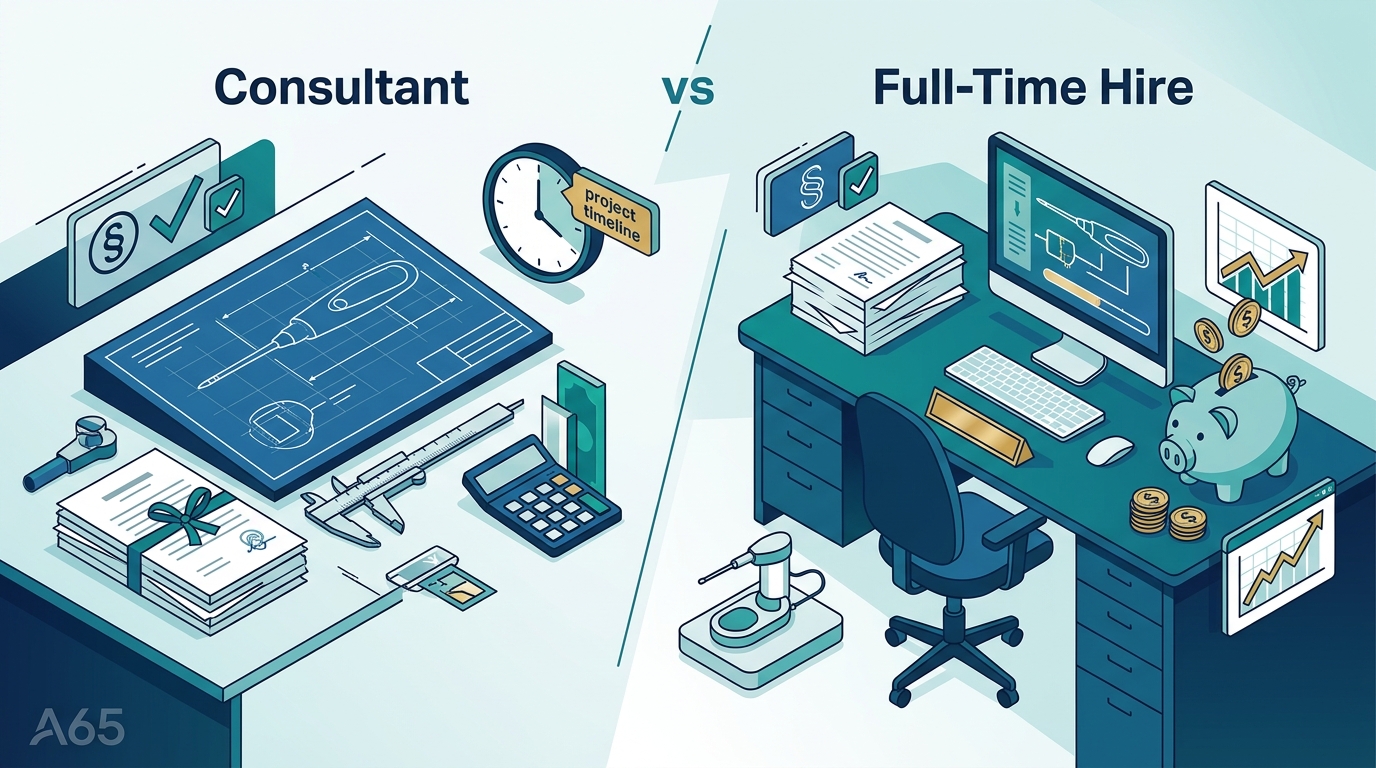
Cost analysis is rarely straightforward in the medical device sector. The apparent lower cost of a consultant’s hourly or project-based rate often masks the long-term financial advantages of specialized expertise. Full-time employees require salaries, health benefits, payroll taxes, and equipment. For a startup with limited capital, these fixed costs can drain resources needed for clinical trials or regulatory submissions.
According to data from the Bureau of Labor Statistics, the median annual wage for mechanical engineers in the United States was approximately $95,000 in 2023. When added to the 20-30% overhead for benefits and office space, the total cost of employment rises significantly. In contrast, a premium engineering partner like A65 Consulting operates on a model that converts fixed costs into variable costs. This allows startups to scale engineering efforts up or down based on project milestones without the burden of permanent headcount.
Furthermore, the cost of failure in medical device development is astronomical. A design that fails to meet manufacturing tolerances or regulatory standards can result in costly redesigns. Experienced consultants mitigate this risk by applying Design for Manufacturing principles early in the process, ensuring that the product is not only innovative but also producible at scale.
Regulatory Compliance and Quality Systems
Regulatory compliance is perhaps the most significant differentiator between hiring a generalist engineer and engaging a specialized medical device engineering firm. The FDA and international bodies require rigorous documentation, risk management, and verification processes. Verification is a system, not a phase, as noted in recent industry insights. This means that compliance must be woven into every stage of development, from initial concept to final production.
Internal teams, especially those new to the medical device space, may lack the nuanced understanding of Quality Management Systems (QMS). They might treat verification as a final checkpoint rather than an ongoing activity. This approach often leads to last-minute surprises and delayed approvals. External partners, however, bring established QMS frameworks and a deep understanding of the regulatory landscape. They ensure that every design decision is traceable to regulatory requirements, reducing the likelihood of audit findings.
For example, the complexity of medical device design often involves balancing competing requirements such as ergonomics, sterilization methods, and electronic safety. A specialized consultant has likely navigated these challenges across multiple product categories, providing a breadth of knowledge that is difficult to replicate internally in the early stages.
Intellectual Property and Data Security
Protecting intellectual property (IP) is a paramount concern for any innovator. Founders often worry that sharing their concepts with an external partner could lead to IP leakage. However, reputable engineering firms operate under strict non-disclosure agreements (NDAs) and have robust data security protocols in place. In many cases, the risk of IP loss is lower with a specialized partner than with a large, less focused internal team where information silos can lead to accidental disclosures.
Moreover, the structure of IP ownership is clearly defined in consulting agreements. When you work with a firm like A65 Consulting, the terms of IP transfer are explicit, ensuring that your company retains full ownership of the innovations developed. This clarity is often more difficult to establish with early-stage employees who may have prior employment agreements or unclear equity arrangements.
Data security in medical device development also involves protecting patient data and design specifications. External partners are typically subject to rigorous security audits and compliance standards, such as HIPAA and GDPR, depending on the nature of the data. This provides an additional layer of protection that might be challenging for a small startup to implement independently.
Scalability and Long-Term Viability
Early-stage development is dynamic. Requirements change, funding rounds alter priorities, and market feedback necessitates pivots. A full-time team is static in its capacity. If the project scope expands, you must hire more people, a process that can take months. If the scope contracts, you are left with excess payroll and potential morale issues.
Consulting partners offer inherent scalability. They can deploy additional resources to critical path activities, such as rapid prototyping or regulatory documentation, without the administrative burden of hiring. This flexibility is crucial for maintaining momentum in a competitive market. As the product moves from development to manufacturing transfer, the role of the engineering partner evolves. They can assist in transferring knowledge to your internal team or manufacturing partners, ensuring a smooth transition.
Long-term viability also depends on the ability to attract top talent. By using external experts to build a robust product foundation, you create a more attractive environment for future hires. Engineers want to work on successful, well-engineered products. A strong initial design, crafted by experienced professionals, sets the stage for future growth and recruitment.
Key Takeaways
- Cost Efficiency: Consulting converts fixed overhead into variable costs, preserving startup runway.
- Regulatory Expertise: Specialized partners bring immediate QMS knowledge, reducing compliance risks.
- Speed to Market: Experienced teams accelerate development by avoiding common pitfalls and rework.
- IP Protection: Clear contractual frameworks ensure full ownership of innovations.
- Scalability: Resources can be adjusted dynamically based on project needs and funding stages.
- Risk Mitigation: Proactive design for manufacturing and verification reduces late-stage failures.
- Strategic Focus: Founders can focus on business development and fundraising while experts handle technical execution.
Frequently Asked Questions
When should I hire a consultant instead of a full-time employee?
You should consider a consultant when you need specialized regulatory knowledge, want to preserve cash flow, or require rapid scaling of engineering resources for specific project phases.
How do consultants handle intellectual property rights?
Reputable firms use strict NDAs and clear contracts that assign all IP rights to the client upon payment, ensuring you retain full ownership of your device design.
Can a consultant help with FDA submissions?
Yes, experienced medical device engineering consultants are well-versed in FDA requirements and can assist in preparing necessary documentation for 510(k) or PMA submissions.
What is the typical timeline for engaging a consulting partner?
Engagement can begin within days of signing an NDA, allowing for immediate start on critical path activities like design validation or prototyping.
Do consultants stay involved after the product launches?
Many firms provide ongoing support for manufacturing transfer, post-market surveillance, and future product iterations, ensuring long-term success.
How does consulting compare to hiring an agency?
Consulting firms often provide more dedicated, expert-level attention compared to larger agencies that may assign junior staff to accounts. They focus on deep technical problem-solving.
Is it safe to share sensitive design data with external partners?
Yes, when working with established firms that adhere to strict data security protocols and confidentiality agreements, the risk is minimal and well-managed.
Next Steps for Your Product
The decision to hire a consultant or a full-time employee is not just a financial calculation; it is a strategic choice that impacts your product’s quality, speed, and regulatory success. For early-stage medical device developers, the agility and expertise of a specialized partner often provide the necessary leverage to navigate the complex path from concept to market.
If you are overwhelmed by tight deadlines, missing critical knowledge, or have other distractions and skillset gaps, we solve these challenges. A65 is the only engineering partner you need to help you transform your device into a real and viable product. We thrive in the stress of program/product management, hard hitting requirements and delivering results.
Ready to discuss your project? Book a consultation today to explore how our team can accelerate your medical device development.