
Medical Device Engineering Consultant vs. Full-Time Hiring for Early-Stage Product Development
Early-stage medical device companies face a critical resource dilemma that often dictates their survival. Regulatory frameworks demand rigorous documentation and validation, yet cash flow is typically constrained by long development cycles. According to industry data, over 60 percent of startups fail to reach commercialization due to resource mismanagement rather than technical failure. This statistic highlights the urgency of choosing the right engineering model from day one. (Contact A65 Consulting)
The Core Dilemma: Speed vs. Stability
Medical device development is not merely an engineering challenge. It is a complex dance between regulatory compliance, technical innovation, and financial sustainability. ISO 13485 standards require a structured quality management system that is difficult to build from scratch without experienced leadership. (Medical Device Design and)
Founders must decide whether to build an internal team or leverage external expertise. This decision impacts the timeline to market, the quality of the design history file, and the overall burn rate. A65 Consulting specializes in navigating this exact intersection, helping clients avoid the pitfalls of both under-resourcing and over-hiring.
Advantages of an Engineering Consultant
Engaging a specialized engineering partner offers immediate access to deep domain expertise. Unlike generalist agencies, a focused medical device engineering firm brings decades of cumulative experience in regulated environments.
Rapid Scalability and Flexibility
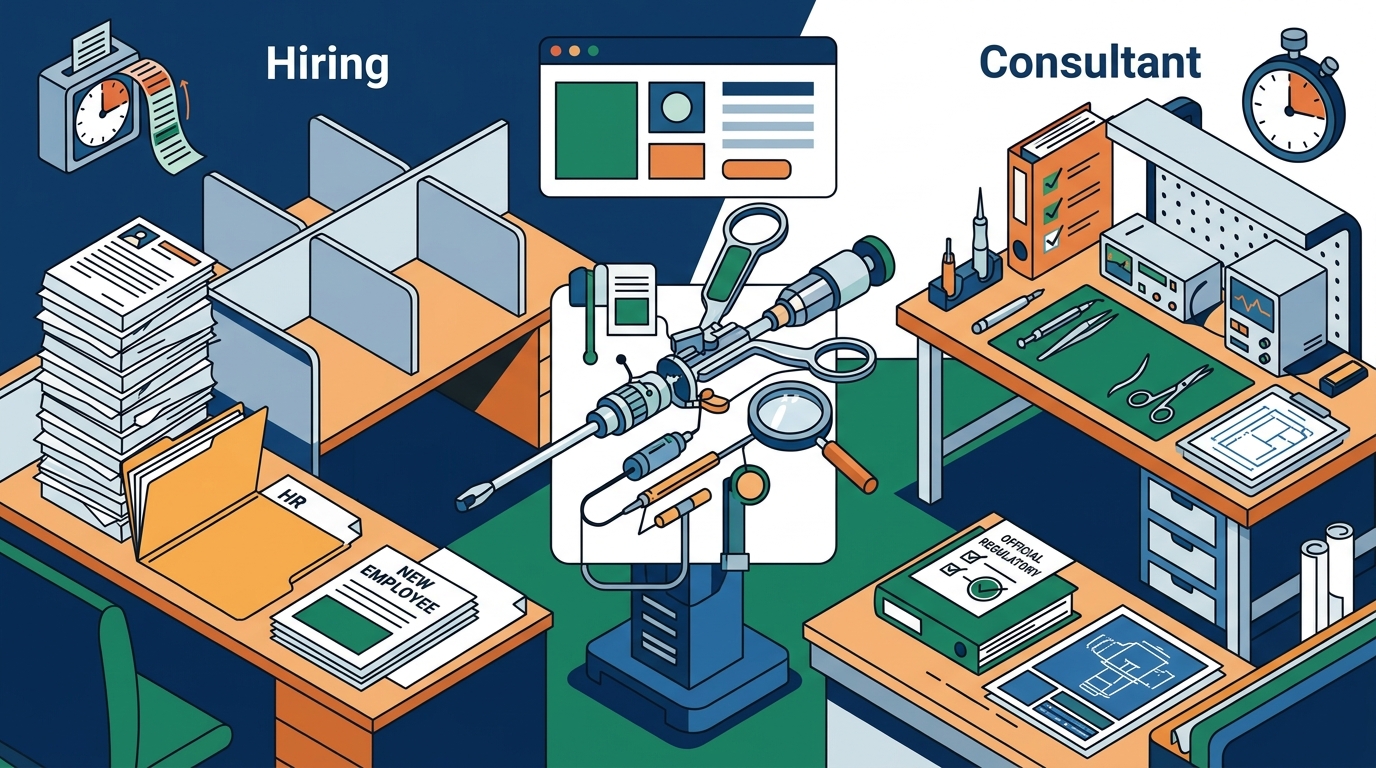
Early-stage projects often experience fluctuating workloads. During the conceptual phase, you may need systems engineering support. During design verification, you may require intensive mechanical testing resources. A consultant model allows you to scale these capabilities up or down without the legal and financial burdens of hiring and firing.
This flexibility is crucial for managing cash flow. You pay for the expertise you need, when you need it, rather than maintaining a full salary structure for idle capacity. This approach aligns costs directly with project milestones.
Breadth of Regulatory Knowledge
Regulatory strategy is not a one-time event. It evolves with every design change. A dedicated consultant brings a holistic view of the FDA 510(k) or De Novo submission process. They understand how design decisions impact the final regulatory pathway.
For example, material selection in the early stages can dictate whether a device is classified as a Class II or Class III device. An experienced consultant can identify these regulatory landmines before they become costly redesigns. This proactive approach saves months of development time and thousands of dollars in rework.
Objective Technical Leadership
Internal teams can sometimes become too close to the technology, leading to confirmation bias. An external consultant provides an objective perspective, challenging assumptions and identifying gaps in the design process. This objectivity is vital for rigorous risk analysis and design validation.
Benefits of Full-Time Hiring
Building an internal engineering team offers long-term stability and institutional knowledge. However, it requires significant upfront investment and time to become productive.
Deep Institutional Knowledge
Full-time employees develop a deep understanding of the specific product and company culture. This continuity is valuable for long-term product iterations and post-market surveillance. They become the subject matter experts who remember every design decision and rationale.
However, this knowledge is only an asset if the employee remains with the company. High turnover in early-stage startups can lead to a loss of critical design history, forcing new hires to spend months catching up.
Control and Culture
Direct oversight allows for tighter control over daily workflows and intellectual property protection. Some founders prefer the cultural cohesion of a dedicated team that lives and breathes the company mission. This alignment can drive innovation and speed in the long run.
Yet, building this culture requires strong leadership. Without experienced engineering management, early hires may struggle to establish the rigorous processes required by regulatory bodies. This can lead to technical debt that is difficult to repay later.
Cost and Resource Comparison
The financial implications of each model are stark. Understanding the true cost of employment versus consulting is essential for accurate budgeting.
| Factor | Engineering Consultant | Full-Time Hire |
|---|---|---|
| Upfront Cost | Low (Monthly Retainer) | High (Recruitment Fees) |
| Salary & Benefits | Included in Rate | 20-30% Overhead |
| Regulatory Expertise | Immediate Access | Requires Training |
| Scalability | High | Low |
| IP Control | Contractual | Inherent |
According to industry benchmarks, the total cost of hiring a senior medical device engineer can exceed $150,000 annually when including benefits, equipment, and recruitment fees. In contrast, a consultant retainer provides immediate access to senior-level expertise without the long-term commitment. This model is particularly advantageous for pre-seed and seed-stage companies with limited capital.
Decision Framework for Founders
Choosing between a consultant and a full-time hire depends on your current stage and specific needs. Consider the following factors:
- Regulatory Complexity: If your device requires a complex regulatory pathway, a consultant with specific submission experience is invaluable.
- Timeline: If speed to market is critical, a consultant can start immediately, whereas hiring takes months.
- Core IP: Identify which aspects of your technology are core to your competitive advantage. Keep those in-house. Outsource non-core engineering tasks.
- Budget Certainty: Consultants offer predictable monthly costs. Full-time hires introduce variable costs related to benefits and overhead.
A65 Consulting often recommends a hybrid approach. Use consultants for the initial design and regulatory strategy, then transition to a smaller internal team for production support. This strategy balances expertise with long-term sustainability.
Key Takeaways
- Regulatory Risk: Early-stage companies face higher regulatory risk without experienced guidance. Consultants mitigate this by providing proven frameworks.
- Cost Efficiency: Consultants reduce overhead by eliminating the need for full-time benefits and recruitment costs during the volatile early stages.
- Speed to Market: External experts can accelerate development by avoiding common pitfalls and leveraging existing templates and processes.
- Scalability: The consultant model allows for rapid scaling of engineering resources without the legal complexities of hiring.
- Expertise Access: A single consultant provides access to a network of specialists, from mechanical design to software validation, which is difficult for a startup to replicate.
- Focus: Founders can focus on business development and fundraising while consultants handle the technical execution.
- Proven Track Record: A65 Consulting has helped clients achieve more than $300M in projected revenue through successful product development.
Frequently Asked Questions
When should I hire a full-time engineer instead of a consultant?
You should consider hiring full-time when your product design is stable and you need ongoing support for manufacturing transfer or post-market surveillance. Consultants are best for the initial concept and design phases where flexibility and high-level expertise are prioritized.
How does A65 Consulting handle intellectual property?
We operate under strict non-disclosure agreements and standard work-for-hire contracts. All intellectual property created during the engagement is transferred to the client. We prioritize protecting your proprietary technology while delivering high-quality engineering services.
Can a consultant help with FDA 510(k) submissions?
Yes. Our team has experience contributing to more than 8 FDA 510(k) submissions. We assist with the technical documentation, design history file, and regulatory strategy required for a successful submission.
What is the typical engagement model?
We typically charge on a monthly retainer basis and work toward mutually agreed upon project milestones. This model ensures alignment between our efforts and your project goals while providing cost predictability.
How long has A65 Consulting been in business?
Our team has been working together since 2018, with decades of combined medical device development experience. We have served more than 20 clients, delivering viable products that meet rigorous regulatory standards.
Do you have bandwidth for new projects?
Yes, we maintain a network of engineers with diverse discipline experience. We can expand our resources as needed to accommodate new projects without compromising quality or timelines.
What types of medical devices do you design?
We have experience designing a wide variety of medical devices. Our broad range of experience affords us insight into many areas, from diagnostic equipment to therapeutic devices. We tailor our approach to the specific needs of each project.
Next Steps for Your Project
Choosing the right engineering partner is a pivotal decision for your medical device startup. Whether you opt for a consultant or a full-time hire, the goal is the same: to deliver a safe, effective, and compliant product to market.
A65 Consulting offers the expertise and flexibility to guide you through this complex journey. We help you avoid the pitfalls of under-resourcing and over-hiring, ensuring your project stays on time and on budget.
Ready to discuss your project? Schedule a discovery call with our team to explore how we can support your product development objectives. Visit our services page to learn more about our engineering capabilities.