
Medical Device Engineering Consultant vs. Full-Time Hire for Early-Stage Product Development
Early-stage medical device development is defined by high uncertainty and strict regulatory constraints. According to FDA guidelines, the path from concept to market requires rigorous verification, validation, and risk management. For founders and product leaders, the first major structural decision is whether to build an internal engineering team or engage an external partner. This choice dictates cash flow, speed to market, and the quality of the initial design.
The Core Dilemma: Control vs. Agility
Medical device engineering is not merely about building a prototype. It is about creating a viable product that meets clinical needs while satisfying complex regulatory requirements. ISO 13485 standards define the quality management systems necessary for this process. When a company is in the early stages, resources are limited. The decision to hire full-time employees introduces long-term fixed costs. Conversely, engaging a consultant offers variable costs but requires careful management of intellectual property and knowledge transfer.
Full-time hiring provides deep institutional knowledge. Engineers become immersed in the company culture and long-term vision. However, recruiting specialized talent takes months. During this time, product development stalls. A consulting partner, such as A65 Consulting, provides immediate access to seasoned professionals who have navigated similar challenges across multiple industries.
Agility is critical in early-stage development. Market requirements shift, and design iterations are frequent. A full-time team may struggle to scale up or down quickly. External partners can adjust their resource allocation based on the current phase of the project. This flexibility allows startups to conserve capital during the conceptual phase and deploy more resources during critical testing milestones.
Financial Impact: Retainers vs. Salaries
Financial planning for medical device development requires accurate forecasting. Research indicates that medical device development costs can exceed hundreds of millions of dollars for complex devices. For early-stage companies, cash flow is often the primary constraint. Understanding the cost structure of each option is essential for survival.
Cost of Full-Time Employment
Hiring a full-time medical device engineer involves more than just the base salary. Employers must account for benefits, payroll taxes, equipment, and office space. In high-cost tech hubs, the total compensation package for a senior engineer can reach $150,000 to $200,000 annually. These are fixed costs that persist regardless of whether the engineer is actively contributing to the product.
Additionally, there is the hidden cost of recruitment. Finding the right fit can take three to six months. During this period, the product roadmap is delayed. If the hire does not work out, the company faces severance costs and the need to restart the recruitment process. This financial risk is significant for bootstrapped ventures.
Cost of Consulting Engagements
Consulting firms typically operate on a monthly retainer basis. This model aligns costs with project milestones. A65 Consulting notes that their clients often see products contribute to significant projected revenue, highlighting the value of efficient development. Retainers allow companies to budget precisely for each phase of development.
When the project moves from design to manufacturing, the scope of work changes. A consulting partner can shift resources from design engineering to manufacturing support without the administrative burden of hiring or firing staff. This dynamic pricing model protects the company from overpaying for idle capacity.
Expertise Depth: Generalists vs. Specialists
Medical device engineering spans multiple disciplines. Mechanical design, electronics, software, regulatory affairs, and human factors are all required. A single full-time hire rarely possesses deep expertise in all these areas. The World Health Organization defines medical devices broadly, encompassing everything from simple bandages to complex imaging systems. This breadth requires a diverse skill set.
The Generalist Trap
Early-stage companies often hire generalists who can handle multiple tasks. While this seems efficient, it can lead to gaps in critical areas. For example, a mechanical engineer may lack the depth to navigate complex software validation requirements. This gap can result in costly redesigns later in the process. Regulatory submissions may be rejected due to incomplete documentation.
The Specialist Advantage
External consulting firms bring a network of specialists. They can deploy a regulatory expert for FDA 510(k) preparation and a manufacturing engineer for design for manufacturing (DFM) reviews. This targeted expertise ensures that each aspect of the product is handled by a professional with specific experience. A65 Consulting emphasizes that their team brings decades of experience in medical device innovations.
This access to specialized knowledge is particularly valuable for early-stage companies that cannot afford to make expensive mistakes. The consulting partner acts as a force multiplier, elevating the entire team's capability through mentorship and best practices.
Regulatory Compliance and Risk
Regulatory compliance is the most critical aspect of medical device development. Failure to comply can result in product recalls, fines, or market exclusion. ISO 13485 certification is often required for quality management systems. Navigating these regulations requires specific experience.
Building Internal Compliance Capability
Hiring a regulatory affairs specialist internally is expensive. This role requires continuous education to keep up with changing guidelines. For a single product, the cost of a full-time regulatory expert may not be justified. The knowledge may become obsolete once the product is launched.
Leveraging External Regulatory Expertise
Consulting firms specialize in regulatory strategy. They have experience with multiple agencies and device classes. This breadth of experience allows them to anticipate potential hurdles before they become critical issues. They can guide the team through the submission process, ensuring that all documentation is complete and accurate.
Risk management is another area where external partners excel. Engineering leadership insights highlight that risk analysis must be integrated into the design process, not treated as a separate phase. Consultants bring proven methodologies for hazard analysis and risk mitigation, reducing the likelihood of design failures.
Strategic Comparison Matrix
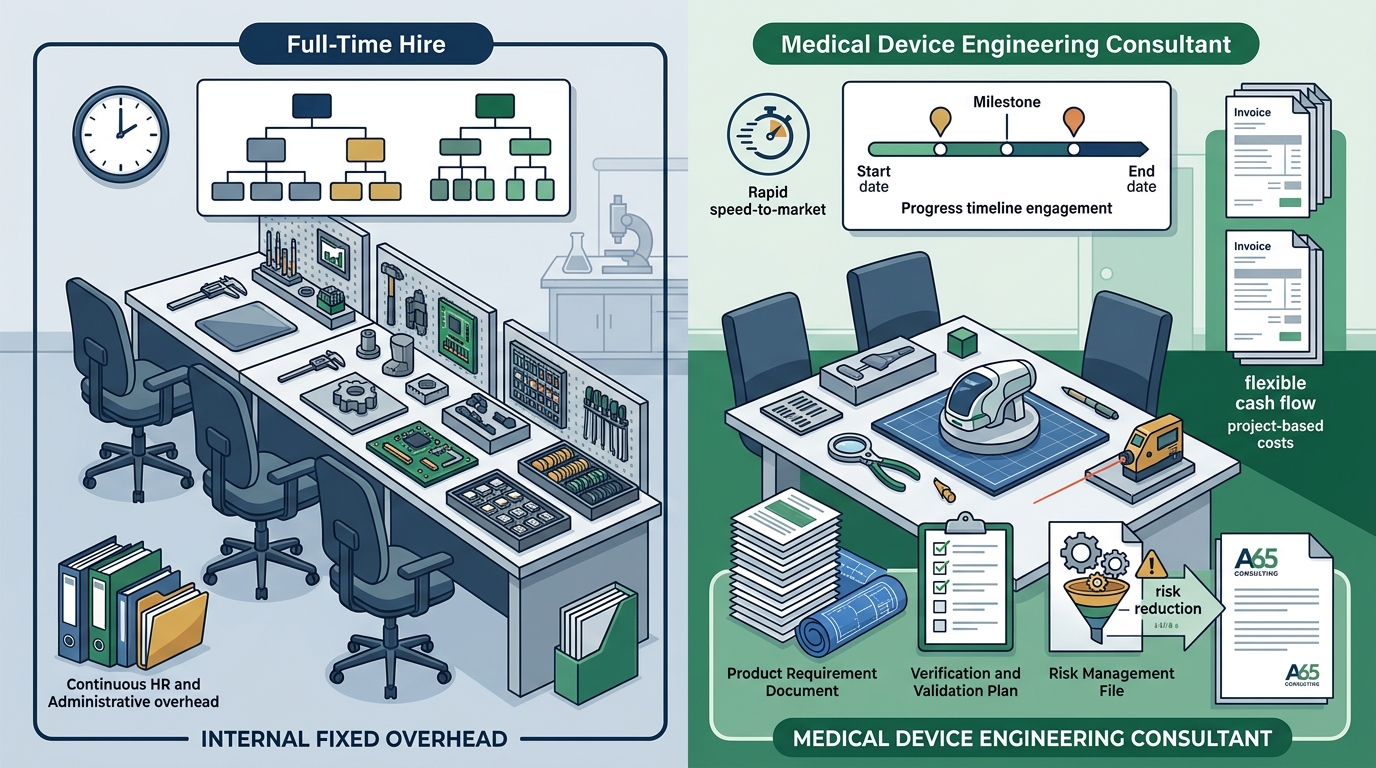
The following table summarizes the key differences between hiring full-time and engaging a consultant for early-stage medical device development.
| Factor | Full-Time Hire | Consulting Partner |
|---|---|---|
| Cost Structure | Fixed salary, benefits, overhead | Variable retainer or milestone-based |
| Time to Start | 3-6 months for recruitment | Immediate availability |
| Expertise Breadth | Limited to individual skill set | Access to diverse specialist network |
| Regulatory Experience | Must be built internally | Proven track record across multiple devices |
| Scalability | Difficult to scale up/down quickly | Flexible resource allocation |
| Intellectual Property | Owned entirely by the company | Transferred upon contract completion |
Key Takeaways
- Cost Efficiency: Consulting retainers often provide better cash flow management for early-stage companies compared to fixed salaries.
- Speed to Market: External partners can begin work immediately, avoiding the long recruitment cycles associated with full-time hires.
- Regulatory Readiness: Experienced consultants bring proven strategies for FDA submissions and ISO compliance, reducing approval risks.
- Specialized Knowledge: Access to a network of specialists in mechanical, electrical, and software engineering ensures comprehensive coverage.
- Risk Mitigation: Consultants help identify and mitigate design risks early, preventing costly late-stage changes.
- Scalability: External resources can be adjusted based on project phases, aligning costs with development needs.
- IP Ownership: Properly structured consulting agreements ensure that all intellectual property remains with the client company.
Frequently Asked Questions
When should I choose a consultant over a full-time hire?
Consultants are ideal for early-stage development when you need specialized expertise quickly and want to manage cash flow flexibly. They are particularly valuable for navigating regulatory requirements and complex design challenges.
How does A65 Consulting charge for its services?
A65 Consulting typically charges on a monthly retainer basis and works toward mutually agreed upon project milestones. This approach aligns costs with deliverables and ensures transparency.
Can a consultant help with FDA 510(k) submissions?
Yes, experienced medical device consultants have a track record of supporting FDA 510(k) submissions. They understand the documentation and testing requirements necessary for approval.
What happens to the intellectual property?
In standard consulting agreements, all intellectual property created during the engagement is transferred to the client company. This ensures that you own the design and associated patents.
How long does the development process take?
The timeline varies based on device complexity and regulatory class. However, engaging an experienced partner can significantly reduce development time by avoiding common pitfalls and streamlining processes.
Do consultants replace the need for an internal team?
Consultants complement internal teams by providing specialized skills and capacity. As the product matures, companies often transition to hiring full-time employees to manage manufacturing and post-market surveillance.
What types of medical devices do consultants work on?
Consultants work on a wide variety of medical devices, including diagnostic tools, therapeutic devices, and surgical instruments. Their experience spans multiple therapeutic areas and device classes.
Next Steps for Your Development Journey
Choosing between a consultant and a full-time hire is a strategic decision that impacts the success of your medical device. A65 Consulting offers expert support across every phase of development, from concept to manufacturing. Their team provides the engineering leadership and specialized expertise needed to navigate complex product development.
If you are facing gaps in engineering capability or need to accelerate your time to market, consider engaging a trusted partner. Contact A65 Consulting today to schedule a discovery call and discuss how they can help you transform your device concept into a viable product.