
Steps to Prepare a Medical Device for FDA 510(k) Submission and Manufacturing Transfer
Preparing a medical device for market entry is a high-stakes engineering challenge that demands precision at every stage. According to the FDA, the 510(k) pathway remains the most common route for clearing new devices, yet the failure rate for submissions often stems from poor preparation during the design and manufacturing phases. Data shows that nearly 30% of 510(k) submissions require additional information before clearance, often due to incomplete design history files or inadequate manufacturing validation. This guide outlines the critical steps to ensure your device meets regulatory standards and is ready for scalable production. (About A65 Consulting)
Understanding the 510(k) Pathway
The 510(k) premarket notification is a submission made to the FDA to demonstrate that the device to be marketed is as safe and effective as, and substantially equivalent to, a legally marketed device. The FDA defines this pathway as the primary mechanism for devices that do not require a Premarket Approval (PMA). To succeed, you must identify a valid predicate device that has already received 510(k) clearance. (Medical Device Design Consulting)
Identifying the right predicate is not merely a regulatory checkbox; it is a strategic decision that influences your testing requirements and labeling. If your device differs significantly from existing predicates, you may need to pursue a De Novo classification or a PMA instead. Understanding the regulatory landscape early prevents costly pivots later in the development cycle. (Blog A65 Consulting)
Design Control and Compliance
Design controls are the systematic procedures used to ensure that products and services conform to requirements. The FDA mandates that manufacturers implement design controls under 21 CFR Part 820.30. This framework ensures that design inputs are translated into design outputs and that the design is verified and validated against those inputs.
Defining Design Inputs
Design inputs are the physical and performance requirements of the device. These must be clear, unambiguous, and measurable. Common inputs include user needs, regulatory requirements, and safety standards. At A65 Consulting, we help clients translate vague user needs into precise engineering specifications that stand up to regulatory scrutiny.
Establishing Design Outputs
Design outputs are the results generated at each design phase, such as drawings, specifications, and bills of materials. Every design output must trace back to a design input. This traceability is critical during the 510(k) review, as it demonstrates that the device was built according to plan.
Verification and Validation
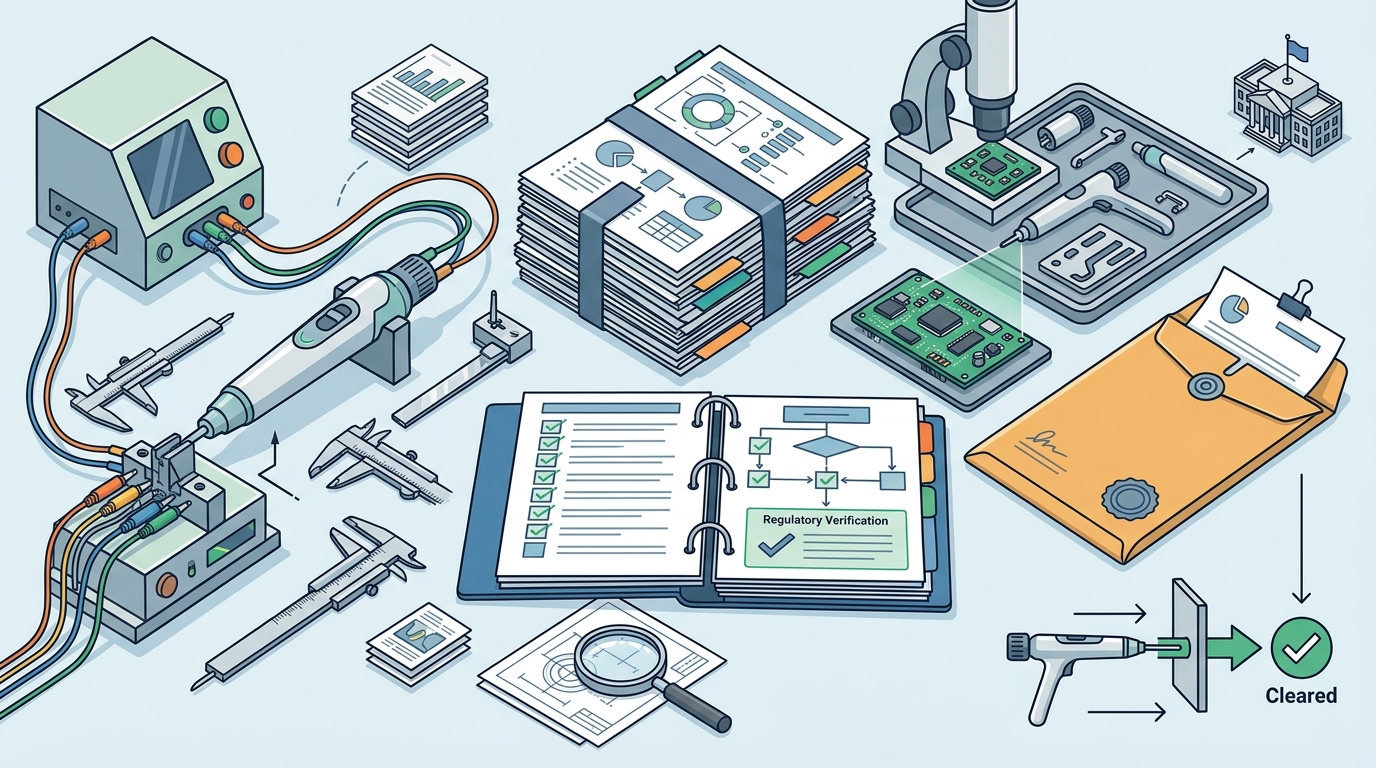
Verification and validation are often confused, but they serve distinct purposes in the regulatory process. Regulatory guidance clarifies that verification confirms the design outputs meet the design inputs, while validation ensures the device meets user needs and intended uses.
Verification Testing
Verification is typically performed in a controlled laboratory environment. It answers the question, "Did we build the device right?" This includes mechanical testing, electrical safety testing, and software validation. Rigorous verification reduces the risk of design flaws reaching the manufacturing floor.
Validation Testing
Validation is performed under actual or simulated use conditions. It answers the question, "Did we build the right device?" This often involves human factors testing, clinical evaluations, and biocompatibility studies. Validation proves that the device works as intended in the real world.
Manufacturing Transfer and DFM
Transferring the design from the lab to the factory floor is a critical juncture. The FDA emphasizes that manufacturing processes must be validated to ensure they consistently produce products meeting specifications. This phase is where many projects face delays due to unforeseen production challenges.
Design for Manufacturing (DFM)
DFM involves optimizing the design for ease of production. This includes selecting appropriate materials, simplifying assembly steps, and ensuring tolerances are achievable. Early engagement with manufacturing partners can identify potential issues before they become costly problems.
Process Validation
Process validation demonstrates that the manufacturing process will consistently produce a product meeting its predetermined specifications. This includes installation qualification (IQ), operational qualification (OQ), and performance qualification (PQ). Without robust process validation, the FDA may reject the 510(k) submission.
Documentation Preparation
The Design History File (DHF) is the repository of records that documents the history of the design of a finished device. FDA regulations require that the DHF contain or reference all records necessary to demonstrate that the design was developed according to the approved design plan. A well-organized DHF is essential for a smooth 510(k) review.
Technical File Components
The technical file includes the device description, general principles of operation, design drawings, specifications, risk management file, verification and validation reports, and labeling. Each component must be complete and accurate. Incomplete documentation is a leading cause of 510(k) refusals.
Risk Management Integration
Risk management must be integrated throughout the product lifecycle. ISO 14971 standards provide the framework for managing risk. The risk management file should include hazard analysis, risk evaluation, risk control measures, and residual risk assessment. This documentation is often reviewed closely by FDA auditors.
Submission Strategy and Review
Preparing the 510(k) submission involves compiling all necessary documents into a coherent narrative. The submission must clearly demonstrate substantial equivalence to a predicate device. This includes comparing the device's intended use, technological characteristics, and performance data.
Pre-Submission Meetings
For complex devices, a pre-submission meeting with the FDA can be invaluable. This allows you to discuss your proposed testing plan and receive feedback before formal submission. The FDA offers pre-submission programs to help sponsors navigate the regulatory process.
The Review Process
Once submitted, the FDA has 90 days to review the 510(k). During this time, they may issue a "Not Substantially Equivalent" (NSE) letter or request additional information. Being prepared to respond quickly and effectively is crucial to maintaining project timelines.
Key Takeaways
- Early Predicate Selection: Identifying a valid predicate device early in the process is critical for defining testing requirements and regulatory strategy.
- Design Controls: Implementing rigorous design controls under 21 CFR Part 820.30 ensures traceability and compliance throughout the development lifecycle.
- Verification vs. Validation: Verification confirms the device meets specifications, while validation confirms it meets user needs and intended use.
- Manufacturing Transfer: Design for Manufacturing (DFM) and process validation are essential to ensure consistent, scalable production.
- Documentation Integrity: A complete and accurate Design History File (DHF) is non-negotiable for successful 510(k) clearance.
- Risk Management: Integrating ISO 14971 risk management throughout the product lifecycle mitigates regulatory and clinical risks.
- Proactive Engagement: Utilizing FDA pre-submission meetings can clarify expectations and reduce the risk of rejection.
Frequently Asked Questions
What is the difference between 510(k) and PMA?
The 510(k) pathway is for devices that are substantially equivalent to a predicate device, while Premarket Approval (PMA) is required for high-risk devices that do not have a valid predicate. The 510(k) process is generally faster and less costly than PMA.
How long does the 510(k) review process take?
The FDA has 90 days to review a 510(k) submission. However, the actual timeline can vary depending on the complexity of the device and the responsiveness of the sponsor to FDA questions.
What is a Design History File (DHF)?
A Design History File is a compilation of records that documents the history of the design of a finished device. It includes design plans, inputs, outputs, verification, validation, and design changes.
Why is Design for Manufacturing (DFM) important?
DFM ensures that the device design is optimized for production, reducing costs, improving quality, and minimizing the risk of manufacturing defects. It helps bridge the gap between engineering design and production reality.
When should I engage a regulatory consultant?
It is advisable to engage a regulatory consultant early in the development process to help navigate the complex regulatory landscape, identify potential pitfalls, and ensure compliance from the start.
What is the role of human factors testing?
Human factors testing ensures that the device can be used safely and effectively by its intended users. It is a critical component of validation and is often required by the FDA for devices with user interface complexities.
How do I choose a manufacturing partner?
Choose a partner with experience in medical device manufacturing, relevant certifications (such as ISO 13485), and a proven track record of successful production transfers. Compatibility with your design complexity is also key.
Next Steps for Your Medical Device Journey
Navigating the path from concept to 510(k) clearance requires expertise, precision, and a strategic approach. At A65 Consulting, we specialize in guiding medical device companies through these complex challenges. Our team of experienced engineers and regulatory experts can help you streamline your development process, ensure compliance, and accelerate your time to market.
Whether you need assistance with design controls, verification and validation, or manufacturing transfer, we are here to support your success. Contact A65 Consulting today to schedule a discovery call and discuss how we can help you bring your medical device to market.