
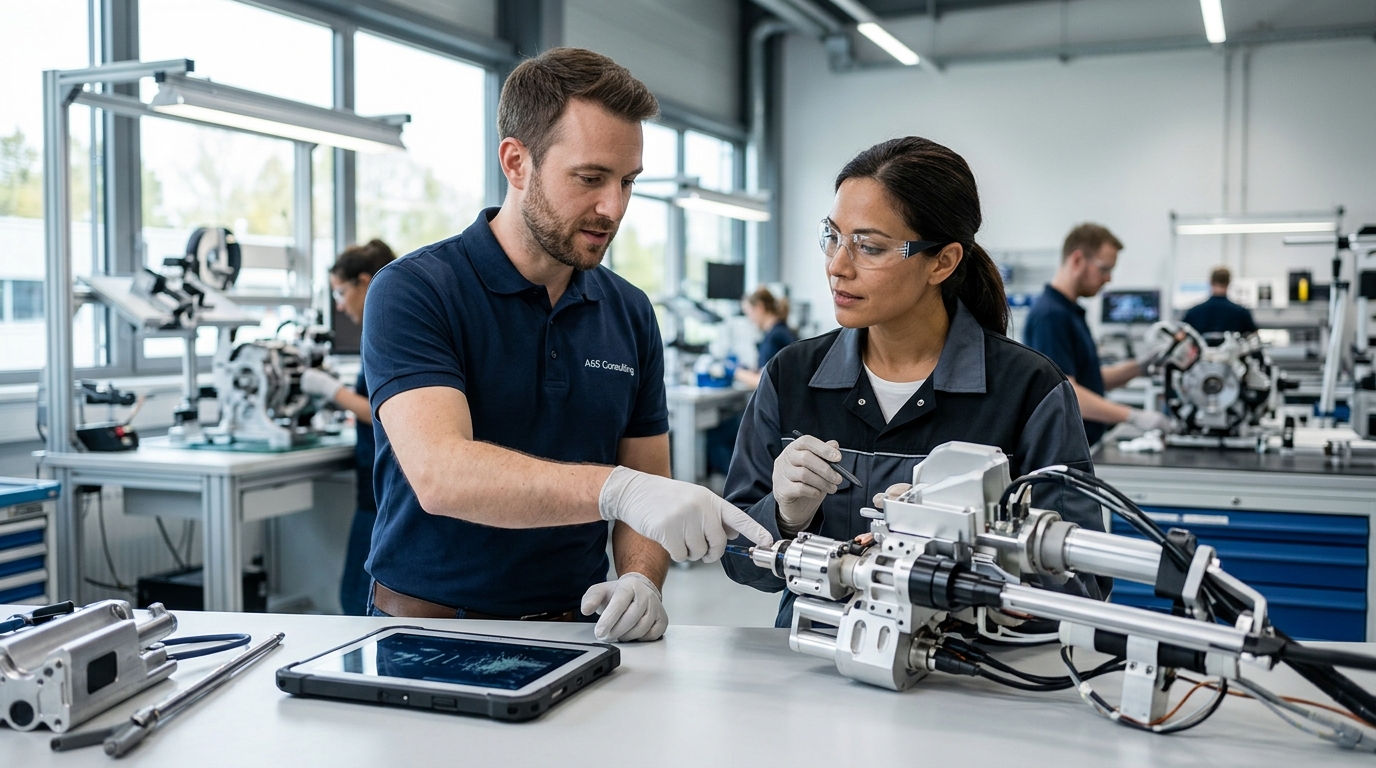
For complex medical devices, the lowest quoted component price is rarely the same as the lowest manufacturing cost. A part that appears inexpensive may require difficult inspection, manual assembly, multiple suppliers, special handling, high scrap rates, or expensive rework. Conversely, a higher-priced component may reduce assembly time, improve yield, simplify validation, and lower the total cost of each acceptable device.
The more useful objective is therefore not simply to reduce the bill of materials. It is to reduce the cost per good unit: the total cost required to produce a device that meets its specifications and is ready for release. That calculation includes materials, direct labor, tooling, equipment, inspection, scrap, rework, inventory, freight, supplier management, quality activities, and the financial impact of delays.
For medical device companies, cost reduction must also preserve safety, performance, usability, reliability, and regulatory compliance. FDA design and manufacturing controls are intended to help ensure that a device performs as intended when produced for commercial distribution, while process controls and validation support consistent production. ([fda.gov](https://www.fda.gov/medical-devices/premarket-approval-pma/pma-quality-system?utm_source=openai))
1. Start with the cost per good unit—not the part price
A reliable cost-reduction program begins with a transparent cost model. Instead of looking only at the purchase price of each component, calculate the cost of producing released, conforming devices.
A simplified model is:
Cost per good unit = total production cost ÷ number of conforming units released
Total production cost may include:
- Raw materials, purchased components, and packaging
- Direct assembly and test labor
- Tooling, fixtures, equipment, and maintenance
- Incoming inspection and in-process inspection
- Scrap, rework, retest, and nonconformance disposition
- Manufacturing engineering and supplier-quality support
- Freight, tariffs, warehousing, and inventory carrying cost
- Validation, calibration, and environmental-control requirements
For example, a component that costs $12 but causes frequent alignment problems may be more expensive than a $15 alternative that installs consistently and eliminates a manual adjustment. A device with a nominal unit cost of $100 may have an effective cost of $125 if 20% of units require rework. The correct decision depends on the entire production system.
Segment the model by expected production volume. A low-volume launch product may favor flexible processes and standard components, while a high-volume product may justify tooling, dedicated fixtures, automated inspection, or a different component architecture.
2. Apply Design for Manufacturing before design freeze
The most powerful cost decisions are usually made before production tooling is ordered and before the design history is difficult to change. Design for Manufacturing is a quality exercise, not merely a cost exercise. A design that is easier to manufacture is often easier to inspect, validate, service, and control.
Conduct structured DFM reviews at concept selection, preliminary design, detailed design, prototype build, and manufacturing-transfer milestones. Each review should bring together design engineering, systems engineering, quality, manufacturing engineering, operations, and—when possible—key suppliers.
Look for common cost drivers
- Unnecessarily tight tolerances that require precision machining or extensive inspection
- Complex geometries that need multiple setups, specialty tooling, or difficult molds
- Custom fasteners, connectors, electronics, or seals when qualified standard options exist
- Large part counts that increase purchasing, kitting, inspection, and assembly workload
- Interfaces that can be assembled incorrectly or only in one awkward orientation
- Cosmetic requirements that add manual finishing without clinical value
- Materials that are difficult to source, process, clean, sterilize, or package
- Features that require post-processing, secondary operations, or operator adjustment
As one possible design tradeoff, a custom-machined metal component may be replaced by a molded polymer component when the clinical, mechanical, thermal, chemical, and regulatory requirements permit it. The source design example describes potential part-cost reductions of up to 80% in an appropriate application, but such savings are not universal and must be confirmed through engineering analysis, risk management, verification, and validation.
3. Reduce complexity at the system level
Many unit-cost problems originate above the individual part level. A device can contain inexpensive components and still be costly to manufacture because its architecture creates excessive assembly, calibration, inspection, or service work.
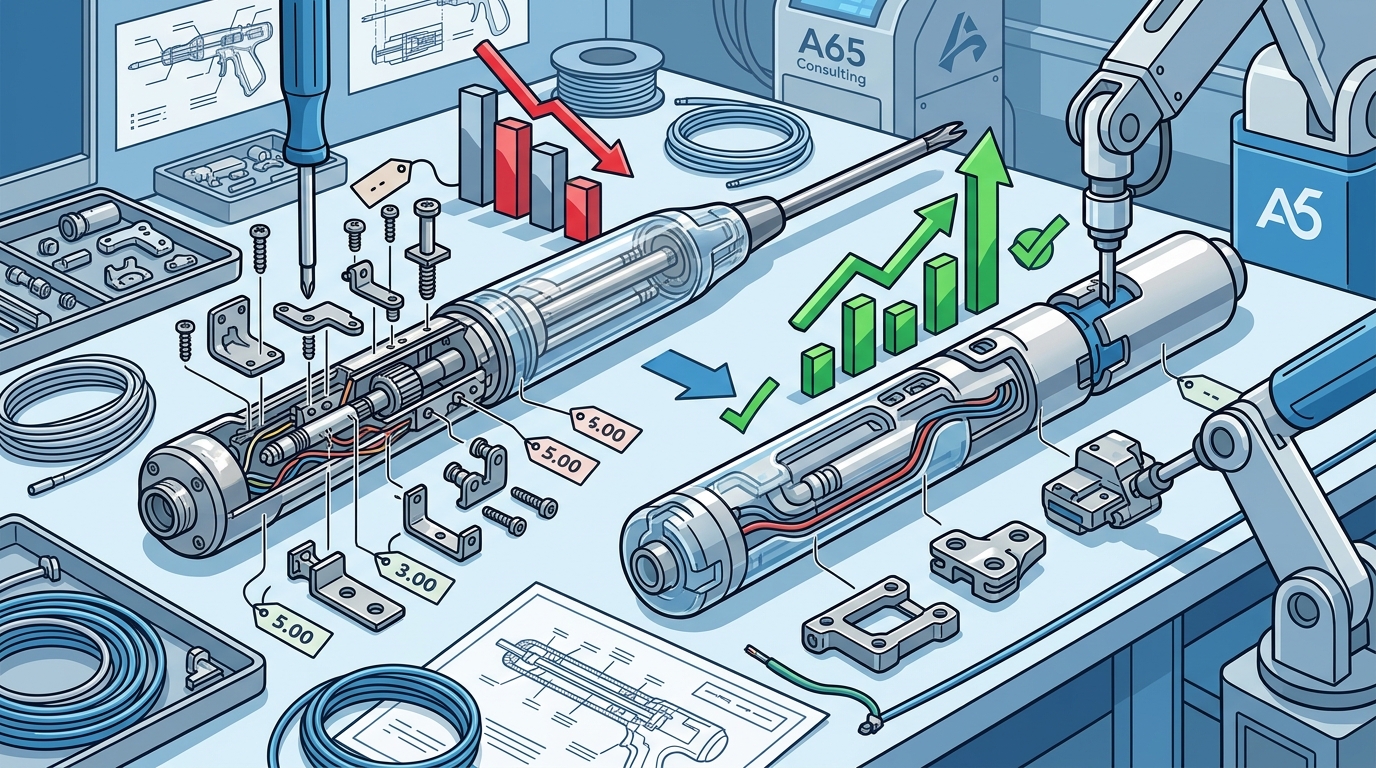
Evaluate opportunities to simplify the product
- Reduce part count: Combine compatible functions into one component when doing so does not create unacceptable tooling, reliability, or service risks.
- Minimize interfaces: Every mechanical, electrical, fluidic, or software interface can introduce alignment, testing, documentation, and failure modes.
- Use common platforms: Shared subassemblies across product variants can increase purchasing leverage and reduce qualification effort.
- Separate critical from noncritical features: Apply precision only where it affects safety, performance, or regulatory requirements.
- Design for modular testing: Enable subassemblies to be tested before final integration so defects are found closer to their source.
- Control configuration deliberately: Avoid unnecessary product variants that multiply bills of material, work instructions, tooling, and inventory.
Complexity should be removed carefully. Combining parts may make a component harder to mold or replace. Reducing a tolerance may affect performance. Eliminating a test may remove an important risk control. Each proposed change should be evaluated against user needs, design inputs, risk controls, verification coverage, and manufacturing capability.
4. Make material and component choices using total cost of ownership
Material selection affects more than the raw-material line item. The right choice can influence machining time, molding cycle time, scrap, cleaning, sterilization, biocompatibility evidence, packaging, shipping weight, shelf life, and supplier availability.
Compare candidate materials and components using a decision matrix that includes:
- Functional and mechanical performance
- Biocompatibility and chemical compatibility
- Temperature, humidity, radiation, and sterilization exposure
- Manufacturability and available process capability
- Material utilization and waste generation
- Minimum order quantities and lead times
- Supplier capacity, quality history, and geographic location
- Change-control and regulatory impact
- Recyclability, disposal, and sustainability considerations where relevant
Standardization is often one of the safest cost levers. Qualified off-the-shelf connectors, fasteners, sensors, seals, and electronic modules can reduce custom engineering, procurement effort, and lead time. However, “standard” does not mean automatically acceptable. The selected component still needs appropriate specifications, supplier controls, incoming inspection, compatibility assessment, and risk-based qualification.
For specialized manufacturing support, including process development and DFM reviews, see A65 Consulting’s medical device engineering services.
Use substitution as an engineering hypothesis
A lower-cost material should be treated as a proposed design change, not an automatic savings. For example, replacing stainless steel with a medical-grade polymer may reduce machining, mass, and assembly cost, but it may also change strength, wear, dimensional stability, chemical resistance, sterilization compatibility, or long-term reliability. The substitution is worthwhile only when the complete risk and validation picture supports it.
5. Design the assembly and inspection process around repeatability
Manual assembly is not inherently inefficient. Skilled technicians are often the best choice for low-volume, high-mix, or delicate products. The cost problem arises when the process depends on tribal knowledge, repeated adjustment, difficult visual judgments, or operator-specific technique.
Practical assembly improvements
- Orient parts so they can be installed in one obvious direction.
- Use poka-yoke features to prevent reversed, misplaced, or incompatible components.
- Reduce fastener variety and standardize drive tools where possible.
- Replace adhesive application by eye with controlled dispensing and defined cure conditions.
- Use fixtures that establish alignment without repeated operator measurement.
- Make critical features accessible for inspection and service.
- Write work instructions around measurable acceptance criteria rather than vague descriptions.
- Move tests upstream to isolate defective subassemblies before final assembly.
Inspection also deserves design attention. A feature that is difficult to measure may require expensive fixtures, destructive tests, or extended operator time. Whenever possible, favor nondestructive, fast, and objective inspection methods. If a characteristic cannot be fully verified after production, the associated manufacturing process may require validation and ongoing control. FDA guidance describes process validation as objective evidence that a process consistently produces output meeting predetermined specifications, and notes that effective process controls can reduce scrap and rework. ([fda.gov](https://www.fda.gov/media/116573/download?utm_source=openai))
6. Improve yield before chasing labor-rate reductions
Yield is one of the clearest drivers of cost per good unit. If a process produces scrap or rework, the organization pays for the failed unit and still must produce a replacement. Yield losses can also consume capacity, delay shipments, and obscure the true cost of the design.
Track yield by operation rather than only at final inspection. Useful measures include:
- First-pass yield at each assembly and test station
- Rolled throughput yield across the complete process
- Scrap cost by defect category
- Rework hours and material consumption
- Retest frequency and test escape rate
- Supplier defect rates and incoming rejection trends
- Cycle-time variation and queue time
Use Pareto analysis to identify the few failure modes responsible for most losses. Then investigate root causes using process mapping, cause-and-effect analysis, measurement-system review, and controlled experiments. Statistical process control can help teams detect drift before it creates a large nonconformance event, but it should be applied to meaningful process parameters and product characteristics—not as a paperwork exercise.
Manufacturing validation should be proportionate to the process and risk. Processes with outputs that cannot be fully verified by subsequent inspection require particular attention. FDA materials explain that production and process controls must ensure conformance to specifications and that process changes or increased nonconforming product may require review and revalidation. ([fda.gov](https://www.fda.gov/medical-devices/quality-and-compliance-medical-devices/medical-device-premarket-approval-and-postmarket-inspections-part-i-background?utm_source=openai))
7. Automate selectively, based on volume and risk
Automation can reduce repetitive labor, improve consistency, increase throughput, and create better production data. It can be valuable for dispensing, screwdriving, pick-and-place operations, optical inspection, labeling, packaging, and repetitive functional testing.
Automation is not automatically cheaper. Include the following in the business case:
- Equipment, tooling, integration, programming, and validation costs
- Maintenance, calibration, spare parts, and technical support
- Changeover time for product variants
- Expected utilization and annual production volume
- Operator training and staffing changes
- Failure recovery and downtime
- Software, cybersecurity, data integrity, and equipment obsolescence
For a variable-volume product, a flexible fixture or semi-automated workstation may outperform a dedicated robotic cell. For a stable, high-volume product, automation may offer a compelling return. The best solution often combines automation for repeatable tasks with skilled technicians for judgment-intensive or low-volume work.
8. Reduce total landed cost and supply-chain exposure
A supplier’s quoted price is only one part of sourcing economics. Analyze total landed cost, including freight, tariffs, brokerage, packaging, warehousing, inventory carrying cost, inspection, supplier-development effort, and the cost of line stoppages caused by late or nonconforming material.
Supply-chain actions that can lower effective unit cost
- Qualify second sources for critical or long-lead components.
- Use common materials and components across product families where appropriate.
- Negotiate volume tiers, blanket orders, or longer-term agreements without creating excessive obsolete inventory.
- Evaluate regional and domestic suppliers alongside global sources.
- Share forecasts and capacity expectations with strategic suppliers.
- Define component specifications clearly so cost reductions do not come from silently relaxing critical requirements.
- Audit or assess supplier process capability based on component risk.
- Design packaging to protect the device while reducing dimensional weight and damage.
Single sourcing can be justified for proprietary technology or highly specialized processes, but it should be treated as a managed risk. A second source may require substantial qualification, so the decision should be made early enough to avoid a crisis-driven supplier change.
9. Use verification and risk management to prevent expensive rework
Late verification failures are often symptoms of incomplete requirements, weak interfaces, untested assumptions, or insufficient manufacturing representation in the design process. Fixing a problem after tooling, supplier qualification, packaging design, or regulatory submission can be dramatically more expensive than correcting it during concept or prototype development.
A strong verification strategy connects user needs, design inputs, design outputs, risk controls, test methods, acceptance criteria, and production-representative units. FDA design-control guidance identifies requirements such as design inputs, design outputs, design reviews, risk analysis, verification, validation, and transfer to production as connected elements of controlled development. ([fda.gov](https://www.fda.gov/medical-devices/premarket-approval-pma/pma-quality-system?utm_source=openai))
Risk management should continue across the device life cycle. ISO 14971:2019 describes a systematic process for identifying hazards, estimating and evaluating risks, implementing controls, and monitoring the effectiveness of those controls from initial conception through decommissioning. ([iso.org](https://www.iso.org/cms/live/live/en/sites/isoorg/contents/data/standard/07/27/72704.html?browse=tc&utm_source=openai))
To determine whether a verification plan is likely to fail, review whether each requirement has an objective acceptance criterion, whether the test method is capable of detecting failure, whether production variation is represented, and whether critical supplier and manufacturing assumptions have been challenged. Early prototypes, design-of-experiments work, tolerance analysis, and pilot builds can expose cost drivers before they become engineering change orders.
10. Build a staged cost-reduction roadmap
Cost reduction is most effective when managed as a cross-functional improvement program rather than a last-minute purchasing exercise.
Phase 1: Establish the baseline
- Define the target annual volume and production scenarios.
- Map the device architecture, bill of materials, assembly steps, and test flow.
- Calculate cost per good unit, not only nominal unit cost.
- Identify the largest contributors to material, labor, scrap, rework, and lead time.
Phase 2: Generate and rank opportunities
- Conduct a DFM and design-for-assembly review.
- Evaluate part-count reduction, tolerance changes, material substitutions, and standard components.
- Assess supplier alternatives and total landed cost.
- Prioritize ideas by expected savings, implementation effort, risk, and time to impact.
Phase 3: Prove the change
- Update the risk analysis and identify affected requirements.
- Build prototypes or pilot lots using the proposed design or process.
- Measure yield, cycle time, defect rates, reliability, and operator burden.
- Complete required verification, validation, supplier qualification, and process validation activities.
Phase 4: Transfer and sustain
- Update drawings, specifications, bills of material, work instructions, inspection plans, and training.
- Document the change through the applicable quality-system process.
- Monitor post-implementation yield, complaints, returns, supplier performance, and cost.
- Confirm that savings remain in place after production volume, staffing, and supplier conditions change.
Key takeaways
- Optimize cost per good unit: Include scrap, rework, inspection, labor, logistics, inventory, and quality costs in the analysis.
- Start with the design: DFM is most effective before design freeze, tooling release, and supplier qualification.
- Simplify the system: Fewer parts, interfaces, variants, and manual adjustments can reduce both cost and risk.
- Choose materials strategically: Evaluate processing, sourcing, validation, and lifecycle implications—not just material price.
- Improve yield: A reliable process can reduce scrap and rework while increasing available capacity.
- Automate selectively: Match the process technology to volume, product mix, risk, and expected utilization.
- Protect the supply chain: Compare total landed cost and qualify alternatives for critical components.
- Verify early: A traceable verification and risk-management process helps prevent late, expensive redesigns.
- Use experienced engineering support: A65 Consulting reports that its developed products have contributed to more than eight FDA 510(k) submissions and that its mission-critical projects have achieved 90% on-time completion.
Frequently asked questions
What is the fastest way to reduce the manufacturing cost of a complex medical device?
Begin by identifying the largest contributors to cost per good unit. In many programs, the highest-impact opportunities involve part-count reduction, simplified assembly, improved yield, tolerance optimization, standard components, or supplier changes. The fastest opportunity is not always the safest, so every change should be assessed for risk, verification, validation, and regulatory impact.
When should DFM reviews begin?
DFM should begin during concept development and continue through detailed design, prototype builds, and manufacturing transfer. Early reviews provide the greatest leverage because geometry, material, tolerance, and architecture decisions are still relatively inexpensive to change.
Can a lower-cost material be used without affecting regulatory compliance?
Possibly, but the answer depends on the device, intended use, risk profile, material characteristics, and applicable requirements. A material substitution may affect biocompatibility, sterilization, mechanical performance, chemical compatibility, reliability, or labeling. It should be handled as a controlled design change supported by risk analysis and appropriate verification or validation.
How does manufacturing yield affect unit cost?
Yield affects the number of conforming units produced from the labor and material invested. Scrap and rework consume resources without increasing released output. Improving first-pass yield can lower the effective cost per good unit, increase capacity, and reduce delivery risk.
Should every complex medical device be automated?
No. Automation is most attractive when a task is repetitive, stable, high-volume, and measurable. Low-volume or highly variable devices may be more economical with skilled technicians, flexible fixtures, or semi-automated workstations. The decision should include the full lifecycle cost of equipment, integration, validation, maintenance, changeover, and downtime.
Does A65 Consulting support supply-chain optimization?
Yes. A65 Consulting can support supplier evaluation, second-source planning, manufacturing process development, DFM reviews, and manufacturing transfer. The objective is to balance component cost, quality, capacity, lead time, and resilience.
How does A65 Consulting balance cost reduction with clinical performance?
A65 Consulting uses an engineering and value-analysis approach that distinguishes requirements essential to safety and performance from features that may be over-specified. Potential changes are evaluated against user needs, risk controls, design inputs, verification, validation, and manufacturing capability.
What medical device regulatory experience does A65 Consulting have?
A65 Consulting states that products developed by its team have contributed to more than eight FDA 510(k) submissions. This experience supports cost-reduction strategies that account for design controls, risk management, verification, validation, and production transfer.
Can A65 Consulting help transfer a device into production?
Yes. A65 Consulting provides support across product development, DFM, process development, manufacturing transfer, quality, and cost optimization to help teams move from a development design to a controlled, repeatable production process.
How long has the A65 Consulting team been working together?
The A65 Consulting team reports that it has been working together since 2018 and brings decades of combined medical device development experience.
Reduce manufacturing cost without compromising the device
Lowering the cost of a complex medical device requires more than negotiating a lower component price. It requires coordinated decisions across product architecture, materials, tolerances, assembly, inspection, process capability, suppliers, verification, and manufacturing transfer.
A65 Consulting helps medical device companies identify practical cost-reduction opportunities while keeping safety, performance, quality, and time to market in view. Book a discovery consultation with A65 Consulting to discuss your device, production volume, manufacturing constraints, and cost targets.