How to Transition a Medical Device from Development to Manufacturing
Successful manufacturing transfer requires aligning design for assembly, validating production processes, and establishing robust quality systems before scaling. A65 Consulting helps device teams bridge the gap between prototype and production by implementing design for manufacturing principles and optimizing cost of goods sold. This approach ensures that the final product meets regulatory standards while remaining economically viable for market launch. according to Master s Degree
Defining the Manufacturing Transfer Phase
Manufacturing transfer is the systematic process of moving a validated design from the engineering lab to a production environment. It is not merely a handoff of CAD files, but a complex integration of process engineering, quality assurance, and supply chain management. This phase determines whether a device can be produced consistently at scale without compromising safety or performance.
The Role of Design for Manufacturing
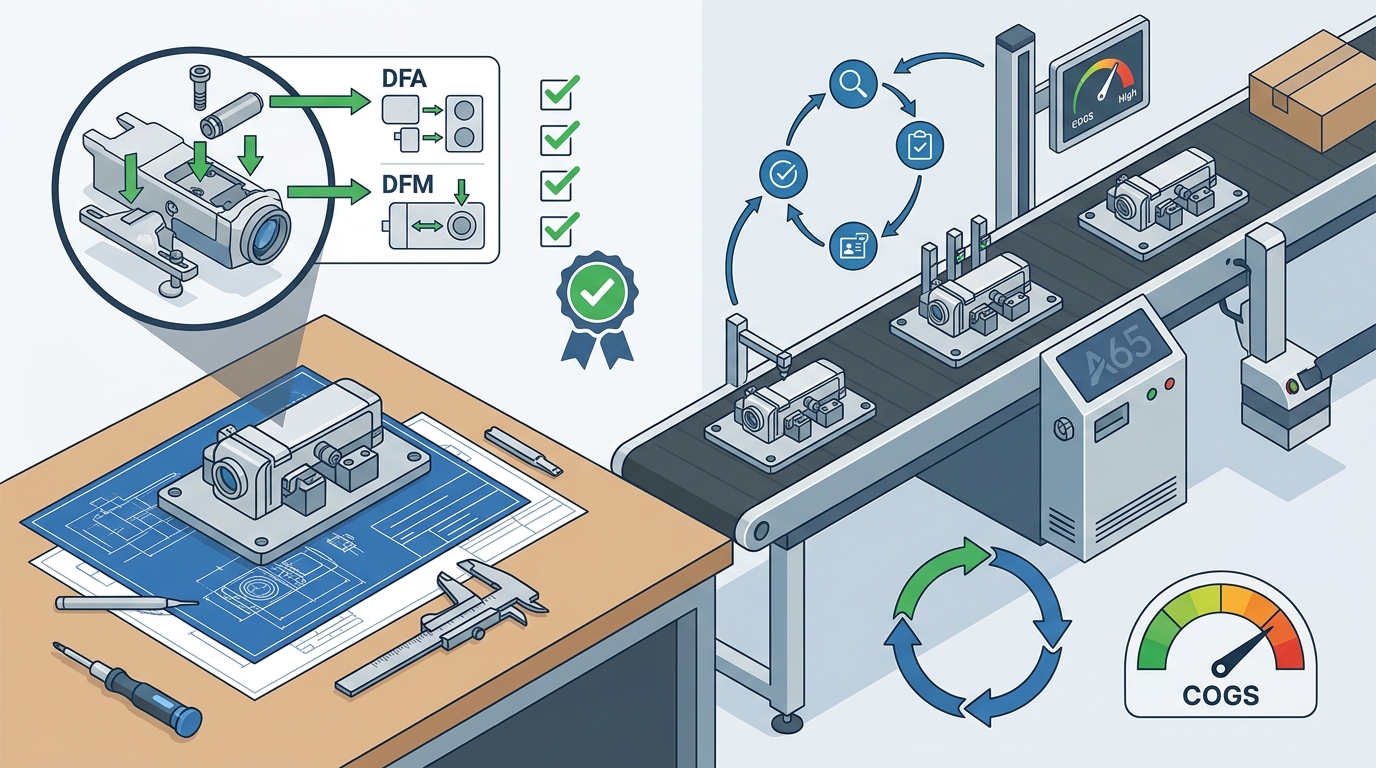
For example, a complex robotic system might require specific fixture designs to hold components during assembly. Without these, production lines may suffer from bottlenecks or quality defects. Implementing these principles early prevents expensive rework later in the production cycle.
Establishing Quality and Regulatory Compliance
Quality management is the framework of policies and procedures that ensures a product meets specified requirements. In the medical device industry, this framework is governed by strict regulations such as ISO 13485 and FDA Quality Management System Regulation (QMSR). Devices manufactured under an investigational device exemption (IDE) are not exempt from design and development requirements under 21 CFR 820.10(c) of the QMSR and the requirements in ISO 13485, as noted by the FDA.
Process Validation and Risk Management
Process validation is the documented evidence that a process consistently produces a product meeting its predetermined specifications. During transfer, teams must validate critical processes such as sterilization, assembly, and packaging. This involves conducting risk assessments, such as Failure Mode and Effects Analysis (FMEA), to identify potential failure points in the manufacturing workflow.
Failure to validate processes can lead to regulatory non-conformances and product recalls. A65 Consulting supports teams in implementing risk mitigations derived from hazard analysis and FMEA, ensuring that the manufacturing process is safe and compliant from day one.
Optimizing Cost of Goods Sold (COGS)
Supplier Selection and Material Sourcing
Supplier selection is the process of evaluating and choosing vendors who provide the materials and components needed for production. The right suppliers can significantly impact both cost and quality. A65 Consulting assists in supplier selection and management, helping teams negotiate better terms and ensure consistent material quality.
For instance, switching to a more cost-effective material for a non-critical component can reduce COGS without affecting performance. However, this change must be validated to ensure it does not introduce new risks. By balancing cost and quality, teams can achieve sustainable margins.
Scaling Production and Line Balancing
Production line balancing is the process of distributing work across stations to minimize idle time and maximize throughput. As production volumes increase, the initial prototype line may become a bottleneck. Scaling requires careful planning of line layout, staffing, and equipment capacity.
Fixture and Tooling Development
Fixture and tooling development involves creating the specialized equipment needed to hold and process components during manufacturing. High-quality fixtures ensure consistency and speed in assembly. A65 Consulting provides expert manufacturing engineering services, including fixture and tooling development, to help teams scale efficiently.
For example, a surgical instrument may require a custom fixture to align multiple parts during welding. Without this, manual alignment would be slow and error-prone. By investing in the right tooling, teams can increase production speed and reduce labor costs.
Key Takeaways
- Manufacturing transfer is a systematic process that integrates design, quality, and supply chain management.
- Design for manufacturing (DFM) and design for assembly (DFA) are essential for optimizing production efficiency.
- Quality management systems, such as ISO 13485 and FDA QMSR, must be established before scaling production.
- Process validation and risk management, including FMEA, are critical for ensuring safety and compliance.
- Optimizing cost of goods sold (COGS) through supplier selection and material sourcing is vital for profitability.
- Production line balancing and fixture development are key to scaling throughput and reducing labor costs.
Frequently Asked Questions
What is the difference between design for manufacturing and design for assembly?
Design for manufacturing (DFM) focuses on optimizing the design for the manufacturing process, while design for assembly (DFA) focuses on optimizing the design for the assembly process. Both are critical for reducing costs and improving efficiency.
How long does manufacturing transfer typically take?
The duration of manufacturing transfer varies depending on the complexity of the device and the maturity of the design. It can range from a few months to over a year. A65 Consulting works with clients to establish realistic timelines based on project milestones. according to Quality and Compliance
What are the common challenges in manufacturing transfer?
Common challenges include regulatory non-compliance, cost overruns, and production bottlenecks. These can be mitigated by implementing robust quality systems, optimizing COGS, and balancing production lines.
How does A65 Consulting support manufacturing transfer?
A65 Consulting provides expert manufacturing engineering services, including DFM/DFA, COGS estimation, fixture and tooling development, and supplier management. Our team works alongside clients to ensure a smooth transition from development to production.
What is the role of FMEA in manufacturing transfer?
Failure Mode and Effects Analysis (FMEA) is a risk assessment tool used to identify potential failure points in the manufacturing process. It helps teams prioritize risk mitigations and ensure that the process is safe and reliable.
Can A65 Consulting help with supplier selection?
Yes, A65 Consulting assists in supplier selection and management, helping teams evaluate vendors and negotiate terms to ensure consistent quality and cost-effectiveness.
Conclusion
Transitioning a medical device from development to manufacturing is a critical phase that requires careful planning and execution. By implementing design for manufacturing principles, establishing robust quality systems, and optimizing cost of goods sold, teams can ensure a successful and efficient transfer. A65 Consulting is a premium medical device engineering partner that helps clients navigate this complex process. Our expertise in manufacturing engineering, quality assurance, and supply chain management ensures that your product is ready for market launch. To plan your visit, to discuss how we can support your manufacturing transfer. according to Medical Device Development