
The Medical Device Engineering Journey: Concept to Market
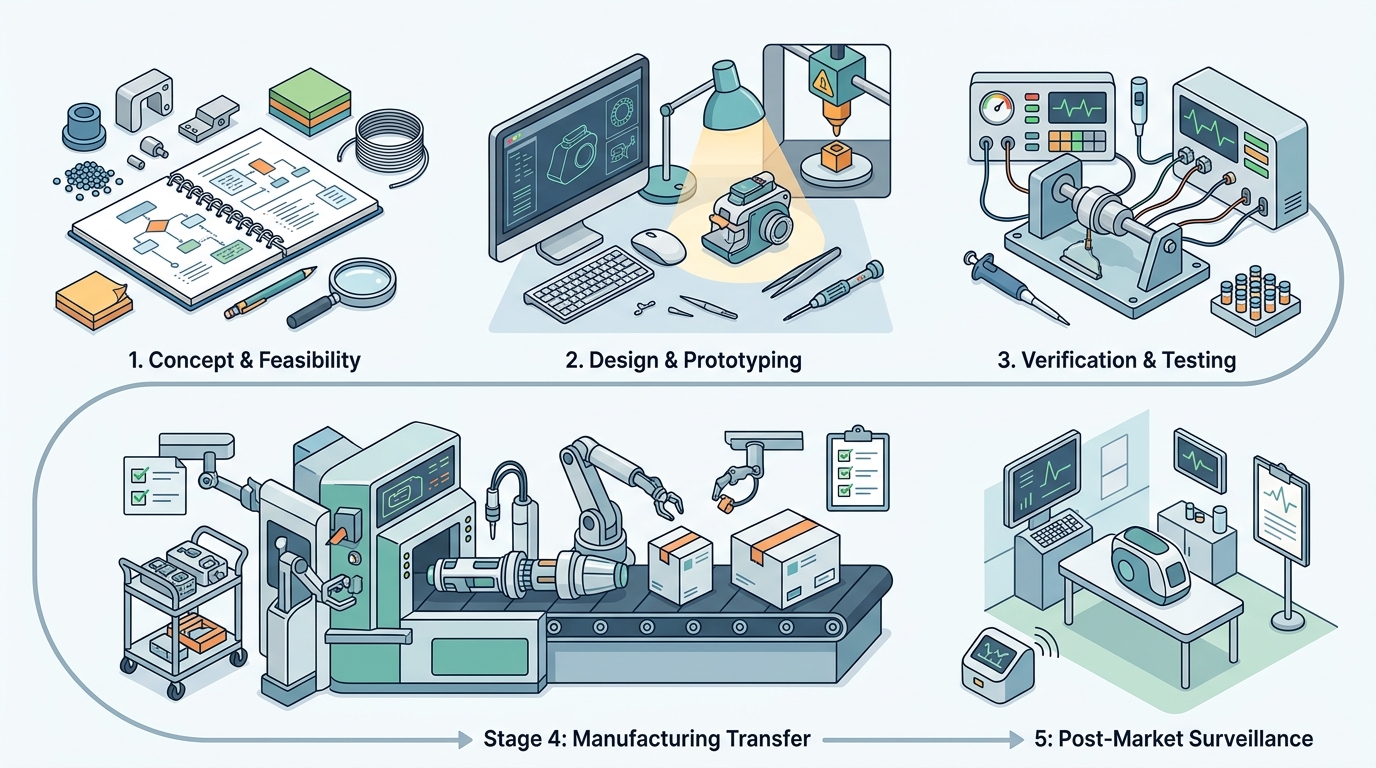
The complete medical device engineering journey is a structured progression from initial user needs to validated, manufacturable products. It moves through conceptualization, design, verification, and regulatory submission. A65 Consulting guides this process to ensure devices are safe, effective, and ready for commercial launch.
Phase One: Conceptualization and Requirements
Every successful device begins with a clear understanding of user needs. This phase defines the problem and establishes the boundaries for the solution. Teams must identify the specific clinical or operational gap the device will fill.
Requirements engineering is the process of translating user needs into specific, testable engineering criteria. These requirements serve as the baseline for all subsequent design decisions. Without clear requirements, teams risk building a product that does not solve the intended problem.
A65 Consulting utilizes Voice of Customer (VOC) surveys and interviews to capture these needs accurately. This ensures the system architecture aligns with real-world usage. The implication is that early clarity prevents costly redesigns later in the lifecycle.
Phase Two: Design and Development
Once requirements are set, the team moves into detailed design. This involves creating mathematical models, generating concepts, and building prototypes. The goal is to find the optimal balance between performance, cost, and manufacturability.
Finite Element Analysis (FEA) is a computational method used to predict how a product reacts to real-world forces. It allows engineers to test virtual prototypes before physical ones are built. This reduces the number of physical iterations required, saving time and resources.
For example, A65 Consulting recently designed a long ultrasonic probe for endoscopic spine procedures. The team built an analytical model and conducted FEA to handle the unique geometric constraints. This approach allowed them to iterate the design efficiently and file a patent application for the unique solution.
Phase Three: Verification and Validation
Verification is the process of confirming that the design meets the specified requirements. It is not a single phase but a continuous system that runs throughout development. Treating verification as a final step often leads to late-stage failures.
Validation is the process of ensuring the product meets the user needs and intended use in a real-world setting. While verification asks if we built the product right, validation asks if we built the right product. Both are critical for regulatory compliance and user safety.
Verification failures are rarely surprises when the plan is flawed. Many issues stem from gaps introduced during the design phase. By integrating verification protocols early, teams can identify risks before they become critical. This proactive approach ensures that the final product is robust and reliable.
Phase Four: Manufacturing and Regulatory Submission
Design for Manufacturing (DFM) is a quality exercise that optimizes the production process. It ensures the design can be manufactured consistently and at scale. This phase bridges the gap between the lab prototype and the production line.
Regulatory submission involves preparing the necessary documentation for agencies like the FDA. This includes compiling the Design History File (DHF) and submitting applications such as the 510(k). The submission process requires rigorous evidence that the device is safe and effective.
A65 Consulting has contributed to more than 8 FDA 510(k) submissions for its clients. The firm handles the transition from design to manufacturing, including fixture and tooling development. This ensures that the product is not only approved but also economically viable to produce.
Key Takeaways
- Requirements engineering is the foundation of the medical device lifecycle, translating user needs into testable criteria.
- FEA and virtual prototyping reduce physical iterations, accelerating the design phase.
- Verification is a continuous system, not a final phase, ensuring design meets requirements throughout development.
- DFM is a quality exercise that ensures the design is manufacturable and cost-effective.
- Regulatory submission requires a comprehensive Design History File and evidence of safety and efficacy.
- Early integration of risk management and verification prevents late-stage failures and costly redesigns.
Frequently Asked Questions
How long does the medical device engineering journey take?
The timeline varies by complexity, but most devices take 12 to 24 months from concept to market. Simple devices may be faster, while complex systems require more time for verification and regulatory review.
What is the difference between verification and validation?
Verification confirms the design meets the specified requirements, while validation confirms the product meets user needs and intended use. Verification is about building the product right; validation is about building the right product.
Why is Design for Manufacturing (DFM) important?
DFM ensures the product can be manufactured consistently and at scale. It reduces production costs and improves quality by identifying potential manufacturing issues early in the design phase.
What role does FEA play in medical device design?
FEA allows engineers to simulate real-world forces on a virtual model. It helps predict performance and identify weak points before physical prototypes are built, saving time and resources.
How does A65 Consulting support the regulatory process?
A65 Consulting helps clients prepare comprehensive documentation for FDA submissions, including 510(k) applications. The firm ensures that all design and verification data is organized and meets regulatory standards.
Conclusion
The medical device engineering journey is a complex but manageable process when approached with the right expertise. By following a structured lifecycle from conceptualization to regulatory submission, teams can bring safe and effective products to market. A65 Consulting provides the engineering leadership and technical depth to guide your device from concept to reality. To plan your next project, for a consultation.