

Design for manufacturability (DFM) is the practice of optimizing a product's design to simplify its production process. By aligning engineering decisions with manufacturing capabilities early in development, teams can significantly lower unit costs without compromising safety or performance. A65 Consulting integrates DFM principles into every phase of medical device development, ensuring that cost efficiency and regulatory compliance are achieved simultaneously rather than treated as conflicting goals.
Streamlining Component Architecture
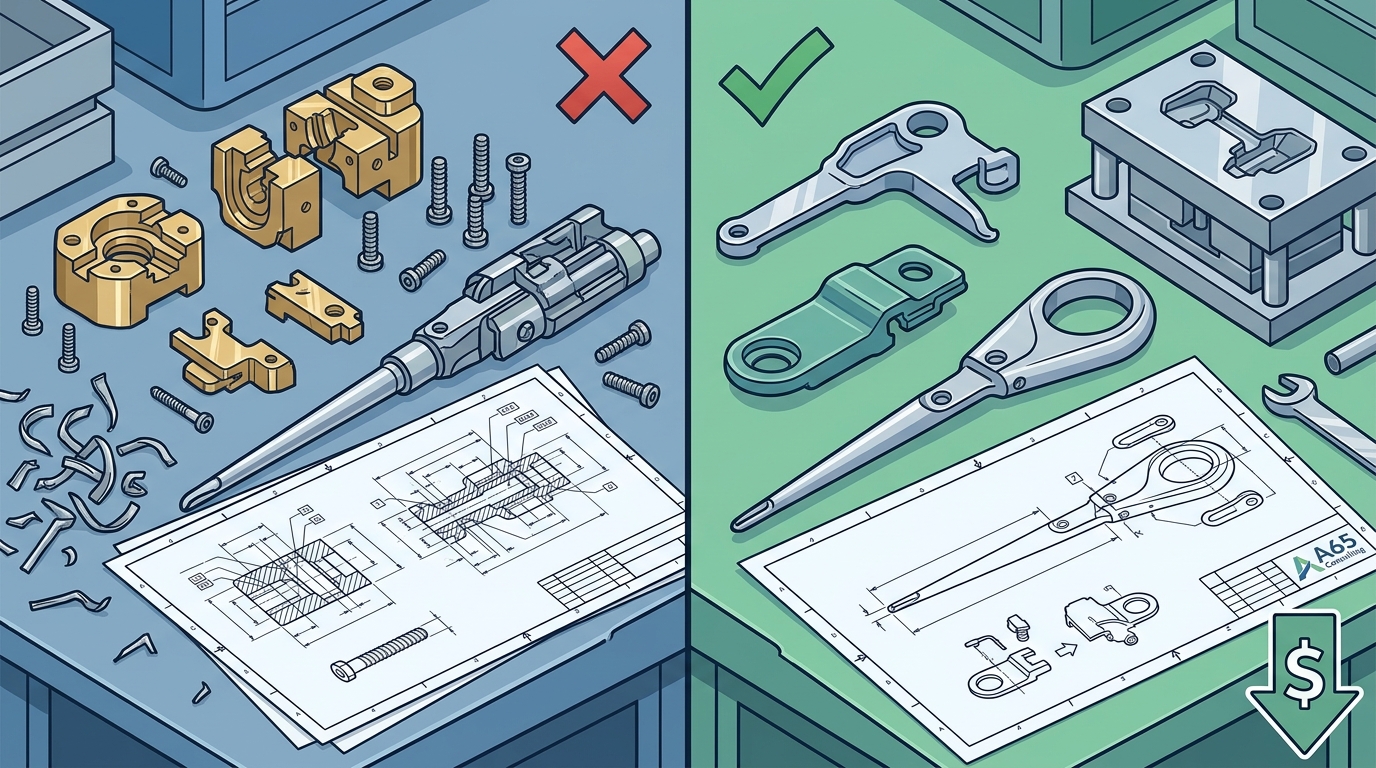
One of the most effective ways to reduce manufacturing costs is by minimizing the number of individual parts in a device. Each additional component introduces assembly time, potential failure points, and increased inventory complexity. A65 Consulting often works with clients to consolidate multiple mechanical parts into a single molded or machined unit, which reduces assembly labor and improves reliability. For example, combining a housing and a mounting bracket into one piece can eliminate fasteners and reduce the risk of misalignment during production. This architectural simplification directly lowers the bill of materials (BOM) cost while maintaining structural integrity.
Optimizing Tolerances and GD&T
Geometric Dimensioning and Tolerancing (GD&T) is a communication system that defines the allowable variation in a part's geometry. Overly tight tolerances increase manufacturing difficulty and cost, as they require more precise tooling and slower machining speeds. A65 Consulting applies GD&T strategically to ensure that only critical features receive strict tolerance controls, while non-critical dimensions are relaxed to accommodate standard manufacturing processes. This approach prevents unnecessary cost inflation without sacrificing functional performance. By treating GD&T as a design tool rather than a drafting requirement, engineers can create parts that are both manufacturable and reliable.
Material Selection and Substitution
Choosing the right material is a critical decision that impacts both cost and quality. High-performance materials like titanium or specialized polymers can be expensive and difficult to process. A65 Consulting evaluates material alternatives that meet regulatory and performance requirements while offering better manufacturability. For instance, switching from a custom alloy to a standard medical-grade polymer can reduce machining time and tooling wear. This substitution must be validated through rigorous testing to ensure it does not compromise biocompatibility or mechanical strength. The goal is to find the optimal balance between material performance and production efficiency.
Designing for Assembly Efficiency
Design for Assembly (DFA) focuses on reducing the number of steps required to put a product together. Complex assemblies with many fasteners, adhesives, or alignment features increase labor costs and the likelihood of errors. A65 Consulting designs devices with snap-fit features, self-aligning components, and minimal fastener counts to streamline the assembly process. This not only reduces labor time but also improves quality by minimizing human error. For example, a device with a single sliding latch instead of four screws can be assembled in seconds rather than minutes, significantly lowering per-unit costs.
Early Integration of Manufacturing Feedback
Manufacturing engineers often identify cost-saving opportunities that design teams may overlook. A65 Consulting embeds manufacturing expertise into the design phase, ensuring that production constraints are considered from the start. This early integration allows for iterative design improvements that address tooling, fixture, and process limitations before prototypes are built. By collaborating with suppliers and manufacturing partners early, teams can identify potential bottlenecks and adjust the design accordingly. This proactive approach prevents costly redesigns later in the development cycle and ensures a smoother transition to production.
Key Takeaways
- Consolidating parts reduces assembly time and BOM costs.
- Strategic use of GD&T prevents unnecessary tolerance costs.
- Material substitution can lower costs without sacrificing performance.
- DFA principles streamline assembly and improve quality.
- Early manufacturing feedback prevents late-stage redesigns.
- DFM and DFA are quality exercises, not just cost reduction tactics.
Frequently Asked Questions
What is design for manufacturability?
Design for manufacturability is the practice of optimizing a product's design to simplify its production process and reduce costs.
Does DFM compromise quality?
No, when done correctly, DFM improves quality by reducing complexity and potential failure points.
When should DFM be applied?
DFM should be applied early in the design phase to maximize cost savings and avoid late-stage redesigns.
How does GD&T impact manufacturing costs?
Can material substitution reduce costs?
Yes, choosing standard or easier-to-process materials can lower costs, provided they meet regulatory and performance requirements.
What is design for assembly?
Design for assembly is the practice of designing a product to minimize the number of steps required to put it together.
How does A65 Consulting support DFM?
A65 Consulting integrates DFM principles into every phase of medical device development, ensuring cost efficiency and regulatory compliance.
Partner with A65 Consulting for Cost-Effective Design
A65 Consulting brings decades of medical device engineering experience to every project, ensuring that your product is not only cost-effective but also safe, reliable, and compliant. Our team of skilled engineers works seamlessly with your staff to deliver solutions that meet your unique requirements. To learn more about how we can help you optimize your medical device design, today. Learn more: Contact A65 Consulting.