
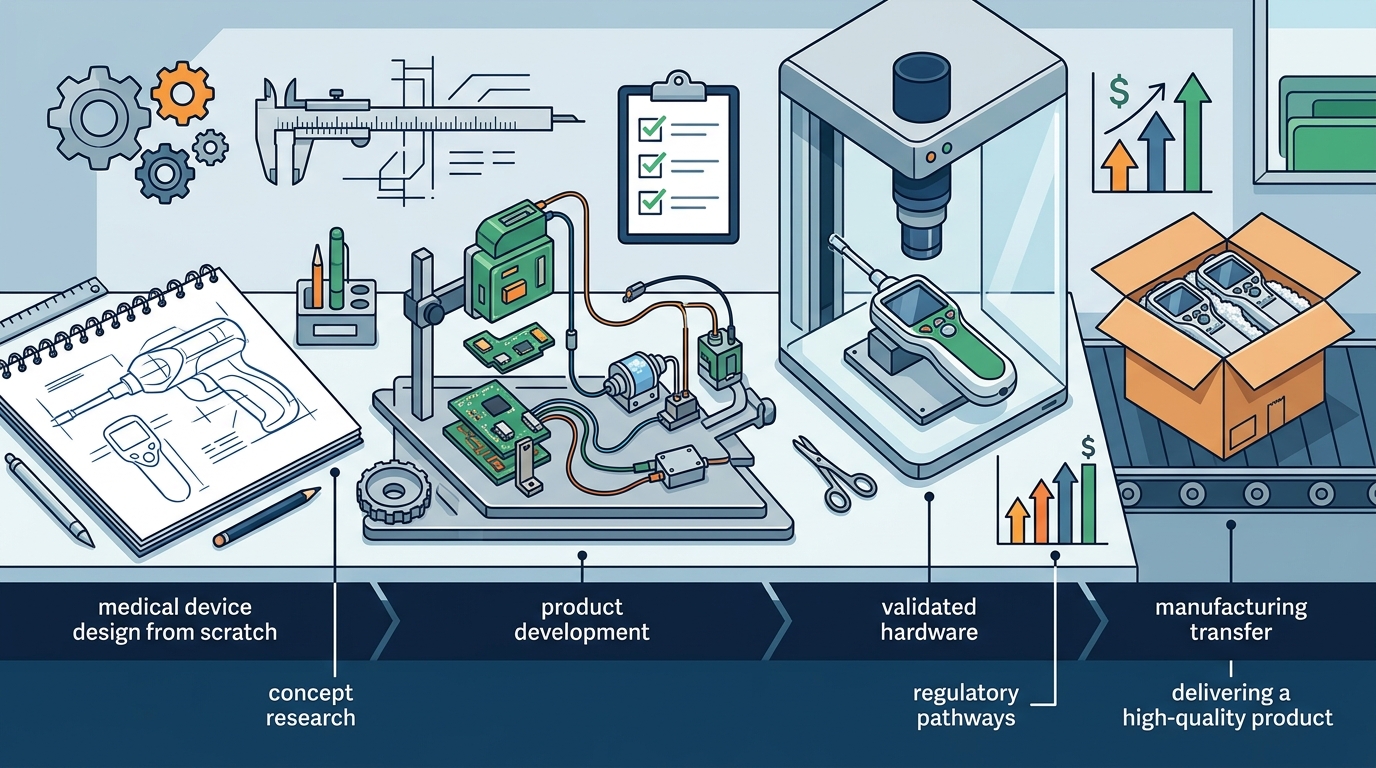
Yes, you can get a medical device designed from scratch. A65 Consulting provides end-to-end engineering services that take a concept from initial research through validated hardware and manufacturing transfer. This guide covers the regulatory pathways, engineering disciplines, and project management structures required to build a viable medical device from the ground up.
FDA Regulatory Pathways
Designing a medical device from scratch requires navigating a complex regulatory landscape. The U.S. Food and Drug Administration (FDA) classifies devices into three classes based on risk. Class I devices are generally low-risk and often exempt from premarket review. Class II devices are moderate-risk and typically require a 510(k) submission to demonstrate substantial equivalence to a predicate device. Class III devices are high-risk and usually require Premarket Approval (PMA), which is the most rigorous and time-consuming pathway.
Understanding these pathways early is critical. A65 Consulting integrates regulatory strategy into the initial design phase. This approach ensures that the device architecture aligns with the intended regulatory route. By defining the classification and predicate device early, engineering teams can avoid costly redesigns later in the development cycle. The firm has contributed to more than 8 FDA 510(k) submissions, demonstrating a strong track record in navigating these requirements.
Defining the Intended Use
The intended use statement is the foundation of the regulatory strategy. It dictates the risk profile and the required testing protocols. A65 Consulting works with clients to refine this statement through Voice of Customer (VOC) surveys and interviews. This process ensures that the device meets actual user needs while remaining within a manageable regulatory scope.
Risk Management and Hazard Analysis
Risk management is a continuous process, not a one-time event. The firm implements hazard analysis and Failure Mode and Effects Analysis (FMEA) to identify and mitigate potential risks. These activities are embedded in the system engineering workflow. This proactive approach helps ensure that the final product is safe and effective for its intended users.
Core Engineering Disciplines
Building a device from scratch requires a multidisciplinary approach. A65 Consulting offers comprehensive services across mechanical, electrical, and systems engineering. This breadth of expertise allows the firm to handle complex projects that involve multiple technical domains. The team integrates seamlessly with client teams to fill gaps in leadership or specialized skills.
Mechanical Engineering
Mechanical engineering services cover the physical structure and mechanisms of the device. This includes precision mechanism design, hardware and electromechanical system design, and electronic enclosure design. The firm utilizes Finite Element Analysis (FEA) and classical engineering analysis to validate structural integrity. Tolerance analysis with Geometric Dimensioning and Tolerancing (GD&T) ensures that parts fit and function correctly in mass production.
Electrical Engineering
For devices with electronic components, A65 Consulting provides complete electrical engineering solutions. The team partners with clients from initial concept through validated hardware. This includes developing circuit and system architectures and building working prototypes for testing. The firm also supports redesigns aimed at reducing unit cost or improving manufacturability.
Systems Engineering
Systems engineering ties all components together into a cohesive product. A65 Consulting develops system architectures that meet product requirements and project objectives. The team focuses on traceability, verification, and validation protocols. They also conduct human factors engineering to ensure the device is user-friendly and safe. This holistic view is essential for complex medical devices.
Project Management and Leadership
Technical expertise alone is not enough to deliver a successful product. Effective project management is crucial for keeping development on track. A65 Consulting provides interim engineering leadership and project management services. The firm’s founder is a Professional Engineer (PE) in Colorado and a Certified Project Manager (CPM). This combination of technical and managerial expertise ensures that projects are completed on time and on budget.
Resource Allocation and Bandwidth
Many development programs face resource constraints. A65 Consulting maintains a network of engineers to expand resources as needed. This flexibility allows the firm to take on new projects without compromising quality. The team brings in the right discipline experience to address specific challenges. This approach helps clients scale their engineering capabilities without the overhead of full-time hires.
Milestone-Driven Delivery
The firm typically charges on a monthly retainer basis and works toward mutually agreed-upon project milestones. This structure provides transparency and accountability. It allows clients to track progress against specific deliverables. The firm has achieved a 90% on-time completion rate for mission-critical projects. This reliability is a key factor for clients looking to accelerate their development timelines.
Manufacturing Transfer and Cost Optimization
Designing a prototype is only the first step. Transferring the design to manufacturing is where many projects fail. A65 Consulting provides expert manufacturing engineering services to bridge this gap. The firm implements Design for Manufacturing and Assembly (DFM/DFA) principles to optimize the production process. This focus on manufacturability helps reduce costs and improve quality.
COGS Estimation and Reduction
Cost of Goods Sold (COGS) is a critical metric for medical device companies. A65 Consulting provides COGS estimation and cost reduction strategies. The team analyzes the design to identify opportunities for simplification and efficiency. They also assist with supplier selection and management. This expertise helps clients achieve their financial targets while maintaining product quality.
Production Line Setup
The firm supports the setup of production lines, including fixture and tooling development. They create manufacturing instructions and balance the production line for efficiency. This hands-on approach ensures a smooth transition from prototype to mass production. The firm has established low-volume production lines to meet initial launch volumes and COGS targets for several clients.
Key Takeaways
- Medical device design from scratch is feasible with the right engineering partner and regulatory strategy.
- FDA regulatory pathways (510(k), PMA) must be defined early to guide design decisions.
- Multidisciplinary engineering (mechanical, electrical, systems) is essential for complex devices.
- Project management and interim leadership are critical for on-time and on-budget delivery.
- Manufacturing transfer and DFM/DFA principles are key to cost optimization and quality.
- A65 Consulting has a track record of contributing to 8+ FDA 510(k) submissions and 10+ patent applications.
- Working with a premium engineering firm can solve overwhelming challenges and accelerate development.
Frequently Asked Questions
How long does it take to design a medical device from scratch?
The timeline varies depending on the complexity of the device and the regulatory pathway. Simple Class I devices may take several months, while complex Class III devices can take several years. A65 Consulting works with clients to establish realistic timelines based on project milestones.
What is the role of FEA in medical device design?
Finite Element Analysis (FEA) is a simulation technique used to predict how a device will respond to real-world forces. It helps engineers validate structural integrity and performance before building physical prototypes. This reduces the need for costly physical testing iterations.
Can A65 Consulting work with our existing engineering team?
Yes, A65 Consulting’s team can seamlessly integrate with your existing engineering team. They can supplement your team’s leadership or provide specialized expertise in areas where you have gaps. This flexible approach allows you to scale your capabilities as needed.
What is the difference between verification and validation?
Verification ensures that the product is built correctly according to specifications. Validation ensures that the product meets the user’s needs and intended use. Both are critical steps in the development process and are required for regulatory submission.
How does A65 Consulting charge for its services?
A65 Consulting typically charges on a monthly retainer basis and works toward mutually agreed-upon project milestones. This structure provides flexibility and transparency for clients. It allows for ongoing collaboration and adjustment as the project evolves.
What experience does A65 Consulting have with similar devices?
A65 Consulting has experience designing a wide variety of medical devices. Their portfolio includes endoscopic ultrasonic surgical probes, ultrasonic dental scaler tips, and RF ablation probes. They are happy to share more details about their experience with similar projects upon request.
Conclusion
Getting a medical device designed from scratch is a complex but achievable goal. It requires a partner with deep technical expertise, regulatory knowledge, and strong project management skills. A65 Consulting provides the full spectrum of services needed to take a device from concept to launch. our team of knowledgeable engineers is committed to delivering results that exceed expectations. If you are ready to start your medical device development journey, contact A65 Consulting to schedule a discovery call and discuss your project needs.