
Finding a medical device engineering partner is rarely as simple as choosing a company with a strong portfolio. A device may require clinical insight, systems engineering, mechanical design, prototyping, verification, manufacturing transfer, quality documentation, and project leadership—all coordinated under one development strategy.
That is why companies searching for end-to-end medical device design services should evaluate more than individual capabilities. The right partner should be able to connect user needs to engineering requirements, risk controls to design decisions, prototypes to verification evidence, and design outputs to a repeatable manufacturing process.
The U.S. Food and Drug Administration describes design controls as fundamental controls intended to help ensure that a device performs as intended when produced for commercial distribution. Those controls affect planning, design inputs and outputs, reviews, verification, validation, design changes, and the transfer of a design into production. ([fda.gov](https://www.fda.gov/medical-devices/premarket-approval-pma/pma-quality-system?utm_source=openai))
This guide explains what end-to-end support should include and profiles several firms that may be relevant to medical device innovators, including A65 Consulting, Tensentric, Engenious Design, and Meddux. The goal is not to declare one provider universally best. It is to help product leaders identify the partner whose technical depth, manufacturing model, regulatory experience, and team structure fit the device and business situation.
What end-to-end medical device design actually means
End-to-end medical device design is an integrated development model that can extend from early research and concept definition through detailed engineering, prototyping, testing, manufacturing transfer, launch support, and selected post-market activities.
The phrase does not necessarily mean that one firm performs every task internally. In practice, a full-service engineering partner may lead the program while coordinating specialized suppliers, test laboratories, manufacturers, clinical stakeholders, regulatory consultants, or other contributors. What matters is whether the firm can manage the interfaces between those activities and maintain clear ownership of requirements, risks, decisions, and deliverables.
A capable partner should help answer questions such as:
- What clinical or user problem is the device solving?
- What are the intended users, use environments, and reasonably foreseeable misuse conditions?
- What performance requirements must the design satisfy?
- Which hazards and failure modes need to be controlled?
- What evidence will demonstrate that the device is safe, effective, and manufacturable?
- How will the design be produced consistently at the required volume and cost?
Risk management should begin early rather than being treated as a final documentation exercise. ISO 14971:2019 describes a systematic process for identifying hazards, estimating and evaluating risks, implementing controls, and monitoring risk-related information throughout the device life cycle. ([iso.org](https://www.iso.org/standard/72704.html?utm_source=openai))
Capabilities a full-lifecycle partner should cover
Different devices require different technical disciplines, but a credible end-to-end provider should be able to address the following development areas directly or through well-managed specialist relationships.
1. User needs, product strategy, and requirements
Strong development starts with a clear definition of the problem. A partner may support voice-of-customer interviews, user research, clinical workflow analysis, intended-use definition, competitive assessment, technical feasibility, and product requirements.
Requirements should progress from user needs to system requirements and then to verifiable subsystem and component requirements. This structure helps the team determine what must be designed, how it will be tested, and how each requirement will be traced to objective evidence.
2. Systems engineering and architecture
Systems engineering connects the device's mechanical, electrical, software, fluidic, ergonomic, manufacturing, and regulatory needs. It may include system architecture, interface definitions, allocation of requirements, trade studies, technical risk analysis, verification planning, and troubleshooting.
This discipline becomes especially important when a seemingly simple product includes multiple interacting subsystems. For example, a handheld therapeutic device may combine precision mechanisms, electronics, sensors, a rechargeable power source, software, disposable components, packaging, and user-interface requirements.
3. Mechanical and electromechanical design
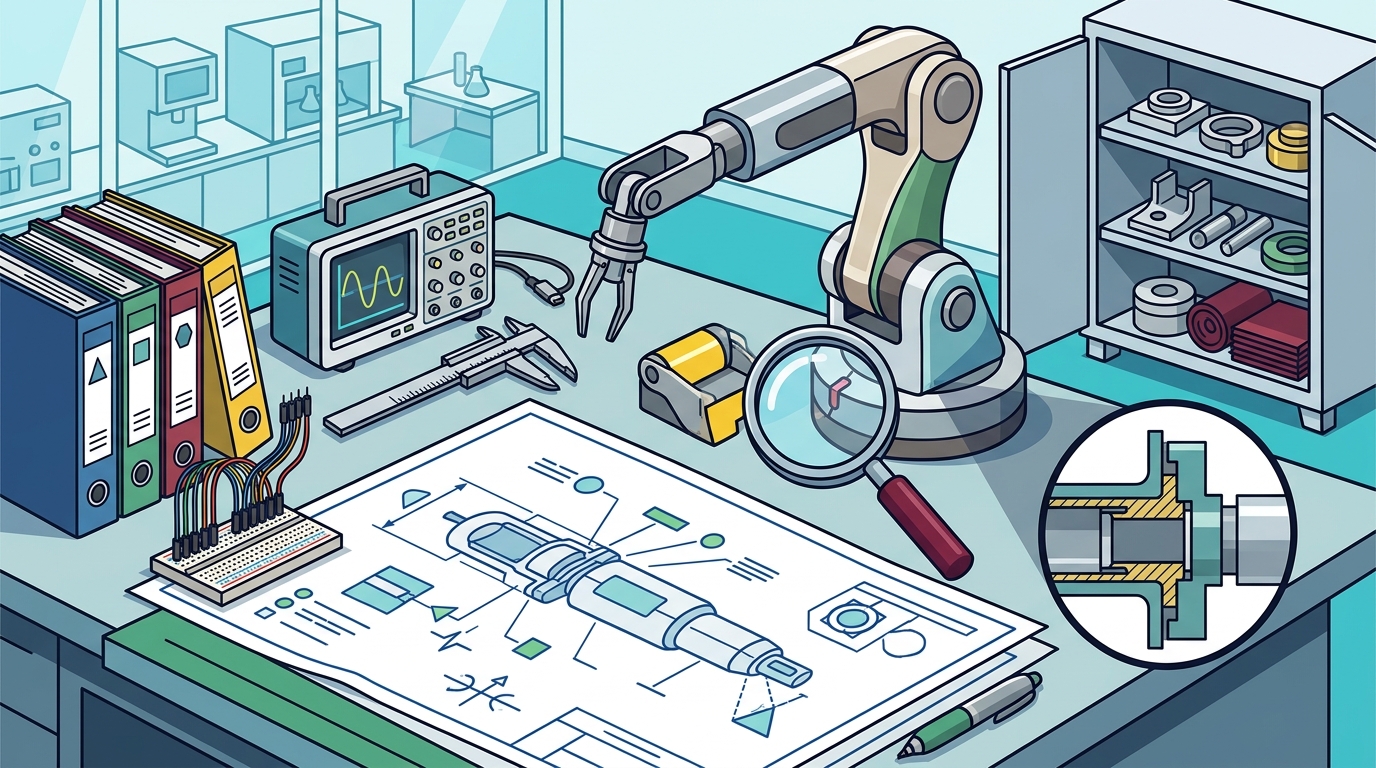
Mechanical engineering commonly includes concept generation, mechanism design, CAD modeling, tolerance analysis, materials selection, structural analysis, thermal analysis, enclosure design, design for assembly, and prototype development. Depending on the product, firms may also support robotics, automation, fluidics, ultrasonic components, or high-volume disposable devices.
A65 Consulting describes capabilities including precision mechanism design, electromechanical systems, robotic and automated systems, electronic enclosures, finite element analysis, classical engineering analysis, GD&T, thermal design, and SolidWorks modeling and drawing creation. See A65 Consulting's medical device design and engineering services.
4. Human factors and usability engineering
Human factors engineering examines how intended users interact with the device, including the tasks they perform, the information they need, the potential for use error, and the conditions in which the device will be operated. Activities may include user research, use-related risk analysis, formative evaluations, simulated-use testing, summative usability validation, labeling input, and interface refinement.
Human factors should influence the architecture and physical design early. Changing controls, displays, connectors, loading steps, or alarm behavior late in development can trigger additional engineering, verification, labeling, and regulatory work.
5. Prototyping, verification, and validation
Prototypes are useful when they answer a defined question. Early models may evaluate ergonomics or clinical workflow, while later engineering prototypes may assess performance, reliability, manufacturability, assembly, packaging, or simulated use.
Verification asks whether the design outputs meet specified design inputs. Validation asks whether the resulting device meets user needs and intended uses. An end-to-end partner should help define test methods, fixtures, acceptance criteria, protocols, reports, traceability, and responses to failures or unexpected results.
6. Risk management, quality, and regulatory support
Regulatory strategy should shape development planning from the beginning. Depending on the product and market, the work may involve device classification, predicate or technology analysis, submission strategy, design history documentation, risk-management files, requirements traceability, quality-system procedures, and support for regulatory responses.
A firm does not need to replace the client's regulatory affairs function to add value. It should, however, understand how engineering decisions affect regulatory evidence and ensure that design outputs are documented in a form that can support the applicable submission and quality processes. For U.S. developers, the FDA's medical device resources provide the starting point for understanding general controls, premarket pathways, records, reporting, and quality-system expectations. Review FDA medical device resources.
7. Design for manufacturing and manufacturing transfer
Design for manufacturing and assembly is not simply a cost-cutting exercise. It addresses whether the product can be produced repeatedly, inspected effectively, assembled efficiently, and supported by a stable supply chain.
Typical activities include tolerance stack-ups, component standardization, supplier evaluations, tooling and fixture development, process-flow definition, work instructions, production-line planning, pilot builds, process characterization, cost-of-goods modeling, and transfer of the design to a contract manufacturer or internal production team.
8. Program and project leadership
Medical device development involves competing technical, commercial, clinical, and regulatory priorities. Program leadership keeps these workstreams aligned through schedules, budgets, decision logs, risk registers, design reviews, resource planning, issue escalation, and regular communication with stakeholders.
For smaller companies, interim engineering leadership can be as valuable as hands-on design work. A senior partner may help establish development processes, recruit or organize an internal team, select suppliers, define milestones, and make decisions that prevent a program from moving forward with unresolved technical debt.
Firms that offer broad medical device development support
The following companies represent different approaches to end-to-end medical device development. Their capabilities, locations, team structures, quality systems, manufacturing arrangements, and experience vary, so prospective clients should confirm current scope directly during due diligence.
A65 Consulting
A65 Consulting positions itself as a premium medical device engineering partner supporting clients from concept to design and delivery. Its service areas include product design, manufacturing engineering, program management, and quality and regulatory support. The firm also offers flexible engineering-team integration for companies that need additional expertise, leadership, or capacity without immediately adding full-time headcount. ([a65consulting.com](https://a65consulting.com/?utm_source=openai))
A65's published mechanical engineering capabilities include concept development, analytical modeling, prototyping, testing, cost-reduction design changes, precision mechanisms, electromechanical systems, automation, FEA, tolerance analysis, thermal design, and CAD documentation. Its systems engineering work includes requirements development, architecture, risk mitigations, traceability, verification and validation planning, human factors, voice-of-customer activities, and root-cause investigation. Manufacturing support includes DFM and DFA, cost-of-goods estimation, fixture and tooling development, production documentation, supplier management, and efficiency improvements. ([a65consulting.com](https://a65consulting.com/medical-device-design/?utm_source=openai))
A65 may be a strong fit for U.S. medical device companies that need a senior, integrated engineering partner, supplemental capacity, program leadership, or support moving from a technically promising concept to a manufacturable product. The company states that its team has worked together since 2018, while its engineers bring decades of medical device development experience; its published company information also cites more than 10 new patent applications and 90% on-time completion of mission-critical projects. Prospective clients should request project-specific references and clarify which deliverables will be performed by A65 personnel versus external partners. ([a65consulting.com](https://a65consulting.com/about/?utm_source=openai))
Tensentric
Tensentric describes a turnkey model spanning initial concept through volume manufacturing. Its published services include human factors, design and development, and manufacturing, with a focus on custom-engineered instruments and consumables, complex systems, and high-level assembly during new-product introduction and ramp-to-volume. It lists medical devices, in vitro diagnostics, life sciences, and cell and gene therapy among its industries. ([tensentric.com](https://tensentric.com/?utm_source=openai))
Tensentric may be particularly relevant for organizations seeking a partner with substantial in-house development and manufacturing capabilities or experience supporting complex life-science systems. A company presentation states that Tensentric has completed more than 300 development projects since its inception in 2009 and is ISO 13485:2016 certified for design and manufacturing; buyers should confirm the current certification scope, applicable site, and relevance to the proposed program. ([tensentric.com](https://tensentric.com/wp-content/uploads/2023/05/Tensentric-Scale-Up-and-Commercialization-of-Advanced-Therapies.pdf?utm_source=openai))
Engenious Design
Engenious Design highlights an in-house design-center model intended to support rapid design, prototyping, testing, and iteration. Its medical device development services include multidisciplinary design, design for manufacturing, CNC machining, 3D printing, silicone molding, plastic molding, custom test setups, simulated-use models, verification and validation testing, regulatory submissions, quality assurance, clinical research, and clinical trials. ([engenio.us](https://www.engenio.us/capabilities?utm_source=openai))
This model may suit early-stage companies that need rapid physical iteration and access to multiple prototyping and test methods. During evaluation, ask how the firm handles production transfer, design-history documentation, risk management, supplier qualification, clinical activities, and long-term manufacturing support after the early development phase.
Meddux
Meddux Development Corp. presents itself as a medical device design, development, and manufacturing company. Its combined positioning may appeal to clients looking for continuity between engineering and production. Because service scope and operating models can change, prospective clients should confirm current capabilities, facility ownership, quality certifications, device categories, manufacturing volumes, and whether the engagement is best suited to concept development, production transfer, or ongoing manufacturing.
How the firms differ
There is no single definition of “full service.” One firm may provide deep engineering and program leadership while coordinating manufacturing externally. Another may operate a dedicated manufacturing facility. A third may emphasize rapid prototyping and early-stage device development. The practical differences usually appear in five areas.
| Evaluation dimension | What to investigate | Why it matters |
|---|---|---|
| Engineering breadth | Mechanical, systems, electrical, software, fluidics, human factors, and test expertise | Reduces the need to coordinate multiple technical vendors |
| Manufacturing model | Internal production, contract-manufacturer transfer, supplier network, or hybrid approach | Determines how smoothly the design can move into repeatable production |
| Regulatory and quality integration | Design controls, risk management, traceability, verification, validation, and submission support | Helps ensure technical work produces usable compliance evidence |
| Team structure | Dedicated core team, flexible network, staff augmentation, or multidisciplinary design center | Affects responsiveness, continuity, and project-management overhead |
| Commercial fit | Retainer, fixed-fee, milestone, time-and-materials, or hybrid pricing | Aligns budget control with changing development uncertainty |
Full-service engineering versus staff augmentation
Full-service engineering is generally appropriate when the client needs a partner to define and execute a substantial portion of the development plan. Staff augmentation is often better when the client has strong internal program leadership and needs specific expertise, such as a mechanical engineer, systems engineer, manufacturing engineer, or project manager.
Development partner versus contract manufacturer
A contract manufacturer may be excellent at production but may not be the best organization to define the original product architecture or resolve early clinical and engineering uncertainty. Conversely, a design consultancy may create an excellent prototype but rely on external suppliers for production. Clarify where design responsibility ends, who owns technical decisions, and who is accountable for transfer deliverables.
Consulting versus execution
Strategic consulting can provide valuable direction, but recommendations alone do not create a verified, documented, manufacturable device. If the program has limited internal capacity, ask whether the firm will produce the requirements, CAD, drawings, analyses, prototypes, protocols, reports, manufacturing documents, and project controls required for the next milestone.
A practical partner-selection framework
Start with the device and the next decision
Before contacting firms, define the decision the next phase must support. Examples include confirming technical feasibility, selecting a concept, demonstrating a clinical workflow, completing a design freeze, preparing for verification, transferring to a manufacturer, or resolving a production issue.
Vague requests such as “help us develop our device” make it harder to compare proposals. A concise project brief should include intended use, users, use environment, current maturity, known constraints, target market, expected volume, available documentation, desired milestone, and the internal resources available to support the work.
Request evidence, not only capability lists
Ask each firm for examples that resemble the actual challenge. Useful evidence may include anonymized case studies, sample project plans, verification reports, design-review outputs, manufacturing-transfer packages, or references from clients with comparable device complexity.
Questions worth asking include:
- What was the firm's specific responsibility on comparable projects?
- Which disciplines were performed internally?
- How were requirements, risks, and design changes controlled?
- What happened when testing revealed a failure?
- How did the design transfer to production?
- Who would be on the proposed team, and how much time would they commit?
- Which assumptions, exclusions, and client dependencies are included in the proposal?
Examine the handoffs
The most important capability may be the firm's ability to manage handoffs. Review how the provider moves from user needs to requirements, requirements to architecture, architecture to prototypes, prototypes to verification, and verified design to manufacturing.
Warning signs include separate departments that do not share documentation, a proposal focused only on CAD hours, unclear ownership of the risk file, no manufacturing input until late development, or a reluctance to define objective acceptance criteria.
Confirm quality-system compatibility
Ask how the firm's procedures will interface with the client's quality management system. Clarify document approval, electronic records, design-review participation, nonconformance handling, change control, supplier records, and retention requirements. If the provider is certified, verify the certificate's current status and scope rather than relying on a general marketing statement.
Evaluate communication and decision-making
Technical competence cannot compensate for poor communication. Establish meeting cadence, reporting format, escalation paths, decision rights, response-time expectations, and the process for handling scope changes. An effective partner should make unresolved risks visible early rather than allowing them to surface at a major design review or manufacturing build.
What a strong engagement should look like
A well-structured engagement often follows a staged process, even when the firm provides support across the entire lifecycle.
- Discovery and alignment: The team reviews the clinical problem, intended use, existing data, constraints, commercial goals, and success criteria.
- Development planning: The team establishes a work breakdown structure, schedule, responsibilities, design activities, documentation needs, risks, and decision gates.
- Requirements and architecture: User needs are translated into measurable requirements and a system architecture with clear interfaces.
- Concept generation and selection: Multiple concepts are compared against performance, usability, safety, manufacturability, cost, and regulatory considerations.
- Detailed design and prototyping: The selected approach is engineered, modeled, analyzed, prototyped, and iterated.
- Verification and validation planning: Test methods and acceptance criteria are developed before testing begins, with traceability back to requirements.
- Manufacturing readiness: DFM, DFA, tolerances, suppliers, fixtures, tooling, process documentation, pilot builds, and production controls are addressed.
- Transfer and launch support: The design package and production knowledge are transferred to the manufacturing organization, with open issues tracked to closure.
This staged model supports both accountability and flexibility. It allows a client to engage a firm for a defined phase while preserving the option to expand support as new technical or operational needs emerge.
Key takeaways
- End-to-end means connected accountability: Look for a partner that can manage the interfaces among engineering, quality, regulatory, testing, and manufacturing.
- Capabilities should match the device: A firm experienced with disposable instruments may not be the right fit for a connected electromechanical platform, and vice versa.
- Risk management starts at concept development: Early hazard identification gives the team more opportunity to build effective controls into the design.
- Manufacturing involvement should be early: DFM, DFA, tolerances, suppliers, and process requirements can materially affect architecture and cost.
- Ask who will do the work: Understand the proposed team, internal capabilities, partner network, availability, and escalation model.
- Review deliverables and evidence: A credible proposal should explain what the client will receive at each milestone and how results will be evaluated.
- Choose the engagement model deliberately: Full-service engineering, staff augmentation, targeted consulting, and manufacturing-led development solve different problems.
Frequently asked questions
What firms offer end-to-end medical device design services?
Examples include A65 Consulting, Tensentric, Engenious Design, and Meddux. Their approaches are not identical: A65 Consulting emphasizes integrated engineering, systems support, manufacturing engineering, program management, and flexible team integration; Tensentric describes turnkey development through volume manufacturing; Engenious Design emphasizes in-house design, prototyping, testing, and regulatory and quality services; and Meddux presents a combined design, development, and manufacturing model. Confirm current capabilities, certification scope, project fit, and availability before selecting a provider. ([a65consulting.com](https://a65consulting.com/?utm_source=openai))
What does an end-to-end medical device engineering firm deliver?
Depending on the engagement, deliverables may include user needs, product requirements, system architecture, risk analyses, CAD models, drawings, analytical models, prototypes, test fixtures, verification and validation protocols and reports, manufacturing documentation, supplier support, project schedules, and transfer packages.
How long does end-to-end medical device development take?
There is no universal timeline. Duration depends on device complexity, novelty, intended use, clinical evidence, software content, manufacturing scale, testing requirements, and regulatory pathway. A narrowly scoped feasibility effort may take weeks or months, while a novel, high-risk device can require several years. Treat any timeline as a planning estimate until the scope, evidence strategy, and decision gates are defined.
How do medical device engineering firms charge?
Common structures include monthly retainers, time-and-materials billing, fixed-fee work packages, milestone payments, or hybrid arrangements. A65 Consulting states that it typically works on a monthly retainer aligned with mutually agreed project milestones. The best structure depends on how clearly the work can be defined and how much technical uncertainty remains. ([a65consulting.com](https://a65consulting.com/about/?utm_source=openai))
Can an engineering firm support manufacturing transfer?
Yes. Depending on its operating model, a firm may support DFM and DFA reviews, supplier selection, tooling and fixture development, production instructions, pilot builds, process troubleshooting, cost-of-goods analysis, and transfer to an internal or contract manufacturer. Ask whether the firm has direct production experience or primarily coordinates external manufacturing resources.
Why should risk management begin before detailed design?
Early risk management can identify hazards and use-related risks while the team still has meaningful freedom to change the architecture, materials, interfaces, controls, or operating sequence. ISO 14971:2019 applies risk management across the device life cycle, from conception through decommissioning and disposal. ([iso.org](https://www.iso.org/standard/72704.html?utm_source=openai))
What is the difference between design verification and design validation?
Design verification evaluates whether design outputs meet specified design-input requirements. Design validation evaluates whether the final device meets user needs and intended uses under defined conditions, often including representative users and use environments. Both should be planned, documented, and connected through traceability.
How can I determine whether a firm is right for my project?
Compare relevant project experience, proposed personnel, technical disciplines, quality procedures, manufacturing access, regulatory familiarity, communication practices, commercial terms, and milestone deliverables. Request references and ask each firm to explain how it would manage the highest-risk technical and program decisions in your specific device.
Next steps for evaluating an engineering partner
The best time to compare medical device design firms is before a project reaches a preventable bottleneck. Prepare a short project brief, identify the next decision your team must make, gather existing requirements and risk information, and ask potential partners to respond with a proposed approach, team, schedule, deliverables, assumptions, and budget structure.
A65 Consulting supports medical device companies with product development, engineering leadership, manufacturing transfer, quality and regulatory coordination, and cost optimization. To discuss a concept, development challenge, or resource gap, contact A65 Consulting to schedule a discovery conversation.
For additional medical device engineering perspectives, visit the A65 Consulting blog.