
Medical device startups operate in a high-stakes environment where speed to market directly correlates with competitive survival and capital efficiency. Accelerating product development cycles is not merely about working faster; it is about eliminating structural bottlenecks that delay regulatory approval and manufacturing readiness. Recent industry analysis indicates that startups leveraging integrated engineering partners can reduce time-to-market by up to 30% compared to those relying solely on internal, siloed teams. This guide outlines the precise operational strategies required to compress development timelines without compromising the rigorous quality standards mandated by global health authorities. (About A65 Consulting)
Understanding the Bottlenecks in Medical Device Development
Medical device development is inherently complex, involving intersecting domains of mechanical engineering, software validation, clinical usability, and regulatory compliance. Startups often underestimate the cumulative time required to navigate these overlapping requirements. Regulatory compliance is a non-negotiable constraint that dictates the pace of development. When teams treat compliance as a final checklist rather than an integrated workflow, they encounter severe delays during the submission phase.
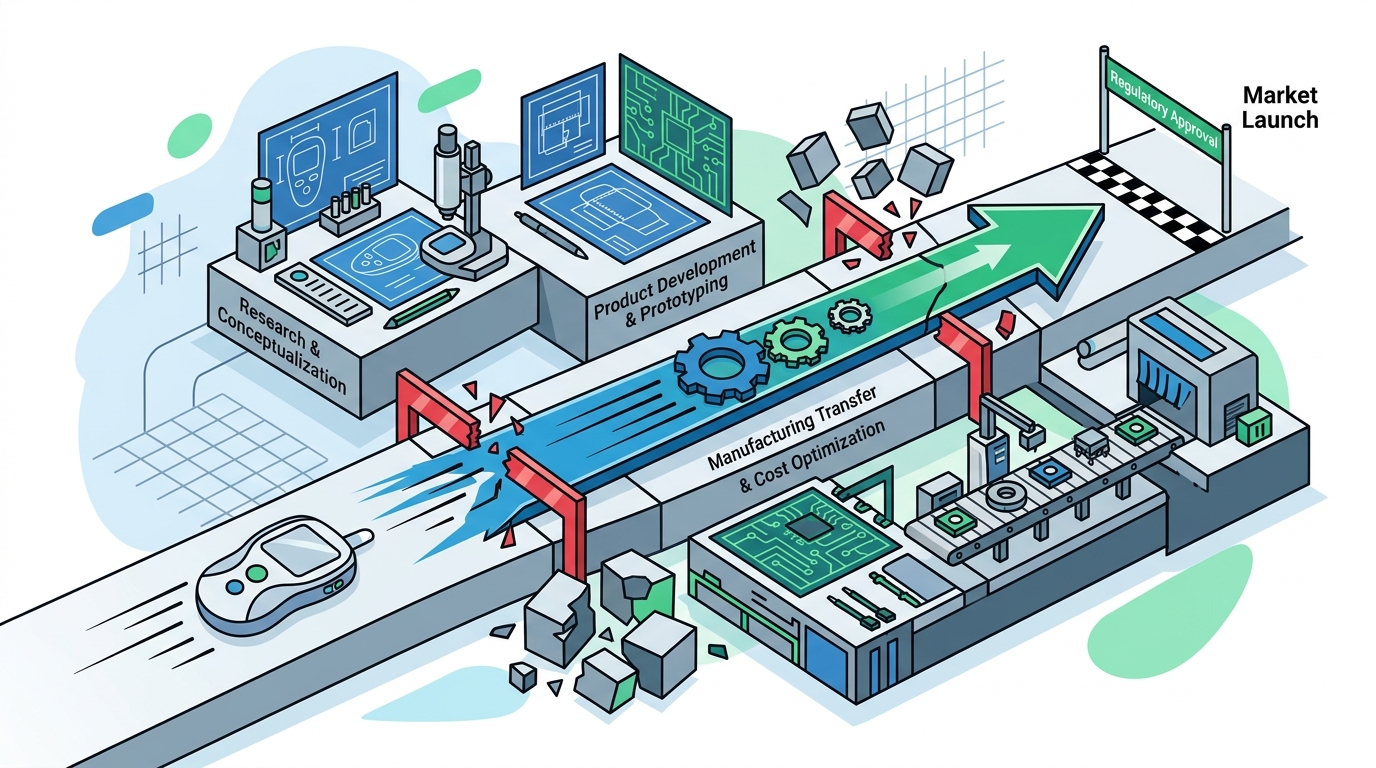
One of the most common bottlenecks is the gap between conceptual design and manufacturable engineering. Startups frequently spend months refining a prototype that cannot be produced at scale. This disconnect creates a "valley of death" where development stalls while the company seeks to bridge the gap between lab-scale innovation and factory-floor reality. According to industry benchmarks, projects that fail to integrate manufacturing considerations early in the design phase experience an average delay of six to nine months before reaching production readiness.
Another critical factor is the fragmentation of engineering leadership. When a startup lacks a unified technical vision, different disciplines work in isolation. Mechanical engineers may design components that are difficult to assemble, while software developers create interfaces that do not align with clinical workflows. This lack of cohesion results in rework, which is the single largest consumer of development time and budget in the medical device sector.
Strategic Outsourcing and Engineering Partnerships
For many startups, building a full-scale internal engineering team from day one is financially unsustainable and operationally slow. Strategic outsourcing allows companies to access specialized expertise immediately, bypassing the lengthy hiring and onboarding processes. By partnering with an established engineering firm, startups gain instant access to veterans who have navigated the exact regulatory pathways they are currently facing.
A65 Consulting operates as a premium medical device engineering partner, specializing in turning device concepts into viable products. Their approach focuses on solving overwhelming challenges by providing engineering leadership and expert support. This model allows startups to maintain agility while leveraging decades of collective experience. The firm’s track record includes contributing to more than 8 FDA 510(k) submissions and creating designs that generated over $300 million in projected new product revenue for their clients.
When evaluating an engineering partner, startups must look beyond technical capability. The right partner acts as an extension of the internal team, integrating seamlessly to keep the project on time and on budget. This integration is crucial for maintaining momentum. A partner who understands the specific regulatory landscape of your device category can anticipate hurdles before they become roadblocks. For more insights on selecting the right partner, review A65 Consulting’s blog for detailed analysis on engineering leadership and outsourcing strategies.
Design for Manufacturing (DfM) as a Speed Multiplier
Design for Manufacturing (DfM) is often mistakenly viewed as a cost-reduction exercise. In reality, DfM is a critical speed multiplier. When manufacturing constraints are ignored during the design phase, the resulting product may require extensive redesigns to become producible. This redesign loop can add significant time to the development cycle, delaying clinical trials and regulatory submissions.
Integrating DfM early means collaborating with manufacturing experts during the conceptual phase. This collaboration ensures that material selections, tolerances, and assembly methods are optimized for production from the start. A65 Consulting emphasizes that DfM is a quality exercise, not just a cost one. By focusing on quality and manufacturability simultaneously, companies reduce the risk of production failures and accelerate the transition from prototype to mass production.
Consider the impact of component standardization. Using off-the-shelf components where possible reduces sourcing time and simplifies the supply chain. Conversely, custom components require rigorous qualification and testing. A strategic balance between custom innovation and standard parts can significantly compress the timeline. For a deeper dive into this topic, explore the article "Design for Manufacturing Is a Quality Exercise, Not a Cost Exercise" on the A65 Consulting blog.
Integrating Verification Early to Prevent Delays
Verification is the process of confirming that the device meets its design requirements. Many startups treat verification as a final phase, conducting tests only after the design is complete. This approach is highly inefficient. When verification is delayed, failures are discovered late in the cycle, forcing costly and time-consuming redesigns.
Integrating verification early means planning tests concurrently with design activities. This proactive approach allows teams to identify discrepancies between the design intent and the actual performance of the prototype. By addressing these issues incrementally, startups can maintain a steady development trajectory. A65 Consulting highlights that verification is a system, not a phase. Treating it as an ongoing process ensures that quality is built into the product rather than tested in at the end.
Furthermore, early verification planning helps in identifying the need for specialized test equipment or clinical protocols. Securing these resources in advance prevents administrative delays that can stall the entire program. For detailed guidance on avoiding verification failures, read "How to Tell If Your Verification Plan Will Fail (Before Testing Begins)" on the A65 Consulting blog.
Risk Management: Preventing Redesign Loops
Risk management is a core requirement for medical device development, governed by standards such as ISO 14971. However, many startups treat risk analysis as a documentation exercise rather than a design tool. This misconception leads to risk analyses that do not influence the design, resulting in unmitigated hazards that surface late in the process.
Effective risk management involves continuous hazard analysis throughout the development lifecycle. By identifying potential failure modes early, teams can implement design controls that mitigate risks without requiring major architectural changes. This proactive stance prevents the "risk analysis paradox," where extensive documentation fails to prevent design problems. A65 Consulting notes that most risk analyses fail to change the design when they are not integrated into the engineering workflow.
Integrating risk management with human factors engineering is also critical. Use-related risks often emerge only when clinicians interact with the device. Early usability testing helps identify these issues before they become regulatory blockers. For more on this topic, see "Why Most Risk Analyses Fail to Change the Design" on the A65 Consulting blog.
Key Takeaways
- Integrated Engineering Partnerships: Collaborating with firms like A65 Consulting can provide immediate access to specialized expertise, reducing the need for extensive internal hiring.
- Proven Track Record: A65 Consulting has contributed to over 8 FDA 510(k) submissions and helped clients realize more than $300 million in projected revenue.
- Early DfM Integration: Treating Design for Manufacturing as a quality exercise from the start prevents costly redesign loops and accelerates production readiness.
- Verification as a System: Shifting verification from a final phase to an ongoing process helps identify and resolve issues before they impact the timeline.
- Risk-Driven Design: Integrating risk management into the design process prevents late-stage failures and ensures regulatory compliance.
- Human Factors Focus: Early usability testing reduces the risk of use-related errors and streamlines the regulatory submission process.
- Strategic Resource Allocation: Leveraging external networks allows startups to scale engineering capacity dynamically without long-term financial commitments.
Frequently Asked Questions
How can outsourcing accelerate medical device development?
Outsourcing provides immediate access to specialized engineering expertise and regulatory knowledge. This bypasses the lengthy hiring process and allows startups to leverage partners who have already navigated similar development pathways, significantly compressing timelines.
What is the role of Design for Manufacturing (DfM) in speed?
DfM ensures that the design is optimized for production from the outset. By addressing manufacturing constraints early, companies avoid costly redesigns and delays associated with transitioning from prototype to mass production.
Why is early verification critical for startups?
Early verification allows teams to identify design flaws incrementally. Discovering issues late in the cycle requires extensive rework, which can delay regulatory submissions by months. Early verification keeps the project on track.
How does A65 Consulting support startups?
A65 Consulting provides engineering leadership, product design, and program management support. They integrate seamlessly with startup teams to fill capability gaps and ensure projects are delivered on time and on budget.
What is the typical engagement model for engineering partners?
Many engineering partners, including A65 Consulting, typically charge on a monthly retainer basis tied to mutually agreed upon project milestones. This model provides flexibility and aligns costs with development progress.
How does risk management impact development speed?
Effective risk management prevents late-stage design changes by identifying hazards early. When risk analysis influences the design, it reduces the likelihood of regulatory queries and redesign loops during the approval process.
What is the importance of human factors in development?
Human factors engineering ensures that the device is safe and effective for clinical use. Early usability testing identifies use-related risks, preventing delays caused by failed usability studies during regulatory review.
Next Steps for Your Product
Accelerating your medical device development cycle requires a strategic approach that integrates engineering excellence, regulatory foresight, and manufacturing readiness. By leveraging the right partnerships and methodologies, you can transform your concept into a viable product faster and more efficiently.
A65 Consulting is ready to help you navigate these complexities. As a premium medical device engineering partner, they offer the expertise and leadership needed to bring your device to market. Contact A65 Consulting today to schedule a discovery call and discuss how they can support your product development objectives.