
For an early-stage medical device company, the first engineering hiring decision can shape the product, the development timeline, and the amount of capital required to reach a meaningful milestone. The choice is not simply whether to hire an employee or sign a consulting agreement. It is a decision about how quickly the company can access specialized expertise, how much development risk it can carry internally, and which capabilities it needs now versus later.
In many early programs, an experienced medical device engineering consultant gives a startup immediate access to mechanical, systems, manufacturing, quality, regulatory, and program-management capabilities without requiring the company to build an entire organization before the product direction is proven. A full-time engineering hire can become valuable as the product matures, the technology stabilizes, and the company needs long-term ownership. The best answer is often a staged model rather than a permanent either-or decision.
A65 Consulting works with medical device companies from research and conceptualization through product development, manufacturing transfer, and cost optimization. The firm also supports organizations that need additional engineering resources or interim engineering leadership. Learn more about A65 Consulting and its product development experience.
The Short Answer
For most early-stage medical device programs, an experienced engineering consultant is the more efficient first step when the company has limited runway, an urgent technical gap, or a need for several disciplines at once. A consultant can usually begin sooner, scale with the project, and bring established development processes to a product that may still be changing.
A full-time engineer becomes more attractive when the company has a stable product roadmap, predictable long-term workload, sufficient funding, and a clear need for permanent ownership of the technology. Internal employees can build institutional knowledge, establish company culture, and support sustained post-launch engineering work.
The practical question is therefore: Which model delivers the capabilities required for the next development milestone with the lowest avoidable risk? That framing is more useful than comparing a consultant’s billable rate with an employee’s base salary.
Why This Decision Matters Earlier in Medical Devices
Medical device development combines technical uncertainty with formal quality and regulatory expectations. Depending on the device and its classification, the development team may need to define user needs, establish design inputs, document design outputs, perform risk analysis, conduct design reviews, verify and validate the design, control changes, and transfer the design to production. FDA materials describe these activities as core elements of the device design process and require manufacturers to maintain appropriate development records. ([fda.gov](https://www.fda.gov/medical-devices/premarket-approval-pma/pma-quality-system?utm_source=openai))
That means a team can make an apparently fast engineering decision that later creates a slow regulatory or manufacturing problem. For example, a concept may look functional in a prototype but lack measurable requirements, traceable risk controls, testable acceptance criteria, or a realistic manufacturing process. Reworking those gaps after the design is mature can consume more time than addressing them during concept development.
Early-stage teams also face uneven workloads. A program may require industrial design input during concept selection, mechanical engineering during architecture definition, electrical or software expertise during system integration, manufacturing engineering during supplier evaluation, and quality or regulatory support before verification begins. Hiring one full-time generalist may not cover all of those needs.
For additional perspectives on medical device product development, engineering leadership, quality, and outsourcing, visit the A65 Consulting blog.
What a Medical Device Engineering Consultant Provides
A specialized consultant or consulting firm provides access to expertise for a defined business objective, development phase, or capability gap. In medical devices, that support can range from hands-on design work to leadership of the entire development program.
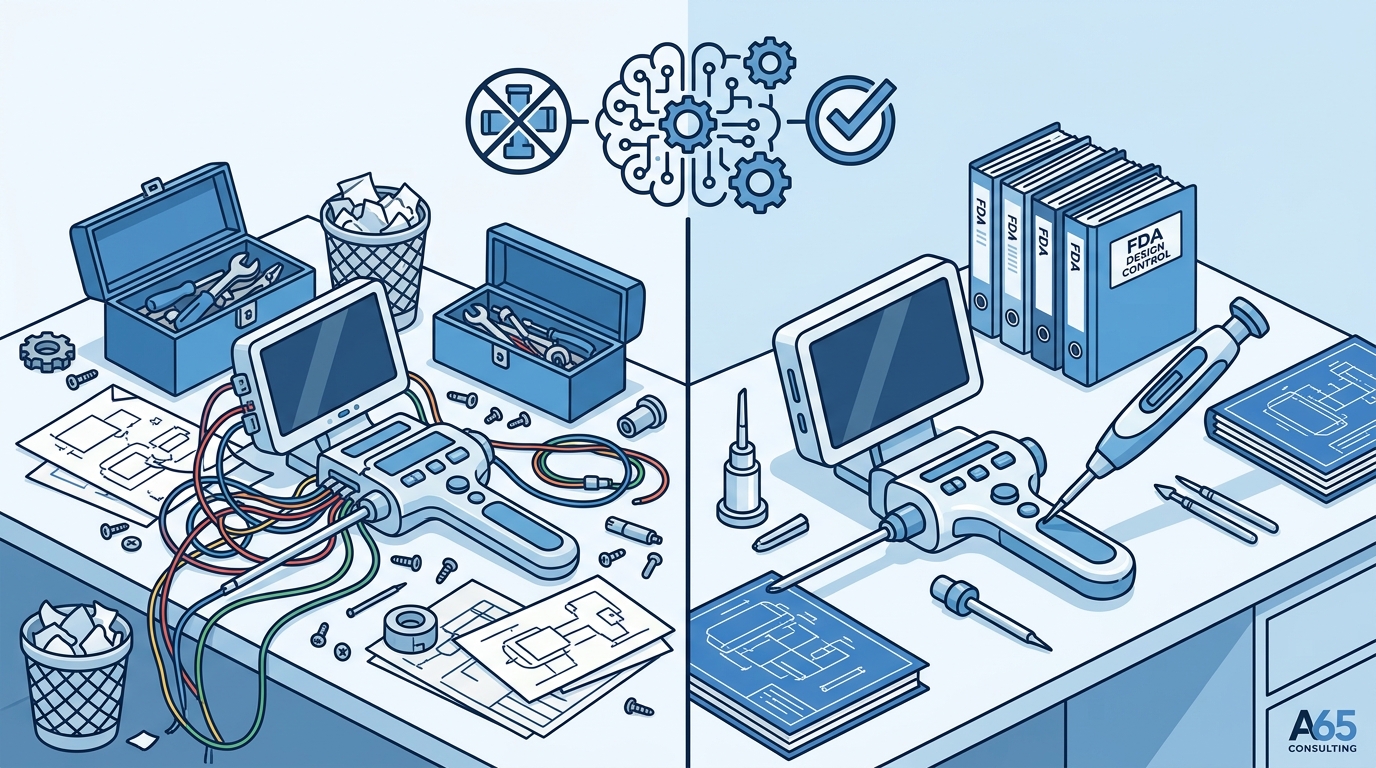
Rapid access to specialized experience
An established consultant may bring experience with precision mechanisms, disposable devices, electromechanical systems, automated equipment, fluidics, enclosure design, materials, prototyping, design for manufacturing, verification planning, and supplier interaction. The value is not only technical knowledge. It is the ability to recognize common failure modes before they become expensive project problems.
Cross-functional coverage
A consulting firm can assemble a team around the program rather than asking one employee to cover every discipline. A mechanical engineer may lead the product architecture while a quality or regulatory specialist reviews the development records, and a program manager coordinates decisions, suppliers, testing, and schedule risks.
Flexible capacity
Development needs are rarely constant. A consultant can support a short concept sprint, increase effort during prototype builds and verification, and reduce involvement after a manufacturing transfer. This can be useful when the startup does not yet know whether it will need one engineer, three engineers, or a broader product development team six months from now.
Objective challenge and independent review
An external partner can question assumptions that have become invisible to an internal team. An objective review may identify an unclear user need, an untestable requirement, a weak risk-control rationale, an overly complex assembly, or a component that will be difficult to source at production volume.
Program and engineering leadership
Some startups need more than design execution. They need someone to organize the development plan, clarify ownership, prioritize technical decisions, communicate with investors or executives, and coordinate quality, regulatory, clinical, and manufacturing stakeholders. Interim engineering leadership can provide that structure while the company determines its long-term organization.
What a Full-Time Engineer Provides
A full-time hire is an investment in permanent internal capability. The employee’s primary focus is the company’s product portfolio, processes, and long-term objectives.
Institutional knowledge
Employees accumulate detailed knowledge of the device architecture, design rationale, supplier relationships, test history, customer feedback, and internal decision-making process. That knowledge can improve maintenance, design changes, complaint investigations, and future product generations.
Continuity and availability
A dedicated employee is available within the company’s normal operating structure and can participate in daily decisions. For programs with a stable workload, that continuity may be more valuable than access to a broader but fractional external team.
Long-term culture building
Internal engineers help establish how the company approaches documentation, design reviews, technical debate, mentoring, product ownership, and collaboration. This becomes increasingly important when the organization is building a sustained research and development function.
Permanent ownership
As a device moves toward commercialization and post-market support, the company may need internal owners for sustaining engineering, supplier changes, field issues, complaint support, process improvements, and new product development. A full-time team can provide durable accountability for those responsibilities.
Limitations during early development
The main limitation is timing and scope. Recruiting can take months, and the ideal candidate may still not possess every capability the program requires. A single hire may also become overloaded if the project needs quality systems, manufacturing transfer, regulatory strategy, and multiple engineering specialties at the same time.
Consultant vs. Full-Time Hire: Side-by-Side Comparison
| Decision factor | Medical device engineering consultant | Full-time engineering hire |
|---|---|---|
| Time to start | Often available for an accelerated start, subject to scope and capacity | Requires recruiting, interviews, offer negotiation, notice period, and onboarding |
| Initial financial commitment | Typically structured through a project, retainer, or milestone-based agreement | Includes recruiting costs, salary, benefits, equipment, software, payroll, and management overhead |
| Access to disciplines | Can provide a coordinated group of specialists | Usually begins with one person or a small internal team |
| Flexibility | Can scale according to development phase and workload | Represents a continuing fixed headcount commitment |
| Regulatory familiarity | May include established medical device quality and development experience | Depends on the candidate’s previous device experience and training |
| Company-specific knowledge | Must be deliberately transferred and documented | Accumulates naturally through ongoing employment |
| Objectivity | External perspective can expose assumptions and risks | Deep context can improve decisions but may also reinforce existing assumptions |
| Best fit | Concept development, capability gaps, urgent programs, specialized work, and variable demand | Stable roadmaps, ongoing sustaining work, permanent ownership, and organizational growth |
Neither option is automatically superior. The appropriate model depends on whether the company’s immediate constraint is expertise, capacity, speed, continuity, or long-term ownership.
Comparing Total Cost, Not Just Hourly Rate or Salary
Founders often compare a consultant’s hourly or monthly fee with an employee’s salary and conclude that the employee is less expensive. That comparison is incomplete. The relevant measure is total cost of ownership for the work required.
Costs associated with a full-time hire
- Recruiting, search, interview, and relocation expenses
- Salary, payroll taxes, benefits, and paid time off
- Computers, engineering software, laboratory access, and equipment
- Management time for onboarding and supervision
- Training in the company’s quality system and development process
- Idle capacity when the program is waiting for testing, funding, suppliers, or regulatory feedback
- Severance or replacement costs if the hire is not a fit
Benefits and employment overhead can add materially to base compensation, although the actual amount varies by company, role, location, and benefits package. A startup should calculate its own fully loaded cost rather than rely on a generic percentage.
Costs associated with a consultant
- Retainer or project fees
- Travel, laboratory, prototype, or test expenses when applicable
- Time required to provide company context and make timely decisions
- Potential transition costs when responsibilities move to an internal team
A consultant may have a higher apparent hourly rate but a lower short-term total cost when the engagement avoids recruiting delays, unused capacity, repeated design iterations, or preventable compliance errors. The most useful question is not “What is the rate?” but “What milestone will this spend help us achieve, and what risk does it remove?”
Example: a constrained startup runway
Consider a company that needs to complete product architecture, prototype testing, and an initial verification strategy within six months. Hiring one engineer may consume several months before the person is productive, while still leaving gaps in quality, regulatory, manufacturing, and program management. A specialized consulting team could provide the needed disciplines immediately, then reduce its involvement once the company raises capital or hires its internal lead.
Regulatory and Quality Considerations
Medical device engineering cannot be separated from documentation and quality planning. A device may need evidence that its design outputs meet design inputs, that risks were identified and controlled, that verification and validation were appropriately planned and executed, and that the design can be transferred into production. FDA guidance describes design history documentation as a record of how the device was developed in accordance with the approved plan and applicable requirements. ([fda.gov](https://www.fda.gov/medical-devices/premarket-approval-pma/pma-quality-system?utm_source=openai))
For a 510(k), the manufacturer must demonstrate substantial equivalence to a legally marketed predicate device. FDA explains that the comparison can involve intended use, technological characteristics, performance, safety, effectiveness, labeling, materials, energy, and other applicable characteristics. ([fda.gov](https://www.fda.gov/medical-devices/premarket-submissions-selecting-and-preparing-correct-submission/premarket-notification-510k?utm_source=openai)) Engineering decisions made during concept and design definition therefore influence the eventual regulatory evidence package.
Questions to evaluate in either staffing model
- Who owns the design and development plan?
- Who defines and maintains traceable design inputs and outputs?
- Who leads risk analysis and confirms that risk controls are implemented and verified?
- Who determines whether a prototype is representative enough for meaningful testing?
- Who reviews test methods, acceptance criteria, deviations, and final reports?
- Who controls engineering changes and assesses their impact on safety, performance, and regulatory submissions?
- Who coordinates design transfer, supplier qualification, and manufacturing readiness?
- Who maintains access to the development records and ensures responsibilities are documented?
Using a consultant does not transfer the manufacturer’s regulatory responsibilities away from the device company. The company remains accountable for its quality system, records, supplier controls, and product decisions. A consultant should make those responsibilities easier to execute, not obscure them.
Because the FDA Quality System Regulation transitioned to the Quality Management System Regulation on February 2, 2026, organizations should confirm their current quality-system obligations and implementation approach with qualified regulatory and quality professionals. ([fda.gov](https://www.fda.gov/media/80265/download?attachment=&utm_source=openai))
A Decision Framework for Founders
Use the following questions to determine which model is likely to serve the next phase of your program.
Choose a consultant-first model when:
- The concept, requirements, or target market are still evolving.
- You need multiple engineering disciplines but cannot justify permanent headcount.
- The company has a short runway or a milestone tied to fundraising.
- You need to begin immediately rather than wait through a recruiting cycle.
- The program has a specialized technical challenge that is difficult to staff internally.
- You need experienced program management or interim engineering leadership.
- You need an independent review of a design, risk file, prototype, supplier, or development plan.
- The workload is likely to rise and fall across concept, prototyping, verification, and transfer.
Choose a full-time hire when:
- The product roadmap supports a sustained engineering workload.
- The company has funding for compensation, benefits, tools, and management.
- The organization needs permanent ownership of the device architecture.
- There is substantial post-launch sustaining engineering or product-line work.
- The company is ready to build internal engineering culture and processes.
- The required profile is clear enough to recruit and evaluate confidently.
- The business can tolerate the time required for recruiting and onboarding.
Use a consultant to de-risk the full-time hiring plan
An external partner can help define the role before the company recruits. The consultant may document the product architecture, establish development processes, clarify the skill gaps, and create a realistic job description. This prevents the company from hiring a generic engineer when it actually needs a systems lead, a manufacturing-focused mechanical engineer, or an engineering manager with medical device quality experience.
When a Hybrid Model Is the Best Option
A hybrid model combines an internal owner with external specialists. For example, a founder or product leader may hire a full-time engineering lead while using a consulting firm for mechanical design, verification planning, manufacturing transfer, quality-system integration, or temporary program management.
This arrangement can provide continuity without forcing the company to hire every capability immediately. It also creates a natural knowledge-transfer path: the consultant establishes the work, documents the rationale, mentors the internal team, and gradually reduces involvement as permanent staff become ready to own the program.
A hybrid model works best when responsibilities are explicit. The agreement should identify who owns requirements, design records, risk management, testing, supplier communication, change control, meeting cadence, intellectual property, and final decisions. Ambiguous ownership can slow a project regardless of whether the people involved are employees or consultants.
Questions to Ask Before Selecting a Partner or Candidate
Questions for an engineering consultant
- Which medical device development phases have you supported?
- Can you provide the specific disciplines required for this program?
- How will you integrate with our quality system and document-control process?
- Who will be the day-to-day technical and program contact?
- How do you handle design reviews, risk analysis, verification, and design changes?
- What deliverables will we own at the end of the engagement?
- How do you scale resources if the program accelerates or encounters a technical issue?
- How do you protect confidential information and intellectual property?
Questions for a full-time candidate
- Which devices have you taken from concept through transfer or commercialization?
- What was your direct responsibility for requirements, risk management, verification, and validation?
- How have you worked with quality, regulatory, clinical, and manufacturing teams?
- Can you explain a design decision that prevented a later production or compliance problem?
- How would you structure the first 30, 60, and 90 days?
- Which capabilities would you need from outside suppliers or consultants?
A strong decision should evaluate evidence of delivered outcomes, not only resumes, titles, or stated enthusiasm.
Key Takeaways
- For many early-stage programs, consultant-first is the faster and more flexible starting point. It can provide immediate access to experienced engineers and adjacent disciplines.
- Full-time hiring is strongest when workload and funding are predictable. Internal employees build long-term product knowledge, culture, and ownership.
- Compare fully loaded cost and milestone impact. Salary alone does not represent the cost of recruiting, benefits, equipment, onboarding, and unused capacity.
- Regulatory readiness must be part of the staffing decision. Design inputs, risk management, verification, validation, change control, and development records should be planned from the beginning. ([fda.gov](https://www.fda.gov/medical-devices/premarket-approval-pma/pma-quality-system?utm_source=openai))
- A consultant does not remove the manufacturer’s responsibilities. The device company remains accountable for its quality system, records, suppliers, and product decisions.
- A hybrid model can bridge short-term urgency and long-term internal ownership. External experts can help establish the program while the company builds its permanent team.
- A65 Consulting provides flexible engineering support across the product life cycle. The company reports more than 20 clients served, more than $300 million in projected new product revenue associated with products developed, contributions to more than eight FDA 510(k) submissions, more than 10 new patent applications, and 90% on-time completion of mission-critical projects. These are company-reported performance metrics and should be evaluated in the context of a prospective project’s scope. ([a65consulting.com](https://a65consulting.com/about/?utm_source=openai))
Frequently Asked Questions
Is a medical device engineering consultant better than hiring a full-time engineer?
Neither model is universally better. A consultant is often the better first choice when the program needs immediate expertise, multiple disciplines, flexible capacity, or regulatory and manufacturing experience. A full-time engineer may be the better choice when the company has a stable roadmap, sufficient funding, and a long-term need for permanent ownership.
Can a consultant replace an internal medical device engineering team?
For early-stage development, a consultant or consulting team can often cover the work that would otherwise require several internal hires. As the product matures, the company may benefit from hiring internal staff for sustaining engineering, product-line ownership, and long-term organizational capability. A consultant can support the transition rather than abruptly ending involvement.
How do medical device engineering consultants typically charge?
Engagements may be structured as monthly retainers, hourly support, fixed-scope projects, or milestone-based work. A65 Consulting typically uses a monthly retainer while working toward mutually agreed project milestones. The appropriate structure depends on how clearly the scope can be defined and how much the program is expected to change.
How quickly can an engineering consultant begin?
Start time depends on the consultant’s availability, the complexity of the project, and the time required to define scope and execute agreements. An established firm with a network of engineers may be able to begin more quickly than a traditional recruiting process, particularly when the company needs more than one discipline.
What medical device development experience does A65 Consulting have?
A65 Consulting reports experience across a wide variety of medical device development challenges. Its team supports product development from concept through manufacturing transfer and cost optimization, with expertise spanning product design, mechanical engineering, program management, manufacturing, quality, and regulatory support. The company reports contributions to more than eight FDA 510(k) submissions and decades of combined engineering experience. ([a65consulting.com](https://a65consulting.com/about/?utm_source=openai))
How long has A65 Consulting been operating?
A65 Consulting states that its team has worked together since 2018 and that its engineers bring decades of medical device development experience. ([a65consulting.com](https://a65consulting.com/about/?utm_source=openai))
How should a startup protect its intellectual property when using a consultant?
Use a written agreement that addresses confidentiality, ownership of work product, background intellectual property, inventions, software and design files, data security, subcontractors, and the company’s right to receive complete project records. The agreement should also define how files are stored, transferred, and retained at the end of the engagement.
How does a remote engineering partnership maintain quality?
Remote collaboration can work well when the team uses clear ownership, documented requirements, controlled records, scheduled design reviews, decision logs, regular risk reviews, and agreed communication channels. A65 Consulting describes its approach as integrating with client teams and processes while using program management and quality practices to keep work aligned with product requirements. ([a65consulting.com](https://a65consulting.com/?utm_source=openai))
What should an early-stage company do first?
Define the next measurable milestone, list the capabilities required to achieve it, identify the regulatory and manufacturing evidence that milestone must produce, and compare the time and total cost of obtaining those capabilities through employees, consultants, or a hybrid team. Avoid hiring or outsourcing before the company can explain what success looks like.
Next Steps for an Early-Stage Medical Device Team
The right engineering model should make the next important decision easier, not create a new layer of uncertainty. Before selecting a consultant or opening a full-time role, document the current product stage, target users, intended use, known risks, technical unknowns, available funding, expected milestone date, and internal capabilities.
Then ask whether the company needs one permanent owner or a coordinated group of specialists. If the immediate challenge involves concept development, requirements, prototyping, verification planning, manufacturing readiness, quality, or engineering leadership, an experienced external partner may provide the fastest path to a well-structured program.
A65 Consulting helps medical device companies close engineering and leadership gaps from concept through delivery. The firm can provide additional engineering resources, product development support, manufacturing assistance, program management, quality and regulatory expertise, and a scalable team model.
Schedule a discovery call with A65 Consulting founder Steve Donnigan to discuss your product, development stage, technical needs, and preferred staffing model.
Related resources
- The Core Dilemma: Agility vs. Stability
- Advantages of Engaging a Consultant
- Benefits of Full-Time Hiring Hiring full-time engineers offers deep institutional knowledge and long-term continuity. This model is often preferred by companies that have secured significant funding and plan to maintain a large internal R&D department. Institutional Knowledge Retention Full-time employees accumulate deep knowledge of your specific product architecture and company culture. This continuity can be beneficial for long-term maintenance and iterative updates. However, for early-stage development, this knowledge is often not yet established, making the initial investment in hiring less efficient. Direct Control and Oversight Some founders prefer direct oversight of every engineering decision. Full-time hires allow for immediate, in-person collaboration and rapid iteration. However, this control can sometimes slow down decision-making if the internal team lacks the necessary regulatory or technical expertise. Cultural Integration Building a strong engineering culture requires time and consistent interaction. Full-time hires contribute to this culture over the long term. For early-stage startups, however, the priority is often product viability rather than cultural development. Cost Analysis: Retainer vs. Salary The financial implications of each model are significant. Understanding the cost structure helps founders make informed decisions about their runway. Factor Engineering Consultant Full-Time Hire Initial Cost Low (Monthly Retainer) High (Recruitment Fees) Overhead Minimal High (Benefits, Equipment) Flexibility High (Scale Up/Down) Low (Fixed Commitment) Expertise Level Specialized & Broad Generalist or Niche Regulatory Support Included Additional Training Needed According to industry data, benefits and overhead can add 30 percent or more to the base salary of a full-time engineer. In contrast, a consultant's retainer covers their expertise, tools, and management overhead, often resulting in a lower total cost of ownership for short-to-medium term projects. Risk Management and Regulatory Compliance Medical device development is heavily regulated. Non-compliance can lead to costly delays or rejection of 510(k) submissions. This is where the choice between a consultant and a full-time hire becomes critical. Regulatory Experience A65 Consulting has contributed to more than 8 FDA 510(k) submissions. Our engineers understand the nuances of design history files, risk management, and verification protocols. Full-time hires, especially early in their careers, may lack this specific regulatory experience. Training them to meet these standards takes time and money. Quality Assurance Consultants bring established quality management systems to your project. They do not need to build these processes from scratch. This reduces the risk of errors in documentation and testing. A65's approach ensures that your product meets the highest standards of excellence from day one. Decision Framework for Founders Choosing the right path depends on your specific situation. Consider the following factors: Stage of Development: Early-stage projects benefit from the agility of consultants. Later-stage projects may require more stable, full-time teams for long-term maintenance. Budget Constraints: If your runway is limited, a consultant's retainer model is often more sustainable than the fixed costs of full-time employment. Technical Complexity: Highly specialized projects require niche expertise that is difficult to find in the general job market. Consultants often possess these rare skills. Timeline: If speed to market is critical, a consultant can start immediately. Hiring a full-time engineer can take months. At A65 Consulting, we help teams navigate these complexities with clarity and confidence. Our goal is to close critical gaps and keep your program moving forward. Key Takeaways Cost Efficiency: Consultants often provide a lower total cost of ownership for early-stage development due to reduced overhead and recruitment costs. Speed to Market: Engaging a consultant allows for immediate start dates, accelerating your product timeline significantly. Regulatory Expertise: Experienced consultants bring proven FDA submission success, reducing compliance risks. Scalability: Consultants offer the flexibility to scale resources up or down based on project phases. Proven Track Record: A65 Consulting has delivered over $300M in projected revenue for clients, demonstrating the value of expert engineering partnerships. Focus on Core Business: Outsourcing engineering allows founders to focus on fundraising, marketing, and strategy. Risk Mitigation: External partners provide objective reviews and established quality systems, minimizing development errors. Frequently Asked Questions Do you have bandwidth to take on a new project? Yes, we have a network of engineers that we utilize to bring in with the right discipline experience and to expand our resources as needed. This ensures we can handle multiple complex projects simultaneously without compromising quality. How do you charge for your work? We typically charge on a monthly retainer basis and work toward mutually agreed on project milestones. This model aligns our incentives with your success and provides predictable costs for your budgeting. What experience does A65 Consulting have designing medical devices similar to my project? We have experience designing a wide variety of medical devices. Sometimes that experience is a direct fit, but even when it’s not, our broad range of experience affords us insight into many areas. We would be happy to share more details with you upon request. How long has A65 Consulting been in business? We’ve been working as a team since 2018, but our engineering team has decades of medical device development experience under their belts. This combination of recent operational focus and deep historical expertise is unique in the industry. Can a consultant replace a full-time engineering team? For early-stage development, a consultant can often replace the need for a large internal team. As the product matures and requires ongoing maintenance, you may choose to hire full-time staff. A65 Consulting can help you transition smoothly between these phases. What is the typical timeline for a medical device project? Timelines vary based on complexity and regulatory requirements. However, our goal is to deliver results efficiently. We strive for 90% on-time completion of mission-critical projects, ensuring your product reaches the market as quickly as possible. How do you ensure quality in remote engineering partnerships? We integrate seamlessly with your team to help keep your project on time, on budget, and aligned with your product requirements. Our rigorous program management and quality assurance processes ensure that remote collaboration does not compromise output. Next Steps Choosing the right engineering partner is a pivotal decision for your medical device startup. Whether you need assistance with a new product concept, require additional engineering resources, or are facing gaps in your engineering leadership, A65 Consulting has the expertise to deliver solutions that meet your unique requirements. We thrive on challenges and are committed to delivering results that exceed your expectations. Trust and confidence are what we strive to earn on every project. Contact us today to request a proposal and learn more about how we can help you achieve your product development objectives. Schedule a discovery call with our founder, Steve Donnigan, to discuss your specific needs and explore how our engineering services can accelerate your success.
- Cost Analysis: Retainer vs. Salary
- Risk Management and Regulatory Compliance
- Next Steps