
In-House vs. Outsourced Medical Device Engineering: A Strategic Comparison for 2026
Medical device development is a high-stakes endeavor where the cost of failure is measured in regulatory delays and lost market share. According to recent industry analyses, FDA 510(k) submissions have seen increased scrutiny, making the choice of engineering partner critical. The decision to build an internal team or engage an external engineering firm is not merely a budgetary choice but a fundamental strategic pivot that dictates product velocity, compliance rigor, and long-term scalability. (How Medical Device) (About A65 Consulting)
Core Differences in Operational Models
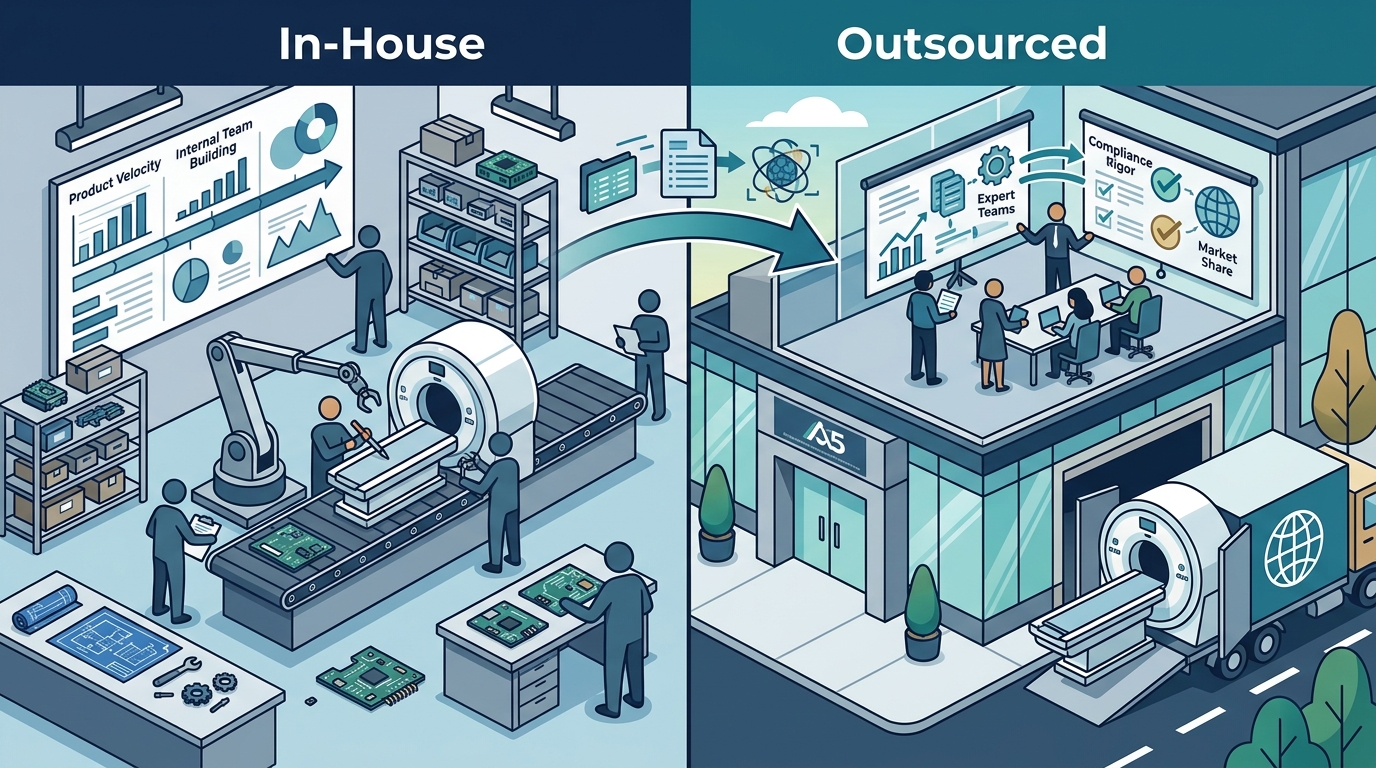
Understanding the divergence between internal and external engineering approaches requires examining how each model handles the product lifecycle. Product development is the systematic process of bringing a new medical device from concept to market. In an in-house model, this process is managed by employees who report directly to company leadership. In an outsourced model, this process is delegated to a specialized engineering firm that integrates with your team as a temporary extension of your capabilities. (Blog A65 Consulting)
The primary distinction lies in resource allocation and expertise depth. Internal teams offer continuity and deep institutional knowledge but may lack specialized skills for niche technologies. External partners provide immediate access to diverse technical expertise and proven regulatory frameworks but require robust management to ensure alignment with your company culture and timeline.
The In-House Engineering Model
Building an internal engineering team is often viewed as the gold standard for long-term intellectual property (IP) protection and brand control. However, this model carries significant operational burdens.
Advantages of Internal Teams
The most significant benefit of an in-house team is direct control over the development roadmap. When engineers are embedded within your organization, communication barriers are minimized. This proximity allows for rapid iteration and immediate feedback loops, which are crucial during the early design phases. Furthermore, internal teams develop a deep understanding of your specific clinical needs and user base, leading to products that are finely tuned to market expectations.
Additionally, keeping engineering functions internal ensures that all intellectual property remains within the company. There is no risk of IP leakage to competitors or third-party vendors. This is particularly important for startups and established firms alike who rely on their proprietary technology as their primary competitive advantage.
Challenges and Limitations
Despite these benefits, the in-house model is fraught with challenges. The most pressing issue is the high fixed cost of talent acquisition and retention. Recruiting senior medical device engineers is difficult and expensive. Once hired, these professionals require continuous training to stay current with evolving regulations such as ISO 13485 and IEC 62304. If a project stalls or is delayed, the company still bears the full salary and benefits burden.
Another critical limitation is the "single point of failure" risk. If a key engineer leaves the company, institutional knowledge walks out the door. This can lead to significant delays and rework, as new hires take months to reach full productivity. Furthermore, internal teams may suffer from groupthink, lacking the fresh perspectives that external consultants bring to complex problem-solving scenarios.
The Outsourced Engineering Partner Model
Outsourcing medical device engineering has evolved from a cost-cutting measure to a strategic capability expansion. Modern engineering partners do not just execute tasks; they provide leadership, risk management, and regulatory guidance.
Access to Specialized Expertise
One of the primary advantages of outsourcing is immediate access to a broad spectrum of specialized skills. A medical device project may require expertise in mechanical design, embedded software, human factors engineering, and regulatory affairs. Building an internal team with all these specialties is often financially unviable for small to mid-sized companies. An engineering partner like A65 Consulting provides this multidisciplinary expertise on demand, allowing you to scale your team up or down based on project needs. (How Medical Device)
External partners also bring proven methodologies and best practices from previous projects. They have likely encountered and solved similar technical challenges across various device classes. This experience accelerates the development timeline and helps avoid common pitfalls that inexperienced internal teams might miss.
Regulatory and Compliance Support
Regulatory compliance is a major hurdle in medical device development. External engineering firms often have dedicated quality assurance and regulatory experts who understand the nuances of FDA submissions and CE marking. They can help structure your Design History File (DHF) and ensure that your verification and validation processes meet regulatory standards from the outset. This proactive approach reduces the risk of costly regulatory delays later in the process.
Cost Structure and Financial Implications
The financial comparison between in-house and outsourced engineering is complex and depends on the project's duration and complexity.
Fixed vs. Variable Costs
In-house engineering operates on a fixed cost model. Salaries, benefits, office space, and equipment represent ongoing expenses regardless of project progress. For a startup with limited cash flow, these fixed costs can be unsustainable. Outsourcing, on the other hand, operates on a variable cost model. You pay for the services rendered, typically through monthly retainers or milestone-based payments. This flexibility allows for better cash flow management and reduces financial risk.
Hidden Costs of Internal Teams
While the direct costs of outsourcing are transparent, the hidden costs of internal teams are often underestimated. These include recruitment fees, onboarding time, training expenses, and the opportunity cost of management time spent on HR issues rather than product development. Additionally, if an internal team fails to deliver on time, the cost of delayed market entry can far exceed the savings of keeping engineering in-house.
Cost Efficiency of Partnerships
Engineering partners can often deliver results more cost-effectively by leveraging their existing infrastructure and tools. They do not need to invest in new software licenses or hardware for each new project. Furthermore, their experience allows them to identify design optimizations early in the process, reducing manufacturing costs and improving product viability. According to industry data, companies that engage experienced engineering partners often see a reduction in time-to-market by several months, which translates to significant revenue gains.
Risk Management and Regulatory Compliance
Risk management is a critical component of medical device development. Both models have different approaches to handling risk.
Proactive Risk Mitigation
External engineering partners are trained to identify and mitigate risks early in the design process. They use structured risk management frameworks, such as ISO 14971, to analyze potential hazards and implement controls. This proactive approach reduces the likelihood of design failures during verification and validation. Internal teams, especially those without dedicated quality resources, may overlook subtle risks until they become critical issues.
Regulatory Documentation
Regulatory documentation is a major source of stress for many medical device companies. External partners have experience preparing the necessary documentation for FDA 510(k) submissions, PMA applications, and CE marking. They understand the specific requirements for each regulatory pathway and can ensure that your DHF is complete and compliant. This expertise reduces the risk of regulatory rejection and the associated delays.
Continuity and Knowledge Transfer
A common concern with outsourcing is the loss of institutional knowledge. However, reputable engineering partners prioritize knowledge transfer and documentation. They ensure that all design files, test reports, and regulatory submissions are handed over to the client in a usable format. This ensures that the company retains full ownership and control of the product even after the partnership ends.
Strategic Decision Framework
Choosing between in-house and outsourced engineering depends on several factors, including company size, project complexity, and strategic goals.
| Factor | In-House Engineering | Outsourced Engineering Partner |
|---|---|---|
| Cost Structure | High fixed costs, predictable budgeting | Variable costs, scalable spending |
| Expertise | Limited to internal skill set | Access to diverse, specialized skills |
| Regulatory Support | Depends on internal QA resources | Integrated regulatory expertise |
| Speed to Market | Slower due to hiring and onboarding | Faster due to immediate resource availability |
| IP Control | Full internal control | Controlled via contract and NDAs |
| Best For | Large companies with stable pipelines | Startups and projects with tight deadlines |
Key Takeaways
- Strategic Flexibility: Outsourcing allows companies to scale engineering resources up or down based on project needs, providing greater financial flexibility than fixed internal teams.
- Regulatory Expertise: External partners bring specialized knowledge of FDA and international regulatory requirements, reducing the risk of submission delays.
- Cost Efficiency: Variable cost models of outsourcing can be more cost-effective for startups and mid-sized companies by avoiding high fixed overheads.
- Speed to Market: Access to immediate, specialized talent can significantly accelerate product development timelines compared to the slow process of internal hiring.
- Risk Mitigation: Experienced engineering firms use proven methodologies to identify and mitigate risks early in the design process, preventing costly late-stage failures.
- IP Protection: While internal teams offer direct IP control, reputable outsourcing partners use strict NDAs and contractual agreements to protect client intellectual property.
- Complementary Models: Many successful companies use a hybrid approach, keeping core IP development in-house while outsourcing specialized tasks or peak workload periods.
Frequently Asked Questions
When should I choose an outsourced engineering partner over an in-house team?
You should consider outsourcing when you need specialized expertise that is not available internally, when you need to accelerate time-to-market, or when you want to reduce fixed costs and financial risk during the development phase.
How does outsourcing affect intellectual property ownership?
Intellectual property ownership is typically defined in the contract between the client and the engineering partner. In most cases, the client retains full ownership of all IP created during the project. Reputable partners use strict NDAs and clear contractual terms to ensure IP protection.
Can an engineering partner help with regulatory submissions?
Yes, many engineering partners have dedicated regulatory experts who can help prepare and submit FDA 510(k) applications, CE marking documentation, and other regulatory filings. Their experience can significantly reduce the risk of regulatory delays.
What are the risks of outsourcing medical device engineering?
The primary risks include potential communication gaps, loss of control over the development timeline, and the need for careful vendor selection. However, these risks can be mitigated by choosing a reputable partner with a proven track record and establishing clear communication protocols.
How much does it cost to outsource medical device engineering?
Costs vary depending on the scope and complexity of the project. Engineering partners typically charge on a monthly retainer basis or through milestone-based payments. This model allows for better cost predictability and scalability compared to fixed internal salaries.
Is it possible to combine in-house and outsourced engineering?
Yes, a hybrid approach is common. Companies often keep core IP development and strategic decision-making in-house while outsourcing specialized tasks, such as human factors testing, regulatory documentation, or peak workload periods.
How long does it take to onboard an engineering partner?
Onboarding time depends on the complexity of the project and the partner's processes. However, experienced partners can often begin work within weeks, as they have established workflows and teams ready to deploy.
Next Steps for Your Development Program
Choosing the right engineering model is a critical decision that will impact your product's success. Whether you opt for an in-house team, an outsourced partner, or a hybrid approach, the key is to align your strategy with your company's goals, resources, and timeline. If you are facing gaps in engineering capability or need expert support to navigate complex product development, consider scheduling a discovery call with a trusted engineering partner. Visit A65 Consulting to learn more about how they can help you transform your device concept into a viable, compliant product.