
Medical device development is a high-stakes environment where early engineering decisions dictate long-term regulatory success and market viability. Prototyping is not merely a visualization tool; it is a primary mechanism for risk identification and mitigation. According to industry data, products that integrate rigorous prototyping phases see a significant reduction in late-stage design changes, which are notoriously expensive and time-consuming. The FDA 510(k) submission process requires substantial evidence that a device is safe and effective, and this evidence is often built upon the data generated during iterative prototype testing. Without a structured approach to prototyping, companies risk facing costly redesigns, delayed launches, or regulatory rejection. This guide outlines how to select the right prototype strategy to align with your specific risk profile and development stage.
Understanding Prototype Types and Their Roles
In medical device engineering, not all prototypes serve the same purpose. Selecting the wrong type can lead to wasted resources or, worse, incomplete risk data. A65 Consulting categorizes prototypes based on their functional fidelity and intended validation goal.
Alpha Prototypes: Proof of Concept
An Alpha prototype is a rough model used to test the fundamental feasibility of a design. It answers the question, "Does the core technology work?" These prototypes often lack aesthetic finish or ergonomic refinement. They are critical for early-stage risk mitigation because they expose fundamental engineering flaws before significant capital is invested in tooling. At A65 Consulting, we help clients build Alpha prototypes that focus on functional viability rather than cosmetic perfection.
Beta Prototypes: Pre-Production Validation
A Beta prototype closely resembles the final product in terms of materials, manufacturing processes, and user interface. It is used for usability testing, clinical evaluation, and regulatory submission support. This stage is where Design for Manufacturing (DFM) becomes critical. The goal is to identify risks related to assembly, supply chain, and long-term durability. Beta prototypes bridge the gap between engineering concepts and commercial reality.
Verification Prototypes: Regulatory Evidence
Verification prototypes are built specifically to generate data for regulatory submissions, such as the FDA 510(k). These units must be built under controlled conditions that mirror the final production environment. The data generated from these prototypes is used to prove that the device meets its design inputs. A65 Consulting has supported over 8 FDA 510(k) submissions, ensuring that the prototypes used for verification are robust and defensible.
Aligning Prototype Strategy with Risk Profiles
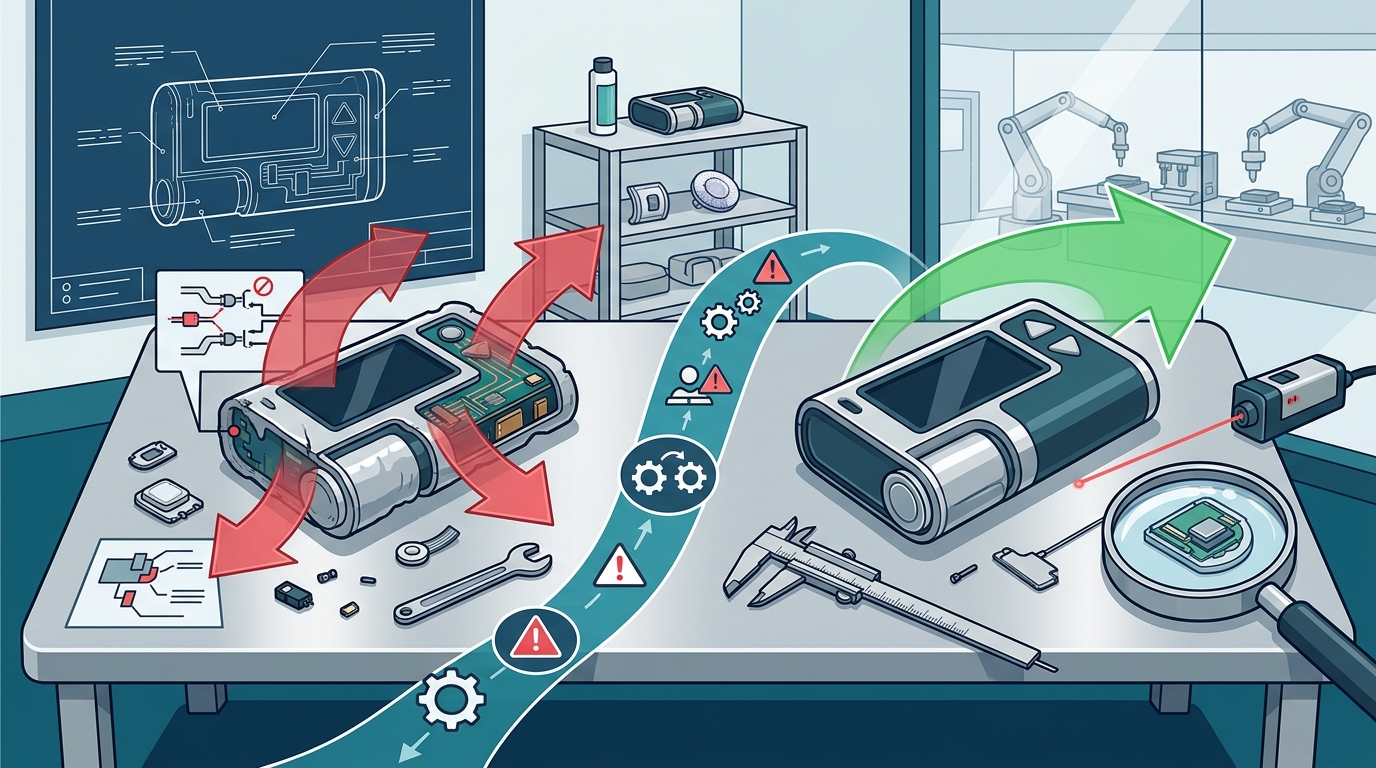
Risk mitigation in medical devices is governed by standards such as ISO 14971. This standard requires a systematic approach to identifying, analyzing, and controlling risks throughout the product lifecycle. Your prototype strategy must directly address the highest-risk elements of your device.
High-Risk Components Require Early Prototyping
If your device contains novel materials, complex mechanics, or critical software algorithms, these components should be prototyped and tested early. Delaying the validation of high-risk elements increases the probability of catastrophic failure later in the development cycle. By isolating these components in early Alpha prototypes, you can mitigate technical risk before it impacts the overall program timeline.
Usability Risks Demand Human Factors Testing
Usability errors are a leading cause of medical device recalls. Prototypes must be evaluated by representative users in simulated clinical environments. This process, known as Human Factors engineering, identifies risks related to user confusion, error-prone interfaces, or ergonomic issues. A65 Consulting emphasizes that Human Factors & Usability is not a final step but an iterative process that begins with early prototype testing.
Manufacturing Risks Are Mitigated Through DFM
Design for Manufacturing (DFM) reviews during the Beta prototype phase help identify risks related to production scalability. Issues such as tight tolerances, difficult assembly sequences, or material sourcing constraints are identified and resolved before tooling is cut. This proactive approach saves millions in potential rework costs and ensures a smoother transition to mass production.
The Benefits of Iterative Development
Iterative development is a methodology where prototypes are built, tested, analyzed, and refined in repeated cycles. This approach is superior to linear development because it allows for continuous risk mitigation and course correction.
Early Failure Detection
In an iterative model, failures are detected early when they are least expensive to fix. Each prototype cycle provides new data that informs the next design iteration. This reduces the "cost of change" curve, which typically rises exponentially as a project progresses. A65 Consulting’s approach ensures that verification is a system, not a phase, allowing for continuous validation throughout the development process.
Enhanced Stakeholder Alignment
Regular prototype reviews keep stakeholders, including investors, regulatory consultants, and clinical advisors, aligned with the project’s progress. Tangible prototypes facilitate better communication than drawings or specifications alone. This alignment is crucial for maintaining momentum and securing continued funding or support.
Adaptability to Changing Requirements
Medical device requirements often evolve as new clinical insights or regulatory guidance emerge. An iterative prototype strategy allows teams to adapt quickly to these changes without derailing the entire project. This flexibility is a key advantage in the fast-paced medical device industry.
Regulatory Compliance and Documentation
Regulatory compliance is a non-negotiable aspect of medical device development. Your prototype strategy must be designed to generate the evidence required by regulatory bodies like the FDA and notified bodies in Europe.
Traceability from Requirements to Prototypes
Every prototype must be traceable to specific design requirements. This traceability is essential for demonstrating that the device meets its intended use. A65 Consulting maintains rigorous documentation standards to ensure that every design decision is justified and recorded. This includes linking prototype test results back to the original design inputs.
Design History File (DHF) Integration
The Design History File (DHF) is a compilation of records that documents the history of the device design. Prototypes and their associated test data are critical components of the DHF. Incomplete or disorganized DHF documentation is a common cause of regulatory delays. By integrating prototype documentation into the DHF from the start, you streamline the regulatory submission process.
Risk Management File Updates
The Risk Management File must be updated throughout the development process to reflect new risks identified during prototype testing. This dynamic process ensures that risk controls are effective and that residual risks are acceptable. A65 Consulting’s expertise in Regulatory & Risk Management ensures that your risk analysis evolves with your design.
Comparing Prototyping Strategies
Selecting the right prototyping strategy involves balancing speed, cost, and fidelity. The table below compares common approaches to help you make an informed decision.
| Strategy | Fidelity | Cost | Best Use Case | Risk Mitigation Focus |
|---|---|---|---|---|
| Rapid 3D Printing | Low to Medium | Low | Alpha prototypes, form and fit checks | Early detection of geometric and assembly issues |
| CNC Machining | High | Medium | Beta prototypes, functional testing | Material property validation and durability testing |
| Soft Tooling | High | High | Pre-production validation, usability testing | Manufacturing process validation and supply chain risk |
| Hard Tooling | Production Grade | Very High | Regulatory verification, clinical trials | Final design verification and regulatory compliance |
Key Takeaways
- Prototyping is Risk Mitigation: Early and iterative prototyping reduces the cost and impact of design changes by identifying flaws when they are cheapest to fix.
- Align with ISO 14971: Your prototype strategy must directly address the highest-risk components of your device, including usability and manufacturing risks.
- Verification is Continuous: Treating verification as a system rather than a phase ensures that regulatory evidence is generated throughout development, not just at the end.
- A65’s Track Record: A65 Consulting has helped clients develop products that contributed to more than $300M of projected new product revenue and achieved 90% on-time completion of mission-critical projects.
- Documentation is Critical: Maintaining a robust Design History File (DHF) and Risk Management File is essential for successful regulatory submissions.
- Human Factors Matter: Usability testing with Beta prototypes is crucial for preventing user error and ensuring clinical safety.
- Expert Partnership: Engaging a partner with decades of experience, like A65 Consulting, can help navigate the complexities of medical device development.
Frequently Asked Questions
How do I choose between rapid prototyping and CNC machining?
Rapid prototyping, such as 3D printing, is ideal for Alpha prototypes where speed and low cost are priorities. CNC machining is better for Beta prototypes where material properties and functional fidelity are critical for testing.
What is the role of prototyping in FDA 510(k) submissions?
Prototypes provide the physical evidence and test data required to demonstrate substantial equivalence to a predicate device. Verification prototypes built under controlled conditions are essential for this process.
How does A65 Consulting support risk management?
A65 Consulting integrates risk management into every phase of development, from initial hazard analysis to final verification testing. Our team ensures that your Risk Management File is comprehensive and compliant with ISO 14971.
Can you help with usability testing?
Yes, we specialize in Human Factors & Usability engineering. We help design and execute usability tests with representative users to identify and mitigate risks related to user error.
What is the typical timeline for prototyping?
Timelines vary based on complexity, but A65 Consulting aims for 90% on-time completion of mission-critical projects. We work closely with clients to establish realistic milestones and manage expectations.
Do you offer ongoing engineering support?
Yes, we provide engineering leadership and expert support to help teams navigate complex product development. We can supplement your team’s capacity or provide full-service engineering from concept to launch.
How do you handle intellectual property?
We treat client intellectual property with the utmost confidentiality. Our team signs strict NDAs and follows rigorous data security protocols to protect your innovations.
Partner with A65 Consulting
Choosing the right prototype strategy is a critical decision that impacts your device’s success, regulatory approval, and market launch. A65 Consulting offers the expertise and experience to guide you through every stage of this process. From concept to design and delivery, we help you mitigate risk and deliver viable products.
Ready to discuss your project? Book a consultation with our team of expert engineers. We look forward to helping you transform your device concept into a reality.