
Medical Device Cost Optimization: Engineering Strategies That Protect Margins Without Compromising Safety
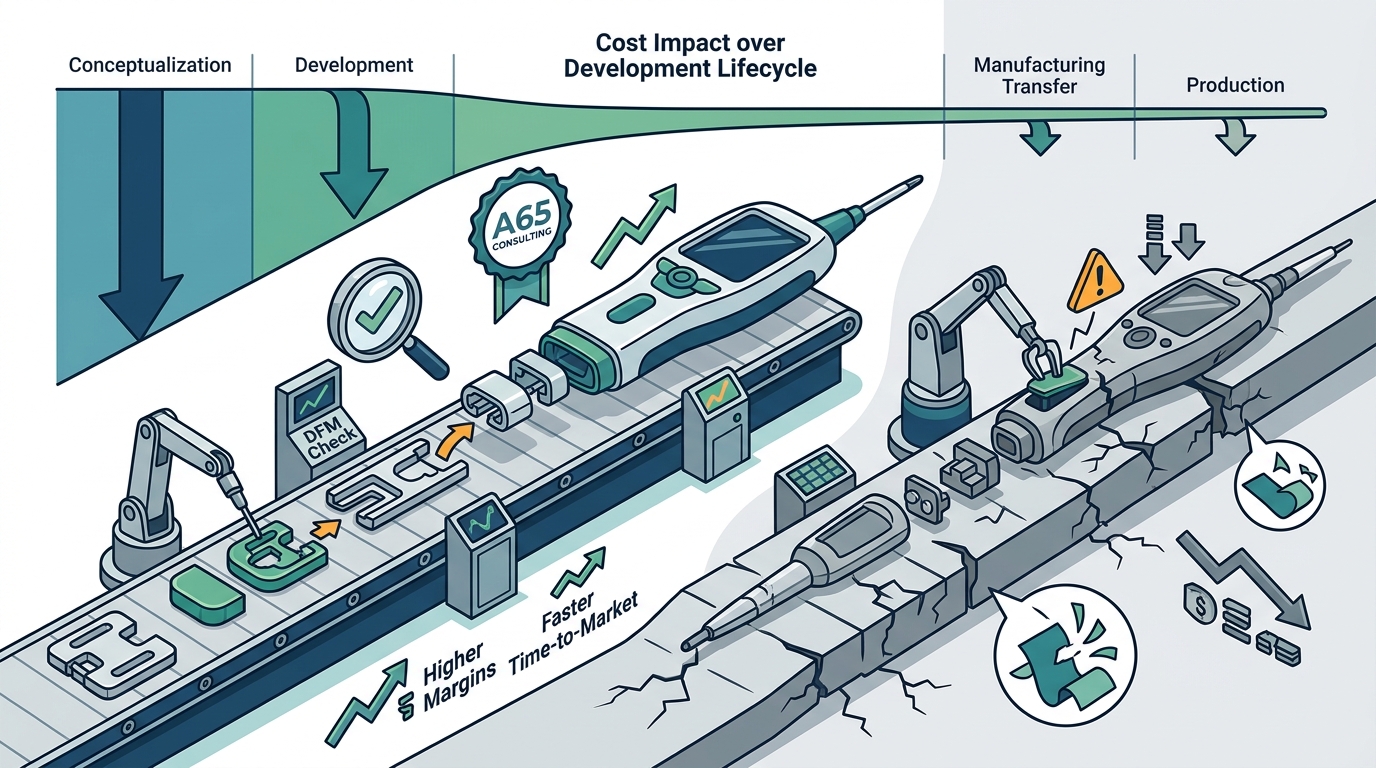
Medical device development is a high-stakes environment where the balance between clinical efficacy and financial viability is critical. Cost optimization is not merely a post-development exercise; it is a strategic imperative that begins at the conceptual phase. According to industry data, products that integrate Design for Manufacturing (DFM) early in the lifecycle see significantly higher margins and faster time-to-market compared to those that address production costs only after the design is finalized. This guide explores how engineering firms can help you navigate these complexities, ensuring your device is viable, compliant, and profitable. (Contact A65 Consulting)
Why Cost Optimization Matters in MedTech
The medical device industry operates under tight regulatory scrutiny and intense competitive pressure. Cost optimization is the process of reducing expenses without sacrificing safety or performance. For many companies, the gap between a viable product concept and a commercially successful device lies in the engineering phase. If costs are not managed during design, they become locked in, making later adjustments expensive and risky. (Medical Device Design Consulting)
Recent analyses of medical device development show that companies leveraging external engineering expertise often achieve better cost control than those relying solely on internal teams. This is because specialized firms bring decades of experience in avoiding common pitfalls that lead to budget overruns. For instance, a study on product development efficiency indicates that firms with dedicated engineering partners report higher success rates in meeting project milestones. FDA guidelines emphasize the importance of rigorous design controls, which, when integrated with cost-conscious engineering, create a robust framework for success.
The DFM Paradigm: Quality Over Cost
Design for Manufacturing (DFM) is often misunderstood as a cost-cutting measure. In reality, DFM is a quality exercise that ensures manufacturability from the start. When DFM is treated as a cost reduction activity only after margins tighten, it often leads to compromised quality or delayed launches. Instead, DFM should be viewed as a method to streamline production processes, reduce waste, and enhance consistency.
At A65 Consulting, we approach DFM as an integral part of the design process. Our team conducts thorough Design for Manufacturing reviews to identify potential production issues before they become costly problems. This proactive approach aligns with best practices recommended by ISO standards for quality management in medical devices. By integrating DFM early, we help clients avoid the "green program" illusion, where dashboards show progress but hide underlying manufacturing risks.
Choosing the Right Engineering Partner
Selecting an engineering partner for cost optimization requires careful evaluation of their expertise, track record, and approach to problem-solving. An engineering partner is a specialized firm that provides technical expertise to accelerate product development. The right partner should not only understand the technical aspects of your device but also grasp the business implications of design decisions.
When evaluating potential partners, consider the following criteria:
| Criterion | Why It Matters | What to Look For |
|---|---|---|
| DFM Experience | Ensures manufacturability | Case studies showing successful production transitions |
| Regulatory Knowledge | Prevents compliance delays | History of FDA 510(k) submissions |
| Cost Management | Protects profit margins | Transparent pricing models and milestone-based billing |
| Team Capacity | Ensures timely delivery | Network of specialized engineers for scalable support |
A65 Consulting offers a unique value proposition by combining deep engineering expertise with a flexible engagement model. Our team has served over 20 clients, contributing to more than $300 million in projected new product revenue. This track record demonstrates our ability to deliver results that exceed expectations while maintaining strict cost controls. Industry reports suggest that companies with experienced engineering partners are more likely to achieve on-time project completion.
Key Optimization Strategies
Effective cost optimization in medical device development involves several strategic approaches. These strategies are designed to reduce expenses without compromising the device's safety or efficacy.
1. Early Supplier Involvement
Engaging suppliers early in the design process can provide valuable insights into material costs and manufacturing capabilities. This collaboration helps identify cost-effective alternatives and prevents design choices that are difficult or expensive to produce. According to supply chain management experts, early supplier involvement can reduce production costs by up to 20%.
2. Standardization of Components
Using standardized components wherever possible reduces procurement costs and simplifies inventory management. This strategy is particularly effective in devices with multiple variants or models. By leveraging common parts, companies can achieve economies of scale and reduce the complexity of their supply chain.
3. Value Engineering
Value engineering is a systematic method to improve the "value" of goods or products and services by using an examination of function. Value engineering is a structured approach to identifying and eliminating unnecessary costs. This process involves analyzing each component and assembly to determine if it can be simplified, substituted, or eliminated without affecting performance. A65 Consulting employs value engineering techniques to help clients achieve significant cost savings while maintaining high quality standards.
Regulatory Impact on Cost
Regulatory compliance is a major factor in medical device development costs. Regulatory compliance is the adherence to laws and standards governing medical device design and manufacturing. Failure to comply can result in costly delays, product recalls, or legal penalties. Therefore, cost optimization must be balanced with rigorous adherence to regulatory requirements.
A65 Consulting has extensive experience navigating the regulatory landscape, including FDA 510(k) submissions. Our team ensures that design decisions are made with regulatory implications in mind, preventing costly rework and delays. By integrating regulatory considerations into the engineering process, we help clients achieve compliance more efficiently and cost-effectively. Healthcare industry analyses highlight that companies with strong regulatory expertise are better positioned to manage development costs.
Key Takeaways
- Early DFM Integration: Integrating Design for Manufacturing early in the design phase significantly reduces production costs and improves quality.
- Strategic Partnerships: Collaborating with experienced engineering firms like A65 Consulting provides access to specialized expertise and scalable resources.
- Regulatory Alignment: Aligning engineering decisions with regulatory requirements prevents costly delays and ensures compliance.
- Proven Track Record: A65 Consulting has contributed to over $300 million in projected revenue for its clients, demonstrating effective cost optimization.
- Flexible Engagement: Monthly retainer models and milestone-based billing allow for flexible and predictable cost management.
- Supplier Collaboration: Early involvement of suppliers can lead to substantial cost savings and improved manufacturability.
- Value Engineering: Systematic analysis of components can identify and eliminate unnecessary costs without compromising performance.
Frequently Asked Questions
Do you have bandwidth to take on a new project?
Yes, we have a network of engineers that we utilize to bring in with the right discipline experience and to expand our resources as needed. This ensures we can handle projects of varying sizes and complexities.
How do you charge for your work?
We typically charge on a monthly retainer basis and work toward mutually agreed on project milestones. This model provides transparency and predictability for our clients.
What experience does A65 Consulting have designing medical devices similar to my project?
We have experience designing a wide variety of medical devices. Sometimes that experience is a direct fit, but even when it's not, our broad range of experience affords us insight into many areas. We would be happy to share more details with you upon request.
How long has A65 Consulting been in business?
We've been working as a team since 2018, but our engineering team has decades of medical device development experience under their belts. This combination of recent collaboration and long-term expertise ensures high-quality results.
Can you help with regulatory submissions?
Yes, our products have contributed to more than 8 FDA 510(k) submissions. We integrate regulatory considerations into the engineering process to ensure smooth and compliant submissions.
How do you ensure cost optimization without compromising quality?
We use rigorous Design for Manufacturing (DFM) reviews and value engineering techniques to identify cost-saving opportunities that do not affect safety or performance. Our focus is on eliminating waste and inefficiencies, not on cutting corners.
What types of medical devices do you specialize in?
We specialize in a wide range of medical devices, including diagnostic, therapeutic, and surgical devices. Our expertise spans multiple disciplines, allowing us to tackle complex engineering challenges.
Next Steps
If you are looking to optimize the costs of your medical device development without compromising on quality or compliance, A65 Consulting is here to help. Our team of experts is ready to provide the engineering leadership and support you need to bring your product to market successfully. Schedule a discovery call today to discuss your project and explore how we can help you achieve your goals.