

Reducing the bill of materials cost for a medical device is not simply a matter of negotiating lower supplier prices. The largest and most durable savings usually come from engineering decisions made before the design is released: selecting the right architecture, eliminating unnecessary part complexity, choosing scalable manufacturing processes, and creating a supply chain that can support the product throughout its lifecycle.
For medical device companies, cost reduction must be balanced against safety, performance, usability, reliability, biocompatibility, sterilization, cybersecurity, and regulatory obligations. A cheaper component is not a successful cost reduction if it introduces a new hazard, increases failure rates, creates production delays, or requires extensive rework and regulatory testing.
This guide explains how product teams can reduce medical device BOM cost through a disciplined, risk-based engineering process. It also outlines when component substitutions and manufacturing changes may require additional verification, validation, documentation, or regulatory assessment.
What medical device BOM cost really includes
A bill of materials is the structured list of components, materials, subassemblies, and sometimes consumables required to build a finished device. Depending on the product, it may include printed circuit boards, sensors, batteries, displays, cables, fasteners, molded housings, machined parts, adhesives, seals, tubing, labels, sterile barriers, packaging components, and production-specific materials.
However, the purchase price shown in a BOM is only one part of the cost equation. A component can have a low unit price but create high total cost through difficult assembly, excessive inspection, low yield, long lead times, special tooling, supplier qualification work, or frequent obsolescence. A useful cost review therefore evaluates both the direct BOM price and the downstream effects of each design decision.
Cost categories to evaluate
- Direct component cost: The quoted price of each purchased or manufactured part.
- Tooling and setup: Molds, fixtures, dies, programming, process qualification, and production setup.
- Assembly cost: Labor, machine time, alignment steps, torque operations, soldering, bonding, and inspection.
- Quality cost: Scrap, rework, incoming inspection, in-process testing, supplier corrective actions, and complaint investigation.
- Supply-chain cost: Freight, minimum order quantities, inventory carrying costs, expediting, and secondary sourcing.
- Lifecycle cost: Obsolescence, engineering changes, field replacement, serviceability, and future manufacturing transfer.
The World Health Organization identifies affordability, availability, appropriateness, and accessibility as important considerations when improving access to medical technologies. For product developers, this means cost optimization should support a device that is affordable and reliably available while remaining safe and fit for its intended use. WHO guidance on medical device affordability and access provides useful context for this broader objective.
Start with the cost drivers, not the entire BOM
Most device BOMs contain a small number of components that account for a disproportionately large share of material cost or manufacturing risk. These may include a proprietary sensor, battery pack, sterile component, custom molded housing, precision actuator, medical-grade connector, display, or specialized electronic module.
Before redesigning anything, create a cost-driver analysis that ranks parts by more than unit price. A practical scorecard can include unit cost, annual spend, lead time, supplier concentration, defect history, tooling dependence, regulatory criticality, and ease of substitution.
| Component | Unit cost | Annual volume | Annual spend | Primary concern |
|---|---|---|---|---|
| Custom sensor module | $42 | 20,000 | $840,000 | High price and single-source dependence |
| Injection-molded housing | $8.50 | 20,000 | $170,000 | Long cycle time and cosmetic scrap |
| Specialized connector | $3.20 | 20,000 | $64,000 | Limited availability |
| Fastener family | $0.18 | 20,000 | $3,600 | Multiple sizes increase assembly complexity |
In this example, redesigning the fastener family may improve assembly efficiency, but the custom sensor module is the first target for a major BOM reduction. This kind of prioritization helps teams focus engineering resources where they can produce measurable savings.
12 engineering strategies for reducing medical device BOM cost
1. Establish cost targets at the concept stage
Set a target cost before detailed design decisions become difficult to reverse. The target should be connected to expected selling price, reimbursement conditions, manufacturing volume, gross-margin requirements, service assumptions, and the device's intended market.
Use a should-cost model to estimate what the product ought to cost based on materials, process steps, labor, yield, tooling, and supplier margins. This gives the team a fact-based reference for evaluating design alternatives and supplier quotations.
2. Simplify the product architecture
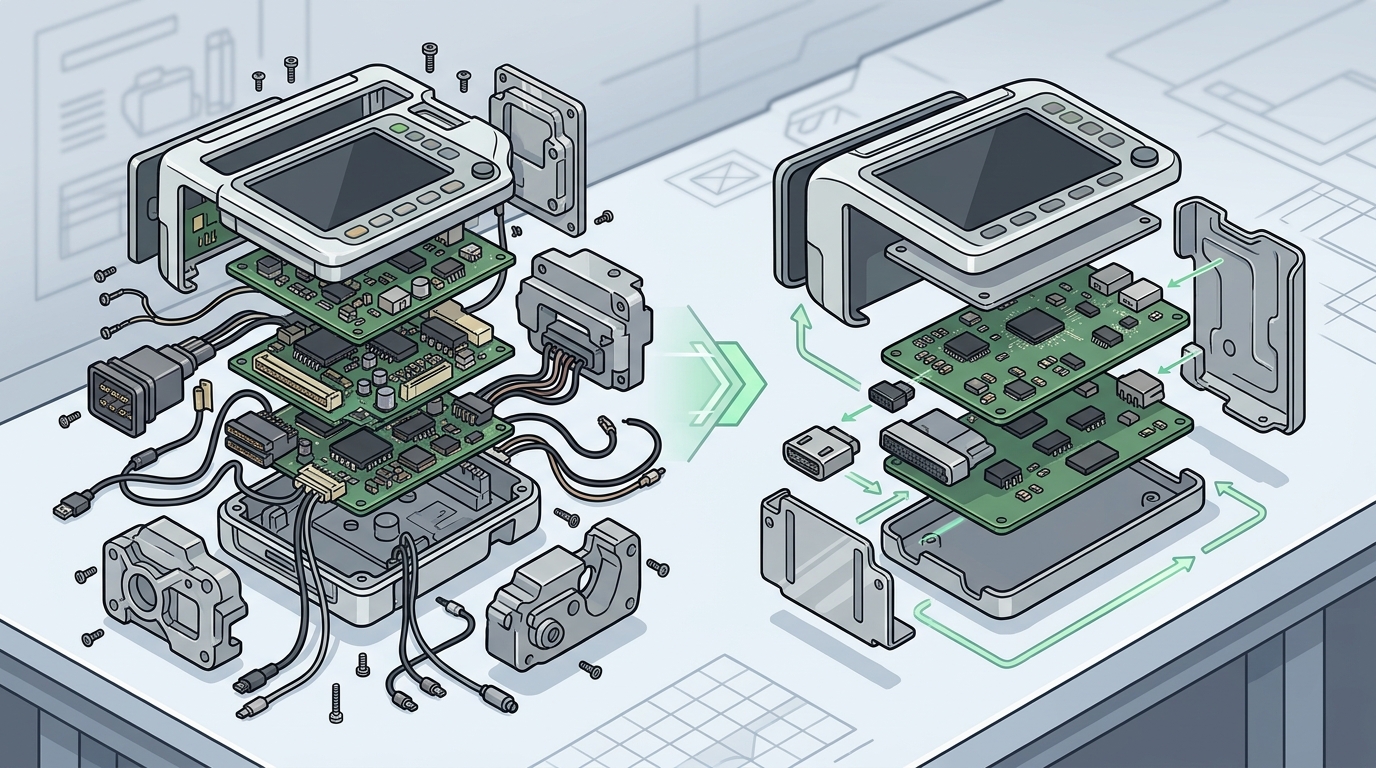
Every subsystem, interface, connector, fastener, adjustment, and unique component adds cost or risk. Review whether the device can achieve the same clinical function with fewer modules or fewer interfaces.
Architectural simplification may involve combining brackets, reducing cable paths, integrating a strain-relief feature into a molded housing, or relocating electronics so that a separate enclosure is unnecessary. Simplification should be evaluated against heat dissipation, serviceability, electromagnetic compatibility, cleaning, sterilization, and risk-control requirements.
3. Replace unnecessary custom parts with qualified commercial components
Custom components can provide an exact fit, but they often carry engineering, tooling, qualification, and supply-chain premiums. Where requirements allow, evaluate off-the-shelf components with established performance and availability.
Commercial components still need to be assessed for reliability, operating environment, material compatibility, electrical safety, cleanability, sterilization exposure, and supplier controls. The objective is not to use the cheapest available part; it is to select a component that meets the design inputs with the lowest justified total cost.
4. Standardize components across products
Using common fasteners, connectors, batteries, sensors, seals, cables, and electronic subassemblies across a product family can reduce cost beyond the individual part price. Standardization can increase purchasing volume, simplify incoming inspection, reduce inventory variety, shorten training, and make service more efficient.
Create an approved component library that records technical specifications, approved suppliers, lifecycle status, environmental limits, and applicable verification evidence. Standardization is most effective when introduced before multiple product variants develop independent part families.
5. Reduce the number of unique parts
Part-count reduction lowers purchasing activity, inventory complexity, assembly time, and opportunities for error. Conduct a structured review of every component and ask:
- Does this part perform a required function?
- Can an existing part perform the same function?
- Can two parts be combined without creating a new manufacturing or service problem?
- Can a feature be formed into an adjacent part?
- Can the part be eliminated through a change in assembly sequence?
Part-count reduction should be supported by risk analysis. Removing a component that serves as a critical isolation barrier, retention feature, grounding path, or risk control may create unacceptable consequences.
6. Design for manufacturing and assembly
Design for manufacturing and assembly, commonly called DFM or DFMA, addresses how efficiently a product can be produced. Good DFM reduces unnecessary tolerances, difficult orientations, manual adjustments, excessive handling, scrap, and rework.
Practical DFM actions include using self-locating features, reducing the number of assembly orientations, designing for automated dispensing or fastening, avoiding cosmetic surfaces that are difficult to protect, and specifying tolerances that match the actual capability of the selected process.
DFM is also a quality activity. A design that is easier to build consistently is often less vulnerable to variation and operator-dependent errors. A65 Consulting's engineering resources can help teams connect design decisions with manufacturing and lifecycle cost considerations.
7. Avoid over-specification
Over-specification occurs when a drawing, material specification, finish, tolerance, connector, or test requirement exceeds what the device actually needs. Tight tolerances can increase machining time and inspection cost. Premium materials can add expense without improving safety or performance. Custom finishes can create additional process steps and supplier constraints.
Review each requirement against user needs, design inputs, risk controls, applicable standards, and verification evidence. Do not relax a requirement solely to reduce cost; instead, determine whether the requirement is technically justified and whether an alternative can satisfy it.
8. Select materials using total performance requirements
Material selection should account for mechanical strength, fatigue, chemical resistance, biocompatibility, sterilization, temperature, electrical properties, cleanability, appearance, availability, and manufacturing process. A lower-cost resin may fail after repeated sterilization. A cheaper metal may increase wear or corrosion. A premium material may be unnecessary for a non-patient-contact structural part.
Compare materials using a requirements matrix rather than price alone. For patient-contacting materials, evaluate the applicable biological safety strategy and required evidence before making a substitution.
9. Match production volume to the manufacturing process
The lowest-cost process depends on annual volume, product life, geometry, material, tolerance, tooling investment, and required throughput. CNC machining may be appropriate for prototypes or low-volume metal parts, while injection molding may become more economical for high-volume polymer housings after tooling costs are considered.
Other options may include sheet metal fabrication, stamping, die casting, extrusion, thermoforming, additive manufacturing, laser cutting, or insert molding. Compare the complete economic model, including tooling amortization, cycle time, scrap, secondary operations, inspection, and expected yield.
10. Design for scalable manufacturing transfer
A prototype process is not automatically a production process. Prototype parts may be hand-finished, manually aligned, or made with temporary fixtures. Those methods can hide cost and quality problems that become visible at scale.
Involve manufacturing engineering and potential suppliers before design freeze. Confirm that production equipment, tooling, process controls, inspection methods, and operator training can support the intended volume. Early manufacturing input is especially valuable for components with high cosmetic expectations, tight tolerances, complex bonding, or sterilization constraints.
11. Collaborate with suppliers before finalizing the design
Qualified suppliers often know how to reduce cost through geometry changes, material substitutions, tooling adjustments, process consolidation, or improved production sequencing. Request supplier design-for-process feedback before drawings and specifications are locked.
Supplier collaboration should not mean accepting an unverified substitution. Establish clear requirements for change notification, quality agreements, traceability, process validation, incoming controls, and documentation. A supplier proposal becomes a viable cost-reduction option only after engineering and quality teams confirm that it meets the device's requirements.
12. Optimize packaging and accessory content
Packaging, cables, chargers, instructions, protective inserts, labels, and accessories can represent a meaningful portion of total material cost. Review whether packaging can use fewer unique materials, smaller dimensions, or a more efficient pack-out without compromising protection, sterility, shelf life, labeling, or transportation performance.
Accessory rationalization can also reduce BOM cost. If a reusable accessory is included in every package but only needed by a subset of users, consider whether the commercial model or product configuration can be changed without impairing the intended use.
How to choose a lower-cost manufacturing process
Manufacturing process selection should be based on the complete production scenario rather than a single quoted unit price. A process with a lower nominal part cost may require expensive tooling, specialized inspection, high minimum order quantities, or costly secondary operations.
Questions to ask during process selection
- What is the expected annual and lifetime production volume?
- How long will the product remain on the market?
- What tooling investment is required?
- What is the expected cycle time and throughput?
- How much dimensional or cosmetic variation is expected?
- Can the process be validated and controlled consistently?
- What secondary operations are required?
- Can the supplier support future volume increases?
- What happens if the supplier or tooling becomes unavailable?
For example, a machined aluminum bracket may be appropriate for early prototypes, but a stamped or die-cast version could be more economical at production volume. Conversely, investing in a mold too early may be inefficient if the design is still changing or annual demand is uncertain.
Build savings and resilience into sourcing
Use dual sourcing selectively
Dual sourcing can reduce dependence on one supplier and protect production from shortages, capacity limitations, or unexpected price increases. It can also provide useful commercial leverage during negotiations.
However, dual sourcing is not automatically cheaper. Maintaining two qualified suppliers may increase audits, incoming inspection, tooling duplication, validation work, and inventory complexity. Use it for components whose interruption would create significant business or patient-safety consequences, and confirm that both sources can meet equivalent specifications.
Evaluate lifecycle and obsolescence risk
A low-cost electronic component may become expensive if it is near end-of-life or available only through brokers. For electronics, review manufacturer lifecycle status, authorized distribution, second-source options, firmware dependencies, and long-term availability.
For mechanical and polymer components, evaluate resin availability, tooling ownership, material substitutions, and regional manufacturing capacity. A component with a slightly higher initial price may have a lower lifecycle cost when it reduces redesign and requalification risk.
Control inventory without creating shortages
Inventory strategy should reflect demand stability, lead time, supplier reliability, minimum order quantities, and component criticality. Just-in-time purchasing may lower carrying costs for stable, readily available components, but it can increase exposure to disruption when forecasts are uncertain or lead times are long.
Maintain clear lot, batch, and supplier traceability where required by the quality system. ISO 13485 is specifically designed for quality management in the design and manufacture of medical devices and emphasizes controls appropriate to regulatory and safety requirements, including supply-chain considerations. Learn more about ISO 13485 from ISO.
Manage BOM cost changes through design controls
A component substitution or manufacturing change can affect safety, effectiveness, reliability, usability, sterilization, biocompatibility, electromagnetic compatibility, software behavior, or shelf life. It should therefore be evaluated as a controlled design change rather than treated as an informal purchasing decision.
FDA design-control guidance describes the need to identify, document, review, approve, and appropriately verify or validate design changes before implementation. The FDA also explains that design controls include risk analysis, design inputs and outputs, verification, validation, transfer to production, change control, and documentation. FDA design control guidance provides additional detail.
A risk-based change assessment should consider
- Whether the changed part performs a safety-related or essential performance function.
- Whether the material contacts the patient, user, medication, or sterile pathway.
- Whether dimensional, electrical, thermal, chemical, or mechanical characteristics change.
- Whether the supplier, manufacturing site, process, or inspection method changes.
- Whether sterilization, packaging, shelf life, or transportation performance may be affected.
- Whether existing risk controls remain effective.
- Whether new verification, validation, process validation, or clinical evidence is needed.
- Whether a premarket submission, supplement, notification, or other regulatory action may be required.
For a device already cleared through the 510(k) pathway, FDA explains that a new 510(k) may be needed when a modification to design, components, manufacturing method, or intended use could significantly affect safety or effectiveness. FDA's guidance on determining whether a new 510(k) is required should be considered alongside the manufacturer's regulatory strategy.
At a minimum, maintain the change rationale, affected drawings and specifications, supplier information, risk analysis, verification and validation plan, test results, approvals, implementation date, and updated production documentation. Cost savings are not realized if a poorly controlled change leads to field failures, recalls, rejected lots, or regulatory findings.
A practical BOM cost-reduction workflow
- Baseline the current product: Export the approved BOM, supplier quotations, annual volume, labor assumptions, scrap data, and quality history.
- Rank cost and risk drivers: Identify high-spend, single-source, high-defect, long-lead, and regulatory-critical components.
- Define the non-negotiables: Document clinical, safety, performance, usability, material, sterilization, and regulatory requirements.
- Generate alternatives: Consider architecture changes, standard parts, material options, process changes, supplier alternatives, and packaging simplification.
- Review with manufacturing and suppliers: Obtain practical feedback on tooling, yield, assembly, inspection, capacity, and lifecycle support.
- Perform risk and regulatory assessment: Determine the effect of each proposed change on hazards, essential performance, verification, validation, and submissions.
- Prototype and test strategically: Test the highest-risk assumptions first rather than waiting until the complete redesign is finished.
- Update controlled documentation: Revise drawings, BOMs, specifications, work instructions, inspection plans, supplier records, and risk files.
- Confirm production economics: Validate quoted savings using pilot builds, actual yields, assembly time, scrap, and supplier performance.
- Monitor after implementation: Track cost, defects, complaints, returns, supplier performance, and any unintended changes in product behavior.
A useful project dashboard should report more than unit-price savings. Include total annualized savings, one-time engineering and tooling cost, payback period, yield improvement, assembly-time reduction, supply risk, regulatory impact, and implementation status.
Key takeaways
- Reduce total cost, not just unit price: Include tooling, assembly, quality, inventory, logistics, and lifecycle effects.
- Start early: Product architecture and design decisions create the largest opportunity for sustainable cost reduction.
- Target the biggest drivers first: Use annual spend, risk, lead time, and supplier concentration to prioritize work.
- Simplify carefully: Fewer parts, interfaces, fasteners, and process steps can reduce cost and variation when risk is controlled.
- Use DFM as a quality strategy: Designs that are easier to manufacture consistently often reduce scrap, rework, and inspection burden.
- Collaborate with suppliers before design freeze: Process expertise can reveal savings that internal teams may not see.
- Plan for the full product lifecycle: Obsolescence, dual sourcing, service, and future manufacturing transfer affect real BOM cost.
- Control every change: Component substitutions and manufacturing changes require documented risk assessment and appropriate verification or validation.
- Measure realized savings: Confirm that expected savings appear in production without compromising safety, performance, or compliance.
Frequently asked questions
What is the fastest way to reduce medical device BOM cost?
The fastest opportunities are often found by reviewing high-spend components, eliminating unnecessary part variants, standardizing common components, reducing over-specified tolerances, and improving assembly steps. The best target depends on the device's architecture, production volume, risk profile, and regulatory status. A cost-driver analysis should be completed before selecting a redesign strategy.
Can a medical device company replace a component with a cheaper alternative?
Yes, but the replacement must be evaluated against the device's design inputs, risk controls, safety and performance requirements, supplier controls, and applicable regulatory obligations. A cheaper component may require additional verification, validation, process qualification, biocompatibility assessment, sterilization testing, or regulatory review.
Does changing a component always require a new 510(k)?
No. A new 510(k) is not automatically required for every component change. The manufacturer must assess whether the modification could significantly affect safety or effectiveness or change the intended use. The determination should be documented using the applicable FDA guidance and the company's regulatory procedures.
How much can DFM reduce medical device manufacturing cost?
The savings vary widely by product and process. DFM may reduce material waste, assembly labor, scrap, rework, cycle time, inspection burden, or tooling complexity. Avoid relying on a universal percentage; calculate savings from the specific design and manufacturing data for the device.
Should medical device designs use off-the-shelf components?
Off-the-shelf components can reduce custom engineering, tooling, and sourcing costs, but they still need to meet the device's requirements. Evaluate operating conditions, reliability, material compatibility, sterilization, electrical safety, cybersecurity where applicable, supplier quality, lifecycle status, and availability before approval.
Is dual sourcing always the best supply-chain strategy?
No. Dual sourcing can improve resilience for critical components, but it can also increase qualification, inspection, documentation, and inventory complexity. Use a risk-based approach that compares the cost of maintaining a second source with the operational and patient-impact consequences of a supply interruption.
What documentation should support a BOM cost-reduction change?
Documentation commonly includes the change request, rationale, affected BOM and drawings, supplier information, risk analysis, design-review records, verification and validation plans and results, process-validation evidence where applicable, regulatory assessment, approvals, implementation instructions, and updated production and quality records.
How can A65 Consulting support medical device cost optimization?
A65 Consulting supports medical device companies across research, concept development, detailed engineering, manufacturing transfer, and cost optimization. Its multidisciplinary capabilities can help identify cost drivers, simplify designs, evaluate materials and components, collaborate with suppliers, improve manufacturability, and manage verification and change-control needs. Explore A65 Consulting's medical device engineering services.
Reduce BOM cost without compromising the device
Medical device BOM cost reduction is most effective when engineering, manufacturing, quality, regulatory, and supply-chain decisions are made together. The goal is not simply to purchase cheaper parts. It is to create a product that delivers the required clinical function with fewer unnecessary components, more efficient processes, reliable suppliers, and controlled lifecycle costs.
A65 Consulting provides medical device design, consulting, and engineering support from early concept through product development, manufacturing transfer, and optimization. If your team is preparing a new device, responding to margin pressure, or evaluating a component substitution, contact A65 Consulting to discuss your program.