
Hiring a medical device design firm is not simply a matter of finding engineers who can create a prototype. The right partner must help translate clinical needs into defensible requirements, manage technical risk, produce reliable design evidence, and prepare the product for repeatable manufacturing.
That distinction matters because medical device development is governed by interconnected design, quality, risk-management, usability, and manufacturing activities. The U.S. Food and Drug Administration identifies design inputs, design outputs, risk analysis, design reviews, verification, validation, design transfer, change control, and design-history-file documentation as core elements of the development process. ([fda.gov](https://www.fda.gov/medical-devices/investigational-device-exemption-ide/ide-related-topics?utm_source=openai))
This guide explains what to examine before selecting an engineering partner, what questions to ask during interviews, and which warning signs should make you reconsider a proposal. A65 Consulting supports medical device companies across product development, engineering leadership, manufacturing transfer, and cost optimization. Learn more about the company’s capabilities on the A65 Consulting About page.
1. Start with regulatory and quality-system fit
A design firm should understand the regulatory pathway before it commits to a technical direction. The partner does not necessarily need to serve as your regulatory consultant of record, but its engineers should know how intended use, device classification, predicate strategy, standards, risk controls, labeling, software, biocompatibility, sterilization, and manufacturing processes affect the design.
FDA design-control expectations make this an operational issue, not merely a documentation issue. Design inputs should account for user and patient needs, intended use, performance, safety, environmental conditions, human factors, risk analysis, standards, packaging, sterility, and manufacturing considerations. Risk analysis performed early can help identify unreasonable risks while design changes are still relatively inexpensive. ([fda.gov](https://www.fda.gov/medical-devices/investigational-device-exemption-ide/ide-related-topics?utm_source=openai))
Questions to ask
- Which regulatory pathways have your engineers supported?
- How do you connect intended use and user needs to measurable design inputs?
- How are hazards, foreseeable misuse, and risk controls incorporated into design decisions?
- Who owns the risk-management file, requirements traceability, and design-history-file inputs?
- How do you handle changes when a new risk is discovered?
What a strong answer sounds like: The firm should be able to describe a repeatable process in which regulatory assumptions and risk controls influence architecture, materials, interfaces, testing, and manufacturing choices. Be cautious if risk analysis appears only as a late-stage spreadsheet exercise.
2. Evaluate technical depth beyond the prototype
A visually impressive prototype can conceal unresolved engineering problems. During due diligence, determine whether the firm can perform the analysis required to make the device robust, not just attractive or functional in a controlled demonstration.
Depending on the product, relevant capabilities may include mechanical design, systems engineering, tolerance analysis, finite element analysis, computational modeling, materials selection, thermal analysis, electrical integration, software coordination, packaging, reliability engineering, and test-method development. Ask the firm to explain how it decides when analysis, prototyping, or empirical testing is appropriate.
For example, A65 Consulting describes projects involving analytical modeling, finite element analysis, prototype construction, test iteration, surgical-probe design, dental instruments, RF ablation probes, and augmented-reality surgical-navigation tools. Its published project examples also describe designs that progressed toward production and generated patent applications. Review A65 Consulting’s recent medical device projects for examples of its engineering approach.
Evidence worth requesting
- An anonymized case study showing the original problem, engineering method, design iterations, and measurable outcome.
- Examples of analysis reports that drove a design change.
- Representative drawings, specifications, or test protocols with confidential information removed.
- A description of the firm’s experience with similar materials, mechanisms, energy sources, anatomical interfaces, or use environments.
The most useful case studies explain tradeoffs. Look for evidence that the team considered performance, safety, manufacturability, cost, clinical workflow, and intellectual property together.
3. Review the verification and validation strategy
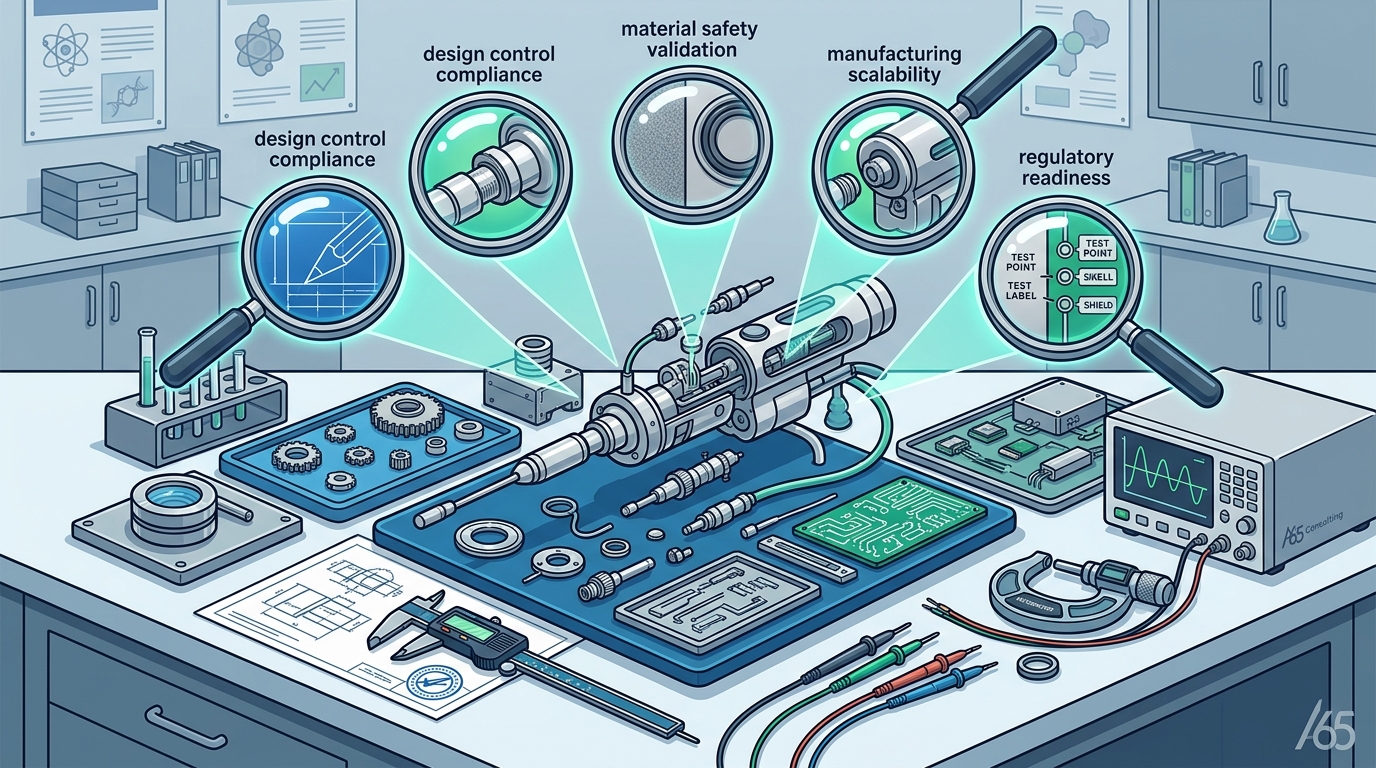
Verification and validation should be planned while requirements are being developed, rather than postponed until the end of the project. Verification asks whether design outputs meet specified design inputs. Validation asks whether the resulting device meets user needs and intended uses in the appropriate use context. These activities may involve inspection, bench testing, laboratory studies, clinical evaluation, usability work, software testing, biocompatibility testing, package-integrity testing, sterilization-related testing, reliability testing, and standards-based evaluation, depending on the device.
FDA materials describe verification and validation as integral parts of design development and emphasize that design reviews should occur at important decision points. ([fda.gov](https://www.fda.gov/medical-devices/investigational-device-exemption-ide/ide-related-topics?utm_source=openai))
A practical way to assess the firm
Ask prospective partners to create a preliminary verification-and-validation map from your current requirements. The map should identify:
- The requirement being evaluated.
- The planned test or analysis method.
- Acceptance criteria.
- Required test fixtures, samples, equipment, or laboratories.
- Applicable consensus standards.
- When the activity should occur.
- What happens if the result fails.
A capable partner will identify ambiguous requirements and missing acceptance criteria early. That is a positive sign. A partner that promises a quick prototype without discussing how the prototype will be evaluated may be optimizing for short-term excitement rather than regulatory and commercial readiness.
4. Look for manufacturing-transfer capability from the beginning
Design for manufacturing is more than a cost-reduction review performed immediately before launch. It is a way to ensure that the product can be built consistently, inspected effectively, sourced reliably, and scaled without sacrificing performance or safety.
Manufacturing considerations should influence material choices, tolerances, part count, assembly sequence, joining methods, cleanability, sterilization compatibility, inspection strategy, supplier capability, tooling, packaging, and process validation needs. FDA design-control descriptions include transferring the design to production specifications and controlling design changes, which makes manufacturing readiness part of the product-development process. ([fda.gov](https://www.fda.gov/medical-devices/premarket-approval-pma/pma-quality-system?utm_source=openai))
Ask prospective firms about
- Design-for-manufacturing and design-for-assembly reviews.
- Supplier and contract-manufacturer interaction.
- Prototype-to-production transition experience.
- Drawing, specification, bill-of-materials, and inspection-document development.
- Tolerance stack-ups and critical-to-quality characteristics.
- Low-volume launch support and scale-up planning.
- Cost-of-goods analysis and value-engineering options.
- Manufacturing-process characterization and validation support.
Request a clear explanation of what the firm will deliver at design transfer. “CAD files” alone are not a complete transfer package. Depending on the product and the agreement, production readiness may also require controlled drawings, specifications, test methods, inspection criteria, supplier requirements, assembly instructions, risk updates, and traceability between requirements and outputs.
5. Assess human factors and clinical usability
A medical device can meet bench-test requirements and still be difficult or unsafe to use. Human factors engineering examines how users perceive information, interpret device status, make decisions, manipulate controls, perform setup, respond to alarms, clean or maintain the product, and recover from foreseeable errors.
FDA describes the device user interface broadly: it can include physical controls, displays, packaging, labeling, setup, maintenance, and training materials. The central objective is to minimize use-related risk and confirm that intended users can operate the device safely and effectively. ([fda.gov](https://www.fda.gov/medical-devices/device-advice-comprehensive-regulatory-assistance/human-factors-and-medical-devices?utm_source=openai))
When interviewing a design firm, ask whether it can collaborate with clinicians, patients, caregivers, technicians, and other intended users. A mature process may include contextual inquiry, task analysis, use-related risk analysis, user-interface requirements, formative evaluations, usability protocols, and validation testing appropriate to the device’s risk profile.
Do not accept “the customer will provide feedback” as a complete usability strategy. Informal feedback can be valuable, but it does not replace a documented, risk-based human-factors process when use error could contribute to harm.
6. Confirm who will actually do the work
The senior engineer who wins the proposal may not be the person who performs the design work. Before signing, establish the names, roles, disciplines, availability, and decision rights of the actual project team.
Your partner may need mechanical, systems, manufacturing, quality, software, electrical, clinical, regulatory, human-factors, or project-management expertise. No single firm must perform every task internally, but it should be transparent about which capabilities are in-house, which are provided through trusted specialists, and who remains accountable for integration.
Capacity is especially important for startups and lean device companies. A project can stall when a single consultant becomes unavailable or when the firm lacks the discipline needed for an unexpected technical issue. A65 Consulting states that it uses a network of engineers to add the right discipline experience and expand resources as needed.
Questions to clarify in the proposal
- Who is the day-to-day technical lead?
- Who serves as program manager or engineering leader?
- What percentage of each person’s time is allocated to the project?
- What happens if a key contributor becomes unavailable?
- How are subcontractors qualified and managed?
- Who makes final technical decisions when disciplines disagree?
- Can the firm provide interim engineering leadership as well as hands-on execution?
The best partner model combines accountability with flexibility: you should have access to experienced leadership without being forced into a permanent full-time hiring commitment.
7. Test the firm’s program-management discipline
Technical competence is necessary, but it does not guarantee delivery. Medical device programs often involve changing requirements, supplier lead times, test failures, design reviews, clinical feedback, quality-system documentation, and cross-functional dependencies. The design firm should have a method for managing these realities.
Ask to see a sample development plan or milestone structure. It should show how the firm will manage requirements, decisions, risks, action items, dependencies, change requests, design reviews, test readiness, and deliverable acceptance.
Useful performance indicators
- Percentage of mission-critical projects completed on time.
- Number and type of regulatory submissions supported.
- Experience resolving verification or validation failures.
- Number of products transferred to manufacturing.
- History of achieving cost-of-goods targets.
- Client references who can discuss communication and delivery, not only technical creativity.
A65 Consulting reports that its products have contributed to more than eight FDA 510(k) submissions, its designs have generated more than ten patent applications, it has served more than twenty clients, and it has completed 90% of mission-critical projects on time. These are company-reported metrics, so prospective clients should still request context, references, and examples relevant to their own device. ([a65consulting.com](https://a65consulting.com/about/?utm_source=openai))
8. Compare the commercial model, ownership terms, and communication rhythm
Two firms can have similar hourly rates but very different total project costs. Compare proposals based on scope clarity, assumptions, deliverables, decision points, staffing, testing responsibilities, travel, outside laboratory costs, tooling, and change-control procedures.
Also review the contract carefully. Confirm who owns CAD files, drawings, source files, test data, reports, inventions, patentable concepts, and design-history-file content. Clarify confidentiality obligations, background intellectual property, payment milestones, termination rights, warranty limitations, and responsibilities for third-party vendors.
A65 Consulting states that it typically works on a monthly retainer basis toward mutually agreed project milestones. That type of arrangement can be useful when the scope must evolve as technical information becomes available, but the agreement should still define priorities, reporting, deliverables, and acceptance criteria.
Compare partners using the same scorecard
| Evaluation area | Questions to score | Evidence to request |
|---|---|---|
| Regulatory integration | Does the team connect intended use, risk, requirements, and testing? | Sample development plan, risk workflow, submission experience |
| Engineering depth | Can the firm analyze and solve the difficult technical issue? | Relevant case studies, analysis examples, technical resumes |
| Verification and validation | Are acceptance criteria and test methods defined early? | Traceability example, draft V&V matrix, test protocols |
| Manufacturing readiness | Can the design transition into repeatable production? | Transfer checklist, supplier examples, DFM deliverables |
| Human factors | Does the team address use-related risk systematically? | Usability plan, task analysis, formative or summative experience |
| Team capacity | Will the right people be available when needed? | Named team, allocation, backup plan |
| Program management | Can the firm manage decisions, risks, dependencies, and milestones? | Schedule, reporting sample, references |
| Commercial fit | Are cost, scope, ownership, and change processes clear? | Proposal, statement of work, intellectual-property terms |
Warning signs that a design firm may be a poor fit
- Prototype-first promises: The firm focuses on appearance or demonstrations without discussing requirements, risk, testing, or manufacturing.
- Unclear regulatory boundaries: The team makes confident submission promises without understanding your intended use, classification, predicate landscape, or evidence requirements.
- Generic case studies: The portfolio shows polished products but does not explain the engineering problem, design rationale, or measurable result.
- Late-stage DFM: Manufacturing is treated as someone else’s responsibility after the design is considered complete.
- No named project team: The proposal depends on unnamed resources or vague access to specialists.
- Weak change control: The firm cannot explain how it documents decisions or evaluates the impact of design changes.
- Unrealistic schedules: The timeline excludes testing, iteration, supplier development, design reviews, or regulatory documentation.
- Ownership ambiguity: The contract does not clearly address design files, inventions, test results, and background intellectual property.
A low-risk process for selecting your partner
- Prepare a project brief: Summarize intended use, users, use environment, clinical problem, current concept, known constraints, regulatory assumptions, schedule, budget, and available documentation.
- Build a shortlist: Select firms with relevant device, technical, manufacturing, and regulatory experience rather than choosing solely by portfolio appearance.
- Run structured interviews: Ask every candidate the same questions so their answers can be compared fairly.
- Request a discovery-phase proposal: If uncertainty is high, begin with requirements definition, risk review, feasibility analysis, and a development plan instead of committing immediately to full product development.
- Validate references: Ask former clients about missed milestones, communication, technical judgment, documentation quality, and post-prototype support.
- Review the statement of work: Confirm deliverables, assumptions, staffing, acceptance criteria, intellectual-property ownership, and change-control terms.
- Start with a measurable first milestone: Examples include a requirements baseline, feasibility report, risk analysis, architecture review, or preliminary verification plan.
This approach gives both sides an opportunity to assess working style and technical fit before the highest-cost development activities begin.
How A65 Consulting can support your device program
A65 Consulting provides medical device design, consulting, and engineering support from early research and conceptualization through product development, manufacturing transfer, and cost optimization. The firm’s model is designed for companies that need experienced engineering execution, additional technical capacity, or interim leadership.
Its published company information reports experience serving more than twenty clients, supporting products associated with more than $300 million in projected new-product revenue, contributing to more than eight FDA 510(k) submissions, creating designs associated with more than ten patent applications, and completing 90% of mission-critical projects on time. ([a65consulting.com](https://a65consulting.com/about/?utm_source=openai))
Every development program is different, so the most appropriate next step is a focused discussion of your device, current maturity, technical risks, regulatory pathway, and manufacturing objectives. You can contact A65 Consulting to request a proposal or schedule a discovery call with a principal consultant.
Key takeaways
- Choose for the full lifecycle: The right firm should support more than ideation and prototyping; evaluate requirements, risk, verification, validation, manufacturing transfer, and post-design support.
- Regulatory knowledge should shape engineering decisions: Design controls and risk management should be integrated into the work from the beginning.
- Ask for evidence: Case studies, test strategies, references, delivery metrics, and manufacturing-transfer examples are more useful than broad capability claims.
- Make usability part of safety: Human factors should address real users, environments, workflows, labeling, setup, operation, and foreseeable use errors.
- Confirm the actual team: Identify the technical lead, project manager, specialists, allocation of time, and backup resources before signing.
- Compare total delivery risk, not just rates: A low initial quote can become expensive if it leads to redesign, failed testing, manufacturing delays, or incomplete documentation.
- Begin with a defined milestone: A focused discovery or feasibility phase can reveal fit and reduce uncertainty before full-scale development.
Frequently asked questions
What should I provide before contacting a medical device design firm?
Provide whatever is available: the clinical or customer problem, intended users, use environment, intended use, concept sketches, competing products, known requirements, regulatory assumptions, schedule, budget range, intellectual-property concerns, and any test data. A complete package is helpful but not required. An experienced firm can help identify missing information during an initial discovery phase.
Does a medical device design firm need to have designed my exact product before?
Direct product experience can reduce learning time, but it is not the only selection criterion. A firm with strong fundamentals in systems engineering, risk management, materials, mechanisms, testing, manufacturing, and clinical workflows may be able to transfer knowledge effectively across device categories. Ask the firm to explain which prior experience is directly relevant and which parts of its approach are transferable.
When should design for manufacturing begin?
DFM should begin during concept development and continue through detailed design, prototype builds, supplier engagement, and manufacturing transfer. Early DFM can prevent choices that are difficult to source, assemble, inspect, sterilize, package, or scale.
What is the difference between verification and validation?
Verification evaluates whether design outputs meet specified design inputs. Validation evaluates whether the device meets user needs and intended uses in the appropriate context. The exact activities depend on the device, risk profile, intended users, regulatory pathway, and applicable standards.
Should human factors be included in the engineering-firm selection process?
Yes. If users interact with the device, human factors can directly affect safety, effectiveness, training, labeling, setup, operation, maintenance, and the risk of use error. Ask how the firm identifies critical tasks and coordinates usability work with risk management and design changes. FDA identifies human factors and usability engineering as methods for reducing use-related risks and confirming safe and effective use. ([fda.gov](https://www.fda.gov/medical-devices/device-advice-comprehensive-regulatory-assistance/human-factors-and-medical-devices?utm_source=openai))
Can A65 Consulting provide additional engineering bandwidth?
Yes. A65 Consulting states that it uses a network of engineers with relevant discipline experience to expand resources as needed. This can help companies address temporary capacity gaps without immediately making long-term full-time hires.
How does A65 Consulting typically charge?
A65 Consulting states that it typically uses a monthly retainer model while working toward mutually agreed project milestones. The specific commercial structure should be defined in the proposal and statement of work.
How long has A65 Consulting been working as a team?
A65 Consulting states that its team has been working together since 2018 and that its engineering team brings decades of medical device development experience.
Does A65 Consulting provide leadership support or only individual engineering resources?
A65 Consulting provides both leadership support and hands-on engineering expertise. The appropriate mix depends on whether your organization needs program leadership, a technical workstream owner, specialized analysis, manufacturing-transfer support, or a broader product-development team.
Final hiring checklist
Before selecting a medical device design firm, confirm that you can answer “yes” to most of the following:
- Does the firm understand the likely regulatory and quality requirements for the device?
- Can it connect user needs and intended use to measurable design inputs?
- Does it have a credible risk-management process?
- Can it plan verification and validation before final design freeze?
- Does it understand manufacturing, suppliers, inspection, assembly, and scale-up?
- Can it address human factors and real-world clinical use?
- Are the actual team members and their availability clearly identified?
- Does the firm offer accountable engineering leadership?
- Can it show relevant outcomes, references, and delivery metrics?
- Are scope, deliverables, costs, change control, confidentiality, and intellectual-property ownership clear?
The best engineering partner is not necessarily the largest firm or the least expensive bidder. It is the partner that can make sound technical decisions, expose risks early, communicate clearly, preserve design evidence, and carry the product toward a manufacturable and commercially viable outcome.
Related resources
- 1. Regulatory & Risk Management Expertise
- 2. Verification as a System, Not a Phase
- 3. Design for Manufacturing (DFM) Integration
- 4. Team Capacity & Leadership Support
- 5. Human Factors & Usability
- 6. Financial Track Record & Milestone Delivery
- 7. Next Steps for Your Project
- Frequently Asked Questions
- Ready to Transform Your Device Concept?