
Yes, you can hire an engineering firm to optimize the cost of a medical device—and in many cases, bringing in the right partner before design freeze is one of the most effective ways to improve margins without sacrificing safety, performance, or regulatory readiness.
Medical device cost optimization is not simply a search for cheaper components. It is a structured engineering activity that examines the product architecture, materials, tolerances, manufacturing processes, assembly methods, supplier strategy, verification plan, and production controls. Done correctly, it can reduce avoidable complexity while making the device easier to build consistently.
For U.S. medical device companies, cost decisions must remain connected to design controls, risk management, verification, validation, and production transfer. FDA design control expectations include risk analysis, design reviews, verification, validation, design transfer, change control, and documented design history records. ([fda.gov](https://www.fda.gov/medical-devices/premarket-approval-pma/pma-quality-system?utm_source=openai))
A65 Consulting supports medical device companies with product development, medical device engineering, manufacturing transfer, and cost-conscious design decisions. To discuss a specific product or cost challenge, contact A65 Consulting.
The Short Answer: When an Outside Firm Makes Sense
An external medical device engineering firm can be especially valuable when your company has a promising design but lacks the time, manufacturing expertise, or cross-functional capacity to optimize it internally.
Common triggers for hiring outside support include:
- The projected unit cost is too high for the target market or reimbursement environment.
- The design contains more parts, operations, or tight tolerances than necessary.
- Manufacturing partners are quoting more than expected.
- The product is difficult to assemble consistently.
- A sourcing change has created cost, availability, or supply-chain risk.
- The project is approaching design freeze without a clear costed bill of materials.
- A production transfer is revealing unexpected labor, yield, tooling, or inspection expenses.
- The internal engineering team is fully occupied with development, quality, or sustaining work.
Outside engineering support does not have to replace your internal team. The firm may provide a focused cost-reduction sprint, a design-for-manufacturing review, specialized manufacturing expertise, interim engineering leadership, or complete support through production transfer.
What Medical Device Cost Optimization Actually Includes
Medical device cost optimization is the process of improving the total cost structure of a product while preserving or improving its intended performance, safety, reliability, usability, and compliance position.
That definition matters because the lowest purchase price is not always the lowest total cost. A less expensive material may increase scrap. A cheaper supplier may require more incoming inspection. A reduced wall thickness may create failure risk. A complex assembly may increase labor and training requirements. A component with a lower unit price may have a longer lead time or require expensive tooling.
A qualified engineering firm evaluates the relationship among:
- Product cost: materials, purchased components, labor, packaging, sterilization, and manufacturing overhead.
- Development cost: prototypes, tooling iterations, testing, design changes, and documentation.
- Quality cost: scrap, rework, nonconformances, complaints, returns, and corrective actions.
- Regulatory cost: additional testing, submission delays, remediation, or redesign caused by poorly controlled changes.
- Lifecycle cost: service, maintenance, field support, obsolescence, and end-of-life considerations.
The objective is not to make an aggressive change that creates downstream problems. The objective is to find the best design and manufacturing trade-offs for the device's intended use, production volume, risk profile, and business model.
Where Engineering-Led Savings Usually Come From
1. Simplifying the product architecture
Part count is one of the first areas an engineering team can investigate. Fewer parts can mean fewer purchase orders, fewer opportunities for assembly error, fewer inspection steps, and less documentation to maintain. Potential improvements include combining components, eliminating unnecessary fasteners, reducing decorative or nonfunctional features, and standardizing interfaces.
Part reduction should be assessed against risk controls and serviceability. A single molded component may be less expensive than several machined parts, but the change still needs appropriate engineering analysis and verification.
2. Selecting materials for the complete manufacturing system
Material selection affects more than raw material price. An engineering review can examine availability, supplier qualification, sterilization compatibility, biocompatibility considerations, mechanical performance, molding or machining behavior, surface finish, shelf life, and environmental resistance.
For example, a material that is inexpensive but difficult to process may create higher scrap or require specialized equipment. A slightly more expensive material may be the better economic choice if it improves yield and reduces process variation.
3. Improving tolerances and tolerance stack-ups
Unnecessarily tight tolerances can increase machining time, tooling expense, inspection requirements, and rejection rates. A tolerance analysis can identify which dimensions are functionally important and which can be relaxed without compromising performance.
The practical goal is not to loosen every tolerance. It is to apply precision where it protects safety or function and avoid precision that does not add value.
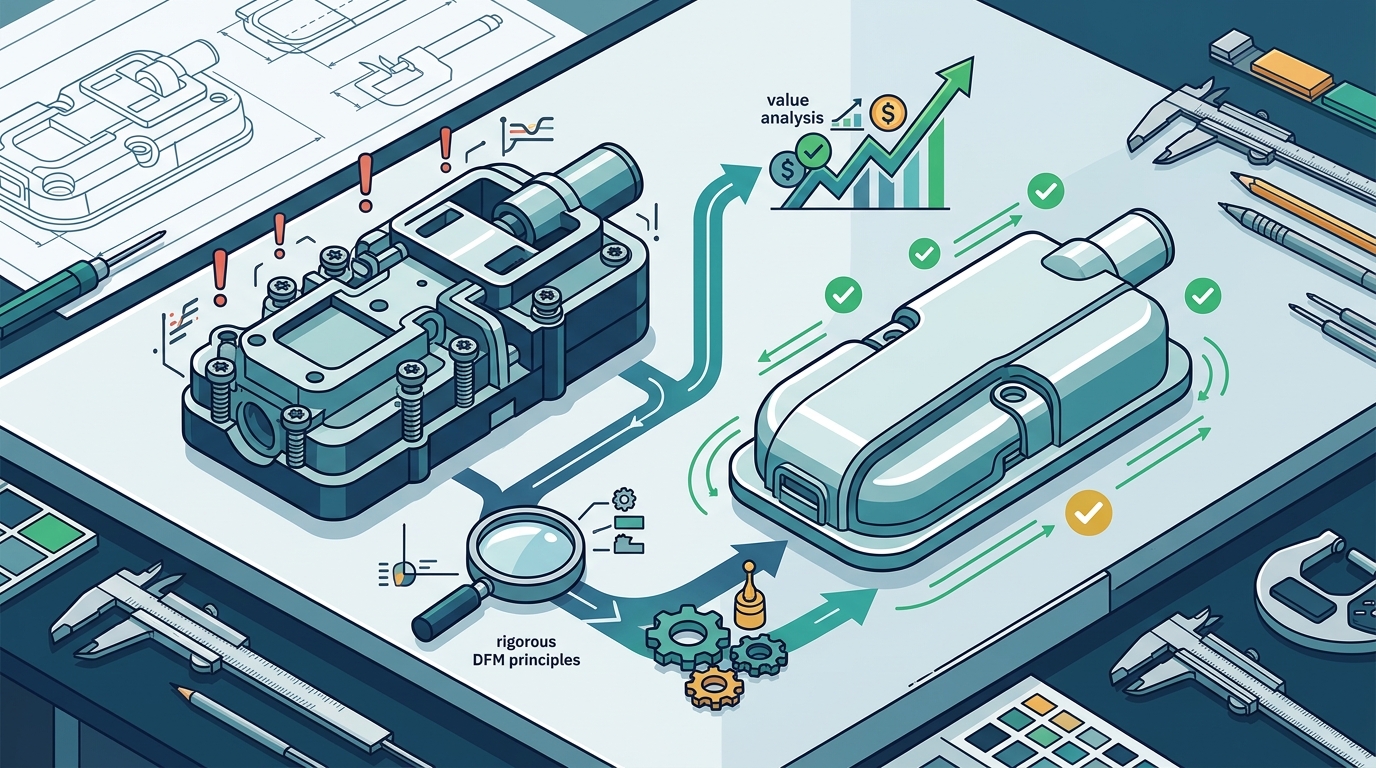
4. Designing for manufacturing and assembly
Design for Manufacturing and Assembly, commonly called DFM or DFMA, evaluates whether a device can be produced repeatedly using realistic processes, equipment, fixtures, and operator steps. Reviews may address component orientation, access for tools, bonding and welding methods, automated versus manual operations, poka-yoke features, inspection access, and line balancing.
DFM is also a quality activity. A design that is easier to assemble correctly is generally less vulnerable to variation, rework, and defects. FDA materials describe design transfer and manufacturing controls as essential parts of ensuring that a finished device can be produced consistently to its design requirements. ([fda.gov](https://www.fda.gov/medical-devices/premarket-approval-pma/pma-quality-system?utm_source=openai))
5. Choosing an appropriate manufacturing process
The best process depends on expected volume, geometry, material, tooling investment, quality requirements, and production ramp. An engineering firm may compare processes such as machining, injection molding, thermoforming, stamping, additive manufacturing, extrusion, overmolding, laser processing, adhesive bonding, ultrasonic welding, or manual assembly.
A prototype process is not automatically the right production process. Machining may be ideal for early prototypes but uneconomical at high volume. Conversely, investing in production tooling too early can create unnecessary expense if the design is still changing.
6. Reducing assembly labor and process variation
Labor cost can be affected by the number of steps, cycle time, operator training, fixture requirements, inspection frequency, and the likelihood of rework. Engineering changes may include reducing adhesive operations, designing self-locating components, simplifying cable routing, using standardized fasteners, improving fixture access, or creating error-proof assembly features.
7. Improving supplier and component strategy
Cost optimization may include reviewing supplier quotes, alternate sources, standard catalog components, minimum order quantities, lead times, tooling ownership, and regional sourcing. A partner can help distinguish between a genuine cost opportunity and a change that merely shifts cost into qualification, inspection, inventory, or supply risk.
8. Designing the verification and validation plan intelligently
Testing is necessary, but inefficient testing can add avoidable cost and schedule risk. Early engineering coordination can help map requirements to verification methods, identify reusable fixtures, avoid redundant testing, and plan representative builds.
Any proposed design change still needs to be assessed through the applicable quality system and change-control process. The correct verification evidence depends on the nature of the change, the device, the risk analysis, and applicable regulatory requirements.
Why Cost Reduction Must Be Linked to Quality and Risk
In a regulated industry, cost optimization cannot be separated from product safety and compliance. A change that reduces component cost but introduces a new hazard is not a successful optimization.
ISO 14971:2019 establishes a lifecycle risk-management process for medical devices, including identifying hazards, estimating and evaluating risks, implementing risk controls, and monitoring the effectiveness of those controls. The process applies from initial concept through decommissioning and disposal. ([iso.org](https://www.iso.org/cms/live/live/en/sites/isoorg/contents/data/standard/07/27/72704.html?browse=tc&utm_source=openai))
ISO 13485:2016 provides a quality-management framework specific to medical devices and emphasizes regulatory requirements, risk management, product realization, and process validation. ISO states that the current edition was reviewed and confirmed in 2025. ([committee.iso.org](https://committee.iso.org/standard/59752.html?utm_source=openai))
For a cost-optimization project, this means the engineering team should ask:
- Does the change affect a safety-related characteristic?
- Does it alter a design input, design output, or essential performance requirement?
- Does it change materials, suppliers, sterilization, packaging, software, or human factors?
- Does it introduce a new manufacturing failure mode?
- Does it change the verification, validation, or clinical evidence needed?
- Does it affect the device's regulatory submission or substantially equivalent comparison?
- Does the production process require new validation or revised controls?
Early risk analysis is particularly important because design decisions are easier and less expensive to change before tooling, validation builds, regulatory submissions, and production commitments are complete. FDA guidance specifically notes that early risk analysis enables designers to identify and reduce unreasonable risks during the earlier phases of development. ([fda.gov](https://www.fda.gov/medical-devices/investigational-device-exemption-ide/ide-related-topics?utm_source=openai))
Cost optimization should therefore be documented as controlled engineering work—not as an informal list of purchasing substitutions.
What the Engagement Process Can Look Like
A medical device engineering firm may structure cost optimization as a defined project with measurable outputs. A practical engagement commonly includes the following stages.
Stage 1: Establish the cost and performance baseline
The team begins by understanding the current design, target unit cost, expected annual volume, manufacturing location, supplier assumptions, labor model, regulatory status, and key performance requirements.
Useful inputs may include a bill of materials, CAD files, drawings, specifications, prototype build notes, supplier quotes, assembly instructions, test reports, complaint data, risk documentation, and the current development schedule.
Stage 2: Identify the dominant cost drivers
Not every component deserves equal attention. The team can rank costs by material spend, labor content, tooling, yield impact, supplier concentration, lead time, and risk. A Pareto-style review often helps focus the project on the relatively small number of design or process decisions that drive a large portion of total cost.
Stage 3: Generate and screen concepts
Potential changes are developed and screened against technical feasibility, cost impact, schedule, regulatory implications, supply-chain resilience, and implementation complexity. The result should be a prioritized opportunity register rather than an unranked list of ideas.
Stage 4: Analyze the design and manufacturing consequences
Promising concepts may require tolerance studies, material reviews, supplier discussions, process trials, prototype builds, fixture concepts, reliability analysis, or updated risk documentation.
Stage 5: Verify the selected changes
Selected changes are evaluated through appropriate engineering verification and, where applicable, validation activities. The level of evidence should reflect the risk and regulatory significance of the change.
Stage 6: Transfer the optimized design to production
Cost savings are only real when the optimized design can be manufactured consistently. Production transfer may include updated drawings, work instructions, inspection plans, tooling, fixtures, supplier documentation, process development, training, and validation support.
Stage 7: Measure results after implementation
Track the outcomes using metrics such as unit cost, labor minutes per unit, first-pass yield, scrap, rework, supplier performance, cycle time, field complaints, and schedule performance. Measurement confirms whether the change created sustainable value.
Internal Team Versus External Engineering Firm
The right model depends on your organization's size, device complexity, program phase, and internal expertise. The following comparison can help frame the decision.
| Consideration | Internal engineering team | External engineering firm |
|---|---|---|
| Cost model | Fixed salaries, benefits, facilities, software, and management overhead. | Variable project or retainer costs aligned to defined needs and milestones. |
| Capacity | May be constrained by existing development, sustaining, quality, or manufacturing priorities. | Can add focused capacity without a permanent headcount commitment. |
| Specialized expertise | Depends on the disciplines and device experience already available. | Can provide access to mechanical, systems, manufacturing, quality, risk, and transfer expertise. |
| Independent perspective | Deep familiarity with the current design and organizational history. | Fresh review that may identify assumptions or legacy decisions internal teams overlook. |
| Speed to start | Can be immediate if the team has available capacity. | Can be faster than recruiting or training for a specialized short-term need. |
| Long-term ownership | Retains knowledge directly within the company. | Requires a deliberate knowledge-transfer and documentation plan. |
Many companies use a hybrid model: internal personnel retain product ownership and decision authority while an external partner conducts the cost review, develops alternatives, supports testing, and assists with manufacturing transfer.
How to Select the Right Medical Device Cost-Optimization Partner
Price alone is not a sufficient selection criterion. A low-cost consultant who lacks regulated product-development experience may create more risk than savings.
When evaluating firms, ask for evidence of:
- Experience with devices at a similar level of technical and regulatory complexity.
- Practical DFM, DFMA, manufacturing, and production-transfer capability.
- Understanding of design controls, risk management, verification, validation, and change control.
- Experience working with suppliers, contract manufacturers, tooling vendors, and inspection teams.
- A clear method for estimating savings and distinguishing one-time from recurring benefits.
- Ability to work within your quality-management system and documentation practices.
- Defined ownership of design files, analyses, test data, and intellectual property.
- References or examples showing measurable engineering outcomes.
It is also useful to ask how the firm handles trade-offs. A credible partner should be willing to explain why an apparently attractive change is not recommended when it would increase risk, qualification burden, or lifecycle cost.
A65 Consulting combines medical device design, engineering, manufacturing support, and product-development leadership. The company reports experience contributing to more than 10 FDA 510(k) submissions, a team operating together since 2018, decades of collective medical device experience, more than $300 million in projected new product revenue supported, and a 90% on-time completion rate for mission-critical projects. These are company-reported figures and should be evaluated in the context of your specific program requirements.
Key Takeaways
- Yes, an engineering firm can help optimize medical device costs. The greatest value usually comes from addressing cost before design freeze or production tooling commitments.
- Optimization is broader than cheaper components. It can include architecture, tolerances, materials, assembly, manufacturing processes, suppliers, tooling, testing, and transfer.
- DFM is both a cost and quality strategy. A manufacturable design can reduce defects, rework, scrap, and production variability.
- Risk management must remain connected to every cost change. ISO 14971 covers lifecycle medical device risk management, while ISO 13485 provides a medical device quality-management framework. ([committee.iso.org](https://committee.iso.org/standard/59752.html?utm_source=openai))
- External support is useful when internal capacity or specialized expertise is limited. A partner can supplement rather than replace your existing team.
- Successful savings must be measurable and sustainable. Track unit cost, yield, labor, rework, supplier performance, quality, and schedule after implementation.
- A structured engagement lowers execution risk. Baseline the design, prioritize cost drivers, analyze alternatives, verify changes, transfer to production, and measure the result.
Frequently Asked Questions
Can I hire an engineering firm if my device is already designed?
Yes. An external firm can review an existing design for manufacturability, assembly complexity, tolerance requirements, material selection, supplier risk, tooling assumptions, and production cost. The earlier the review occurs, the more options are usually available, but meaningful improvements can also be found during prototype builds, design transfer, or sustaining engineering.
Will cost optimization compromise medical device quality?
It should not. Proper cost optimization protects the device's intended performance, safety, reliability, and regulatory requirements. Changes should be assessed through design controls, risk management, verification, validation, and change control as applicable.
What documents should I provide to an engineering firm?
Useful starting materials include the bill of materials, CAD models, drawings, specifications, user needs, design inputs, risk analysis, prototype or production build records, supplier quotes, test results, assembly instructions, quality data, and target cost or volume assumptions. A firm can begin with a smaller document package and identify additional information needed during discovery.
How does an engineering firm charge for medical device cost optimization?
Engagements are often structured as a monthly retainer, a fixed-scope assessment, time-and-materials support, or milestone-based work. The appropriate model depends on whether the project is a short design review, a multi-month redesign, or a broader development and manufacturing-transfer program. A clear scope should identify deliverables, assumptions, decision points, and responsibilities.
Can an external engineering firm support FDA 510(k) work?
Yes. An engineering partner can support design documentation, design controls, risk analysis, verification planning, test methods, design transfer, and technical inputs that contribute to a 510(k) submission. The legal manufacturer remains responsible for the submission and its quality-system obligations. FDA describes design controls as including design inputs and outputs, risk analysis, reviews, verification, validation, transfer, change control, and design history documentation. ([fda.gov](https://www.fda.gov/medical-devices/premarket-approval-pma/pma-quality-system?utm_source=openai))
How early should cost optimization begin?
Ideally, cost targets and manufacturing assumptions should be considered during research, concept development, and architecture selection. Early decisions can influence part count, materials, process selection, tolerances, testing, tooling, and supplier strategy. A later review can still identify opportunities, but late changes may require additional verification, validation, regulatory assessment, and production rework.
What role does risk analysis play in cost reduction?
Risk analysis helps the team understand which design characteristics are safety- or performance-critical and which changes require additional controls or evidence. It prevents the organization from treating a short-term price reduction as a success when the change could increase failure, complaint, recall, or redesign risk.
Does A65 Consulting have capacity for a new project?
A65 Consulting states that it uses a network of engineers with different discipline experience and can expand resources as project needs change. Availability and team composition should be confirmed for the specific device, timeline, and required expertise.
What types of medical devices can A65 Consulting support?
A65 Consulting reports experience across a wide variety of medical devices. The best fit depends on the technical disciplines involved, regulatory pathway, manufacturing process, development phase, and desired scope of work. The company can provide more detail about relevant experience during an initial discussion.
Next Steps for Evaluating a Cost-Optimization Engagement
Before contacting an engineering firm, define the business problem as specifically as possible. For example, you may need to reduce the target unit cost by a certain amount, eliminate a difficult assembly operation, improve manufacturing yield, reduce supplier dependency, or prepare an existing design for a contract manufacturer.
Prepare a short project brief that includes the device category, development phase, expected volume, current manufacturing approach, target cost, known pain points, regulatory status, and desired schedule. This enables a prospective partner to recommend an assessment, a focused DFM review, or a broader engineering engagement.
A65 Consulting can help medical device companies evaluate design and manufacturing opportunities from concept through production transfer. Schedule a discovery call to discuss your product, cost drivers, and next engineering milestone.