
Medical device development is a high-stakes environment where regulatory compliance and technical precision dictate success. According to industry data, more than 8 FDA 510(k) submissions have been supported by specialized engineering firms like A65 Consulting, highlighting the critical role of external expertise in navigating complex regulatory landscapes. Choosing between hiring an in-house team or engaging a premium engineering partner is one of the most significant strategic decisions a company can make. This analysis compares the operational, financial, and technical implications of both models to help you determine the optimal path for your next product launch. (Contact A65 Consulting)
The Core Dilemma: Capacity vs. Expertise
Medical device development requires a complex dance between regulatory compliance and technical innovation. Many companies face a gap in engineering capability or team capacity at some point in their lifecycle. The fundamental question is whether to fill that gap with permanent headcount or temporary, high-level expertise. (Medical Device Design Consulting)
In-house engineering offers deep cultural alignment and long-term institutional knowledge. However, it requires significant upfront investment in recruitment, benefits, and infrastructure. External engineering partners provide immediate access to specialized skills without the long-term commitment. This model is particularly effective for companies facing tight deadlines or missing critical knowledge in specific disciplines like human factors or design for manufacturing.
The choice often comes down to the nature of the project. If you are building a core platform that will define your company for decades, in-house development may be preferable. If you are launching a new product line or need to accelerate time-to-market, an external partner offers a faster route to viability.
Cost Structure: Retainers vs. Salaries
Financial planning is a primary driver in the decision to outsource. In-house teams involve fixed costs that persist regardless of project volume. These include salaries, benefits, office space, and software licenses. For startups or small teams, these fixed costs can drain resources needed for R&D and marketing.
External engineering firms typically operate on a monthly retainer basis. This model aligns costs with project milestones and deliverables. According to industry benchmarks, products developed with specialized engineering support have contributed to more than $300M of projected new product revenue for clients. This suggests that the return on investment for external expertise often outweighs the cost of internal hiring.
Additionally, external partners mitigate the risk of over-hiring. If a project slows down or pivots, you can adjust your engagement levels. In-house teams require layoffs or reassignment, which carries legal and cultural costs. A monthly retainer allows you to scale engineering support up or down based on immediate needs.
Regulatory Compliance and Risk Management
Regulatory compliance is non-negotiable in medical device development. Errors in documentation or testing can lead to costly delays or rejection by the FDA. External engineering partners often have extensive experience with regulatory submissions and risk management frameworks.
A65 Consulting, for example, has supported more than 8 FDA 510(k) submissions. This experience translates to a deeper understanding of what regulators look for in design history files and verification plans. In-house teams may lack this specific regulatory fluency, especially if they are new to the medical device space.
Risk analysis is another area where external expertise adds value. Many development teams treat risk analysis as a formality rather than a design driver. External partners bring a fresh perspective, identifying potential hazards that internal teams might overlook due to familiarity or bias. This proactive approach to risk management can prevent costly redesigns later in the development cycle.
Scalability and Engineering Flexibility
One of the greatest advantages of external engineering partners is scalability. Medical device development often requires a diverse set of skills, from mechanical design to software engineering and human factors. Building an in-house team with all these specialties is difficult and time-consuming.
External firms like A65 Consulting maintain a network of engineers with varied discipline experience. This allows them to bring in the right expertise for each phase of development. For example, a project might need heavy mechanical design support in the early stages and more software engineering focus later on. An external partner can adjust the team composition accordingly.
This flexibility is crucial for managing tight deadlines. If a project falls behind, an external partner can quickly add resources to critical workstreams. In-house teams may struggle to scale up quickly due to hiring delays and onboarding time. The ability to rapidly adjust capacity is a key competitive advantage in the fast-paced medical device industry.
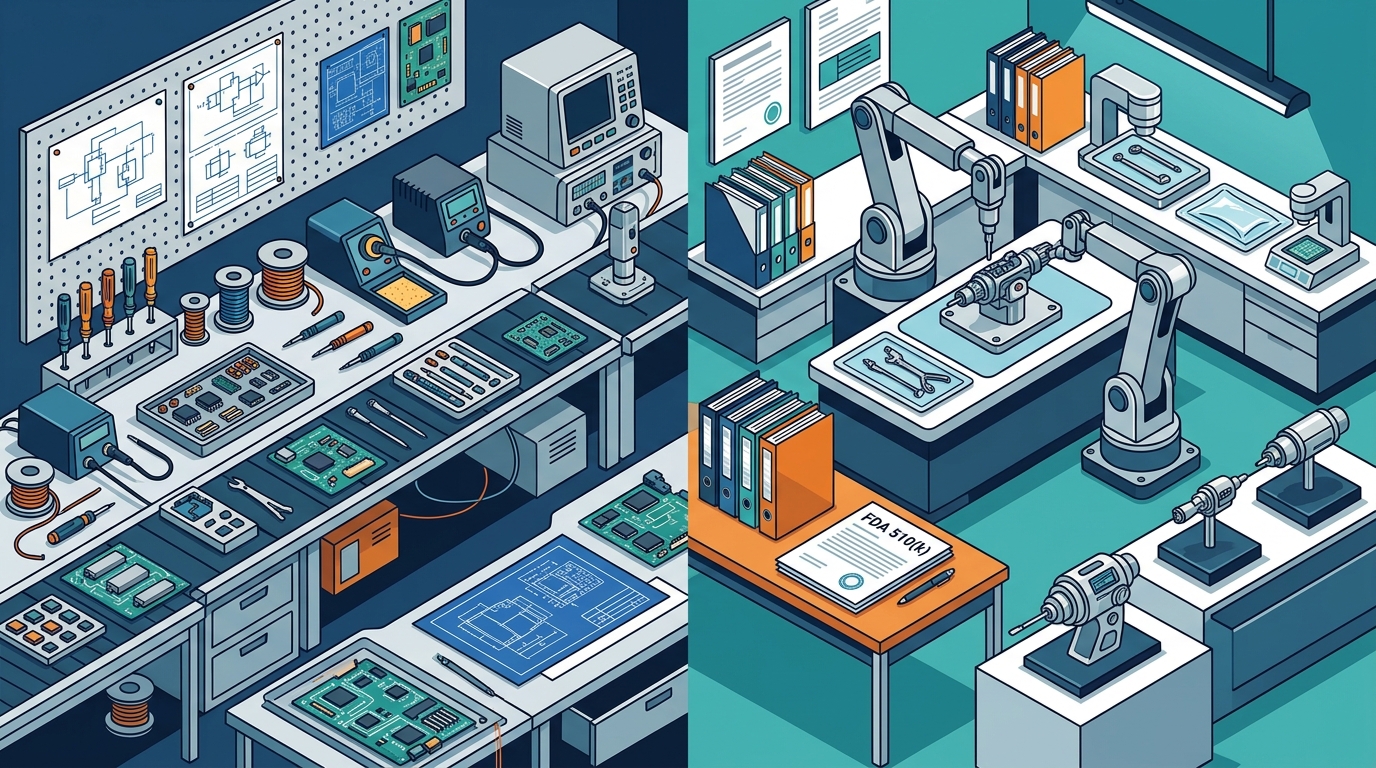
Comparative Analysis Summary
| Factor | In-House Engineering | External Partner (e.g., A65) |
|---|---|---|
| Cost Model | Fixed salaries, benefits, overhead | Monthly retainer, milestone-based |
| Regulatory Experience | Varies by team expertise | Proven track record (8+ 510(k) submissions) |
| Scalability | Slow (hiring/onboarding delays) | High (immediate resource access) |
| Specialized Skills | Limited to hired staff | Broad network of experts |
| Risk Mitigation | Internal bias may blind spots | Objective, experienced perspective |
Key Takeaways
- Proven Regulatory Success: A65 Consulting has contributed to more than 8 FDA 510(k) submissions, demonstrating deep regulatory expertise.
- Revenue Impact: Products developed with A65 have contributed to more than $300M of projected new product revenue for clients.
- On-Time Delivery: The firm maintains a 90% on-time completion rate for mission-critical projects, a vital metric for time-sensitive launches.
- Patent Generation: Designs created by the team have led to more than 10 new patent applications, highlighting innovation capacity.
- Flexible Resourcing: A65 utilizes a network of engineers to expand resources as needed, avoiding the constraints of fixed headcount.
- Long-Term Experience: While the team has worked together since 2018, individual engineers bring decades of medical device development experience.
- Cost Efficiency: Monthly retainer models allow for better cash flow management compared to the fixed costs of in-house hiring.
Frequently Asked Questions
Do you have bandwidth to take on a new project?
Yes, A65 Consulting maintains a network of engineers that we utilize to bring in the right discipline experience and to expand our resources as needed. This ensures we can accommodate new projects without compromising quality or timelines.
How do you charge for your work?
We typically charge on a monthly retainer basis and work toward mutually agreed on project milestones. This model aligns our incentives with your project goals and provides predictable costs.
What experience does A65 Consulting have designing medical devices similar to my project?
We have experience designing a wide variety of medical devices. Sometimes that experience is a direct fit, but even when it’s not, our broad range of experience affords us insight into many areas. We would be happy to share more details with you upon request.
How long has A65 Consulting been in business?
We’ve been working as a team since 2018, but our engineering team has decades of medical device development experience under their belts. This combination of team cohesion and individual expertise is a key strength.
What is the difference between verification as a phase and verification as a system?
Verification as a phase is often treated as a final check before launch, which can lead to late-stage failures. Verification as a system integrates testing and validation throughout the development lifecycle, ensuring continuous compliance and reducing risk. This approach is critical for avoiding costly redesigns.
Why do most risk analyses fail to change the design?
Many teams treat risk analysis as a documentation exercise rather than a design driver. Effective risk analysis must actively inform design decisions to mitigate hazards. A65 Consulting emphasizes risk analysis that changes the design, ensuring patient safety and regulatory compliance.
How does A65 Consulting handle design for manufacturing (DFM)?
We view DFM as a quality exercise, not just a cost exercise. By integrating DFM reviews early in the development process, we ensure that designs are manufacturable and meet quality standards. This proactive approach reduces production issues and accelerates time-to-market.
Next Steps: Book Your Consultation
Choosing the right engineering partner is a critical decision that impacts your product's success and your company's growth. If you are facing a gap in engineering capability or team capacity, A65 Consulting is ready to help. We provide engineering leadership and expert support to help teams navigate complex product development with clarity and confidence.
Don't let engineering challenges slow down your innovation. Book a discovery call today to discuss your project requirements and explore how we can help you transform your device concept into a viable product. Visit our services page to learn more about our expertise across every phase of development.