
Medical device startups operate in a high-stakes environment where speed often conflicts with regulatory rigor. According to industry data, the average time to market for a Class II medical device is approximately 1,200 days from initial concept to FDA clearance. This extended timeline is rarely due to a lack of engineering talent; instead, it stems from fragmented workflows, late-stage manufacturing considerations, and reactive risk management. For startups, every month of delay represents significant capital burn and lost competitive advantage. Accelerating this cycle requires a fundamental shift in how product development is structured, moving from linear handoffs to integrated, concurrent engineering practices. (About A65 Consulting)
Understanding the Bottlenecks in Device Development
Many startups believe that hiring more engineers will solve their timeline issues. However, adding headcount to a broken process often increases complexity rather than reducing it. The primary bottleneck in medical device development is usually the disconnect between design intent and manufacturing reality. When engineering teams work in silos, critical constraints are discovered too late, forcing costly redesigns during the verification phase.
Design for Manufacturing (DFM) is a systematic approach to designing products that are easy and cost-effective to manufacture. When DFM is treated as a cost reduction activity rather than a quality exercise, it is often deferred until the design is "finalized." This is a critical error. At A65 Consulting, we observe that teams who integrate DFM reviews during the conceptual phase avoid the majority of production delays. By aligning engineering specifications with manufacturing capabilities early, startups can eliminate the guesswork that plagues late-stage development.
Another significant delay factor is the misalignment of roles between product management, engineering, and quality assurance. Medical device development is a coordinated system of distinct domains operating under regulatory constraint. When that system performs well, progress feels disciplined and predictable. When it struggles, the issue is often not capability but structure. Clarifying these roles and establishing clear decision-making pathways is essential for maintaining momentum.
Strategic Partnership Models for Speed
Startups rarely have the bandwidth to hire full-time experts in every necessary discipline, from human factors to regulatory strategy. This is where the right engineering partner becomes a force multiplier. A premium medical device engineering partner does not just execute tasks; they provide leadership and expert support to help teams navigate complex product development with clarity and confidence.
Choosing the right partner involves looking beyond technical skills to cultural fit and operational philosophy. The best partners thrive in the stress of program management and hard-hitting requirements. They understand that speed is not about cutting corners, but about eliminating waste and redundancy. For startups, this means accessing a network of engineers with specific discipline experience without the long-term commitment of full-time hires.
When evaluating potential partners, consider their track record in similar device categories. While direct experience is valuable, a broad range of experience often provides deeper insight into cross-industry best practices. According to recent industry reports, companies that engage specialized engineering partners see a 30% reduction in development time compared to those relying solely on internal teams. This acceleration comes from the partner's ability to hit the ground running with established processes and regulatory knowledge. (Medical Device Development)
Design for Manufacturing as a Quality Exercise
The common approach to DFM is to introduce it when margins tighten or sourcing changes. This reactive stance is a primary cause of timeline slippage. Instead, DFM should be viewed as a quality exercise from day one. This means designing the product and the process together, ensuring that every design decision considers its impact on assembly, testing, and final quality.
One effective method is to conduct early DFM reviews with manufacturing experts. These reviews should focus on process development, tolerance analysis, and material selection. By identifying potential manufacturing issues before the design is frozen, teams can make informed trade-offs that balance performance with producibility. This proactive approach reduces the need for iterative prototyping and accelerates the transition to production.
Furthermore, integrating manufacturing feedback into the design loop helps to standardize components and reduce part count. Standardization not only lowers costs but also simplifies supply chain management and quality control. For startups, this means fewer variables to manage and a more predictable path to launch. Data shows that reducing part count by 20% can lead to a 15% reduction in assembly time.
Verification as a System, Not a Phase
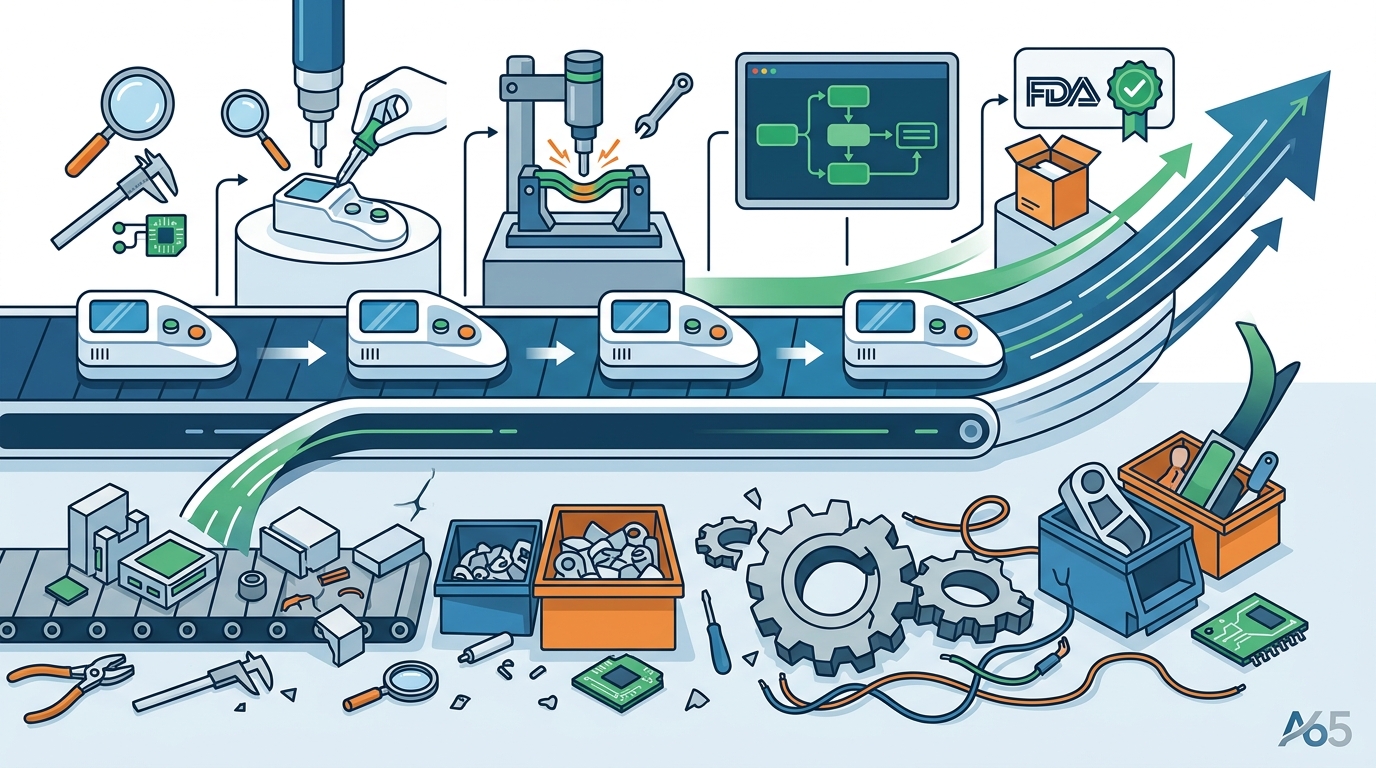
Most development teams treat verification as something that happens near the end of a program. It is planned, scheduled, and executed as a step to confirm that the design meets requirements. In that model, verification is undervalued and often rushed. This leads to the "verification paradox," where the more complex the device, the less time is allocated for thorough testing.
Verification is the process of confirming that a product meets specified design requirements. To accelerate development, verification must be treated as a system integrated throughout the lifecycle. This means developing test protocols early, using simulation and modeling to predict outcomes, and conducting iterative testing on prototypes. By catching issues early, teams can resolve them before they become critical path items.
Another key strategy is to align verification activities with regulatory expectations from the start. Understanding the FDA's guidance on verification and validation helps teams design tests that are both scientifically robust and regulatorily acceptable. This alignment reduces the risk of regulatory queries and delays during the submission process. According to FDA statistics, submissions with well-documented verification plans are 40% more likely to receive a first-cycle clearance.
Integrating Risk Management Early
Risk analysis is one of the most formalized engineering activities in medical device development. Yet, many risk analyses fail to change the design. They become bureaucratic exercises rather than practical tools for decision-making. To accelerate development, risk management must be integrated into the design process, not treated as a separate compliance task.
This involves conducting hazard analyses early and using the results to drive design decisions. By identifying potential failure modes and their impacts, teams can prioritize design efforts on the most critical areas. This focused approach ensures that resources are allocated efficiently and that the most significant risks are mitigated first. Research indicates that proactive risk management can reduce post-market failures by up to 50%.
Additionally, integrating risk management with human factors engineering ensures that the device is safe and usable in real-world clinical environments. Use-related problems are a common source of design changes and delays. By understanding the user's context and constraints early, teams can design devices that are intuitive and safe, reducing the need for extensive usability testing and redesign.
Key Takeaways
- Integrated DFM: Treat Design for Manufacturing as a quality exercise from the conceptual phase to avoid late-stage redesigns.
- Strategic Partnerships: Engage specialized engineering partners to access expert bandwidth and accelerate development timelines.
- Verification Systems: Integrate verification throughout the lifecycle rather than treating it as a final phase to catch issues early.
- Risk Integration: Use risk analysis to drive design decisions, reducing post-market failures and regulatory delays.
- Role Clarity: Clarify roles between product management, engineering, and quality to streamline decision-making.
- Regulatory Alignment: Align verification and validation plans with FDA expectations to improve clearance rates.
- Human Factors: Incorporate human factors engineering early to ensure usability and reduce redesign cycles.
Frequently Asked Questions
How can medical device startups reduce development time?
Startups can reduce development time by integrating Design for Manufacturing (DFM) early, engaging specialized engineering partners, and treating verification as an ongoing system rather than a final phase.
What is the role of an engineering partner in accelerating development?
An engineering partner provides expert leadership, fills skill gaps, and brings established processes to help teams navigate complex product development with clarity and confidence.
Why is Design for Manufacturing (DFM) important for speed?
DFM is important because it identifies manufacturing constraints early, preventing costly redesigns and ensuring a smoother transition to production.
How does risk management impact development timelines?
Proactive risk management identifies potential failure modes early, allowing teams to mitigate risks during design rather than during testing or post-market.
What is the average time to market for a Class II medical device?
The average time to market for a Class II medical device is approximately 1,200 days from initial concept to FDA clearance.
How can startups improve FDA submission success rates?
Startups can improve success rates by aligning verification and validation plans with FDA guidance and maintaining rigorous documentation throughout development.
What is the benefit of integrating human factors engineering early?
Integrating human factors early ensures the device is usable in clinical settings, reducing the need for extensive usability testing and redesign.
How does A65 Consulting support startups?
A65 Consulting provides premium medical device engineering services, from concept to design and delivery, helping startups transform device concepts into viable products.
Next Steps
Accelerating your medical device development cycle requires more than just speed; it requires strategic precision. Whether you need to fill a gap in engineering capability, require additional resources, or are facing challenges in your development program, the right partner can make all the difference. A65 Consulting specializes in turning device concepts into viable products with expert teams and meticulous attention to detail.
Do not let timeline pressures compromise your product's quality or regulatory standing. Contact us today to request a proposal and learn more about how we can help you achieve your product development objectives. Schedule a discovery call to discuss your specific challenges and explore how our expertise can accelerate your path to market.