
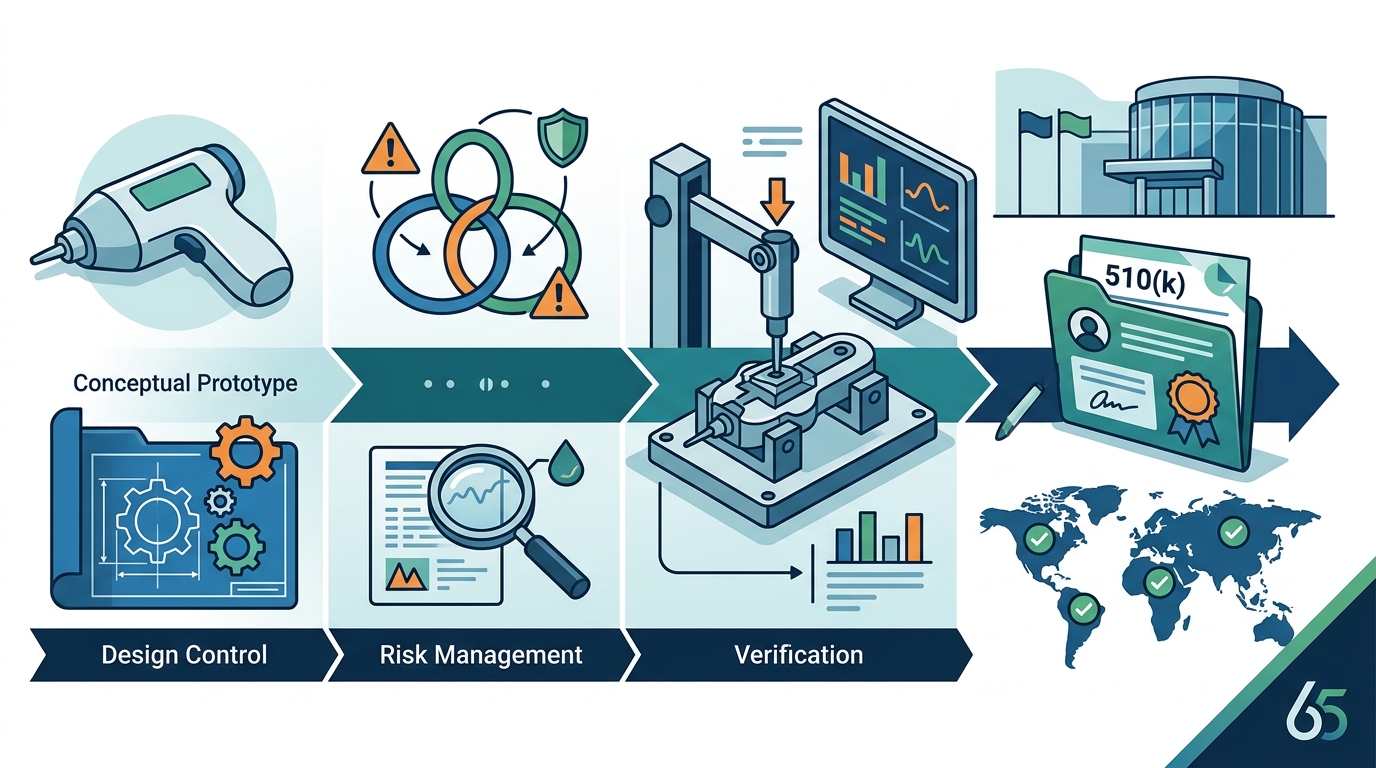
Navigating the path from a raw concept to a market-ready medical device is a complex dance of technical precision and regulatory adherence. According to recent industry analyses, FDA 510(k) submissions have seen increased scrutiny, requiring developers to demonstrate substantial equivalence with rigorous data. A65 Consulting has contributed to more than 8 FDA 510k submissions, helping clients navigate these exact hurdles. This guide outlines the critical phases of design control, risk management, and verification to ensure your device not only functions but also complies with global standards.
Understanding Design Controls and DHF
Design controls are the systematic procedures that ensure medical devices are designed and developed according to user needs and intended uses. The foundation of this process is the Design History File (DHF), which serves as the permanent record of the design process. Without a robust DHF, regulatory bodies cannot verify that your device was developed safely and effectively.
At A65 Consulting, we treat design controls not as a bureaucratic hurdle but as a strategic asset. Our approach integrates product design with rigorous documentation from day one. This ensures that every requirement, from initial concept to final release, is traceable and defensible. By maintaining a living DHF, teams can avoid the costly delays associated with late-stage regulatory audits.
Regulatory compliance begins with clear planning. This involves defining the design inputs, which are the functional and performance requirements, and establishing design outputs, which are the tangible results of the design process. The gap between these two must be closed through rigorous review and approval processes. Our engineering team brings decades of experience in creating these frameworks, ensuring that your device meets the highest standards of excellence.
Integrating Risk Management Early
Risk management is not a phase that happens after design is complete. It is a continuous activity that must be integrated into every stage of development. ISO 14971 is the international standard for the application of risk management to medical devices. It requires developers to identify hazards, estimate the associated risks, and evaluate the need for risk control measures.
Many development teams make the mistake of treating risk analysis as a documentation exercise. However, effective risk management changes the design itself. If a hazard is identified that cannot be mitigated through design, the device concept may need to be reevaluated. A65 Consulting specializes in regulatory and risk management strategies that embed safety into the product DNA.
Our team utilizes advanced hazard analysis techniques to identify potential failure modes before they become costly problems. By addressing risks early, we help clients reduce the likelihood of design changes during verification and validation. This proactive approach not only ensures compliance but also accelerates time to market by preventing late-stage surprises.
Verification vs. Validation: The Critical Distinction
Confusion between verification and validation is a common source of regulatory findings. Verification is the process of confirming that the design outputs meet the design inputs. In simpler terms, you are asking, "Did we build the device right?" Validation, on the other hand, confirms that the device meets the user needs and intended uses. You are asking, "Did we build the right device?"
Verification is often treated as a phase near the end of development, but it should be a system that runs throughout the project. Verification is a system, not a phase, according to industry best practices. This means that testing and analysis should occur iteratively as components are developed, not just at the end of the program.
Validation typically involves clinical or simulated use testing. It requires a representative environment and representative users to ensure the device performs as expected in real-world scenarios. A65 Consulting provides expert support in both areas, ensuring that your testing protocols are robust, reproducible, and compliant with FDA and ISO guidelines. Our track record of 90% on-time completion of mission-critical projects is built on this disciplined approach to testing.
Human Factors and Usability Engineering
Human factors engineering focuses on ensuring that medical devices can be used safely and effectively by the intended users. This is particularly critical for devices used in home care or by patients with limited technical expertise. The FDA has issued specific guidance on human factors, emphasizing that use-related risks must be identified and mitigated through design.
Most development teams believe they understand their users, but usability testing often reveals unexpected problems. These failures are rarely random; they typically stem from a lack of iterative testing with representative users. A65 Consulting integrates human factors and usability engineering into the design process to prevent these issues.
Our approach involves formative and summative usability testing. Formative testing occurs during development to identify and fix usability issues early. Summative testing occurs near the end of development to validate that the device is safe and effective for its intended use. By combining these methods, we ensure that your device is not only compliant but also user-friendly.
Design for Manufacturing and Quality
Design for Manufacturing (DFM) is often introduced as a cost reduction activity. However, it is fundamentally a quality exercise. DFM ensures that the design can be manufactured consistently and reliably at scale. This involves designing components that are easy to assemble, inspect, and test.
At A65 Consulting, we provide manufacturing support spanning process development, DFM reviews, and seamless production transition. We work closely with your manufacturing partners to ensure that the design intent is preserved during production. This includes defining critical process parameters and establishing quality control measures.
By integrating DFM early in the design process, we help clients avoid costly rework and delays. Our team has experience in designing products that are not only innovative but also manufacturable. This holistic approach ensures that your device can be produced at scale without compromising quality or compliance.
Key Takeaways
- Design Controls are Foundational: A robust Design History File (DHF) is essential for regulatory compliance and traceability.
- Risk Management is Continuous: Integrate ISO 14971 principles from concept to launch to identify and mitigate hazards early.
- Verification is a System: Treat verification as an ongoing process rather than a final phase to catch issues sooner.
- Validation Requires Real-World Context: Use representative users and environments to confirm the device meets user needs.
- Human Factors are Critical: Conduct iterative usability testing to prevent use-related errors and ensure safety.
- DFM Ensures Quality: Design for manufacturing to ensure consistent, scalable production without compromising design intent.
- Expert Partnership Matters: A65 Consulting has helped clients generate over $300M in projected revenue through compliant product development.
Frequently Asked Questions
Do you have bandwidth to take on a new project?
Yes, we have a network of engineers that we utilize to bring in with the right discipline experience and to expand our resources as needed.
How do you charge for your work?
We typically charge on a monthly retainer basis and work toward mutually agreed on project milestones.
What experience does A65 Consulting have designing medical devices similar to my project?
We have experience designing a wide variety of medical devices. Sometimes that experience is a direct fit, but even when it is not, our broad range of experience affords us insight into many areas. We would be happy to share more details with you upon request.
How long has A65 Consulting been in business?
We have been working as a team since 2018, but our engineering team has decades of medical device development experience under their belts.
What is the difference between verification and validation?
Verification confirms that the design outputs meet the design inputs (did we build it right?). Validation confirms that the device meets the user needs and intended uses (did we build the right device?).
How does A65 Consulting handle risk management?
We integrate risk management into every stage of development, using ISO 14971 standards to identify hazards and implement mitigation strategies early in the design process.
Can you help with FDA 510(k) submissions?
Yes, our products have contributed to more than 8 FDA 510k submissions, and we provide comprehensive support to ensure a smooth regulatory pathway.
Start Your Compliance Journey
Ensuring your medical device meets regulatory compliance standards requires expertise, experience, and a strategic partner. A65 Consulting is ready to help you navigate the complexities of design controls, risk management, and validation. Book a consultation today to discuss your project and learn how we can help you bring your device to market safely and efficiently.