
Medical device development is a high-stakes engineering discipline where technical precision meets rigorous regulatory compliance. According to recent industry analyses, the average time to market for a Class II medical device has increased by 15% over the last decade due to evolving FDA expectations and supply chain complexities. This shift demands that engineering teams move beyond traditional prototyping and embrace a holistic development strategy. At A65 Consulting, we help innovators navigate this complex landscape by turning abstract concepts into viable, manufacturable products that meet the highest standards of safety and efficacy. (Contact A65 Consulting)
Understanding the Medical Device Lifecycle
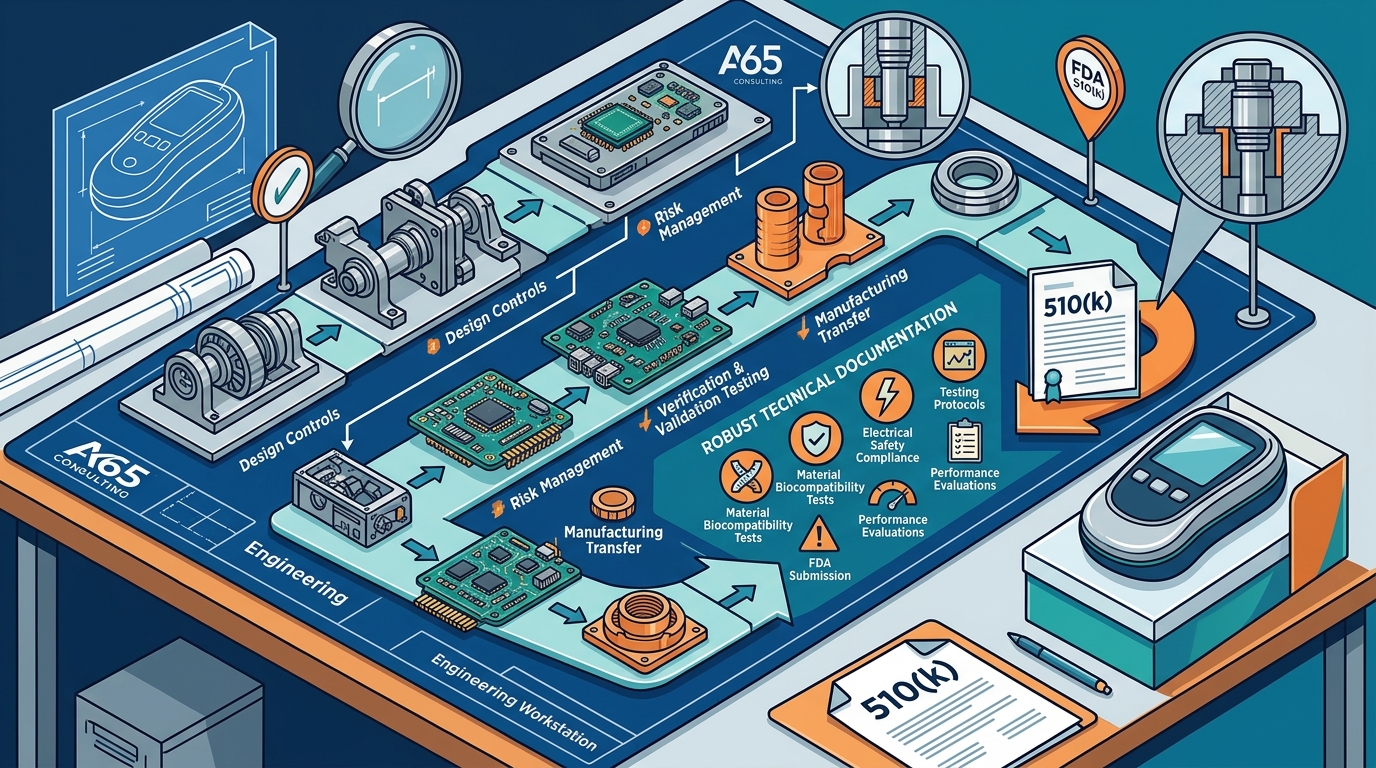
Medical device development is not a linear path but a complex iterative process. It begins with identifying a clinical need and ends with post-market surveillance. The lifecycle is defined by several critical phases, each requiring specific engineering deliverables and regulatory documentation.
Product Design is the foundational phase where functional requirements are translated into technical specifications. This stage involves detailed system architecture, component selection, and initial prototyping. Precision engineering support is crucial here to ensure that the device concept is not only innovative but also technically feasible.
Verification and Validation are often misunderstood as single events. Verification is a system, not a phase, ensuring that the device meets its design specifications. Validation, on the other hand, confirms that the device meets user needs and intended uses. When treated as a phase, verification is undervalued, leading to costly redesigns later in the process. A robust verification plan must be established early, with clear acceptance criteria for every requirement.
Manufacturing Transfer is the bridge between the lab and the factory floor. This phase involves process development, Design for Manufacturing (DFM) reviews, and seamless production transition. The goal is to ensure that the design can be produced consistently at scale without compromising quality or increasing costs unnecessarily.
Overcoming Critical Engineering Challenges
Many development programs encounter expensive tooling changes, failed verification testing, supplier problems, or manufacturing inefficiencies right when they are almost at the finish line. These issues often stem from a lack of early-stage engineering leadership or a gap in specialized knowledge.
Geometric Dimensioning and Tolerancing (GD&T) is often introduced as a drafting standard tied to manufacturing drawings. In many organizations, GD&T enters the conversation late in development, when drawings are nearing release. This delay can create misalignment between design intent and manufacturing capability. GD&T is a communication system, not just a drawing requirement. It ensures that every stakeholder, from the designer to the machinist, interprets the part geometry in the same way.
Risk analysis is another area where many teams struggle. Hazard analyses are created, risk matrices are populated, and mitigation tables are carefully maintained. Yet many design problems are not resolved by the risk analysis itself. The risk analysis paradox occurs when the documentation is perfect, but the design remains vulnerable. Effective risk management requires integrating hazard mitigation directly into the design iterations, not treating it as a separate administrative task.
Executive dashboards rarely show real risk. The "Green Program" that wasn't is a common phenomenon where program reviews look exactly as leadership would hope. Every major workstream is green, milestones are holding, and no critical issues are open. The dashboard signals control, but the underlying engineering risks are being masked by optimistic reporting. Transparent engineering leadership is required to surface these risks early and address them before they become critical path items.
Navigating FDA 510(k) and Regulatory Pathways
Regulatory compliance is a non-negotiable aspect of medical device development. For many Class II devices, the 510(k) premarket notification is the primary pathway to market. This process requires demonstrating that the new device is substantially equivalent to a legally marketed predicate device.
Design History File (DHF) creation is a continuous activity throughout the development lifecycle. It is not a document created at the end of the project. The DHF contains the planning, design, and verification records that prove the device was developed according to Quality System Regulations (QSR). A well-maintained DHF reduces regulatory review time and minimizes the risk of 483 observations or warning letters.
Biocompatibility testing is another critical regulatory hurdle. ISO 10993 standards dictate the testing requirements based on the nature and duration of patient contact. Choosing the right testing strategy early can save months of development time and significant costs. Engaging with a testing laboratory that understands the specific device application is essential for accurate and efficient compliance.
Software as a Medical Device (SaMD) adds another layer of complexity. If your device includes software components, you must adhere to IEC 62304 standards for medical device software life cycle processes. This includes rigorous code review, unit testing, and integration testing. The regulatory expectations for software are increasingly stringent, requiring traceability from user needs to code implementation.
Design for Manufacturing and Quality
Design for Manufacturing (DFM) is often introduced as a cost reduction activity. It shows up when margins tighten, when sourcing changes, or when a program is already under pressure. At that point, teams look for ways to make the product cheaper to produce. However, DFM is fundamentally a quality exercise, not just a cost exercise. Designing for manufacturability ensures that the device can be produced consistently with high yield and low defect rates.
Process validation is required for manufacturing processes where the output cannot be fully verified by subsequent inspection and testing. Sterilization, cleaning, and assembly processes often fall into this category. Process validation involves three stages: Installation Qualification (IQ), Operational Qualification (OQ), and Performance Qualification (PQ). Each stage must be documented and approved before full-scale production begins.
Supplier quality management is critical for maintaining product integrity. Suppliers must be qualified based on their ability to meet specifications, deliver on time, and maintain consistent quality. Regular audits and performance reviews are necessary to ensure that suppliers remain compliant with your quality management system. A breakdown in supplier quality can halt production and delay market launch.
The Strategic Value of Engineering Partnerships
Many medical device companies face gaps in engineering capability or team capacity. Hiring full-time engineers is expensive and time-consuming, especially for specialized skills. Outsourcing engineering services provides a flexible way to access expert support without the long-term commitment.
Engineering outsourcing accelerates development when it provides immediate access to specialized expertise. If a program needs more speed, adding external resources can help. If specialized expertise is missing, bringing in a partner can fill the gap. However, outsourcing can slow down development if communication is poor or if the partner lacks domain knowledge. The key is to choose a partner who understands the medical device industry and can integrate seamlessly with your team.
A65 Consulting provides engineering leadership and expert support to help teams navigate complex product development with clarity and confidence. We work alongside your team to provide the right expertise and guidance for your device, without the cost and commitment of adding full-time headcount. Our team has decades of medical device development experience under their belts, having served more than 20 clients and contributed to over $300M of projected new product revenue.
When evaluating an engineering partner, consider their track record in regulatory submissions. A65 Consulting has contributed to more than 8 FDA 510(k) submissions, ensuring that your device meets regulatory requirements from the start. We also prioritize creating designs that lead to new patent applications, protecting your intellectual property and competitive advantage.
Key Takeaways
- Early Integration is Critical: Integrating regulatory and manufacturing considerations early in the design phase reduces costly late-stage changes.
- GD&T is Communication: Geometric Dimensioning and Tolerancing is a communication system that aligns design intent with manufacturing capability.
- Verification is a System: Verification must be treated as a continuous system, not a final phase, to ensure design requirements are met.
- Risk Analysis Drives Design: Effective risk analysis must directly influence design iterations, not just serve as documentation.
- DFM Ensures Quality: Design for Manufacturing is primarily a quality exercise that ensures consistent production at scale.
- Strategic Outsourcing: Partnering with experienced engineering firms can fill capability gaps and accelerate time to market.
- Regulatory Readiness: Maintaining a comprehensive Design History File throughout development is essential for successful FDA submissions.
Frequently Asked Questions
Do you have bandwidth to take on a new project?
Yes, we have a network of engineers that we utilize to bring in with the right discipline experience and to expand our resources as needed. We can scale our team to match your project requirements.
How do you charge for your work?
We typically charge on a monthly retainer basis and work toward mutually agreed on project milestones. This model provides predictability for both parties and aligns our incentives with your project goals.
What experience does A65 Consulting have designing medical devices similar to my project?
We have experience designing a wide variety of medical devices. Sometimes that experience is a direct fit, but even when it is not, our broad range of experience affords us insight into many areas. We would be happy to share more details with you upon request.
How long has A65 Consulting been in business?
We have been working as a team since 2018, but our engineering team has decades of medical device development experience under their belts. Our collective expertise spans multiple device classes and therapeutic areas.
What is the typical timeline for a 510(k) submission?
The timeline varies based on device complexity and regulatory feedback. However, by integrating regulatory strategy early, we help minimize delays and ensure a smoother submission process.
How do you handle intellectual property protection?
We prioritize creating designs that lead to new patent applications. Our engineering approach is designed to protect your intellectual property while ensuring technical feasibility and regulatory compliance.
Can you help with post-market surveillance?
Yes, we provide ongoing support for post-market surveillance, including design changes, annual reports, and regulatory updates. Our goal is to support your device throughout its entire lifecycle.
Start Your Development Journey
Transforming a medical device concept into a market-ready product requires precision, expertise, and a deep understanding of regulatory requirements. A65 Consulting is your premium engineering partner, dedicated to delivering results that exceed your expectations. Whether you need assistance with a new product concept, require additional engineering resources, or are facing gaps in your engineering leadership, we have the expertise to deliver solutions that meet your unique requirements.
Do not let engineering gaps or regulatory uncertainty delay your innovation. Schedule a discovery call with our team today to discuss your project and explore how we can help you achieve your product development objectives. Visit our services page to learn more about our comprehensive engineering capabilities.