
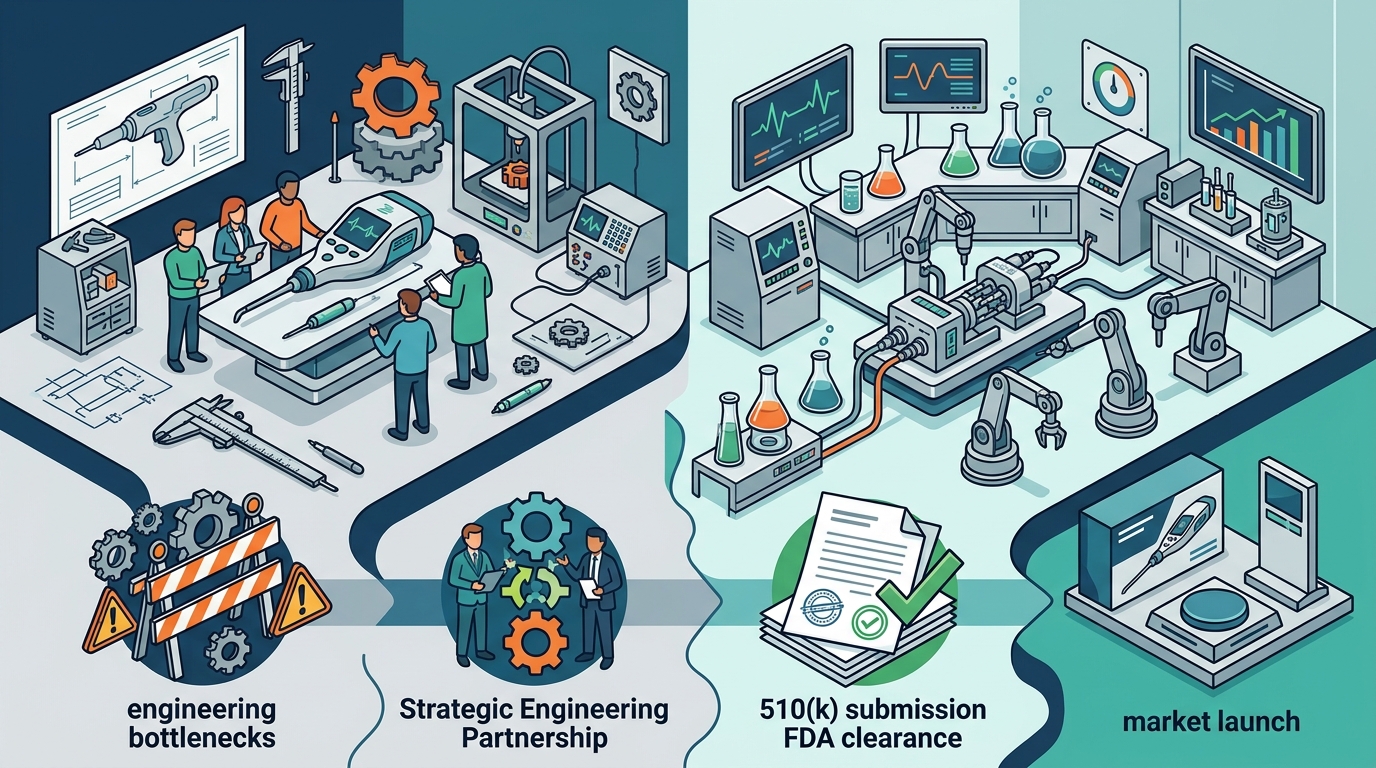
Medical device development is a high-stakes engineering discipline where technical precision meets rigorous regulatory compliance. According to industry data, more than 80% of medical device startups fail to reach market within their projected timelines due to engineering and regulatory bottlenecks. This guide outlines the critical phases of transforming a device concept into a viable, FDA-cleared product. We will explore how strategic engineering partnerships can mitigate risk, accelerate verification, and ensure successful 510(k) submission. (Contact A65 Consulting)
Phase 1: Concept Validation and Feasibility
The journey begins with a clear definition of the clinical need. Product Design is not merely about aesthetics; it is about solving a specific patient or provider problem through engineering. At this stage, the focus is on identifying technical risks and defining the design inputs. Many teams skip this step, leading to costly rework later in the development cycle.
A65 Consulting specializes in turning device concepts into viable products. We help you identify gaps in engineering capability before they become project killers. By establishing a robust design history file (DHF) early, you create a traceable path from user needs to technical specifications. This foundational work is critical for any medical device engineering project.
Phase 2: Product Design and Development
Once the concept is validated, the engineering team moves into detailed design. This phase involves mechanical, electrical, and software engineering working in concert. The goal is to create a prototype that meets all design inputs while remaining manufacturable.
Integrating Human Factors
Human factors engineering is not an afterthought. It is a core component of the design process. Devices must be intuitive for clinicians to use in high-stress environments. Ignoring usability can lead to use-related hazards that regulators will flag during review. Our approach integrates human factors and usability testing early to ensure the device works as intended in real-world clinical settings.
Risk Management Integration
Risk analysis must evolve alongside the design. A static risk assessment created at the start of the project is insufficient. As design choices change, so do the hazards. We utilize dynamic risk management processes to ensure that every design decision is evaluated for potential patient and user harm. This proactive approach reduces the likelihood of design changes during late-stage verification.
Phase 3: Design for Manufacturing (DFM)
Design for Manufacturing (DFM) is a quality exercise, not just a cost reduction activity. It ensures that the design can be produced consistently at scale with high yield and low defect rates. Transitioning from prototype to production requires careful planning and collaboration with manufacturing partners.
Our manufacturing support spans process development, DFM reviews, and seamless production transition. We help you select materials and components that balance performance with supply chain stability. This phase is critical for achieving the 90% on-time completion rate that defines our project management standards.
Phase 4: Verification and Testing
Verification is a system, not a phase. It is the process of confirming that the device meets its design inputs. This includes mechanical testing, electrical safety testing, software validation, and biocompatibility assessments. A well-planned verification strategy prevents the "green program" illusion where dashboards look good, but critical issues remain hidden until testing begins.
When verification is treated as a phase near the end of development, it is often undervalued. Instead, verification activities should be integrated throughout the design process. This allows for early detection of non-conformances and reduces the risk of major delays. Our team ensures that every test is traceable to a design input, creating a defensible record for regulatory review.
Phase 5: Regulatory Strategy and 510(k)
The final hurdle is regulatory clearance. For most Class II medical devices, this means obtaining 510(k) clearance from the FDA. This requires a comprehensive submission that demonstrates substantial equivalence to a predicate device.
Our experience includes contributing to more than 8 FDA 510(k) submissions. We help you navigate the complexities of regulatory strategy, including predicate selection, testing standards, and submission documentation. A strong regulatory strategy is built on a strong engineering foundation. If your design history file is incomplete, your submission will be delayed.
Comparing Development Approaches
| Approach | Pros | Cons | Best For |
|---|---|---|---|
| In-House Development | Full control over IP and timeline | High fixed costs, limited bandwidth | Large OEMs with dedicated teams |
| Full-Service Partner | Expertise across all disciplines | Requires clear communication | Startups and mid-sized companies |
| Staff Augmentation | Flexible resource scaling | Management overhead for client | Teams with specific skill gaps |
Key Takeaways
- Engineering Partnership Value: A65 Consulting has helped clients develop products that contributed to more than $300M of projected new product revenue.
- Regulatory Experience: Our team has contributed to more than 8 FDA 510(k) submissions, ensuring compliance from day one.
- On-Time Delivery: We maintain a 90% on-time completion rate for mission-critical projects through rigorous program management.
- Innovation Output: Our designs have created more than 10 new patent applications, protecting your intellectual property.
- Client Base: We have served more than 20 clients, providing tailored engineering leadership and support.
- Team History: Our engineering team has decades of medical device development experience, working together as a cohesive unit since 2018.
- Flexible Engagement: We offer monthly retainer models and milestone-based work to fit your budget and timeline.
Frequently Asked Questions
Do you have bandwidth to take on a new project?
Yes, we have a network of engineers that we utilize to bring in with the right discipline experience and to expand our resources as needed. This allows us to scale quickly without compromising quality.
How do you charge for your work?
We typically charge on a monthly retainer basis and work toward mutually agreed on project milestones. This model provides predictability for both parties and aligns our incentives with your success.
What experience does A65 Consulting have designing medical devices similar to my project?
We have experience designing a wide variety of medical devices. Sometimes that experience is a direct fit, but even when it is not, our broad range of experience affords us insight into many areas. We would be happy to share more details with you upon request.
How long has A65 Consulting been in business?
We have been working as a team since 2018, but our engineering team has decades of medical device development experience under their belts. This combination of recent collaboration and deep historical knowledge is a key strength.
What is the difference between verification and validation?
Verification confirms that the device meets the design inputs ("Did we build the product right?"). Validation confirms that the device meets the user needs and intended use ("Did we build the right product?"). Both are critical for regulatory submission.
Can you help with software development for medical devices?
Yes, we provide software engineering support that adheres to IEC 62304 standards. This includes requirements analysis, architecture design, coding, and testing to ensure safe and effective software performance.
How do you handle intellectual property?
We work closely with your legal team to ensure that all intellectual property rights are clearly defined and protected. Our standard agreements include robust IP clauses to safeguard your innovations.
Start Your Engineering Partnership
Are you facing a gap in engineering capability or team capacity? A65 Consulting provides engineering leadership and expert support to help teams navigate complex product development with clarity and confidence. From leadership team support to hands-on engineering expertise, we help close critical gaps and keep programs moving forward.
Let’s discuss how we can help you transform your device concept into a reality. Book a consultation today to learn more about our services and how we can support your next medical device project.