
Turning a medical device concept into a functional prototype is a high-stakes engineering challenge that requires balancing clinical need with regulatory reality. According to recent industry analysis, FDA submission timelines have shifted significantly, with average review periods extending due to increased complexity in pre-market data requirements. This means founders cannot afford to treat prototyping as a simple hardware exercise. Instead, it must be viewed as a strategic phase of risk mitigation and design validation. The gap between a sketch on a napkin and a viable product is bridged by rigorous engineering leadership, iterative testing, and a deep understanding of the regulatory landscape. This guide outlines the critical steps early-stage founders must take to navigate this complex journey successfully. (Contact A65 Consulting)
Understanding the Medical Device Lifecycle
Medical device development is not a linear path but a complex, iterative cycle governed by strict quality standards. Design Control is the systematic process that ensures a device meets user needs and regulatory requirements throughout its life cycle. Unlike consumer electronics, where speed to market is the primary driver, medical devices prioritize safety and efficacy above all else. This distinction fundamentally changes how a founder approaches prototyping. (Services A65 Consulting)
Many founders mistakenly believe that a working prototype is the end goal. In reality, the prototype is merely a tool to gather data. The true objective is to de-risk the design before committing to expensive manufacturing tooling. This requires a shift in mindset from "building a product" to "engineering a solution." The process involves translating vague clinical problems into precise technical specifications, validating those specifications through testing, and documenting every step for regulatory review. Without this disciplined approach, even the most innovative ideas can stall due to unforeseen technical or compliance hurdles. (Medical Device Design Consulting)
Defining the Problem and User Needs
The foundation of any successful medical device is a clearly defined problem statement. Before writing a single line of code or sketching a mechanical part, founders must articulate the clinical need with precision. This involves identifying the target patient population, the clinical environment, and the specific pain points that existing solutions fail to address. User needs are the documented requirements that describe what the device must do to solve the problem effectively and safely.
Human factors engineering plays a critical role in this stage. Devices are used by patients, caregivers, and clinicians, each with different levels of technical proficiency and physical constraints. A device that works perfectly in a lab may fail in a busy emergency room if it is not intuitive to use. Founders must engage with end-users early to understand the workflow context. This insight informs the design of the user interface, the ergonomics of the device, and the safety mechanisms required to prevent misuse. Ignoring these human factors early on often leads to costly redesigns later in the development process.
From Concept to Feasible Design
Once the problem is defined, the next step is to explore potential solutions. This phase involves brainstorming, sketching, and creating low-fidelity models to test core concepts. The goal is to identify the most promising technical approaches while eliminating those that are infeasible due to cost, size, or regulatory constraints. Design for Manufacturing (DFM) is the practice of designing products in a way that facilitates efficient and cost-effective manufacturing. While DFM is often associated with later stages, its principles should inform early design decisions to avoid future bottlenecks.
During this phase, founders must also consider the supply chain. Sourcing medical-grade materials and components can be challenging, especially for early-stage companies with low volume requirements. Building relationships with suppliers early can help secure lead times and negotiate better terms. Additionally, founders should evaluate the intellectual property landscape to ensure their concept does not infringe on existing patents. A freedom-to-operate analysis can save significant time and resources by identifying potential legal obstacles before they become critical issues.
The Three Phases of Prototyping
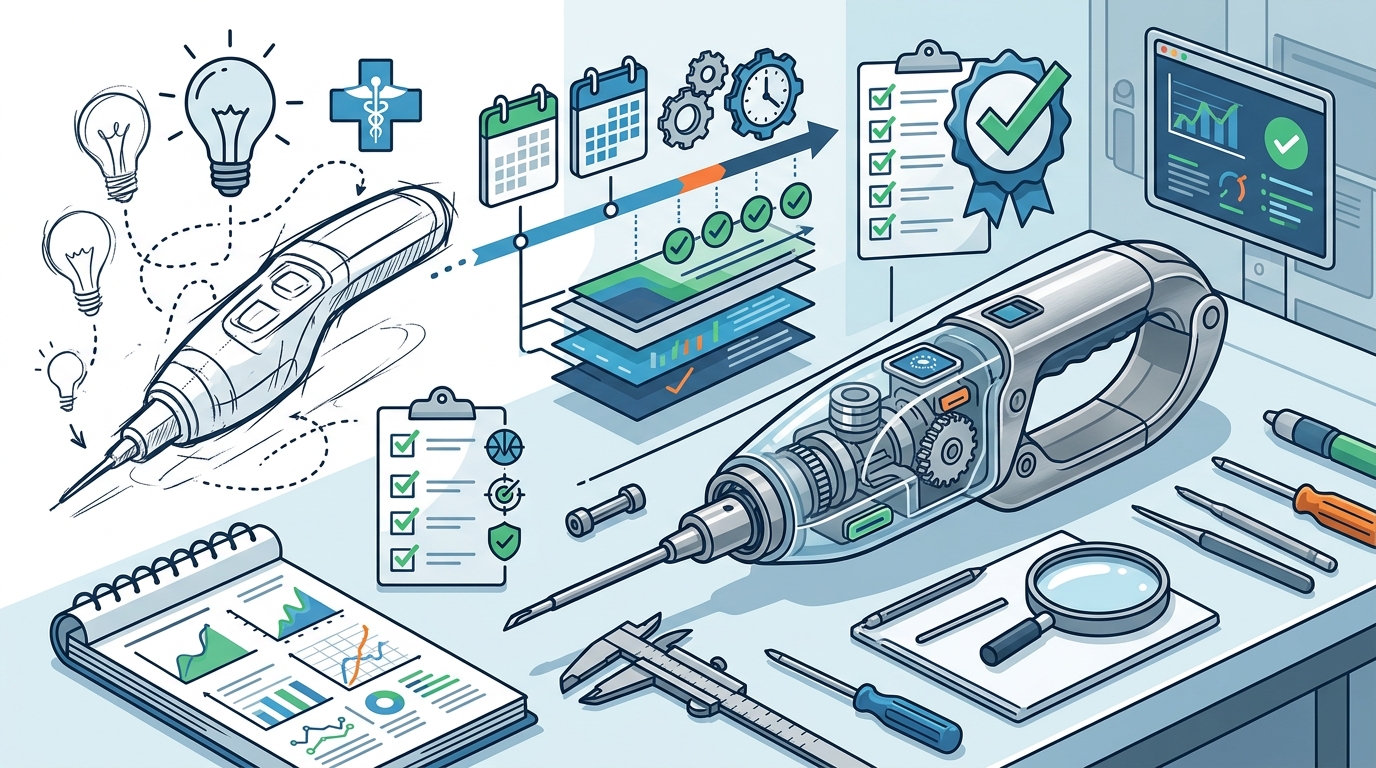
Prototyping in medical device development is not a single event but a series of progressive stages, each serving a specific purpose. Understanding these phases helps founders allocate resources effectively and manage expectations.
1. Proof of Concept (PoC)
The Proof of Concept prototype is a rough, often ugly, model designed to test a single critical function. It is not intended to look like the final product or to be used by patients. Instead, it answers the question: "Does this core technology work?" For example, if the device relies on a new sensor technology, the PoC would focus solely on validating that sensor's accuracy and reliability. This phase is low-cost and fast, allowing founders to pivot quickly if the core technology fails.
2. Alpha Prototype
The Alpha prototype, also known as an engineering validation test (EVT) unit, begins to resemble the final product in form and function. It is built using materials and processes that are close to the final manufacturing method. The goal of this phase is to validate the design against the user needs and technical specifications. This includes testing for durability, performance, and basic safety. Alpha prototypes are often used for internal testing and early feedback from key stakeholders. They are not yet suitable for regulatory submission or clinical trials.
3. Beta Prototype
The Beta prototype, or production validation test (PVT) unit, is built using the final manufacturing process and materials. It is functionally identical to the product that will be sold to customers. This phase is critical for verifying that the manufacturing process can consistently produce devices that meet all requirements. Beta prototypes are often used in clinical trials and pre-market testing. They must be rigorously documented and traced back to the design specifications to support regulatory submissions.
Integrating Regulatory Strategy Early
Regulatory compliance is not an afterthought but a core component of the design process. Early-stage founders must determine the classification of their device (Class I, II, or III) and the corresponding regulatory pathway (510(k), De Novo, or PMA). This decision impacts the depth of testing, the quality management system requirements, and the timeline to market. Quality Management Systems (QMS) are the framework that ensures consistent design and production of medical devices in compliance with regulatory standards.
One of the most common mistakes founders make is treating regulatory strategy as a separate activity. Instead, it should be integrated into every stage of development. For example, risk management activities, such as hazard analysis and mitigation, should begin during the concept phase and continue throughout the lifecycle. This proactive approach reduces the likelihood of costly delays during the regulatory review process. Founders should also engage with regulatory experts early to clarify ambiguities and ensure that their testing plans meet agency expectations.
Choosing the Right Engineering Partner
For most early-stage founders, building a full-time engineering team is not feasible. Outsourcing to a specialized engineering partner can provide the expertise and flexibility needed to navigate the development process. However, not all partners are created equal. Founders should look for firms with a proven track record in medical device development, particularly in their specific therapeutic area. Key factors to consider include the firm's experience with regulatory submissions, their approach to risk management, and their ability to integrate seamlessly with the founder's team.
A65 Consulting specializes in helping founders turn device concepts into viable products. Our team of experienced engineers provides end-to-end support, from initial concept validation to manufacturing transfer. We understand the unique challenges faced by early-stage companies and work to provide the right expertise without the cost and commitment of adding full-time headcount. By integrating with your team, we help keep your project on time, on budget, and aligned with your product requirements.
Key Takeaways
- Iterative Development: Prototyping is a progressive process involving Proof of Concept, Alpha, and Beta stages, each with distinct validation goals.
- Regulatory Integration: Compliance strategies must be embedded in the design process from day one, not added as an afterthought.
- User-Centric Design: Human factors and clinical workflow analysis are critical to ensuring device usability and safety.
- Risk Management: Proactive hazard analysis and mitigation reduce development costs and accelerate regulatory approval.
- Strategic Partnerships: Engaging specialized engineering firms can provide necessary expertise and flexibility for early-stage teams.
- Supply Chain Awareness: Early engagement with suppliers helps secure materials and manage lead times for medical-grade components.
- Documentation Discipline: Rigorous design history file (DHF) maintenance is essential for regulatory submissions and quality assurance.
Frequently Asked Questions
How long does it typically take to develop a medical device prototype?
The timeline varies significantly based on device complexity and classification. Simple Class I devices may take 6-12 months, while complex Class III devices can take 3-5 years. However, the prototyping phase itself, from concept to Beta prototype, typically ranges from 12 to 24 months depending on the rigor of testing and regulatory requirements.
What is the difference between a Proof of Concept and an Alpha prototype?
A Proof of Concept (PoC) is a rough model designed to validate a single core technology or function. It is not intended for user testing. An Alpha prototype is a more refined model that resembles the final product in form and function, used to validate the design against user needs and technical specifications.
Do I need a Quality Management System (QMS) before I start developing?
While you do not need a fully certified QMS on day one, you must implement quality processes early. Regulatory agencies expect evidence of quality planning and risk management throughout the development lifecycle. Starting with basic documentation practices and scaling up as you progress is a common and effective approach.
How can I reduce the cost of prototyping?
Costs can be reduced by focusing on iterative, low-fidelity prototypes early in the process. Using additive manufacturing (3D printing) for initial models can also lower costs compared to traditional machining. Additionally, engaging an engineering partner with experience in cost optimization can help identify design changes that reduce manufacturing expenses without compromising performance.
What role does human factors engineering play in prototyping?
Human factors engineering ensures that the device is safe and effective for its intended users. It involves testing the device with representative users to identify usability issues. This feedback is incorporated into subsequent prototype iterations to improve the user interface and reduce the risk of use-related errors.
Can I outsource the entire development process?
Yes, many engineering firms offer full-service development capabilities. However, it is crucial to maintain active involvement in the process to ensure the product aligns with your vision and business goals. A collaborative partnership model is often more effective than a purely transactional relationship.
What are the key metrics for evaluating a prototype?
Key metrics include performance accuracy, reliability, durability, safety, and usability. Each prototype phase should have specific acceptance criteria based on these metrics. For example, a Beta prototype must meet all performance specifications and pass rigorous safety testing before it can be used in clinical trials.
Start Your Development Journey
Turning a medical idea into a working prototype is a complex but rewarding endeavor. By following a structured development process, integrating regulatory strategy early, and partnering with experienced engineering experts, founders can significantly de-risk their projects and accelerate time to market. If you are facing gaps in engineering capability or team capacity, A65 Consulting is here to help. We provide the engineering leadership and expert support needed to navigate complex product development with clarity and confidence. Book a consultation today to discuss your project and discover how we can help you bring your medical device to life.