
Steps to Prepare a Medical Device for FDA 510(k) Submission and Manufacturing Transfer
Preparing a medical device for regulatory approval and commercial production is a high-stakes engineering challenge. According to FDA data, the 510(k) pathway remains the most common route for market clearance, yet nearly 30% of submissions face initial deficiencies that delay launch. This delay often stems from fragmented documentation or late-stage manufacturing handoffs. A65 Consulting helps engineering teams navigate this complex landscape by integrating regulatory strategy with rigorous design controls from day one. (Contact A65 Consulting)
Understanding the 510(k) Pathway
The 510(k) premarket notification process requires you to demonstrate that your new device is substantially equivalent to a legally marketed predicate device. This is not merely a paperwork exercise. It is a technical argument built on engineering data, clinical evidence, and comparative analysis. (About A65 Consulting)
Many engineering teams treat regulatory compliance as a final step. This approach is flawed. Regulatory strategy must inform design decisions from the conceptual phase. If you select a predicate that is no longer available or lacks the necessary technical characteristics, your entire submission may be rejected. A65 Consulting specializes in predicate selection and gap analysis to ensure your device meets the specific requirements of the FDA before significant development costs are incurred. (Services A65 Consulting)
Understanding the regulatory landscape is critical. The FDA classifies devices into Class I, II, or III based on risk. Most 510(k) devices fall into Class II, which requires special controls in addition to general controls. Knowing your class early dictates your testing requirements and documentation depth. (Medical Device Design Consulting)
Implementing Design Controls Early
Design controls are the backbone of a successful 510(k) submission. These are a set of procedures that ensure your device meets user needs and intended uses. The FDA mandates these controls under 21 CFR Part 820.30. Without them, your submission will lack the necessary traceability.
Defining User Needs and Design Inputs
The process begins with capturing user needs. These are high-level statements of what the device must do. From these needs, you derive design inputs. These are specific, measurable technical requirements. For example, a user need might be "the device must be portable." The corresponding design input might be "weight must be less than 500 grams." This translation is where engineering precision meets regulatory clarity.
At A65 Consulting, we help teams establish these inputs with rigorous traceability matrices. This ensures that every design decision can be linked back to a user need and a regulatory requirement. This traceability is often the first thing reviewers look for during an audit.
Design Outputs and Verification
Design outputs are the actual specifications of the device. These include drawings, software code, and material specifications. The critical step here is verification. Verification answers the question: "Did we build the device right?" This involves testing the outputs against the inputs. If a design input states a battery life of 10 hours, the verification test must prove that the output meets this specification.
Many teams confuse verification with validation. Verification is about meeting specifications. Validation is about meeting user needs. Both are essential, but they serve different purposes in the regulatory narrative.
Verification and Validation Workflows
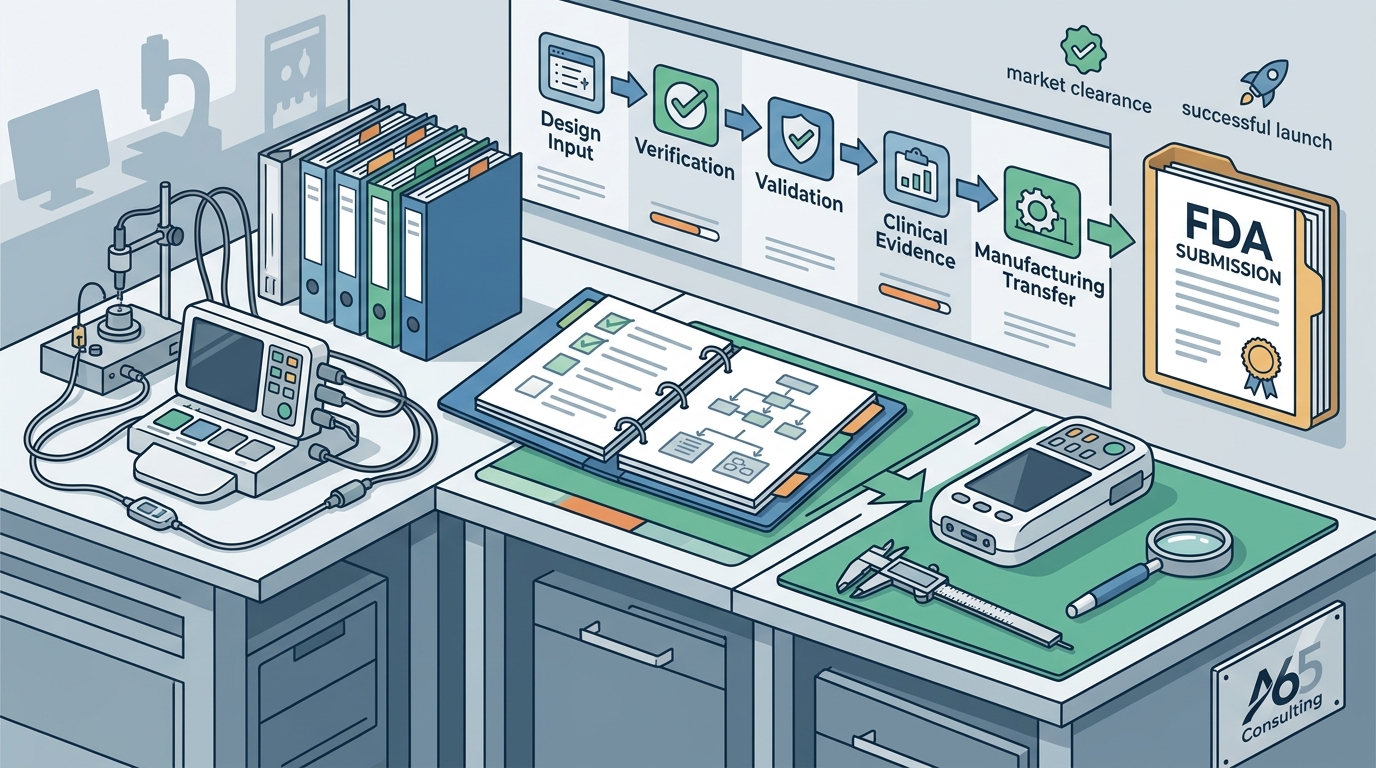
Verification and validation (V&V) are often treated as separate phases. In reality, they are intertwined. A robust V&V plan ensures that your device performs as intended in both laboratory and real-world settings.
Systematic Verification Testing
Verification testing must be comprehensive. It covers mechanical, electrical, software, and biocompatibility aspects. Each test protocol must be pre-approved and executed with documented results. Any deviation from the protocol must be justified and recorded. This level of detail is what separates a successful submission from a deficient one.
According to industry analysis, deficiencies in testing are a leading cause of 510(k) delays. Teams often underestimate the complexity of biocompatibility testing or software validation. A65 Consulting provides expert support in these areas, ensuring that your testing protocols are robust and defensible.
Usability and Human Factors
Human factors engineering is a critical component of validation. It ensures that the device can be used safely and effectively by the intended users. This involves formative and summative usability testing. Formative testing occurs during development to identify and fix issues. Summative testing occurs near the end to confirm that the device is safe for use.
Failure to address human factors can lead to significant delays. The FDA has increased its scrutiny of usability data in recent years. A65 Consulting integrates human factors engineering into the design process, ensuring that your device is not only technically sound but also user-friendly.
Risk Management Integration
Risk management is not a standalone activity. It is a continuous process that runs parallel to design. The ISO 14971 standard provides the framework for this process. It requires you to identify hazards, estimate risk, and implement controls to mitigate that risk.
Hazard Analysis and Mitigation
Start with a hazard analysis. Identify all potential hazards associated with the device. This includes foreseeable misuse. For each hazard, estimate the risk based on severity and probability. Then, implement controls to reduce the risk to an acceptable level. These controls can be inherent in the design, protective measures, or information for safety.
A65 Consulting helps teams create comprehensive risk management files. These files are a required part of the 510(k) submission. They demonstrate to the FDA that you have systematically addressed all potential risks. A well-documented risk management file can significantly speed up the review process.
Residual Risk and Benefit Analysis
After implementing controls, you must evaluate residual risk. Is the remaining risk acceptable in light of the benefits to the patient? This analysis is crucial for the final submission. It shows that you have considered the broader impact of your device. A65 Consulting assists in this analysis, ensuring that your benefit-risk profile is compelling and clear.
Manufacturing Transfer and DFM
Preparing for manufacturing transfer is a critical step that many teams overlook until late in the process. Design for Manufacturing (DFM) ensures that your device can be produced efficiently and consistently at scale. This is not just about cost. It is about quality and regulatory compliance.
Process Validation
Before transferring production, you must validate your manufacturing processes. This involves proving that the process consistently produces a product that meets its specifications. For sterile devices, this includes sterilization validation. For software, it includes software lifecycle validation. These validations must be documented and included in your submission.
A65 Consulting provides manufacturing support spanning process development and DFM reviews. We help you identify potential production issues early, reducing the risk of costly rework later. Our expertise ensures a seamless transition from design to production.
Supplier Quality Management
Your suppliers are an extension of your quality system. You must ensure that they meet your quality standards. This involves auditing suppliers, approving materials, and monitoring performance. A65 Consulting helps establish robust supplier quality management systems. This ensures that your supply chain is reliable and compliant.
Final Submission Preparation
The final step is compiling the 510(k) submission. This involves organizing all your documentation into a coherent narrative. The submission must include a device description, substantial equivalence argument, testing data, and risk analysis.
Structuring the Narrative
The narrative is your opportunity to persuade the reviewer. It must be clear, concise, and logical. Start with a device description. Then, present the substantial equivalence argument. Follow with the testing data that supports your claims. Finally, summarize the risk analysis and benefits.
A65 Consulting assists in drafting this narrative. We ensure that your submission is not just a collection of documents, but a compelling argument for clearance. Our experience with FDA reviewers helps us anticipate questions and address potential concerns proactively.
Review and Refinement
Before submitting, conduct a thorough internal review. Check for consistency, completeness, and accuracy. Ensure that all references are correct and all data is properly cited. A65 Consulting offers a final review service to catch any last-minute issues. This step can save weeks of review time and prevent costly resubmissions.
Key Takeaways
- Early Regulatory Strategy: Selecting the correct predicate and understanding the regulatory pathway early prevents costly redesigns and delays.
- Traceability is Critical: Maintaining a clear link between user needs, design inputs, and verification outputs is essential for FDA compliance.
- Risk Management is Continuous: ISO 14971 compliance must be integrated throughout the design process, not added at the end.
- Manufacturing Transfer Requires Validation: Process validation and supplier quality management are non-negotiable for successful production.
- Human Factors Matter: Usability testing is increasingly scrutinized by the FDA and must be rigorously documented.
- DFM Reduces Risk: Design for Manufacturing principles should be applied early to ensure producibility and quality.
- Expert Support Accelerates Clearance: Partnering with experienced engineering firms like A65 Consulting can significantly reduce submission timelines.
Frequently Asked Questions
How long does the 510(k) submission process take?
The FDA has a statutory goal of 90 days for review, but the actual timeline depends on the complexity of the device and the quality of the submission. Initial reviews can take 30 to 45 days, followed by potential requests for additional information. A65 Consulting helps streamline this process by ensuring high-quality submissions.
What is the difference between verification and validation?
Verification confirms that the device meets its design specifications ("Did we build it right?"). Validation confirms that the device meets user needs and intended use ("Did we build the right device?"). Both are required for a successful 510(k) submission.
Do I need a Quality Management System (QMS) for 510(k)?
Yes, manufacturers must comply with the Quality Management System Regulation (QMSR), which aligns with ISO 13485. A robust QMS is essential for maintaining design controls, risk management, and manufacturing processes.
How does A65 Consulting help with manufacturing transfer?
A65 Consulting provides end-to-end support, including design for manufacturing (DFM) reviews, process development, and production transition. We help ensure that your device can be produced consistently and efficiently.
What is the role of human factors in 510(k)?
Human factors engineering ensures that the device can be used safely by the intended users. It involves formative and summative usability testing. The FDA requires this data to be included in the submission to demonstrate user safety.
Can I use a generic predicate for my 510(k)?
While you can use a generic predicate, it is often better to select a predicate that closely matches your device's technical characteristics. This makes the substantial equivalence argument stronger and reduces the risk of questions from reviewers.
What happens if my 510(k) is rejected?
If your submission is rejected, you will receive a "Not Substantially Equivalent" (NSE) letter. You can then revise and resubmit, or pursue a De Novo classification. A65 Consulting helps analyze NSE letters and develop strategies for successful resubmission.
Partner with A65 Consulting
Preparing a medical device for FDA 510(k) submission and manufacturing transfer requires precision, expertise, and a strategic approach. A65 Consulting is your premium medical device engineering partner. We help you navigate the complexities of regulatory compliance and production readiness. From concept to launch, we provide the engineering leadership and expert support you need. Book a discovery call today to discuss your project and learn how we can help you achieve your product development objectives.