
Preparing Medical Devices for FDA 510(k) and Manufacturing Transfer
Medical device development is a high-stakes endeavor where technical precision meets rigorous regulatory scrutiny. The FDA 510(k) pathway remains the most common route for bringing new devices to market, yet the transition from prototype to mass production often introduces critical failures that delay approval. According to recent industry data, nearly 40% of 510(k) submissions require additional information before clearance is granted, often due to poor documentation or manufacturing inconsistencies. This guide outlines the essential steps to ensure your device clears regulatory hurdles and scales efficiently. (Contact A65 Consulting)
Understanding the 510(k) Pathway
The 510(k) premarket notification is not an approval of safety and effectiveness in the same way as a PMA (Premarket Approval). Instead, it demonstrates that your device is substantially equivalent to a legally marketed predicate device. This distinction is critical because it shifts the burden of proof from proving new safety to proving equivalence. (Services A65 Consulting)
Substantial equivalence is defined as a device that has the same intended use as the predicate and has the same technological characteristics, or has different technological characteristics but does not raise new questions of safety and effectiveness. To navigate this successfully, you must identify a clear predicate early in the development cycle. A65 Consulting helps clients identify the right predicate to minimize regulatory risk and streamline the submission process. (Medical Device Design Consulting)
Many companies fail because they treat the 510(k) as a final documentation exercise. In reality, it is a continuous process that begins with your initial design inputs. If your design history file (DHF) is incomplete, the FDA will issue a "Not Substantially Equivalent" (NSE) letter, forcing you to restart the process or pursue the more expensive and time-consuming De Novo pathway.
Design Control and Compliance
Design controls are the backbone of any successful medical device development program. These are mandatory requirements under 21 CFR Part 820 that ensure design outputs meet design inputs. Without strict adherence to these controls, your device cannot pass regulatory review.
Establishing Design Inputs
Design inputs are the physical, functional, performance, and environmental requirements of the device. These must be documented clearly and unambiguously. For example, a pump must deliver fluid at a specific rate with a defined tolerance. If these inputs are vague, verification becomes impossible. A65 Consulting specializes in translating clinical needs into precise engineering specifications that stand up to regulatory scrutiny.
Creating the Design History File (DHF)
The DHF is the compilation of records that documents the design history of a finished device. It must include design plans, design outputs, design reviews, verification and validation reports, and design changes. Maintaining a robust DHF is not optional; it is a legal requirement. A well-organized DHF allows auditors to trace every design decision back to its origin, proving that the device was developed systematically.
Verification and Validation
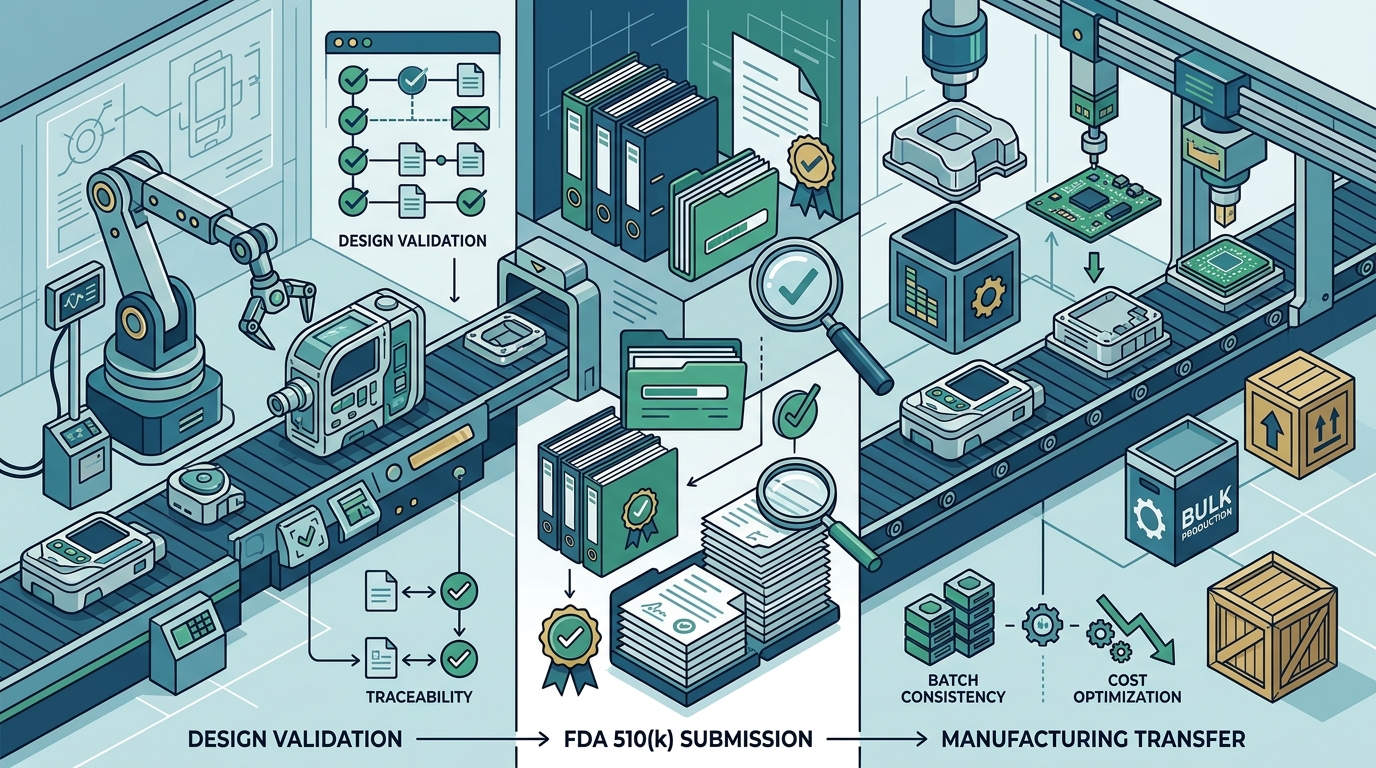
Verification and validation are often confused, but they serve distinct purposes in the development lifecycle. Verification is the process of confirming that the device meets the design specifications. Validation is the process of confirming that the device meets the user needs and intended uses.
Verification: Did We Build the Device Right?
Verification answers the question, "Did we build the device right?" This involves testing the device against the design inputs. For instance, if a design input states that a battery must last 10 hours, verification testing must prove that the battery lasts 10 hours under specified conditions. A65 Consulting provides rigorous verification planning to ensure that every design input is tested and documented.
Validation: Did We Build the Right Device?
Validation answers the question, "Did we build the right device?" This involves testing the device in real-world or simulated use conditions. Human factors testing is a critical component of validation, ensuring that users can operate the device safely and effectively. According to FDA guidance on human factors, failures in usability testing are a leading cause of device recalls and regulatory delays.
Manufacturing Transfer Strategy
Transferring your device from the lab to the factory floor is one of the most challenging phases of development. This process, known as Design Transfer, must be documented in your Design History File. It involves converting design specifications into manufacturing instructions, such as bills of materials (BOM), work instructions, and process validations.
Design for Manufacturing (DfM)
Design for Manufacturing (DfM) is the practice of designing products in a way that makes them easy and cost-effective to manufacture. Ignoring DfM until after regulatory approval is a common mistake. Early involvement of manufacturing engineers can prevent costly redesigns later. A65 Consulting integrates DfM principles into the design phase to ensure that your device can be produced at scale without compromising quality.
Process Validation
Process validation proves that the manufacturing process consistently produces a product meeting its predetermined specifications. For medical devices, this often includes sterilization validation, software validation, and packaging validation. According to ISO 13485 standards, process validation must be performed before routine production begins. This ensures that every unit leaving the factory meets the same high standards as the prototype.
Risk Management Integration
Risk management is not a separate activity; it is integrated throughout the entire product lifecycle. The FDA requires a risk management file in accordance with ISO 14971. This file must include hazard identification, risk analysis, risk evaluation, and risk control measures.
Identifying Hazards
Hazards can include electrical shock, mechanical failure, software errors, and biological hazards. Each hazard must be analyzed to determine its severity and probability of occurrence. A65 Consulting uses structured risk analysis methodologies to identify potential failure modes early, allowing your team to implement mitigations before they become costly problems.
Implementing Risk Controls
Risk controls are implemented in the following order of priority: inherent safety by design, protective measures in the manufacture or monitoring of the device, and information for safety. If a risk cannot be eliminated by design, you must implement protective measures or provide warnings in the labeling. The FDA reviews these controls closely to ensure that residual risks are acceptable.
Key Takeaways
- Substantial Equivalence: The 510(k) pathway requires proving equivalence to a predicate device, not proving new safety.
- Design Controls: Strict adherence to 21 CFR Part 820 design controls is mandatory for regulatory compliance.
- DHF Integrity: A complete Design History File is essential for tracing design decisions and passing audits.
- Verification vs. Validation: Verification confirms design specs; validation confirms user needs and intended use.
- Manufacturing Transfer: Early integration of Design for Manufacturing (DfM) prevents costly late-stage redesigns.
- Risk Management: ISO 14971 compliance must be integrated throughout the product lifecycle, not added at the end.
- Process Validation: Manufacturing processes must be validated before routine production begins to ensure consistency.
Frequently Asked Questions
How long does the 510(k) submission process take?
The FDA has a statutory goal of 90 days to review a 510(k) submission. However, the actual timeline can vary significantly depending on the complexity of the device and the quality of the submission. If the FDA issues a "Additional Information" letter, the review clock stops until you respond. A65 Consulting helps minimize these delays by ensuring submissions are complete and compliant from the start.
What is the difference between 510(k) and De Novo?
A 510(k) is for devices that are substantially equivalent to an existing predicate. A De Novo classification is for low-to-moderate risk devices that do not have a predicate. If your device is novel and has no predicate, you must pursue the De Novo pathway, which is more complex and time-consuming.
Do I need to validate my manufacturing process before submission?
Yes, process validation is a critical part of the 510(k) submission. The FDA requires evidence that your manufacturing process can consistently produce a device that meets its specifications. This includes validation of sterilization, software, and packaging processes.
How does A65 Consulting help with manufacturing transfer?
A65 Consulting provides end-to-end support for manufacturing transfer, including design for manufacturing reviews, process validation planning, and production transfer support. Our team works closely with your manufacturing partners to ensure a smooth transition from prototype to mass production.
What are the most common reasons for 510(k) rejection?
Common reasons for rejection include insufficient predicate comparison, inadequate risk analysis, incomplete design history file, and lack of process validation data. A65 Consulting helps clients avoid these pitfalls by providing expert guidance throughout the development process.
Can I use a contract manufacturer for my 510(k) submission?
Yes, you can use a contract manufacturer, but you are still responsible for ensuring that their processes meet regulatory requirements. A65 Consulting can help you evaluate and qualify contract manufacturers to ensure they meet your quality and compliance standards.
Ready to Accelerate Your Medical Device Development?
Preparing a medical device for FDA 510(k) submission and manufacturing transfer requires precision, expertise, and a deep understanding of regulatory requirements. A65 Consulting is your trusted partner in navigating this complex landscape. From concept to design and delivery, we help you transform your device into a viable product.
Don't let regulatory hurdles slow you down. Book a consultation with A65 Consulting today to discuss your project and learn how we can help you achieve your product development objectives.