
Medical device compliance is strongest when it is engineered into the product—not added as a documentation exercise after the design is complete. A compliant design process connects intended use, user needs, technical requirements, risk controls, testing, manufacturing processes, and post-market responsibilities into one traceable system.
For U.S. manufacturers, the applicable regulatory pathway depends on the device’s classification, risk profile, intended use, and the existence of a legally marketed predicate. FDA pathways may include a 510(k), De Novo request, or Premarket Approval application (PMA). The FDA explains that a 510(k) relies on substantial equivalence to a legally marketed device, while PMA requires an independent demonstration of safety and effectiveness for certain Class III devices. ([fda.gov](https://www.fda.gov/medical-devices/510k-clearances/medical-device-safety-and-510k-clearance-process?utm_source=openai))
This guide explains how engineering teams can create a practical compliance framework that supports safer products, more efficient development, stronger regulatory submissions, and a smoother transition to manufacturing.
1. Start With the Regulatory Strategy
Regulatory compliance begins before industrial design, detailed engineering, or prototype fabrication. The development team should first define what the device is, what it is intended to do, who will use it, where it will be used, and what clinical claims the manufacturer plans to make.
These decisions influence device classification, applicable regulations, consensus standards, testing requirements, labeling, clinical evidence, and the likely submission pathway. A change in intended use can alter the entire evidence strategy. For example, a device marketed for diagnosis may require a different performance demonstration than a mechanically similar product marketed for temporary support or monitoring.
Build a regulatory planning record
A useful early regulatory plan should address:
- Intended use and indications for use.
- Target patient population and intended users.
- Use environments, including hospitals, clinics, ambulances, or homes.
- Device classification and applicable product codes.
- Potential predicate devices or the rationale for a De Novo request.
- Applicable FDA regulations and recognized consensus standards.
- Required biocompatibility, electrical safety, electromagnetic compatibility, software, sterilization, packaging, shelf-life, or clinical testing.
- Submission deliverables and decision points.
For international commercialization, the team should also map requirements for each target market rather than assuming that one U.S. submission package will satisfy every jurisdiction. ISO 13485 provides a widely used quality management framework for medical device organizations, while ISO 14971 establishes the recognized framework for medical device risk management.
A65 Consulting helps clients align product development activities with regulatory and commercial goals from early research through product realization. Explore A65 Consulting’s latest insights on regulatory risk management for additional perspective on integrating compliance into engineering work.
2. Translate User Needs Into Design Inputs
User needs describe what the product must accomplish for patients, clinicians, technicians, caregivers, or other intended users. Design inputs convert those needs into measurable engineering requirements.
Weak design inputs create downstream compliance problems because the team cannot prove that an ambiguous requirement has been met. A requirement such as “the device must be easy to use” should be translated into objective criteria, such as setup time, acceptable error rate, required display visibility, connector orientation, alarm recognition, or the number of steps needed to complete a critical task.
Characteristics of effective design inputs
- Specific: The requirement states exactly what the device must do.
- Measurable: The requirement can be tested through inspection, analysis, or a defined test method.
- Traceable: The requirement can be linked to a user need, risk control, standard, or regulatory expectation.
- Complete: The requirement addresses performance, safety, usability, interfaces, labeling, maintenance, and environmental conditions as appropriate.
- Unambiguous: Different reviewers should interpret the requirement in the same way.
Design inputs should include both functional and nonfunctional requirements. Functional requirements describe what the device does. Nonfunctional requirements may address durability, cleanliness, sterilization compatibility, battery life, cybersecurity, electromagnetic compatibility, packaging integrity, storage conditions, or manufacturability.
At A65 Consulting, structured design control processes help clients convert early concepts into actionable specifications and controlled design outputs. Review A65 Consulting’s product development services to see how multidisciplinary engineering support can be applied across the development lifecycle.
3. Create Traceability Across the Design History File
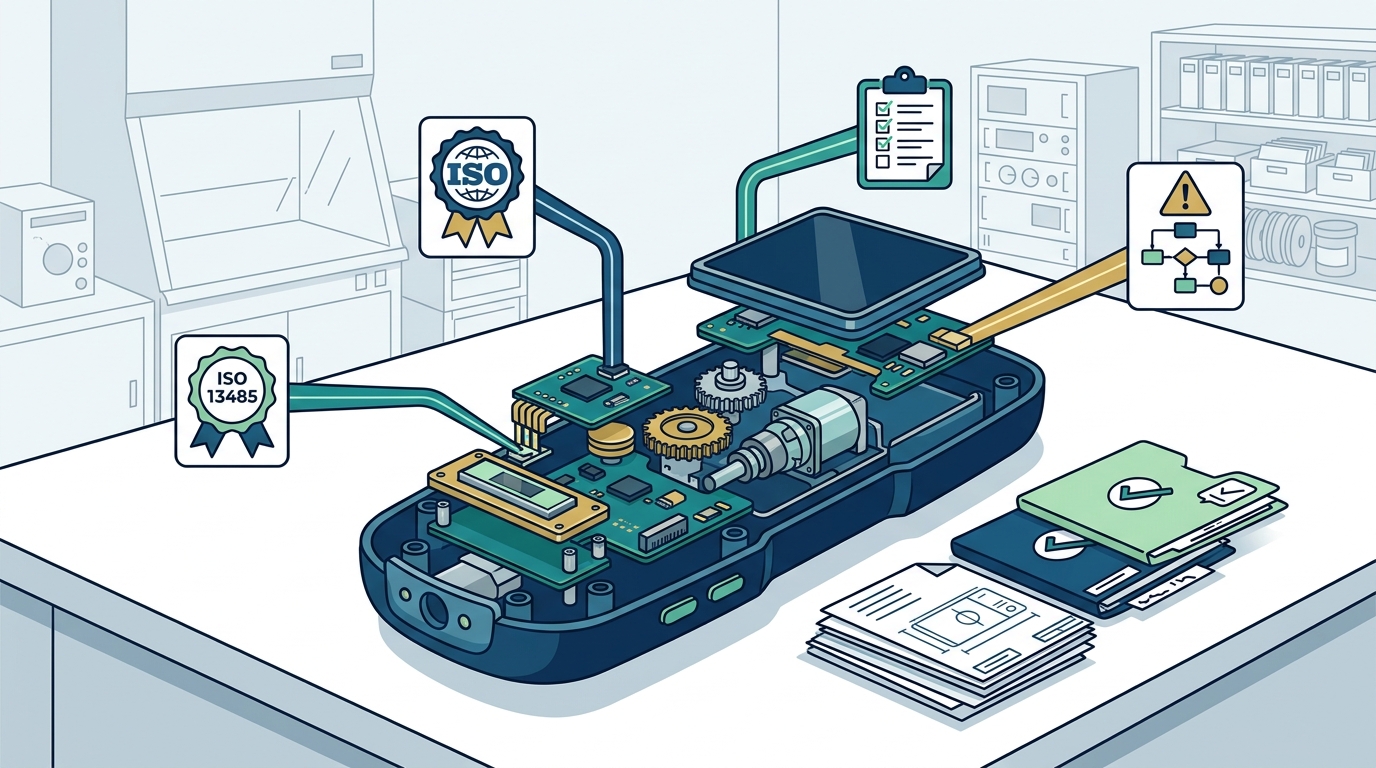
Design documentation should tell a coherent story: what the team intended to build, why each requirement exists, how the design responds to those requirements, how risks were controlled, and what objective evidence demonstrates that the finished device is safe and effective.
The Design History File, or DHF, is the collection of records that demonstrates the design was developed in accordance with the approved design plan and applicable design control procedures. Depending on the company’s quality system and regulatory strategy, the DHF may include:
- Design and development plans.
- User needs and intended-use definitions.
- Design inputs and design outputs.
- Risk management plans, analyses, and reports.
- Design review records.
- Engineering drawings, specifications, software requirements, and bills of materials.
- Verification and validation protocols and reports.
- Human factors and usability engineering records.
- Packaging, labeling, and instructions for use.
- Design transfer documentation.
- Change-control records and rationale.
Traceability is more than a spreadsheet. It is a control mechanism that allows a team to identify whether every important user need has an associated design input, output, risk assessment, verification activity, and validation conclusion.
Use a requirements traceability matrix
A practical matrix may connect each requirement to its source, design solution, risk-control status, verification method, acceptance criteria, test result, and validation relevance. When a requirement changes, the matrix helps the team identify affected drawings, prototypes, test protocols, labeling, manufacturing processes, and regulatory documents.
FDA design control requirements call for procedures that control device design so specified requirements are met. FDA materials describe design controls as including design plans, assigned responsibilities, interfaces between groups, and evidence that the design will perform as intended when commercially produced. ([fda.gov](https://www.fda.gov/medical-devices/premarket-approval-pma/pma-quality-system?utm_source=openai))
4. Integrate Risk Management Into Engineering Decisions
Risk management should influence architecture, component selection, user interface design, testing, manufacturing controls, and labeling. It should not be treated as a report prepared after the design is already fixed.
ISO 14971 provides the framework for identifying hazards, estimating and evaluating risks, implementing risk controls, and evaluating residual risk throughout the device lifecycle. ISO/TR 24971 offers supplementary guidance on developing, implementing, and maintaining a risk management process based on ISO 14971. ([iso.org](https://www.iso.org/standard/74437.html?utm_source=openai))
Apply a risk-first design workflow
- Define the intended use and reasonably foreseeable misuse. Consider who interacts with the device, what they are trying to accomplish, and how the device could be used incorrectly.
- Identify hazards and hazardous situations. Consider mechanical, electrical, thermal, biological, chemical, software, usability, cybersecurity, and manufacturing-related hazards.
- Estimate and evaluate risk. Use the organization’s approved methods for severity, probability, detectability, or other applicable risk parameters.
- Choose risk controls in a logical order. Prefer inherent safety by design, followed by protective measures and then information for safety where appropriate.
- Verify each risk control. A risk-control statement is not evidence that the control works; objective testing is required.
- Evaluate residual risk and benefit-risk. Document the rationale for remaining risks and confirm that the device’s benefits justify them when applicable.
- Feed production and post-market information back into the process. Complaints, deviations, adverse events, and field observations may require updates to risk controls.
For example, if a wearable device may be attached incorrectly, the engineering response should not rely solely on a warning in the instructions. The design team might use keyed connectors, asymmetric geometry, tactile differentiation, software confirmation, or a fail-safe default. The selected control must then be verified and evaluated during representative-use testing.
A65 Consulting promotes a risk-first engineering approach that connects hazard analysis to practical design decisions. Read more about why risk analyses often fail to change the design.
5. Apply Human Factors Before the Design Is Frozen
Human factors engineering evaluates the interaction among intended users, the use environment, and the device user interface. The user interface includes physical controls, displays, alarms, connectors, packaging, labeling, software screens, setup procedures, maintenance activities, and training materials.
FDA states that the central goal of human factors and usability engineering for medical devices is to minimize use-related risks and confirm that intended users can use the device safely and effectively. ([fda.gov](https://www.fda.gov/medical-devices/device-advice-comprehensive-regulatory-assistance/human-factors-and-medical-devices?utm_source=openai))
Human factors work should begin with a use specification that identifies intended users, use environments, operating tasks, critical tasks, and reasonably foreseeable use errors. The team can then perform a use-related risk analysis and determine which tasks require formative research or summative validation.
Formative and summative evaluations
- Formative evaluations: Conducted during development to identify usability problems while design changes are still practical and affordable.
- Summative evaluations: Conducted on a final or representative design to demonstrate that users can perform critical tasks safely and effectively.
Testing should reflect real conditions. A device intended for home use may need to be assessed with distractions, limited lighting, variable dexterity, health-literacy considerations, or incomplete training. A device used in an intensive-care unit may need evaluation in a noisy, crowded environment with multiple competing alarms and interruptions.
FDA-recognized standards include ANSI/AAMI/IEC 62366 for usability engineering, and FDA lists human factors considerations alongside risk management and other design documentation expectations. ([accessdata.fda.gov](https://www.accessdata.fda.gov/scripts/cdrh/cfdocs/cfstandards/detail.cfm?standard__identification_no=41235&utm_source=openai))
Explore A65 Consulting’s insights on human factors and usability in clinical reality to understand why actual workflows matter as much as laboratory performance.
6. Plan Verification and Validation as Distinct Activities
Verification and validation answer different questions and require different evidence.
- Verification
- Did the design outputs satisfy the approved design inputs? Verification may involve testing, inspection, measurement, or engineering analysis.
- Validation
- Does the finished device meet user needs and intended uses under actual or simulated use conditions? Validation may include simulated-use studies, clinical evaluation, clinical investigations, software validation, packaging validation, or other appropriate methods.
Verification should cover every applicable design input, including requirements for performance, safety, reliability, environmental conditions, interfaces, software, materials, packaging, and manufacturing. Each protocol should define the sample configuration, equipment, test conditions, acceptance criteria, deviations process, and data-recording method before testing begins.
Validation should use production-equivalent or appropriately representative devices and realistic intended-use conditions. It should address whether the device fulfills the clinical or user purpose, not merely whether individual components meet specifications.
Common evidence gaps
- Testing a prototype that is materially different from the production-intent device.
- Using acceptance criteria that were created after reviewing the test results.
- Failing to test worst-case configurations or operating conditions.
- Verifying a risk control without evaluating whether it introduces a new hazard.
- Confusing bench performance with clinical or user validation.
- Failing to document deviations and their impact on conclusions.
Learn how verification works as a system rather than a single development phase.
7. Design for Manufacturing and Process Validation
A device is not fully ready for commercialization when the prototype works. It must also be manufacturable, inspectable, repeatable, serviceable, and capable of meeting specifications at the intended production volume.
Design for Manufacturing, or DFM, brings manufacturing engineering into development early enough to influence tolerances, materials, assembly methods, tooling, inspection strategy, supplier capabilities, and cost. Early DFM can prevent a common failure mode: a design that passes engineering tests but cannot be produced consistently.
Include manufacturing requirements in design reviews
- Identify critical-to-quality characteristics and process parameters.
- Confirm that tolerances are achievable with the intended process and suppliers.
- Design fixtures, gauges, and inspection methods before production launch.
- Assess material, component, and supplier availability.
- Review cleaning, sterilization, packaging, and environmental requirements.
- Document assembly instructions and acceptance criteria.
- Use controlled engineering changes during transfer.
- Determine which processes require validation because their outputs cannot be fully verified by later inspection or testing.
Process validation is especially important for processes such as sterilization, sealing, bonding, welding, molding, software installation, and other operations where later inspection may not fully establish process effectiveness. Qualification and validation activities should be planned around the actual production equipment, personnel, procedures, and operating ranges.
See A65 Consulting’s manufacturing support services for help with DFM, manufacturing transfer, process development, and production readiness.
8. Conduct a Pre-Submission Compliance Review
Before a regulatory submission or design transfer, conduct a structured review that examines both the device and the evidence supporting it. The review should be performed by people who understand engineering, quality, regulatory strategy, manufacturing, clinical use, and human factors.
Pre-submission checklist
- Is the intended use consistent across specifications, labeling, testing, and submission documents?
- Are design inputs objective, complete, approved, and traceable?
- Do design outputs fully address the inputs?
- Are all identified risks linked to implemented and verified controls?
- Are residual risks evaluated and documented?
- Have critical user tasks been identified and assessed?
- Are verification protocols approved before testing and supported by objective acceptance criteria?
- Does validation use representative users, environments, and production-intent devices?
- Are software, cybersecurity, electrical, biocompatibility, packaging, sterilization, and reliability requirements addressed where applicable?
- Are manufacturing processes capable of consistently producing conforming devices?
- Are design changes closed, justified, and reflected in all affected records?
- Can an independent reviewer follow the design rationale without relying on undocumented institutional knowledge?
For devices using the 510(k) pathway, the submission must provide the information FDA needs to determine substantial equivalence and assure safety and effectiveness. FDA identifies Traditional, Special, and Abbreviated 510(k) submission types when the applicable conditions are met. ([fda.gov](https://www.fda.gov/medical-devices/510k-clearances/medical-device-safety-and-510k-clearance-process?utm_source=openai))
For Class III devices requiring PMA, the evidence burden is more extensive. FDA describes PMA as a scientific and regulatory review of safety and effectiveness, governed by 21 CFR Part 814. ([fda.gov](https://www.fda.gov/medical-devices/premarket-submissions-selecting-and-preparing-correct-submission/premarket-approval-pma?utm_source=openai))
Key Takeaways
- Define compliance early: Intended use, claims, classification, and market strategy shape the development plan.
- Make requirements testable: Clear design inputs are the foundation for objective verification.
- Maintain traceability: Link user needs, design inputs, outputs, risks, tests, and validation evidence.
- Use risk to drive design: Risk management should change the product when hazards are identified.
- Design for real users: Human factors must account for users, environments, interfaces, and foreseeable use errors.
- Separate verification from validation: Meeting engineering specifications does not automatically prove that the device meets user needs.
- Plan for production: DFM, supplier controls, process capability, and validation belong in the design lifecycle.
- Review the complete evidence package: A compliant device requires both an appropriate design and defensible documentation.
Frequently Asked Questions
What does regulatory compliance mean in medical device design?
Regulatory compliance means developing, documenting, testing, manufacturing, and maintaining a medical device in accordance with applicable laws, regulations, quality system requirements, standards, and regulatory commitments. Compliance covers more than the final product; it also includes the processes and evidence used to demonstrate safety and effectiveness.
Which FDA pathway applies to a new medical device?
The pathway depends on the device’s classification, risk, intended use, technology, and whether a suitable legally marketed predicate exists. A 510(k) generally relies on substantial equivalence, De Novo may apply to certain novel low- to moderate-risk devices without a suitable predicate, and PMA is used for many high-risk Class III devices requiring an independent demonstration of safety and effectiveness. The FDA makes the final regulatory determination based on the applicable requirements.
What is the difference between a DHF and a device master record?
The Design History File documents how the device was designed and developed. The Device Master Record contains the specifications and production instructions needed to manufacture the device consistently. Both are controlled quality records, but they serve different purposes.
When should risk management begin?
Risk management should begin when the intended use and preliminary concept are defined. Early hazard analysis can influence architecture, materials, interfaces, alarms, software behavior, protective features, and manufacturing controls before changes become expensive.
Is human factors testing required for every medical device?
The appropriate level of human factors and usability engineering depends on the device, users, use environments, interfaces, and potential consequences of use error. Devices with use-related risks that could affect safety may require substantial human factors evidence. FDA recommends a risk-based approach to determining the information included in a marketing submission. ([fda.gov](https://www.fda.gov/medical-devices/human-factors-and-medical-devices/human-factors-premarket-information-device-design-and-documentation-processes?utm_source=openai))
What is the role of ISO 14971 in product development?
ISO 14971 provides a framework for identifying hazards, evaluating and controlling risks, assessing residual risk, and maintaining risk management activities throughout the device lifecycle. It helps connect safety decisions to design, verification, validation, manufacturing, and post-market information.
How can a medical device engineering partner support compliance?
An experienced engineering partner can help define requirements, establish design controls, create traceability, conduct risk analysis, develop prototypes, plan verification and validation, address human factors, optimize manufacturability, support design transfer, and prepare technical evidence. The right partner should have experience with the relevant device technologies, markets, quality systems, and regulatory pathway. Learn about A65 Consulting’s specialized engineering expertise.
Can A65 Consulting help after a device reaches the market?
Yes. A65 Consulting can support lifecycle engineering activities such as complaint and failure analysis, design improvements, manufacturing optimization, risk-file updates, adverse-event reporting support, and other post-market activities. Post-market information can reveal new hazards or changes in the frequency or severity of known risks and may require updates to the device or its documentation.
Next Steps With A65 Consulting
Building compliance into medical device design requires coordinated engineering, quality, regulatory, manufacturing, and usability decisions. A65 Consulting supports medical device companies from research and concept development through detailed design, verification and validation, manufacturing transfer, and cost optimization.
If your team needs help assessing design-control gaps, developing a risk-based engineering plan, preparing for verification, improving manufacturability, or building a submission-ready technical record, schedule a discovery call with A65 Consulting.