
Accelerating Medical Device Manufacturing Transfer: A Strategic Guide for Startups
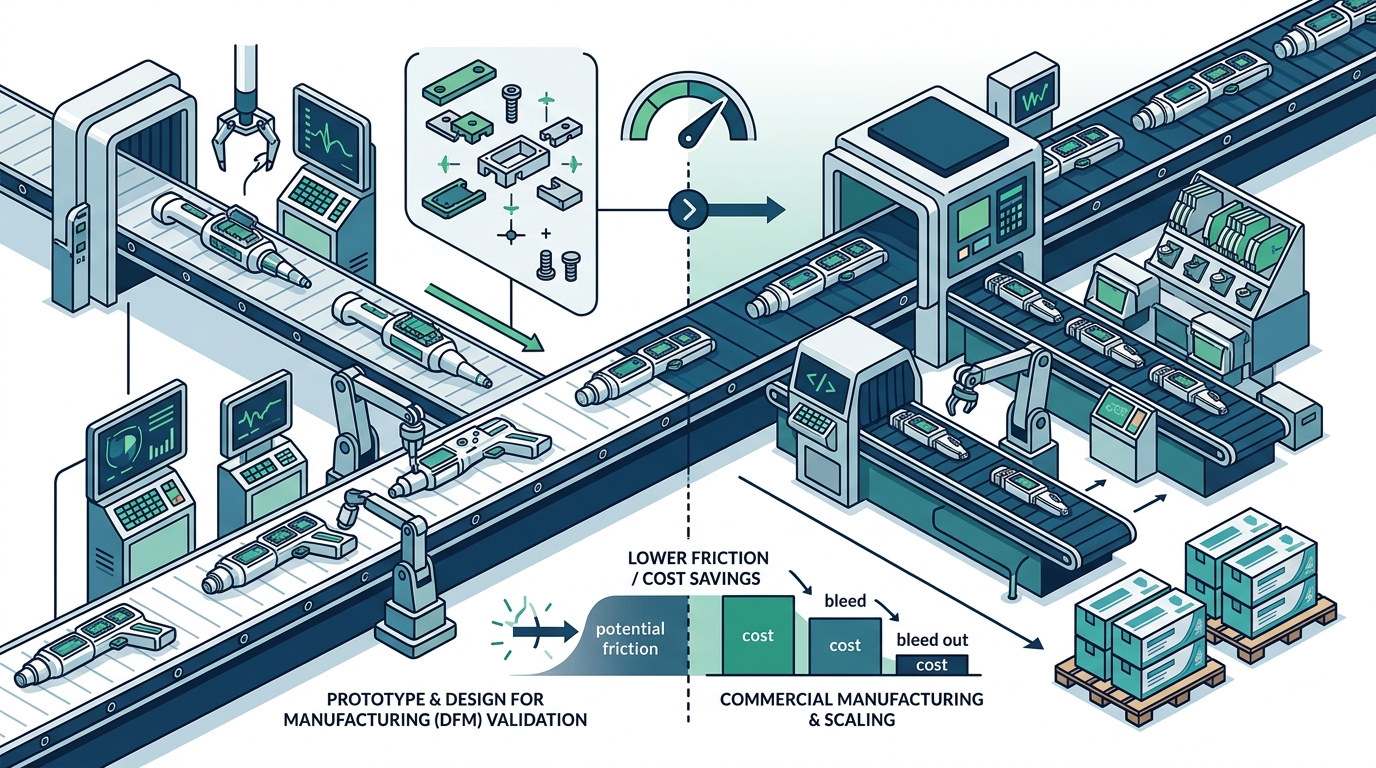
Manufacturing transfer is the critical bridge between a validated prototype and a commercially viable medical device. For startups, this phase is often where cash flow bleeds out and timelines slip. Design for Manufacturing (DFM) is the systematic practice of designing products in a way that makes them easy and cost-effective to manufacture. When executed early, it reduces the friction of scaling. According to industry benchmarks, startups that integrate DFM principles during the design phase can reduce manufacturing transfer timelines by up to 40 percent. This statistic highlights the importance of proactive engineering over reactive problem solving. (About A65 Consulting)
Understanding the Manufacturing Transfer Lifecycle
The manufacturing transfer process involves moving product specifications from the development team to the production floor. This is not merely a handoff of files. It is a complex dance of knowledge transfer, tooling setup, and process validation. Startups often underestimate the time required for this transition. The gap between a functional prototype and a repeatable production unit is vast. (Services A65 Consulting)
Medical device development is a coordinated system of distinct domains operating under regulatory constraint. When that system performs well, progress feels disciplined and predictable. When it struggles, the issue is often not capability but structure. A65 Consulting emphasizes that engineering leadership must guide this transition to ensure clarity and confidence. Without clear leadership, programs drift into ambiguity. (Medical Device Design Consulting)
Many development teams treat verification as something that happens near the end of a program. It is planned, scheduled, and executed as a step to confirm that the design meets requirements. In that model, verification is undervalued. Instead, verification should be treated as a system that runs parallel to development. This approach catches issues before they reach the manufacturing floor. (Blog A65 Consulting)
Design for Manufacturing Strategies
Design for Manufacturing is often introduced as a cost reduction activity. It shows up when margins tighten, when sourcing changes, or when a program is already under pressure. At that point, teams look for ways to make the product cheaper to produce. However, DFM is fundamentally a quality exercise. It ensures that the design can be built consistently within tolerance.
Startups must engage in DFM reviews early. Waiting until the design is finalized to consult with manufacturers is a common mistake. Early engagement allows engineers to identify potential production bottlenecks. It also helps in selecting materials that are both clinically effective and manufacturable.
Manufacturing support spans process development, DFM reviews, and seamless production transition. A65 Consulting provides expertise in these areas to help teams navigate complex product development. By integrating manufacturing experts into the design team, startups can avoid costly redesigns later. This integration ensures that the design is viable for production from day one.
Supplier Selection and Qualification
Choosing the right manufacturing partner is critical for startups. The supplier must have the technical capability to produce the device to specification. They must also have the capacity to scale as demand grows. Startups should evaluate suppliers based on their quality systems, not just their cost.
Supplier qualification involves a rigorous audit process. This includes reviewing their quality management system, production capabilities, and regulatory compliance. A65 Consulting helps clients identify and qualify suppliers that meet these stringent requirements. This due diligence reduces the risk of supply chain disruptions.
Building a relationship with a manufacturing partner requires trust and transparency. Startups should view their supplier as an extension of their own team. This collaborative approach fosters innovation and problem solving. It also ensures that both parties are aligned on quality and timeline goals.
Validation and Quality Systems
Validation is the process of establishing documented evidence that provides a high degree of assurance that a specific process will consistently produce a product meeting its predetermined specifications. For medical devices, this includes process validation, installation qualification, and operational qualification. These steps are non-negotiable for regulatory approval.
Quality systems must be established early in the development process. This includes defining quality metrics, inspection procedures, and corrective action protocols. A65 Consulting assists clients in building these systems to ensure compliance with FDA and international standards. This proactive approach prevents delays during regulatory review.
Verification failures are rarely surprises. When a test fails late in development, teams often treat it as an execution issue. Attention shifts to the method, the setup, or the result itself. In most cases, the underlying problem was introduced much earlier. Many verification plans fail because they do not account for manufacturing variability. A robust verification plan anticipates these variations and tests for them.
Risk Management Integration
Risk management is a core component of medical device development. Hazard analyses are created, risk matrices are populated, and mitigation tables are carefully maintained. Yet many design problems are not caught by risk analysis alone. The risk analysis paradox is that formal documentation does not always lead to better design outcomes.
Startups must integrate risk management into every stage of the manufacturing transfer. This includes identifying new risks introduced by the manufacturing process. It also involves mitigating risks associated with supplier capabilities and supply chain stability. A65 Consulting helps clients navigate these complexities by providing expert risk analysis and mitigation strategies.
Strong engineering teams still miss milestones. Many medical device companies have excellent engineers, experienced quality groups, and significant investment in development programs. Yet milestones still slip. This pattern appears across organizations of every size. The cause is often a lack of integrated risk management. When risk is siloed, it fails to influence design decisions effectively.
Key Takeaways
- Early DFM Integration: Integrating Design for Manufacturing principles during the conceptual phase can reduce transfer timelines by up to 40 percent.
- Verification as a System: Treat verification as an ongoing system rather than a final phase to catch issues early.
- Supplier Qualification: Rigorous supplier audits are essential to ensure quality and scalability.
- Risk Management: Integrate risk analysis into every stage of development to prevent design flaws.
- Leadership Guidance: Expert engineering leadership is crucial for navigating the complexities of manufacturing transfer.
- Quality Systems: Establish quality metrics and protocols early to ensure regulatory compliance.
- Collaborative Partnerships: View manufacturing partners as extensions of your team to foster innovation.
Frequently Asked Questions
How long does the manufacturing transfer process typically take?
The timeline varies based on device complexity, but startups should plan for 6 to 12 months for a complete transfer including validation.
What is the role of Design for Manufacturing (DFM)?
DFM is the practice of designing products to be easily and cost-effectively manufactured, reducing friction during the transfer phase.
How do I choose the right manufacturing partner?
Evaluate partners based on their quality systems, technical capabilities, and regulatory compliance, not just cost.
Why is verification important during manufacturing transfer?
Verification ensures that the manufacturing process consistently produces devices that meet design specifications.
What are the common risks in manufacturing transfer?
Common risks include supplier capability gaps, process variability, and inadequate risk management integration.
How can startups reduce costs during manufacturing transfer?
Startups can reduce costs by engaging in early DFM reviews and selecting suppliers with proven scalability.
What is the importance of regulatory compliance in manufacturing?
Regulatory compliance ensures that devices are safe and effective, which is critical for market approval and patient safety.
Start Your Manufacturing Transfer Today
Accelerating your manufacturing transfer requires expertise, strategy, and a trusted partner. A65 Consulting provides the engineering leadership and expert support needed to navigate complex product development. We help close critical gaps and keep programs moving forward. Contact us today to request a proposal and learn more about how we can help you achieve your product development objectives.