
Common Prototyping Pitfalls in Medical Device Development and How to Avoid Them
Prototyping is the critical bridge between a conceptual idea and a viable medical device. However, the path from concept to reality is fraught with engineering challenges that can derail timelines and budgets. According to industry data, nearly 90% of medical device startups fail to meet their initial launch deadlines due to unforeseen prototyping errors. This statistic highlights the importance of rigorous planning and expert oversight in the early stages of development. At A65 Consulting, we help teams navigate these complexities to ensure their devices are not only innovative but also manufacturable and compliant. (About A65 Consulting)
Understanding Prototyping Phases
Medical device development is a coordinated system of distinct domains operating under regulatory constraint. To build a successful device, teams must understand the different stages of prototyping. Each phase serves a specific purpose in validating the design and reducing risk.
Proof of Concept (POC)
A Proof of Concept prototype validates the core functionality of the device. It answers the question: "Does the basic idea work?" These prototypes are often rough and may not look like the final product. They are crucial for early-stage validation but should not be mistaken for production-ready designs.
Engineering Validation Test (EVT)
Engineering Validation Test prototypes are closer to the final design. They are used to test the device's performance under realistic conditions. This phase helps identify design flaws before they become costly to fix. Teams often use these prototypes to refine the design for manufacturability.
Production Validation Test (PVT)
Production Validation Test prototypes are built using the intended manufacturing processes. They verify that the device can be produced consistently at scale. This phase is critical for ensuring that the final product meets all quality and safety standards.
Pitfall 1: Ignoring Design for Manufacturing
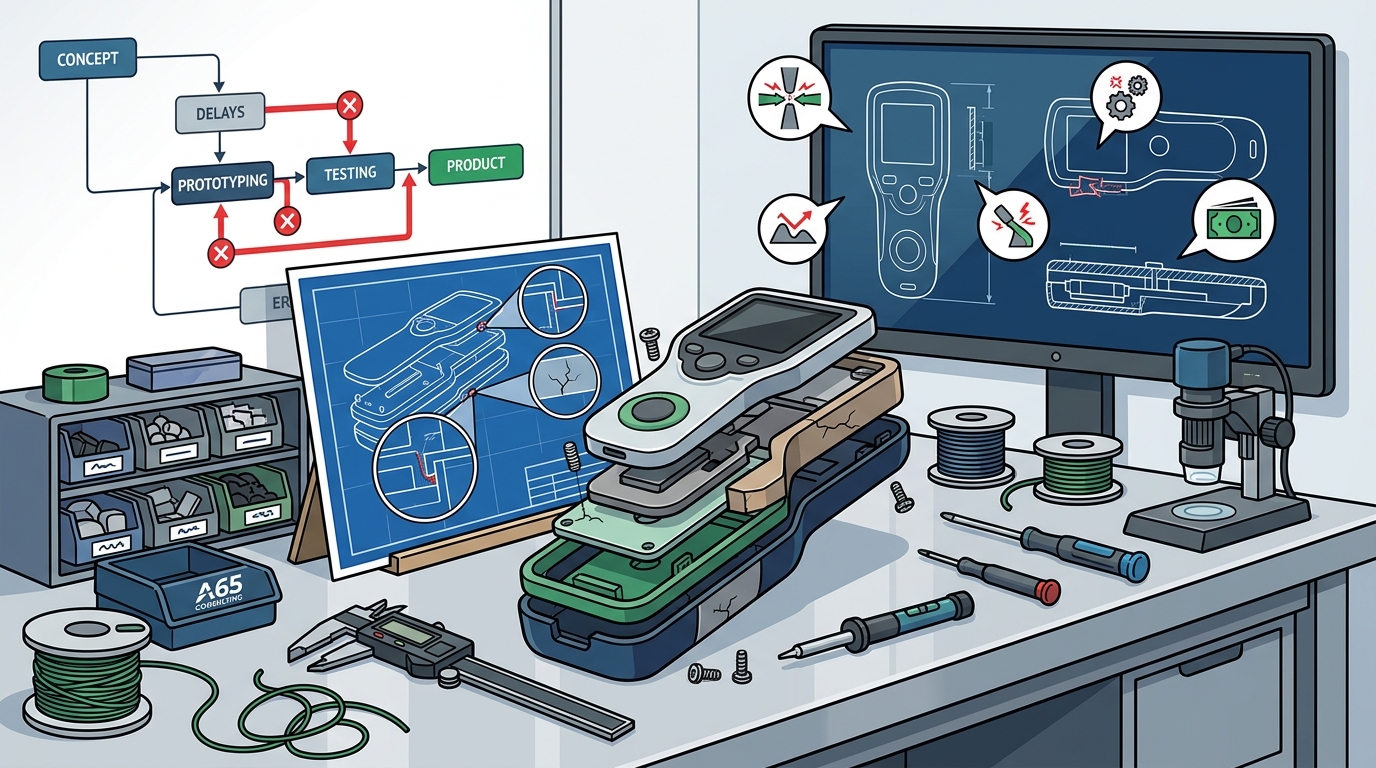
One of the most common pitfalls in medical device development is ignoring Design for Manufacturing (DFM) until late in the process. DFM is often introduced as a cost reduction activity. It shows up when margins tighten, when sourcing changes, or when a program is already under pressure. At that point, teams look for ways to make the product cheaper to produce, but the design may already be locked in.
Design for Manufacturing is a quality exercise, not a cost exercise. Integrating DFM principles early in the design phase ensures that the device can be produced efficiently and consistently. This approach reduces the need for costly redesigns and accelerates time to market. A65 Consulting provides manufacturing support spanning process development, DFM reviews, and seamless production transition to help teams avoid these pitfalls.
Pitfall 2: Inappropriate Material Selection
Selecting the wrong materials can lead to device failure, regulatory rejection, or patient harm. Medical devices must withstand specific environmental conditions, including sterilization processes, bodily fluids, and mechanical stress. Choosing materials without considering these factors can result in premature wear, corrosion, or biocompatibility issues.
To avoid this pitfall, teams should conduct thorough material testing and validation. This includes biocompatibility testing, mechanical strength analysis, and chemical resistance evaluation. Working with experienced engineering partners who understand the regulatory landscape can help ensure that material choices are both safe and effective.
Pitfall 3: Neglecting Regulatory Requirements Early
Regulatory compliance is a cornerstone of medical device development. However, many teams treat regulatory considerations as a final step rather than an ongoing process. This approach can lead to significant delays and additional costs as teams work to bring their devices into compliance.
Regulatory strategy should be integrated into the design process from the beginning. This includes understanding the classification of the device, identifying applicable standards, and planning for necessary testing and documentation. A65 Consulting has experience contributing to more than 8 FDA 510k submissions, ensuring that devices meet regulatory requirements efficiently.
Pitfall 4: Skipping Human Factors Testing
Human factors and usability are critical for the success of any medical device. Most development teams believe they understand their users. Human factors activities are completed, but often too late in the process to make meaningful changes. If a device is difficult to use, it can lead to user error, patient harm, and product rejection.
Human Factors & Usability: Designing Devices for Clinical Reality. Teams should conduct usability testing with representative users early and often. This helps identify potential use errors and allows for design iterations that improve the user experience. Integrating human factors engineering into the development process ensures that the device is intuitive and safe for its intended users.
Pitfall 5: Treating Verification as an Afterthought
Verification is a system, not a phase. When treated as a phase, verification is undervalued. Most development teams treat verification as something that happens near the end of a program. It is planned, scheduled, and executed as a step to confirm that the design meets requirements. In that model, verification becomes a bottleneck rather than a tool for continuous improvement.
Verification failures are rarely surprises. When a test fails late in development, teams often treat it as an execution issue. Attention shifts to the method, the setup, or the result itself. In most cases, the underlying problem was introduced much earlier. By integrating verification activities throughout the development lifecycle, teams can identify and resolve issues early, reducing risk and cost.
Key Takeaways
- Integrate DFM Early: Design for Manufacturing should be a quality exercise, not a cost reduction activity, to ensure efficient production.
- Validate Materials: Conduct thorough biocompatibility and mechanical testing to prevent device failure and regulatory issues.
- Plan for Compliance: Regulatory strategy must be integrated into the design process from the beginning to avoid delays.
- Test with Users: Human factors testing should be conducted early and often to ensure usability and safety.
- Verify Continuously: Treat verification as a system, not a phase, to identify and resolve issues throughout development.
- Partner with Experts: Working with experienced engineering partners can help navigate complex product development challenges.
- Focus on Risk: Proactive risk analysis can prevent design problems and ensure device safety.
Frequently Asked Questions
What is the difference between a Proof of Concept and an Engineering Validation Test?
A Proof of Concept validates the core functionality of the device, while an Engineering Validation Test evaluates the device's performance under realistic conditions to identify design flaws.
Why is Design for Manufacturing important in medical device development?
Design for Manufacturing ensures that the device can be produced efficiently and consistently, reducing the need for costly redesigns and accelerating time to market.
How can I ensure my medical device meets regulatory requirements?
Integrate regulatory strategy into the design process from the beginning, including understanding device classification, applicable standards, and necessary testing.
What is the role of human factors in medical device design?
Human factors ensure that the device is intuitive and safe for its intended users, reducing the risk of user error and patient harm.
When should verification activities begin?
Verification activities should begin early in the development process and continue throughout the lifecycle to identify and resolve issues proactively.
How does A65 Consulting help with prototyping?
A65 Consulting provides expert engineering support across all phases of development, from concept to design and delivery, helping teams avoid common pitfalls and achieve their product development objectives.
What is the typical timeline for medical device prototyping?
The timeline varies depending on the complexity of the device and the regulatory pathway, but integrating expert support can help streamline the process and reduce delays.
Start Your Development Journey
Are you facing a gap in engineering capability or team capacity? We provide engineering leadership and expert support to help teams navigate complex product development with clarity and confidence. From leadership team support to hands-on engineering expertise, we help close critical gaps and keep programs moving forward. Contact us today to request a proposal and learn more about how we can help you achieve your product development objectives.
Schedule a Discovery Call to discuss your project needs with our team of experienced engineers.