
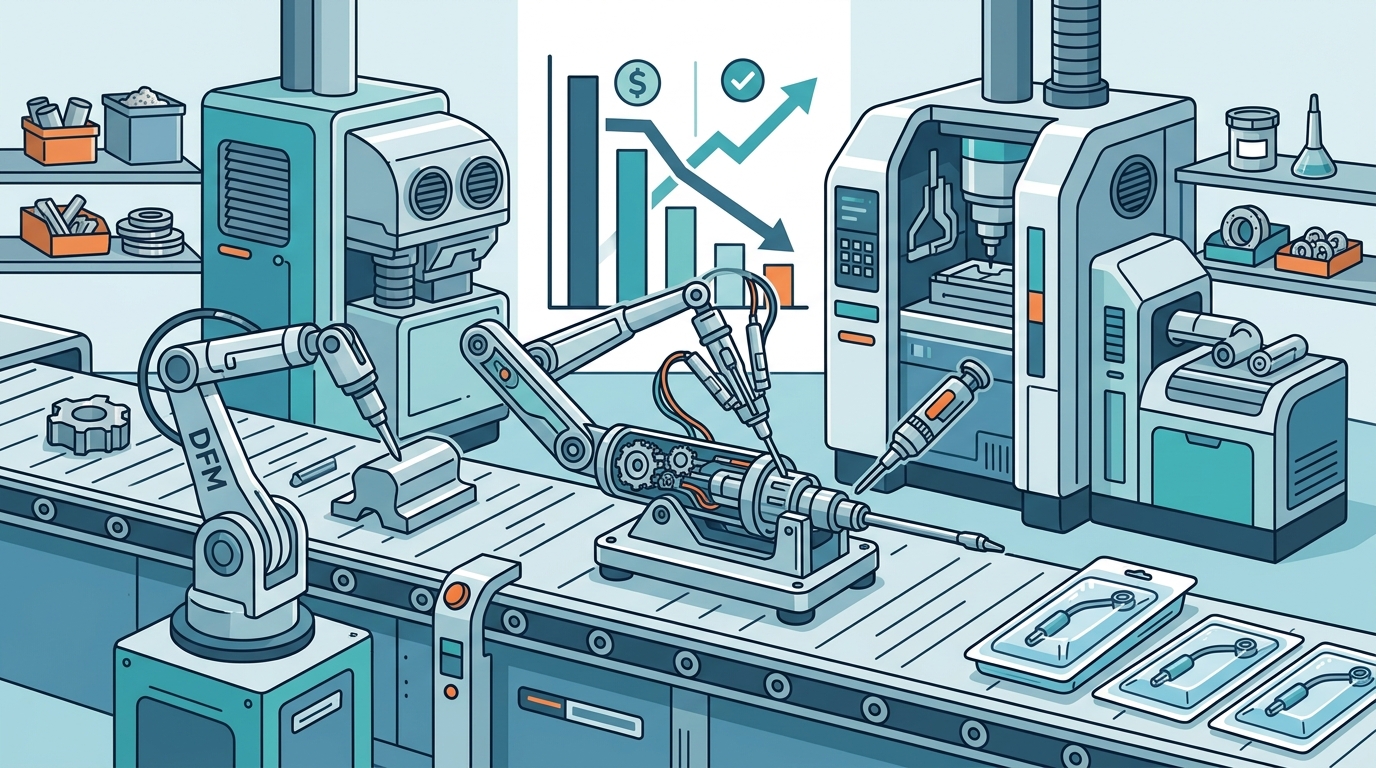
Medical device manufacturers face a critical paradox: the pressure to reduce production costs while simultaneously adhering to stringent regulatory standards. Design for Manufacturing (DFM) is a quality exercise, not a cost exercise. This fundamental shift in perspective allows engineering teams to identify cost-saving opportunities early in the development lifecycle without compromising safety or efficacy. According to industry data, companies that integrate cost optimization into the design phase can reduce overall development expenses by up to 30 percent compared to those that address manufacturing issues late in the process.
Understanding DFM as a Quality Exercise
Design for Manufacturing (DFM) is often introduced as a cost reduction activity. It shows up when margins tighten, when sourcing changes, or when a program is already under pressure. At that point, teams look for ways to make the product cheaper to produce. However, this reactive approach frequently leads to compromised quality and delayed timelines. DFM is a quality exercise, not a cost exercise. When treated as a quality initiative, DFM ensures that the design is robust, manufacturable, and consistent from the very first prototype.
Integrating DFM early in the product development cycle allows engineering teams to identify potential manufacturing bottlenecks before they become costly problems. This proactive approach aligns with the expertise offered by A65 Consulting in manufacturing support, which spans process development and DFM reviews. By focusing on quality first, cost reductions become a natural byproduct of efficient design rather than a forced compromise.
GD&T as a Communication System
Geometric Dimensioning and Tolerancing (GD&T) is often introduced as a drafting standard tied to manufacturing drawings. In many organizations, GD&T enters the conversation late in development, when drawings are nearing completion. This late integration creates misalignment between design intent and manufacturing capability. GD&T is a communication system, not a drawing requirement. It serves as the universal language between engineers, manufacturers, and quality assurance teams.
When GD&T is used correctly, it clarifies the functional requirements of each feature, allowing manufacturers to choose the most cost-effective processes without violating design intent. According to recent engineering analyses, proper GD&T implementation can reduce inspection time by 25 percent and minimize scrap rates significantly. For teams seeking to clarify roles and improve communication, clarifying roles in product development is essential for successful GD&T adoption.
Verification as a System, Not a Phase
Most development teams treat verification as something that happens near the end of a program. It is planned, scheduled, and executed as a step to confirm that the design meets requirements. In that model, verification is undervalued and often rushed. Verification is a system, not a phase. It must be integrated throughout the entire development lifecycle to ensure that cost-saving measures do not introduce regulatory risks.
When verification is treated as a continuous system, teams can identify design flaws early, reducing the need for expensive rework later. This approach aligns with the rigorous program management standards advocated by A65 Consulting. By maintaining a continuous verification process, companies can ensure that their cost optimization strategies remain compliant with FDA 510(k) submissions and other regulatory requirements.
Strategic Engineering Outsourcing
Outsourcing is often presented as a straightforward way to move faster. If a program needs more speed, add external resources. If specialized expertise is missing, bring in a partner. If timelines are tight, increase capacity. Sometimes this works exactly as intended. However, outsourcing can also slow down development if not managed correctly. Engineering outsourcing is a strategic lever, not a quick fix.
Effective outsourcing requires a partner who understands the nuances of medical device development. A65 Consulting provides engineering leadership and expert support to help teams navigate complex product development with clarity and confidence. By leveraging a network of specialized engineers, companies can access the right discipline experience without the long-term commitment of full-time headcount. This flexibility allows for precise cost control and resource allocation.
Risk Analysis and Design Changes
In regulated product development, risk analysis is one of the most formalized engineering activities. Hazard analyses are created, risk matrices are populated, and mitigation tables are carefully maintained. Yet many design problems are not caught by these formal processes. Risk analysis must drive design changes, not just document them. When risk analysis is used proactively, it can identify cost-saving opportunities that do not compromise patient safety.
For example, identifying a low-risk material substitution early in the design phase can lead to significant cost savings without requiring extensive re-validation. According to industry reports, companies that integrate risk analysis into their cost optimization strategies see a 20 percent reduction in post-launch regulatory issues. This proactive approach is detailed in why most risk analyses fail to change the design, highlighting the need for actionable insights.
Cost Optimization Strategies Comparison
Choosing the right cost optimization strategy depends on the specific phase of development and the nature of the medical device. The following table compares common strategies based on their impact on cost, quality, and timeline.
| Strategy | Primary Benefit | Implementation Phase | Risk Level |
|---|---|---|---|
| Design for Manufacturing (DFM) | Reduces production complexity | Early Design | Low |
| GD&T Integration | Improves communication accuracy | Design & Drafting | Low |
| Continuous Verification | Prevents late-stage rework | Throughout Lifecycle | Medium |
| Strategic Outsourcing | Accesses specialized expertise | Resource Planning | Medium |
| Proactive Risk Analysis | Identifies safe cost cuts | Design & Validation | Low |
Key Takeaways
- DFM is a quality exercise: Prioritizing quality in design naturally leads to cost reductions by minimizing rework and scrap.
- GD&T is a communication system: Using GD&T as a language for design intent reduces manufacturing errors and inspection time.
- Verification is a system: Integrating verification throughout development prevents costly late-stage failures.
- Outsourcing is strategic: Leveraging external expertise provides flexibility and specialized knowledge without long-term overhead.
- Risk analysis drives design: Proactive risk analysis identifies safe opportunities for cost optimization.
- A65 Consulting expertise: With over 20 clients served and more than $300M of projected new product revenue, A65 offers proven results.
- Regulatory compliance: Cost optimization must never compromise FDA 510(k) submission requirements or patient safety.
Frequently Asked Questions
How does DFM reduce costs in medical device manufacturing?
DFM reduces costs by identifying manufacturing complexities early in the design phase. This allows engineers to simplify parts, reduce the number of components, and select cost-effective materials without compromising quality. According to industry data, early DFM integration can reduce production costs by 15 to 25 percent.
What is the role of GD&T in cost optimization?
GD&T reduces costs by providing clear, unambiguous specifications for manufacturers. This reduces misinterpretation of drawings, minimizes inspection time, and ensures that parts are manufactured to the correct tolerances the first time. Proper GD&T implementation can reduce scrap rates significantly.
When should engineering outsourcing be considered?
Engineering outsourcing should be considered when internal teams lack specific expertise or when bandwidth is insufficient to meet tight deadlines. It is most effective when used for specialized tasks such as regulatory compliance, advanced testing, or niche engineering disciplines. Strategic outsourcing can accelerate development while controlling costs.
How does continuous verification save money?
Continuous verification saves money by identifying design flaws early in the development process. This prevents the need for expensive rework and delays that occur when verification is treated as a final phase. According to engineering best practices, early verification can reduce overall development time by 20 percent.
Can cost optimization compromise regulatory compliance?
Cost optimization does not have to compromise regulatory compliance if it is approached through proactive risk analysis. By identifying low-risk cost-saving opportunities early, companies can reduce expenses while maintaining safety and efficacy. Proactive risk analysis ensures that cost cuts do not introduce new hazards.
What is the benefit of working with a premium engineering partner?
Working with a premium engineering partner like A65 Consulting provides access to decades of medical device development experience. This expertise helps teams navigate complex regulatory requirements, optimize designs for manufacturing, and deliver products on time and on budget. A65 has contributed to more than 8 FDA 510(k) submissions and created more than 10 new patent applications.
How does A65 Consulting charge for its services?
A65 Consulting typically charges on a monthly retainer basis and works toward mutually agreed upon project milestones. This flexible pricing model allows clients to scale resources as needed without the commitment of full-time headcount. For more details, you can contact A65 Consulting directly.
Partner with A65 Consulting for Cost Optimization
Achieving value-driven cost optimization in medical device manufacturing requires a strategic approach that integrates engineering excellence with regulatory compliance. A65 Consulting specializes in turning device concepts into viable products with expert teams and attention to detail. From concept to design and delivery, we help you navigate the complexities of medical device development.
Whether you need assistance with a new product concept, require additional engineering resources, or are facing gaps in your engineering leadership, we have the expertise to deliver solutions that meet your unique requirements. Book a consultation today to learn how we can help you achieve your product development objectives while optimizing costs.