
Essential Criteria and Standards for Custom Medical Device Design
Developing a custom medical device is a high-stakes endeavor where engineering precision meets rigorous regulatory compliance. According to recent industry analyses, the complexity of bringing a new medical device to market has increased significantly, with many startups facing extended timelines due to overlooked design controls. The global medical device market is projected to reach substantial valuations in the coming years, driven by innovation in personalized healthcare and advanced diagnostics. This growth underscores the necessity for developers to adhere to strict international standards from the earliest stages of conceptualization. Failure to align with these criteria often results in costly redesigns, delayed FDA clearances, and compromised patient safety. This guide outlines the critical frameworks, including ISO 13485 and IEC 60601, that define successful product development.
Quality Management Systems (QMS)
The foundation of any compliant medical device project is a robust Quality Management System (QMS). ISO 13485 is the international standard that specifies requirements for a QMS where an organization needs to demonstrate its ability to provide medical devices and related services that consistently meet customer and regulatory requirements. Unlike general manufacturing standards, ISO 13485 focuses heavily on risk management and regulatory compliance throughout the product lifecycle.
Implementing a QMS early in the development process ensures that documentation, traceability, and process controls are established before physical prototyping begins. This proactive approach prevents the "documentation debt" that often plagues startups. A65 Consulting integrates QMS principles into every phase of development, ensuring that your team remains aligned with regulatory expectations. For more insights on navigating these complexities, explore our blog resources on program management.
Key components of a compliant QMS include: - Document control procedures - Internal audit schedules - Supplier qualification processes - Corrective and Preventive Action (CAPA) systems
Risk Management and Hazard Analysis
Risk management is not a one-time activity but a continuous process that evolves with the design. ISO 14971 is the primary standard that provides guidance on the application of risk management to medical devices, requiring developers to identify hazards and estimate risk throughout the product life cycle. This standard mandates a systematic approach to analyzing, evaluating, and controlling risks associated with device usage.
Effective risk management begins with a hazard analysis. Teams must identify potential failure modes and their impact on patient safety. This process often involves creating a risk matrix to prioritize mitigation efforts. According to regulatory trends, agencies like the FDA are increasingly scrutinizing risk management files during pre-market reviews. A comprehensive risk file demonstrates that the developer has thoroughly considered all potential adverse events.
At A65 Consulting, we emphasize that risk analysis should drive design decisions, not just document them. Our engineers work closely with quality teams to ensure that risk mitigation strategies are integrated into the design itself. This approach reduces the need for excessive warnings and instructions for use, leading to a more user-friendly product. Learn more about our approach in our About Us section.
Electrical Safety and EMC Standards
For any device involving electrical components, compliance with safety and electromagnetic compatibility (EMC) standards is non-negotiable. IEC 60601-1 is the general standard for the basic safety and essential performance of medical electrical equipment, setting the baseline for insulation, leakage current, and mechanical hazards. This standard is widely adopted globally and serves as a cornerstone for regulatory submissions in the US, Europe, and Asia.
EMC compliance ensures that the device operates correctly in its intended electromagnetic environment without causing unacceptable interference to other devices. IEC 60601-1-2 is the specific standard that addresses electromagnetic compatibility requirements, requiring rigorous testing to validate immunity and emission levels. As devices become more connected and wireless, EMC challenges grow in complexity.
Testing for these standards must be conducted by accredited laboratories. Early engagement with testing experts can help identify potential compliance issues before they become costly delays. A65 Consulting provides expert support in navigating these technical requirements, ensuring your device meets all necessary performance criteria. View our services to see how we assist with engineering leadership.
Human Factors and Usability Engineering
Usability is a critical component of medical device safety. IEC 62366-1 is the standard that outlines the process for usability engineering, requiring developers to ensure that the device can be used safely and effectively by its intended users. This standard mandates a user-centered design approach, where the needs and limitations of the end-user drive the design process.
Human factors engineering involves identifying use-related risks and mitigating them through design. This includes conducting formative and summative usability tests with representative users. These tests help validate that the device is intuitive and that users can perform critical tasks without error. Regulatory agencies now require a detailed usability engineering file as part of the submission package.
Ignoring human factors can lead to catastrophic outcomes, as user errors are a significant source of adverse events. A65 Consulting integrates human factors principles from the concept phase, ensuring that usability is built into the device rather than added as an afterthought. Read our latest insights on design and development for more details.
Design Controls and Verification
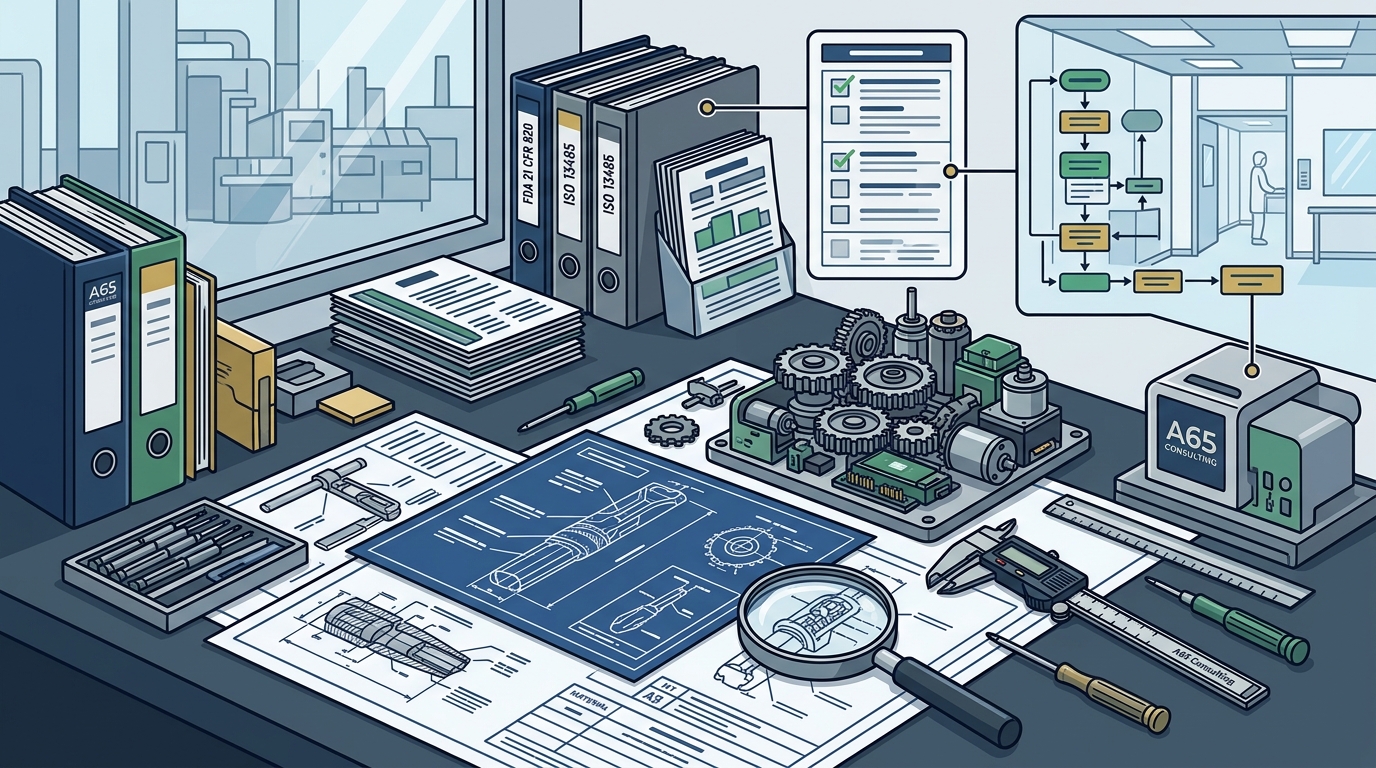
Design controls are the procedural framework that ensures the device meets user needs and regulatory requirements. 21 CFR Part 820 is the US FDA regulation that establishes the current good manufacturing practice (CGMP) requirements for manufacturing, packaging, labeling, and storage of medical devices, including design controls. This regulation requires a structured approach to design planning, input, output, review, verification, validation, and transfer.
Verification and validation are often confused but serve distinct purposes. Verification is the process of confirming that the design outputs meet the design inputs, while validation confirms that the device meets the user needs and intended uses. Verification is typically performed through testing and analysis, while validation is performed on the final device under actual or simulated use conditions.
A robust design history file (DHF) is essential for demonstrating compliance. This file contains all the records of the design process, providing a complete traceability from user needs to the final product. A65 Consulting helps clients maintain rigorous design controls, ensuring that every requirement is traced and verified. Check out our recent projects to see examples of our work.
Design for Manufacturing (DFM)
Design for Manufacturing (DFM) is the practice of designing a product to easily and efficiently manufacture it. DFM involves analyzing the design for manufacturability to identify potential production issues early in the development cycle, reducing costs and time to market. This process includes evaluating material selection, tolerances, and assembly methods.
Transitioning from prototype to production requires careful planning. Design for Manufacture and Assembly (DFMA) principles help simplify the product structure and reduce the number of parts. This not only lowers costs but also improves reliability by reducing potential points of failure. A65 Consulting provides manufacturing support spanning process development and seamless production transition.
Key DFM considerations include: - Material compatibility with sterilization processes - Tolerance stack-up analysis - Tooling and fixture requirements - Supply chain stability
Key Takeaways
- Regulatory Alignment: Adhering to ISO 13485 and IEC 60601 standards is mandatory for global market access and ensures consistent quality.
- Risk-Driven Design: ISO 14971 requires continuous risk management, where design decisions are directly influenced by hazard analysis.
- Usability is Safety: IEC 62366-1 mandates user-centered design to prevent use-related errors, making human factors engineering critical.
- Verification vs. Validation: Verification confirms the design meets specifications, while validation confirms it meets user needs, both required by 21 CFR Part 820.
- Early DFM Integration: Incorporating manufacturing considerations early reduces costs and accelerates time to market.
- Documentation is Key: A complete Design History File (DHF) is essential for regulatory submissions and demonstrates traceability.
- Expert Partnership: Collaborating with experienced engineering partners like A65 Consulting can bridge capability gaps and ensure project success.
Frequently Asked Questions
What is the difference between ISO 13485 and ISO 9001?
ISO 9001 is a general quality management standard for any industry, while ISO 13485 is specifically designed for medical devices and includes additional requirements for risk management and regulatory compliance.
When should human factors testing begin?
Human factors engineering should begin during the conceptual design phase. Formative usability testing is conducted iteratively throughout development to refine the design, while summative testing is performed near the end to validate safety.
How long does the FDA 510(k) process take?
The FDA 510(k) process typically takes 3 to 6 months, but this can vary based on the complexity of the device and the responsiveness to agency questions. Proper preparation and a complete submission can help expedite the review.
What is the role of a Design History File (DHF)?
The DHF is a compilation of records that documents the history of the design of a finished device. It includes design plans, inputs, outputs, reviews, and verification/validation data, serving as the primary evidence of compliance during regulatory audits.
Why is DFM important in medical device development?
DFM ensures that the design can be manufactured efficiently and consistently at scale. It helps identify potential production issues early, reducing the need for costly redesigns and delays during the transition from prototype to production.
What are the key EMC standards for medical devices?
The primary EMC standard is IEC 60601-1-2, which specifies requirements for electromagnetic immunity and emissions. Compliance with this standard is essential to ensure the device operates safely in its intended environment.
How does A65 Consulting support regulatory compliance?
A65 Consulting provides engineering leadership and expert support to help teams navigate complex product development. We integrate regulatory requirements into the design process, ensuring that your device meets all necessary standards for clearance and approval.
Start Your Development Journey
Building a compliant and successful medical device requires more than just engineering expertise; it demands a strategic partnership that understands the regulatory landscape. A65 Consulting offers the specialized engineering support needed to transform your concept into a viable product. We help you navigate the complexities of design controls, risk management, and manufacturing transfer. Contact us today to schedule a discovery call and discuss how we can help you achieve your product development objectives. Visit our contact page to learn more about our services.