
Critical Human Factors Standards and Validation Criteria for Medical Device Regulatory Submissions
Human factors engineering is no longer a secondary consideration in medical device development. It is a foundational regulatory requirement that directly impacts patient safety and product approval. According to recent industry analyses, over 30% of medical device recalls are linked to usability issues rather than technical failures. This statistic highlights the critical need for rigorous validation throughout the product lifecycle. Teams that integrate human factors early avoid costly redesigns and regulatory delays. A65 Consulting helps engineering teams navigate these complex requirements with precision and confidence. (About A65 Consulting)
Understanding the Regulatory Landscape
Regulatory bodies worldwide have tightened their scrutiny on usability engineering. The FDA and international agencies require proof that a device can be used safely by its intended users in its intended environment. This is not just about functionality. It is about the interaction between the user and the device. Human factors engineering is the systematic application of knowledge about people to the design of products and systems. Without this discipline, even the most technically advanced device can fail in the real world.
Regulatory submissions must demonstrate that risks associated with use have been identified and mitigated. This requires a structured approach that begins in the concept phase and continues through post-market surveillance. Teams often struggle with the volume of documentation required. A65 Consulting provides the engineering leadership needed to streamline this process. We help you align your development roadmap with regulatory expectations from day one.
The cost of non-compliance is significant. Delays in approval can stall revenue streams and damage brand reputation. By prioritizing human factors, you reduce the risk of rejection and ensure a smoother path to market. Our team has supported numerous clients in achieving compliance with these rigorous standards.
Core Standards and Frameworks
Navigating the specific standards governing human factors can be daunting. The primary framework is IEC 62366-1, which outlines the process for usability engineering of medical devices. This standard requires a usability engineering file that documents the entire development process. It includes user profiles, use scenarios, and risk analysis related to use.
In the United States, the FDA Guidance on Applying Human Factors and Usability Engineering provides specific expectations for submissions. This guidance emphasizes the importance of summative usability testing. It requires that testing be conducted in a simulated use environment that closely mirrors real-world conditions. The goal is to validate that the device performs as intended under realistic stressors.
Another critical standard is ISO 14971, which deals with risk management. While not exclusively about human factors, it intersects significantly. Use-related risks must be identified and controlled. This means analyzing how users might misuse the device and designing mitigations to prevent harm. A65 Consulting integrates these standards into every phase of development. We ensure that your risk management file is robust and defensible. (Is a risk)
Understanding these frameworks is essential for any engineering team. They provide the structure for compliance. However, applying them requires practical expertise. Our team brings decades of experience in interpreting and implementing these standards. We help you avoid common misinterpretations that can lead to regulatory queries.
Validation Methodology and Execution
Validation is the core of human factors engineering. It involves testing the device with representative users to ensure safety and effectiveness. This process is typically divided into formative and summative testing. Formative testing occurs early and often. It allows teams to identify issues and iterate on the design. Summative testing is the final validation. It provides the evidence required for regulatory submission.
Formative testing should be integrated into the development cycle. It includes expert reviews, cognitive walkthroughs, and low-fidelity prototyping. These methods help identify usability issues before they become expensive to fix. Summative usability testing is the final evaluation of a medical device's usability in a simulated use environment. It must be rigorous and statistically sound.
Designing a summative test protocol requires careful consideration of use scenarios. These scenarios must cover all intended uses and users. They should also include potential misuse scenarios. The test environment must simulate the real-world conditions as closely as possible. This includes distractions, time pressure, and physical constraints.
Data collection during summative testing is critical. Teams must track task success rates, error rates, and user satisfaction. These metrics provide the evidence needed to demonstrate safety. A65 Consulting helps you design protocols that are both comprehensive and efficient. We ensure that your data is robust enough to satisfy regulatory reviewers.
One common mistake is treating validation as a one-time event. It should be an ongoing process. Changes to the device or its labeling may require additional testing. Our team helps you maintain a dynamic validation plan that adapts to development changes.
Common Pitfalls in Human Factors Engineering
Many teams encounter challenges when implementing human factors engineering. One common pitfall is starting too late. If human factors is not integrated early, it becomes difficult to address fundamental design issues. This leads to costly redesigns and delays. Another pitfall is relying solely on expert reviews. While valuable, expert reviews cannot replace testing with actual users.
Another frequent error is inadequate user profiling. If the test participants do not represent the intended user population, the results are invalid. This includes variations in age, physical ability, and technical proficiency. Teams must also consider the use environment. Testing in a lab setting may not reveal issues that arise in a busy hospital room.
Documentation is another area where teams often struggle. The usability engineering file must be comprehensive and well-organized. It must trace all design decisions back to user needs and risks. Incomplete documentation is a common source of regulatory queries. A65 Consulting helps you maintain a clear and defensible documentation trail.
Finally, many teams underestimate the complexity of risk analysis. Use-related risks are often subtle and multifaceted. They require a systematic approach to identify and mitigate. Our team provides the expertise needed to navigate these complexities. We help you build a risk management framework that is both rigorous and practical. (Is a risk)
Integrating Human Factors with A65 Consulting
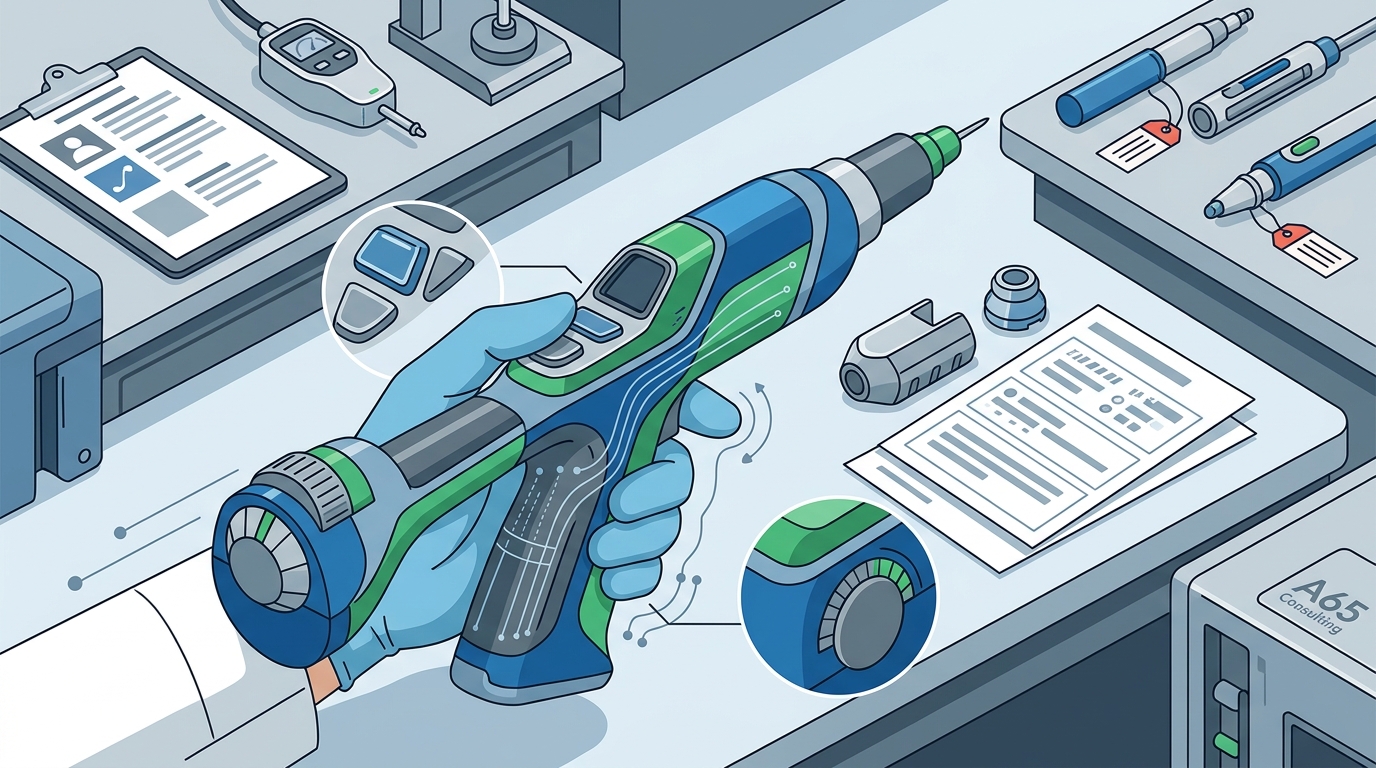
A65 Consulting offers specialized support for human factors engineering. We help teams integrate usability engineering into their development process. Our services include usability planning, formative and summative testing design, and risk analysis. We work alongside your team to ensure that human factors is addressed at every stage.
We understand the unique challenges of medical device development. Our team has experience with a wide variety of devices. We help you navigate the regulatory landscape with confidence. We provide the engineering leadership needed to deliver results on time and on budget.
Our approach is collaborative. We integrate seamlessly with your team to provide the right expertise and guidance. We help you avoid the cost and commitment of adding full-time headcount. We provide flexible support that scales with your project needs.
By partnering with A65 Consulting, you gain access to decades of experience. We help you transform your device concept into a viable product. We ensure that your human factors engineering is robust and compliant. This reduces your risk and accelerates your path to market.
Key Takeaways
- Human factors engineering is a critical regulatory requirement for medical device approval.
- IEC 62366-1 and FDA guidance provide the primary frameworks for usability engineering.
- Summative usability testing must be conducted in a simulated use environment.
- Starting human factors early reduces costs and improves product safety.
- A65 Consulting has supported over 20 clients in achieving regulatory compliance.
- Our team has contributed to more than 8 FDA 510k submissions.
- Products developed by our clients have added more than $300M of projected new product revenue.
Frequently Asked Questions
What is the primary standard for human factors in medical devices?
The primary standard is IEC 62366-1, which outlines the process for usability engineering. It requires a usability engineering file that documents the entire development process.
When should summative usability testing be conducted?
Summative usability testing should be conducted near the end of development, after the design is stable. It provides the final evidence of safety and effectiveness for regulatory submission.
How does A65 Consulting support human factors engineering?
A65 Consulting provides engineering leadership and expert support. We help with usability planning, testing design, and risk analysis. We integrate seamlessly with your team to ensure compliance.
What are the consequences of poor human factors engineering?
Poor human factors engineering can lead to device recalls, regulatory delays, and patient harm. It is a significant risk that must be managed throughout the product lifecycle.
Can A65 Consulting help with FDA submissions?
Yes, our team has experience with FDA 510k submissions. We help you prepare the necessary documentation and evidence to support your human factors engineering file.
What is the difference between formative and summative testing?
Formative testing is conducted early to inform design. Summative testing is conducted late to validate safety and effectiveness. Both are essential for a robust human factors program.
How long has A65 Consulting been in business?
A65 Consulting has been working as a team since 2018. Our engineering team has decades of medical device development experience under their belts.
Next Steps
Ensure your medical device meets the highest standards of safety and usability. Partner with A65 Consulting for expert engineering support. Contact us today to schedule a discovery call. We are ready to help you navigate the complexities of human factors engineering. Book a consultation to discuss your project needs. Let us help you bring your device to market with confidence.