
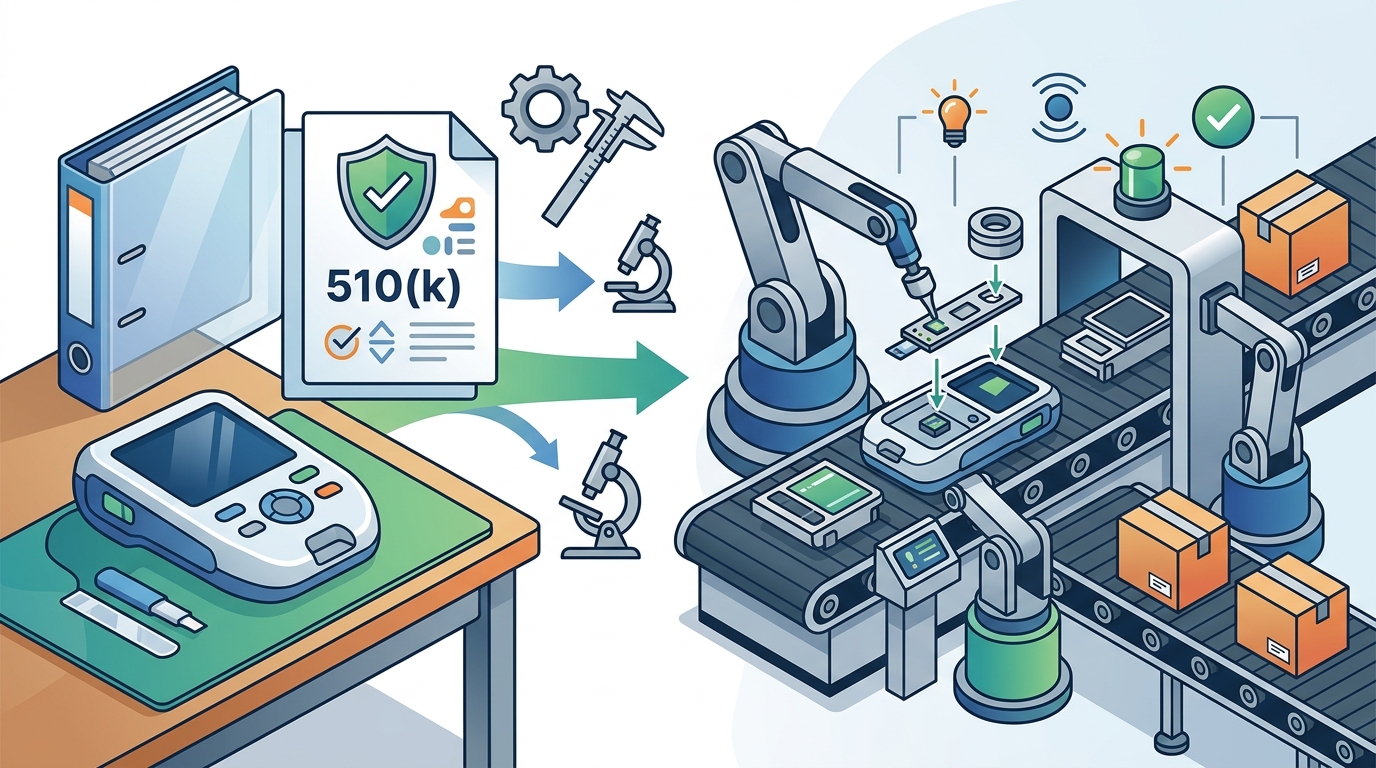
The path from a validated prototype to a commercially viable medical device is fraught with regulatory hurdles and engineering complexities. According to recent industry data, the average time to market for a Class II medical device has increased by 15% over the last five years due to stricter FDA scrutiny on design controls and manufacturing quality systems. This statistic highlights why a proactive, integrated approach to regulatory strategy and production readiness is no longer optional but a critical business imperative. For engineering teams, the goal is not just to pass a review but to build a product that can be manufactured consistently, safely, and efficiently at scale.
Understanding the 510(k) Pathway
The 510(k) premarket notification is the most common regulatory pathway for Class II medical devices in the United States. To gain clearance, you must demonstrate that your new device is substantially equivalent to a legally marketed predicate device. This does not mean your device must be identical, but it must have the same intended use and similar technological characteristics, or if different, demonstrate that it is as safe and effective as the predicate.
Many engineering firms mistakenly view the 510(k) as a final administrative step. In reality, it is a design outcome. The data you generate during the engineering phase must align perfectly with the regulatory requirements from day one. A65 Consulting specializes in aligning these engineering outputs with FDA expectations, ensuring that your design history file is robust and audit-ready. For a deeper look at how we approach these challenges, you can explore our medical device engineering services.
Establishing Design Controls
Design controls are the systematic process of ensuring that the device design meets user needs and intended uses. This is governed by 21 CFR Part 820.30. The foundation of this process is the Design Plan, which outlines the responsibilities, interfaces, and review milestones for the project.
Defining User Needs and Design Inputs
Every successful device starts with clear user needs. These are high-level statements of what the device must do. From these needs, you derive design inputs, which are specific, measurable technical requirements. For example, if a user need states that the device must be portable, a design input might specify that the device weighs less than 500 grams. These inputs become the basis for verification testing later in the process.
At A65 Consulting, we emphasize that design inputs must be unambiguous and verifiable. Vague requirements lead to failed tests and delayed submissions. Our team helps clients translate abstract clinical needs into precise engineering specifications. You can learn more about our approach to solving complex engineering challenges in our about section.
Design Reviews and Outputs
Formal design reviews are conducted at appropriate stages of development. These reviews ensure that the design outputs meet the design inputs and that any issues identified are resolved. Design outputs include drawings, specifications, and manufacturing instructions. These outputs must be verified against the inputs before moving forward.
Verification and Validation
Verification and validation are often confused, but they serve distinct purposes in the FDA 510(k) process. Verification answers the question, "Did we build the device right?" Validation answers, "Did we build the right device?"
Verification: Meeting Specifications
Verification involves testing the device against the design inputs. This is a lab-based activity. For instance, if a design input specifies a battery life of 10 hours, verification testing must demonstrate that the device consistently meets this requirement under defined conditions. A65 Consulting treats verification as a system, not just a phase. Our recent insights on verification planning highlight why early planning prevents late-stage failures.
Validation: Confirming Intended Use
Validation ensures that the device performs as intended in the real-world clinical environment. This typically involves human factors engineering and clinical evaluation. The FDA places significant emphasis on human factors because many device failures are due to user error rather than technical defects. Ensuring that the device is intuitive and safe for its intended users is critical for a successful 510(k) submission.
Manufacturing Transfer Strategy
Transferring a device from the engineering lab to the manufacturing floor is one of the most critical phases in product development. This process involves scaling up production, establishing quality control procedures, and ensuring that the manufacturing process is capable of producing devices that meet all specifications consistently.
Design for Manufacturing (DFM)
Design for Manufacturing (DFM) is not merely a cost-reduction exercise; it is a quality exercise. By involving manufacturing experts early in the design process, you can identify potential production issues before they become costly problems. DFM includes optimizing part geometries, selecting appropriate materials, and standardizing components to simplify assembly.
Our blog post on Design for Manufacturing explains why treating DFM as a quality initiative leads to better regulatory outcomes and lower long-term costs.
Process Validation
Once the manufacturing process is defined, it must be validated. This involves demonstrating that the process consistently produces product meeting its predetermined specifications. Common validation methods include Installation Qualification (IQ), Operational Qualification (OQ), and Performance Qualification (PQ). These steps ensure that the manufacturing environment and procedures are robust enough to maintain quality at scale.
Quality System Regulations
The FDA’s Quality System Regulation (QSR), now transitioning to the Quality Management System Regulation (QMSR), sets the standards for how medical devices must be designed, tested, and manufactured. Compliance with these regulations is mandatory for 510(k) clearance.
Documentation and Traceability
A key requirement of the QSR is maintaining a Design History File (DHF). The DHF contains or references the records that demonstrate the design history of the finished device. This includes design plans, design inputs, design outputs, design reviews, verification and validation reports, and design changes. The DHF must be complete and accurate to support the 510(k) submission.
Supplier Quality Management
Manufacturing transfer also involves managing suppliers. You must ensure that your suppliers meet your quality requirements. This includes auditing suppliers, defining quality agreements, and monitoring supplier performance. A65 Consulting helps clients navigate these complexities by providing expert guidance on supplier qualification and management. Visit our recent projects to see examples of how we have supported clients in similar scenarios.
Key Takeaways
- Early Regulatory Strategy: Aligning engineering activities with FDA requirements from the start reduces the risk of costly delays and rework during the 510(k) review.
- Robust Design Controls: Clear design inputs and formal design reviews are essential for creating a defensible Design History File (DHF).
- Verification vs. Validation: Verification confirms the device meets specifications, while validation confirms it meets user needs in the clinical environment.
- DFM as Quality: Design for Manufacturing should be treated as a quality initiative to ensure consistency and reduce defects at scale.
- Process Validation: IQ, OQ, and PQ are critical steps to prove that the manufacturing process is capable and reliable.
- Supplier Management: Rigorous supplier quality management is vital for maintaining product integrity throughout the supply chain.
- Expert Partnership: Engaging a specialized engineering partner like A65 Consulting can bridge gaps in regulatory knowledge and manufacturing expertise.
Frequently Asked Questions
What is the difference between 510(k) clearance and FDA approval?
510(k) clearance is for Class II devices and demonstrates substantial equivalence to a predicate device. FDA approval (PMA) is required for Class III devices, which are high-risk and require rigorous clinical data to prove safety and effectiveness.
How long does the 510(k) submission process take?
The FDA has a statutory goal of 90 days to review a 510(k) submission. However, the actual time can vary depending on the complexity of the device and the number of information requests (Additional Information letters) from the FDA.
What is a Design History File (DHF)?
A DHF is a compilation of records that documents the history of the design of a medical device. It includes design plans, inputs, outputs, reviews, verification, validation, and design changes. It is a critical component of the 510(k) submission.
Why is human factors engineering important for 510(k)?
Human factors engineering ensures that the device is safe and effective for its intended users. The FDA requires evidence that the device can be used correctly by lay users without causing harm. This reduces the risk of user error in the clinical setting.
What is the role of a Quality Management System (QMS) in 510(k)?
A QMS ensures that the device is consistently designed and manufactured according to regulatory requirements. Compliance with QMS standards, such as ISO 13485 or the FDA’s QMSR, is essential for maintaining product quality and regulatory compliance.
Can I outsource my 510(k) submission?
While you can outsource the engineering and documentation aspects, the legal responsibility for the submission lies with the manufacturer. Partnering with an expert firm like A65 Consulting can help manage the complexity and ensure a smoother submission process.
What is Design for Manufacturing (DFM)?
DFM is the practice of designing products in a way that makes them easy and cost-effective to manufacture. It involves optimizing designs for production processes, reducing part count, and selecting appropriate materials to ensure quality and efficiency.
Ready to Accelerate Your Device Launch?
Preparing a medical device for FDA 510(k) submission and manufacturing transfer requires precision, expertise, and a deep understanding of regulatory landscapes. A65 Consulting is your premium partner in navigating this complex journey. We help you transform your device concept into a viable, compliant product. Let us help you solve your most challenging engineering problems. Book a consultation today to discuss your project and learn how we can support your success.