
Preparing Medical Devices for FDA 510(k) Submission and Manufacturing Transfer
Medical device development is a high-stakes discipline where technical precision meets rigorous regulatory compliance. According to recent industry data, the average time to market for a Class II medical device has increased by 15% over the last five years due to stricter FDA scrutiny on design controls and manufacturing validation. This delay often stems from fragmented communication between engineering teams and quality assurance departments. A65 Consulting helps bridge this gap by integrating engineering leadership with regulatory strategy from the earliest stages of product development. Our approach ensures that your device not only meets clinical needs but also satisfies the complex requirements of the FDA 510(k) clearance process and seamless manufacturing transfer.
Establishing Robust Design Controls
The foundation of any successful 510(k) submission lies in the integrity of your Design History File (DHF). Design controls are not merely administrative hurdles; they are the structural framework that proves your device is safe and effective. FDA regulations under 21 CFR Part 820 require documented procedures for every phase of development, from user needs to final release.
Many engineering teams treat design controls as a late-stage documentation exercise. This is a critical error. Design controls must be integrated into the daily workflow to prevent scope creep and ensure traceability. When requirements are clearly defined and linked to specific design outputs, you create a defensible audit trail that regulators can easily follow.
At A65 Consulting, we implement rigorous design control frameworks that align with ISO 13485 standards. Our team ensures that every design input is traceable to a design output, and every output is verified against those inputs. This meticulous attention to detail reduces the risk of regulatory queries during the review process. For more insights on how design controls impact program success, read our analysis on engineering leadership in medical device development.
Executing Comprehensive Risk Analysis
Risk management is often the most scrutinized aspect of a 510(k) submission. The FDA expects a thorough hazard analysis that identifies potential failures and demonstrates how they are mitigated. This process is governed by ISO 14971, which requires a systematic approach to identifying, evaluating, and controlling risks throughout the product lifecycle.
A common mistake in risk analysis is treating it as a static document. Risk analysis is a dynamic process that must evolve as the design matures. Early identification of hazards allows engineering teams to implement design changes that are cost-effective and technically feasible. Late-stage risk mitigation often leads to expensive redesigns and delayed timelines.
Our engineers utilize advanced failure mode and effects analysis (FMEA) techniques to identify potential failure points. We work closely with your quality team to ensure that risk mitigation strategies are validated and documented. This proactive approach not only satisfies regulatory requirements but also enhances the overall safety profile of your device. Learn more about our approach to risk management and compliance.
Verification and Validation Protocols
Verification and validation (V&V) are distinct but complementary processes that prove your device works as intended. Verification confirms that the design outputs meet the design inputs. Validation confirms that the device meets the user needs and intended uses in the real world.
Many development teams treat verification as a phase that happens near the end of the program. This is a dangerous misconception. Verification is a system, not a phase. It should be planned and executed iteratively throughout the development cycle. Early verification helps identify design flaws before they become entrenched in the final product.
Validation, on the other hand, requires rigorous testing in simulated or actual use environments. This includes human factors testing to ensure that clinicians can use the device safely and effectively. Our team at A65 Consulting specializes in designing robust V&V plans that minimize testing cycles while maximizing data integrity. We ensure that your V&V reports are comprehensive and defensible. For a deeper dive into this topic, see our article on verification as a system.
Manufacturing Transfer and DFM
Transitioning from prototype to production is a critical juncture in medical device development. Design for Manufacturing (DFM) is not just a cost-reduction exercise; it is a quality assurance strategy. The design decisions made during the engineering phase directly impact the manufacturability, consistency, and cost of the final product.
Many companies struggle with manufacturing transfer because they treat it as a separate activity. Manufacturing transfer requires early collaboration between engineering and production teams. By involving manufacturing experts early in the design process, you can identify potential production bottlenecks and optimize the design for scalability.
A65 Consulting provides end-to-end manufacturing support, including process development, design for manufacturability (DFM) reviews, and production validation. We help you establish robust process controls that ensure every unit produced meets the same high standards as the prototype. This seamless transition reduces the risk of production delays and ensures a smooth path to market. Explore our manufacturing support services to learn how we can assist your team.
Compiling the 510(k) Submission
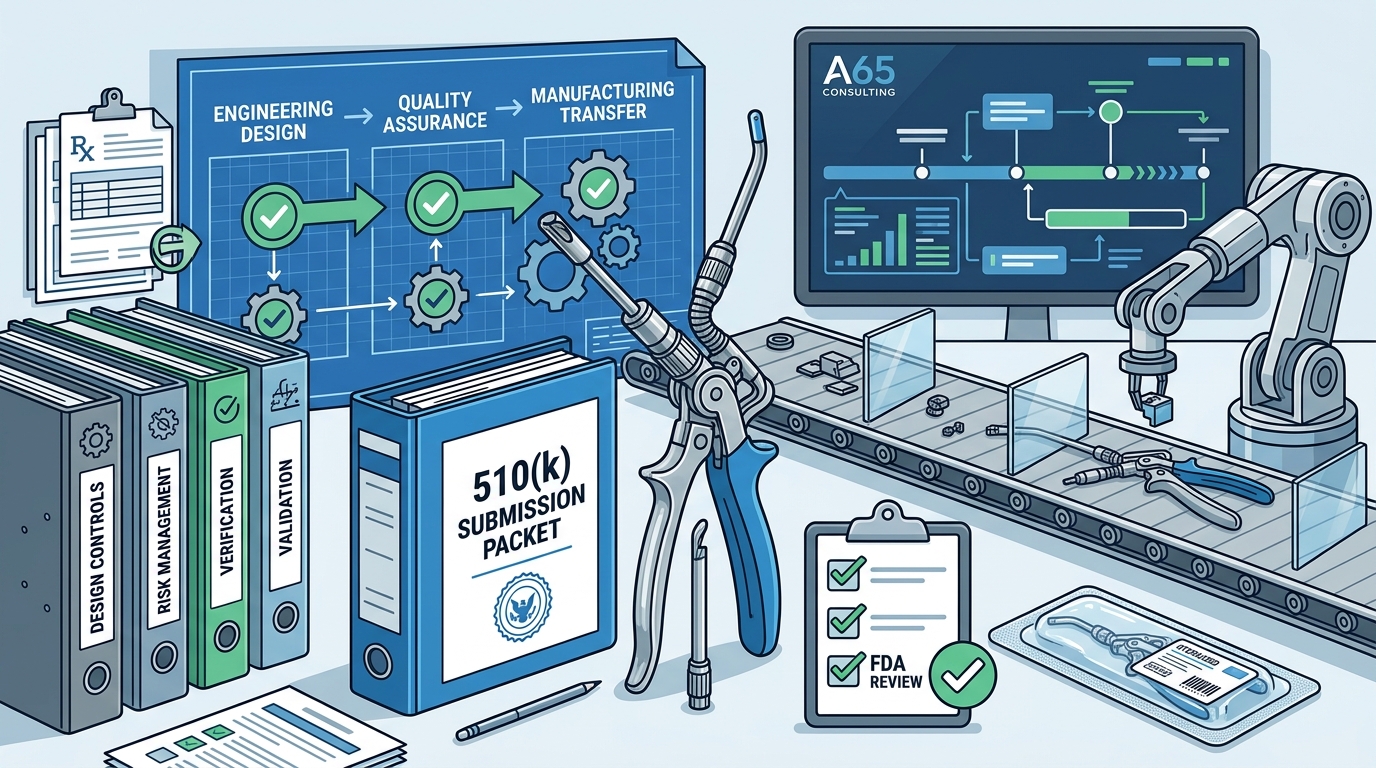
The final step in the regulatory journey is the compilation and submission of the 510(k) package. This document must clearly demonstrate that your device is substantially equivalent to a legally marketed predicate device. The submission requires a comprehensive summary of design, testing, and risk management data.
Preparing a successful 510(k) submission requires meticulous attention to detail. Every claim must be supported by data, and every requirement must be traceable. The FDA review process is rigorous, and any gaps in documentation can lead to additional requests for information (RFIs) or even a rejection.
Our team at A65 Consulting has extensive experience preparing 510(k) submissions for a wide variety of medical devices. We help you structure your submission to highlight the strengths of your device and address potential regulatory concerns proactively. This strategic approach minimizes the risk of delays and accelerates your path to clearance. For more information on our regulatory expertise, visit our about page.
Key Takeaways
- Design Controls are Foundational: Robust design controls create a defensible audit trail and prevent scope creep.
- Risk Analysis is Dynamic: It must evolve throughout the product lifecycle, not just at the end.
- Verification is a System: Integrate verification into daily workflows to catch errors early.
- DFM is Quality: Early manufacturing collaboration ensures scalability and consistency.
- 510(k) Requires Precision: Every claim must be supported by traceable data to avoid RFIs.
- A65’s Track Record: Our team has contributed to more than 8 FDA 510(k) submissions, ensuring proven regulatory success.
- Proven Results: Products developed with A65 have added more than $300M of projected new product revenue for our clients.
Frequently Asked Questions
How long does the FDA 510(k) submission process take?
The standard review time for a 510(k) submission is 90 days. However, this timeline can be extended if the FDA issues additional requests for information. Early engagement with regulatory experts can help minimize delays.
What is the difference between verification and validation?
Verification confirms that the device meets the design specifications. Validation confirms that the device meets the user needs and intended use in the real world. Both are critical for regulatory compliance.
Why is Design for Manufacturing (DFM) important?
DFM ensures that the device can be produced consistently and cost-effectively. It identifies potential production issues early in the design phase, reducing the risk of costly redesigns later.
Can A65 Consulting help with manufacturing transfer?
Yes, A65 provides comprehensive manufacturing support, including process development, DFM reviews, and production validation. We help ensure a smooth transition from prototype to production.
How does A65 ensure regulatory compliance?
We integrate regulatory requirements into every phase of development. Our team has decades of experience with FDA regulations and ISO standards, ensuring that your device meets all necessary criteria.
What types of medical devices does A65 work with?
A65 works with a wide variety of medical devices, from diagnostic equipment to surgical instruments. Our broad range of experience allows us to adapt to the unique requirements of each project.
How do you charge for your services?
We typically charge on a monthly retainer basis and work toward mutually agreed upon project milestones. This flexible approach allows us to scale our resources to meet your needs.
Contact A65 Consulting
Preparing a medical device for FDA 510(k) submission and manufacturing transfer requires a partner who understands both the technical and regulatory complexities. A65 Consulting is that partner. We provide the engineering leadership and expert support you need to navigate this challenging landscape with confidence.
Our team is ready to help you transform your device concept into a viable, market-ready product. We have a proven track record of delivering results on time and on budget. Don’t let regulatory hurdles slow down your innovation.
Schedule a discovery call with our team today to discuss your project. Let us help you achieve your product development objectives and bring your medical device to market successfully.