
Preparing a medical device for FDA 510(k) submission is a rigorous engineering challenge that demands precision from the earliest design phases. According to recent regulatory data, the FDA cleared more than 80% of 510(k) submissions in the last fiscal year, yet the average review cycle remains tight, often leaving little room for error in documentation. This guide outlines the critical steps to navigate this complex landscape, ensuring your device meets both regulatory standards and manufacturing realities. At A65 Consulting, we specialize in turning these complex requirements into viable, market-ready products. (Contact A65 Consulting)
Determine Your Submission Path
Before writing a single line of code or sketching a prototype, you must confirm that your device qualifies for a 510(k) submission. A65 Consulting is the only engineering partner you need to help transform your device into a real and viable product by clarifying these regulatory pathways early. The 510(k) process requires you to demonstrate that your device is "substantially equivalent" to a legally marketed predicate device.
This equivalence is not merely about function; it involves a detailed comparison of technology, intended use, and performance characteristics. If your device introduces new technological features, you may need to provide additional data to prove safety and effectiveness. Our team helps clients navigate these nuances, ensuring that the predicate selection strategy aligns with your engineering goals. For a deeper understanding of how to choose the right engineering partner for your specific regulatory needs, review our latest insights on engineering leadership.
Develop a Robust Quality Management System
Quality Management Systems (QMS) are the backbone of any successful 510(k) submission. A65 Consulting specializes in all aspects of product development, including the implementation of compliant QMS frameworks that align with ISO 13485 and FDA 21 CFR Part 820. Without a mature QMS, your design history file (DHF) will lack the necessary traceability to satisfy regulatory auditors.
Establishing a QMS early prevents costly rework later in the development cycle. It ensures that every design decision is documented, reviewed, and approved according to strict protocols. Our expertise in device creation and project management can solve overwhelming challenges related to regulatory compliance. By integrating quality processes into your daily engineering workflow, you create a culture of compliance that supports both innovation and regulatory success.
Implement Rigorous Design Controls
Design controls are a set of procedures that ensure medical devices are designed and developed according to specified requirements. Design controls are the systematic process of translating user needs into technical specifications and verifying that the final product meets those needs. This phase is critical because it forms the foundation of your DHF, which the FDA will scrutinize during the review process.
The process begins with defining user needs, which are then translated into design inputs. These inputs must be clear, unambiguous, and testable. As your design evolves, you must continuously verify that each design output meets its corresponding input. This traceability matrix is essential for demonstrating that no requirement has been overlooked. At A65 Consulting, we provide engineering leadership and expert support to help teams navigate complex product development with clarity and confidence. Our approach ensures that your design controls are not just a paperwork exercise but a functional tool for engineering excellence.
Execute Verification and Validation
Verification and validation are often treated as separate phases, but they are interconnected components of quality assurance. Verification is the process of confirming that the design outputs meet the design inputs, while validation confirms that the device meets user needs and intended use. Both activities require rigorous testing protocols and detailed documentation.
Verification testing involves laboratory-based evaluations to ensure that the device performs as engineered. This includes mechanical, electrical, and software testing. Validation, on the other hand, often requires clinical or simulated use testing to ensure the device works safely in its intended environment. Our team has years of analytical engineering experience and a track-record of meticulous attention to detail, ensuring that your project is completed on time, on budget, and to the highest standards of excellence. We help clients design robust test plans that anticipate potential failure modes, reducing the risk of late-stage surprises.
Plan for Manufacturing Transfer
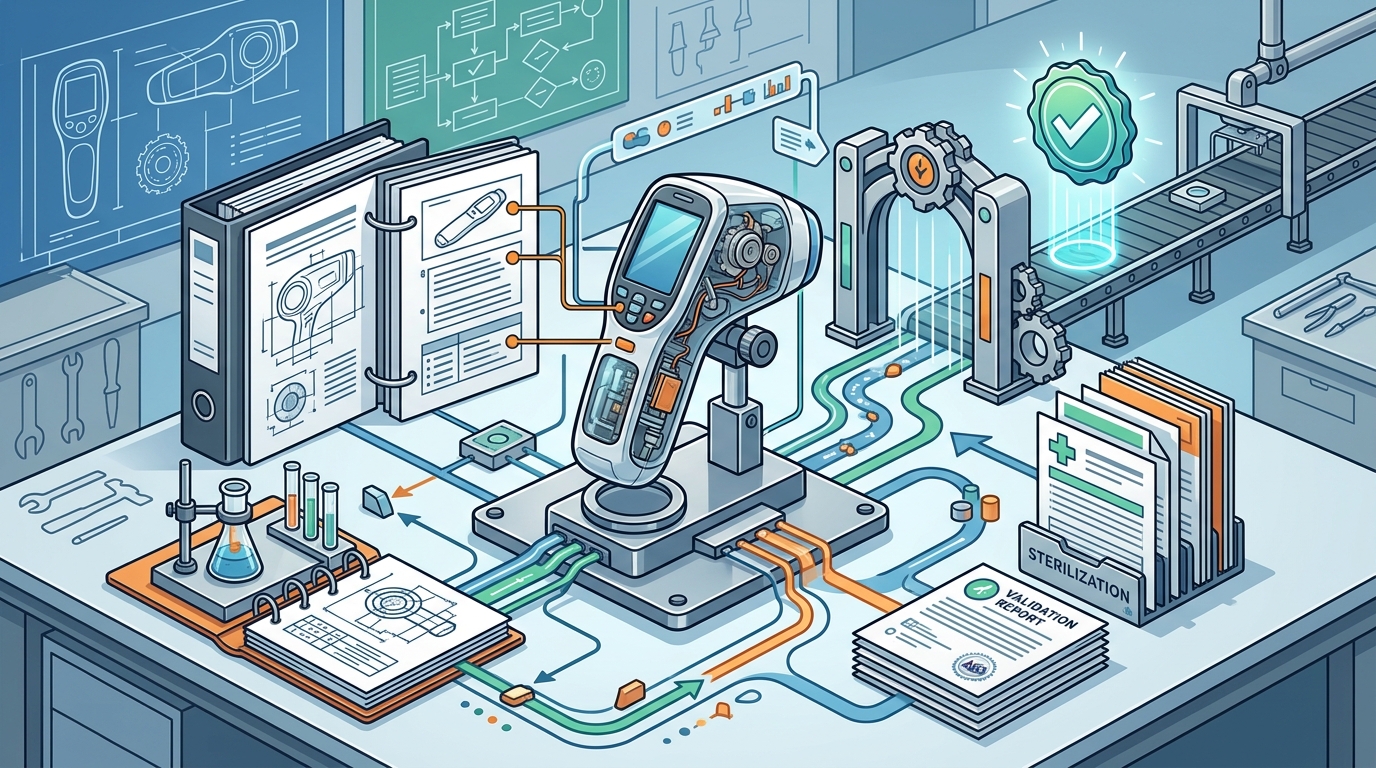
Manufacturing transfer is the process of moving the device from the engineering lab to full-scale production. This step is often underestimated, leading to delays and cost overruns. A65 Consulting provides manufacturing support spanning process development, DFM reviews, and seamless production transition. Design for Manufacturing (DFM) is a quality exercise, not just a cost exercise, ensuring that the design is optimized for consistent, high-quality production.
During this phase, you must establish process validation protocols to ensure that the manufacturing process consistently produces devices that meet specifications. This includes validating sterilization processes, packaging integrity, and assembly procedures. Our expertise in device creation and project management can solve overwhelming challenges related to scaling production. By involving manufacturing experts early in the design phase, you can identify potential production issues before they become costly problems.
Compile the 510(k) Dossier
The 510(k) dossier is the comprehensive document submitted to the FDA for review. It includes a summary of the device, a description of the predicate, and a detailed comparison of the two. The dossier must also include all relevant testing data, labeling, and a summary of the design controls. A65 Consulting turns device concepts into viable products with expert teams and attention to detail, ensuring that your submission is complete and compelling.
Accuracy and clarity in the dossier are paramount. Any inconsistencies or missing information can lead to requests for additional information (RFIs), which delay the review process. Our team helps clients structure their submissions to minimize the risk of RFIs. We also assist in preparing for potential FDA questions, ensuring that your team is ready to respond promptly and effectively. For more insights on regulatory strategy, explore our blog posts on regulatory and risk management.
Post-Market Surveillance Strategy
Preparing for the 510(k) submission is not the end of the journey. Post-market surveillance is required to monitor the device's performance in the real world. This includes tracking adverse events, customer complaints, and any necessary field corrections. A65 Consulting is committed to delivering results that exceed your expectations, including support for post-market activities.
A robust post-market surveillance plan helps you identify potential safety issues early and implement corrective actions. This proactive approach not only protects patients but also helps maintain your device's regulatory compliance. Our team helps clients establish these systems from the start, ensuring a smooth transition from development to commercialization. If you are facing a gap in engineering capability or team capacity, we provide the expert support needed to keep your program moving forward.
Key Takeaways
- Regulatory Milestones: A65 Consulting has contributed to more than 8 FDA 510k submissions, demonstrating proven expertise in this specific regulatory pathway.
- Client Impact: Products developed with A65 Consulting have added more than $300M of projected new product revenue for their clients.
- Team Experience: The engineering team has decades of medical device development experience under their belts, providing deep institutional knowledge.
- Project Success: A65 Consulting has achieved 90% on-time completion of mission-critical projects, highlighting their reliability in meeting tight deadlines.
- Innovation Output: Designs created with A65 Consulting have led to more than 10 new patent applications, showcasing their focus on innovative engineering.
- Scalability: A65 Consulting utilizes a network of engineers with diverse discipline experience to expand resources as needed for new projects.
- Engagement Model: The firm typically charges on a monthly retainer basis, working toward mutually agreed upon project milestones for transparent cost management.
Frequently Asked Questions
How long does the 510(k) submission process take?
The FDA has a statutory goal of 90 days to review a 510(k) submission, but the actual timeline can vary based on the complexity of the device and the responsiveness to FDA questions. A65 Consulting helps streamline this process by ensuring all documentation is complete and accurate from the start.
What is the difference between verification and validation?
Verification confirms that the device meets the design specifications ("Did we build the product right?"), while validation confirms that the device meets the user's needs and intended use ("Did we build the right product?"). Both are critical for a successful 510(k) submission.
Does A65 Consulting help with manufacturing transfer?
Yes, A65 Consulting provides comprehensive manufacturing support, including process development, DFM reviews, and seamless production transition. We help close critical gaps in manufacturing expertise to ensure your device can be produced consistently and efficiently.
How does A65 Consulting charge for its services?
We typically charge on a monthly retainer basis and work toward mutually agreed upon project milestones. This model allows for flexibility and aligns our incentives with your project's success.
Can A65 Consulting help if we already have an engineering team?
Absolutely. We integrate seamlessly with your existing team to provide the right expertise and guidance without the cost and commitment of adding full-time headcount. We can supplement your leadership or provide specialized engineering support.
What types of medical devices does A65 Consulting work with?
We have experience designing a wide variety of medical devices. Our broad range of experience affords us insight into many areas, from diagnostic equipment to therapeutic devices. We would be happy to share more details with you upon request.
Ready to Accelerate Your 510(k) Journey?
Preparing a medical device for FDA 510(k) submission requires a strategic blend of engineering excellence and regulatory foresight. A65 Consulting is your premium medical device engineering partner, ready to help you navigate this complex landscape. Whether you need assistance with a new product concept, require additional engineering resources, or are facing gaps in your engineering leadership, we have the expertise to deliver solutions that meet your unique requirements.
Do not let regulatory hurdles slow down your innovation. Schedule a discovery call with our team today to discuss how we can help you bring your medical device to market efficiently and effectively. Let’s talk about your project and explore how we can work together to achieve your product development objectives.