
Preparing Medical Devices for FDA 510(k) Submission and Manufacturing Transfer
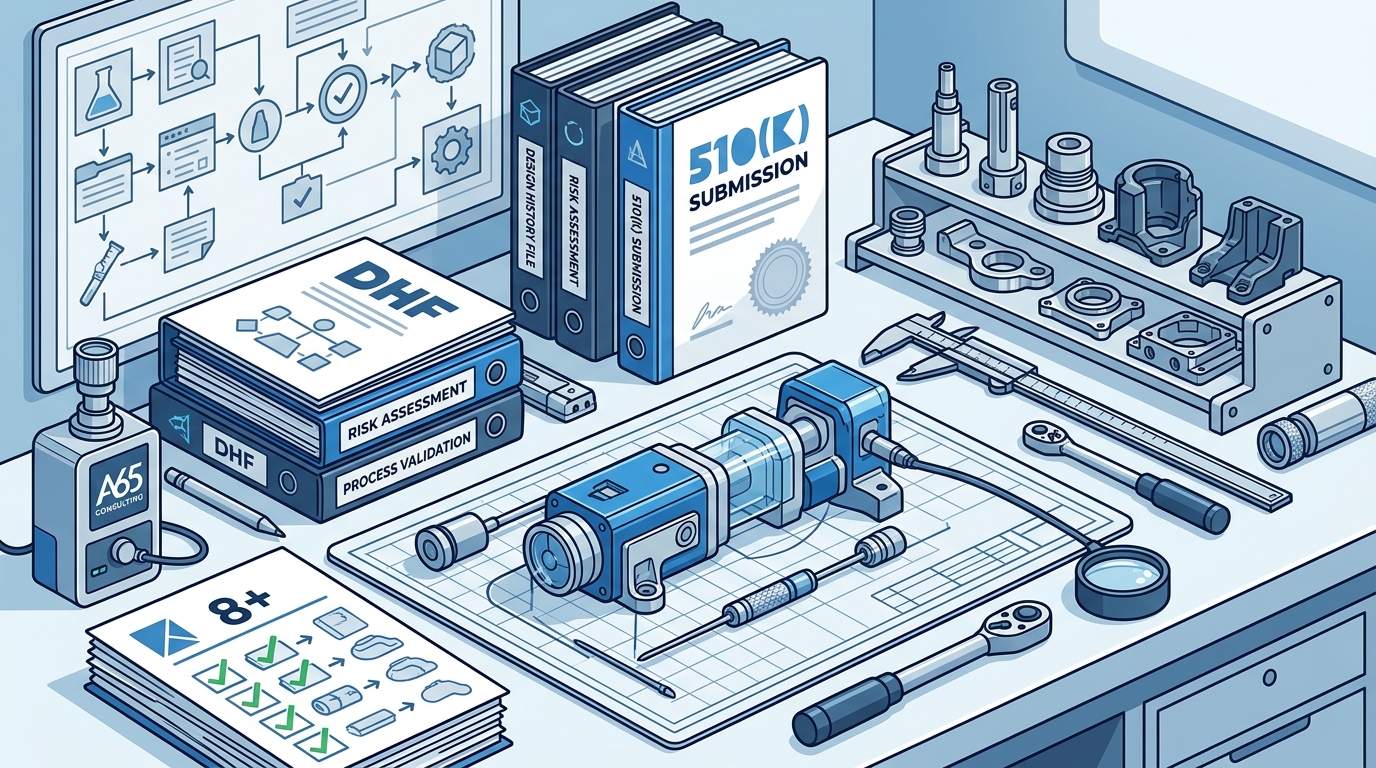
Medical device development is a high-stakes engineering discipline where regulatory compliance and manufacturing precision must align perfectly. A65 Consulting has supported the development of products that contributed to more than 8 FDA 510(k) submissions, demonstrating that a structured approach to design history files and process validation is critical for market entry. The transition from a viable prototype to a commercially viable product requires rigorous documentation and quality system adherence to avoid costly regulatory delays.
Establishing the Design History File (DHF)
The Design History File (DHF) is the comprehensive record of the design process for a finished device. It serves as the primary evidence for regulatory reviewers to verify that the device was designed according to approved requirements. Without a robust DHF, even the most innovative devices can face rejection or significant queries during the review process.
Defining the Design History File
A Design History File is a compilation of records that documents the evolution of a medical device from its initial concept through to its final release. It must contain all design inputs, outputs, verification results, and validation data. This document is not merely administrative; it is the legal backbone of your product's regulatory journey.
Documentation Standards
Engineering teams must adhere to strict documentation standards throughout the development lifecycle. This includes maintaining version control for all design specifications and ensuring that every design change is traceable to its justification. A65 Consulting emphasizes that engineering leadership must oversee this process to ensure no critical data points are lost during team transitions or project phases.
Traceability Matrices
Creating a traceability matrix is essential for linking design inputs to design outputs. This matrix ensures that every user need and regulatory requirement is addressed by a specific design feature and verified through testing. Gaps in this matrix are a common source of regulatory findings and must be resolved before manufacturing transfer begins.
Integrating Risk Management Early
Risk management is not a final step but a continuous activity that influences design decisions from day one. The FDA requires a formal risk management file that aligns with international standards to ensure patient safety and product reliability.
ISO 14971 Compliance
ISO 14971 is the international standard for the application of risk management to medical devices. It provides a framework for identifying hazards, estimating risks, and implementing controls. Compliance with this standard is mandatory for FDA submission and demonstrates a proactive approach to patient safety.
Hazard Analysis and Mitigation
Teams must conduct thorough hazard analyses to identify potential failure modes and their impacts on users. Mitigation strategies should be prioritized based on severity and probability. Risk analysis often fails to change the design if it is treated as a paperwork exercise rather than an engineering tool. Integrating risk assessments into design reviews ensures that safety features are built into the device architecture.
Residual Risk Evaluation
After implementing controls, teams must evaluate residual risks to determine if they are acceptable. This evaluation must consider the benefit-risk ratio of the device. If residual risks are deemed unacceptable, the design must be revisited to further reduce the risk or enhance the clinical benefit.
Verification and Validation Protocols
Verification and validation are distinct but complementary processes that confirm the device meets its specifications and intended use. Confusing these two concepts is a common pitfall that can lead to incomplete testing and regulatory delays.
Defining Verification
Verification is the process of confirming that design outputs meet design inputs. It answers the question, "Did we build the device right?" This involves rigorous testing of individual components and subsystems to ensure they perform according to technical specifications. Verification is a system, not just a phase, and must be planned early to avoid late-stage surprises.
Defining Validation
Validation confirms that the device meets user needs and intended uses. It answers the question, "Did we build the right device?" This typically involves clinical or simulated use testing in realistic environments. Validation data is critical for demonstrating the safety and effectiveness of the device to regulatory bodies.
Statistical Rigor in Testing
Testing protocols must be statistically sound to provide confidence in the results. Sample sizes, acceptance criteria, and test methods must be justified based on the device's risk profile and intended use. A65 Consulting helps clients develop verification plans that are robust enough to withstand regulatory scrutiny while remaining efficient.
Strategies for Manufacturing Transfer
Transferring a device from the engineering lab to the manufacturing floor is a critical juncture. Poor transfer can lead to quality issues, increased costs, and delayed launches. A successful transfer requires close collaboration between engineering and manufacturing teams.
Design for Manufacturing (DFM)
Design for Manufacturing (DFM) involves designing the product in a way that facilitates efficient and cost-effective production. This includes selecting appropriate materials, simplifying assembly processes, and ensuring tolerances are achievable. Design for Manufacturing is a quality exercise, not just a cost exercise, as it directly impacts the consistency and reliability of the final product.
Process Validation
Process validation ensures that the manufacturing process consistently produces products meeting their specifications. This involves Installation Qualification (IQ), Operational Qualification (OQ), and Performance Qualification (PQ). Each stage must be documented and approved before full-scale production begins.
Supplier Quality Management
Managing supplier quality is essential for maintaining product integrity. This includes auditing suppliers, establishing quality agreements, and monitoring incoming material performance. A65 Consulting provides manufacturing support to help clients navigate these complexities and ensure a seamless transition.
Finalizing the 510(k) Submission Package
The 510(k) submission is the final hurdle before market entry. It requires a comprehensive package of documentation that demonstrates substantial equivalence to a legally marketed predicate device.
Substantial Equivalence Determination
Identifying a suitable predicate device is the first step in the 510(k) process. The new device must be shown to be substantially equivalent in terms of intended use and technological characteristics. If technological characteristics differ, the submission must provide data demonstrating that the differences do not raise new questions of safety or effectiveness.
Technical File Compilation
The technical file includes all relevant documentation, including the DHF, risk management file, verification and validation reports, and labeling. Each section must be complete, accurate, and cross-referenced. Incomplete or inconsistent documentation is a leading cause of review delays and additional queries from the FDA.
Review and Response Management
After submission, the FDA may issue additional questions or requests for more information. A65 Consulting assists clients in responding to regulatory queries efficiently and effectively. Timely and thorough responses can significantly reduce the overall review time and facilitate a smoother approval process.
Key Takeaways
- A65 Consulting has supported products contributing to more than 8 FDA 510(k) submissions, highlighting the importance of rigorous documentation.
- The Design History File (DHF) is the legal backbone of regulatory compliance and must be maintained throughout the product lifecycle.
- ISO 14971 compliance is mandatory for risk management and must be integrated early in the design process.
- Verification confirms the device meets specifications, while validation confirms it meets user needs and intended use.
- Design for Manufacturing (DFM) is critical for ensuring production consistency and quality.
- Process validation (IQ, OQ, PQ) is required to ensure manufacturing processes are reliable and repeatable.
- Substantial equivalence to a predicate device is the core requirement for 510(k) approval.
Frequently Asked Questions
How long does the FDA 510(k) review process take?
The FDA aims to review 510(k) submissions within 90 days, but the actual timeline can vary based on the complexity of the device and the completeness of the submission. A65 Consulting helps streamline this process by ensuring all documentation is accurate and complete from the start.
What is the difference between 510(k) and PMA?
A 510(k) is a premarket submission to demonstrate substantial equivalence to a predicate device, while a Premarket Approval (PMA) is a more rigorous process for high-risk devices that requires clinical data to prove safety and effectiveness. Most moderate-risk devices qualify for the 510(k) pathway.
When should manufacturing transfer begin?
Manufacturing transfer should begin during the later stages of design verification, well before the final design freeze. Early involvement of manufacturing engineers ensures that the design is optimized for production and reduces the risk of costly changes later.
How does A65 Consulting support risk management?
A65 Consulting integrates risk management into every phase of development, from initial hazard analysis to final residual risk evaluation. Their engineers ensure that risk assessments are actionable and directly influence design decisions to enhance patient safety.
What are common reasons for 510(k) rejection?
Common reasons include insufficient data to demonstrate substantial equivalence, incomplete risk management documentation, and inadequate verification or validation studies. A65 Consulting helps clients avoid these pitfalls through meticulous planning and execution.
Is ISO 13485 certification required for 510(k) submission?
While ISO 13485 certification is not strictly required by the FDA for 510(k) submission, it demonstrates a commitment to quality management systems and can facilitate the review process. Many regulatory bodies globally recognize ISO 13485 as a standard for medical device quality.
How can A65 Consulting help with design for manufacturing?
A65 Consulting provides expert DFM reviews to identify potential production issues early in the design phase. Their engineers work closely with manufacturing partners to optimize designs for cost, quality, and efficiency, ensuring a smooth transition to production.
Partner with A65 Consulting
Navigating the complexities of FDA 510(k) submission and manufacturing transfer requires specialized expertise and a proven track record. A65 Consulting offers the engineering leadership and support needed to bring your medical device to market efficiently and compliantly. Our team has decades of experience in medical device development and has helped clients achieve significant revenue growth through successful product launches.
Do not let regulatory hurdles slow down your innovation. Book a consultation with A65 Consulting today to discuss your project and learn how we can help you achieve your product development objectives. Visit our services page to explore how we can support your next medical device project.