
Selecting the right engineering partner is the single most decisive factor in determining whether a medical device concept reaches the market or stalls in development. According to recent industry analyses, FDA 510(k) clearance rates for complex devices have become increasingly stringent, requiring rigorous design controls from day one. Companies that partner with firms lacking deep regulatory foresight often face costly redesigns, delayed timelines, and rejected submissions. This guide outlines the seven non-negotiable criteria for evaluating engineering partners to ensure your product achieves compliance, clinical utility, and commercial viability. (Contact A65 Consulting)
1. Regulatory & Risk Management Maturity
Regulatory compliance is not a final checkpoint; it is a continuous engineering discipline. A premium medical device engineering partner must demonstrate proactive risk management rather than reactive documentation. The ISO 14971 standard defines risk management as a critical component of the product lifecycle, requiring hazard analysis to drive design decisions early.
When evaluating potential partners, ask how they integrate risk analysis into the design process. Do they treat risk assessments as static documents, or do they use them to actively shape the product architecture? Firms that excel in this area ensure that hazard mitigations are built into the device's core functionality, reducing the likelihood of late-stage design changes. Look for partners who have successfully navigated FDA 510(k) submissions for devices similar to your intended class.
Key Indicators of Regulatory Strength
- Proactive Hazard Analysis: Risk matrices are populated during concept development, not after design completion.
- Traceability: Clear links between user needs, design inputs, and verification tests.
- Submission History: A track record of successful regulatory filings with minimal queries.
2. End-to-End Technical Capabilities
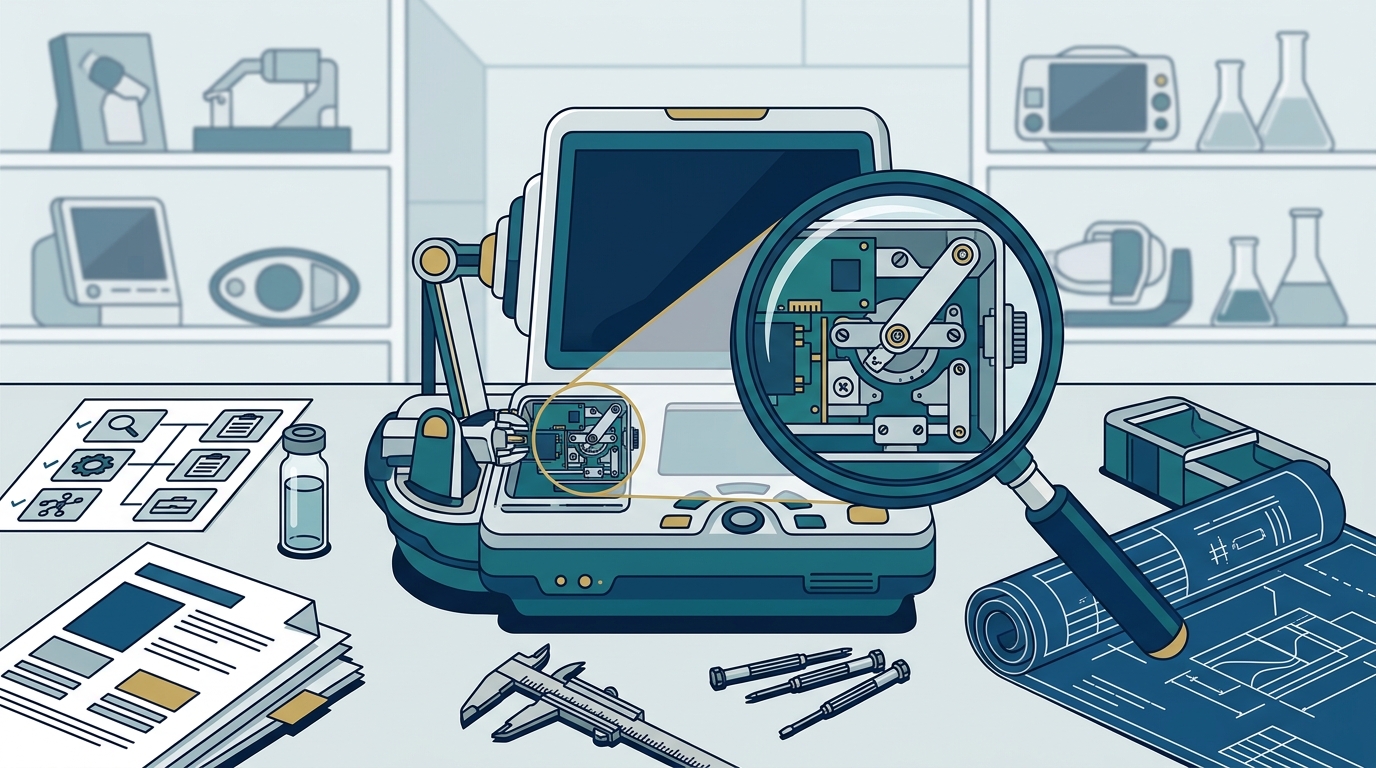
Medical devices often require a convergence of mechanical, electrical, software, and materials engineering. A fragmented approach, where different disciplines are handled by separate vendors, introduces communication gaps and integration risks. The ideal partner provides comprehensive engineering support that spans the entire product lifecycle.
Verify that the firm has in-house expertise across all necessary disciplines. For example, if your device involves software, ensure they have experience with SaMD (Software as a Medical Device) regulations. If it involves biocompatibility, confirm their experience with ISO 10993 testing protocols. A unified team ensures that technical decisions in one domain do not inadvertently compromise another.
Technical Scope Checklist
- Mechanical design and prototyping
- Electrical hardware and embedded software
- Materials science and biocompatibility
- Manufacturing process development
3. Team Composition & Leadership
The quality of your product is directly tied to the experience of the engineers building it. A65 Consulting, for instance, leverages a team with decades of medical device development experience, ensuring that historical lessons inform current projects. When assessing a firm, look beyond the company name to the individuals who will touch your project.
Ask for resumes of the specific engineers who will be assigned to your account. Do they have experience with your specific technology stack? Have they worked on devices in your therapeutic area? A partner with a broad range of experience can offer insights from unrelated industries that may solve unique challenges in your project. Furthermore, ensure that the leadership team has the capacity to provide strategic guidance, not just technical execution.
Evaluating Leadership
- Principal Involvement: Senior engineers should be actively involved in key milestones.
- Continuity: Low turnover rates ensure that institutional knowledge is retained.
- Specialization: Engineers with specific domain expertise reduce the learning curve.
4. Verification as a System, Not a Phase
One of the most common pitfalls in medical device development is treating verification as a final testing phase. In reality, verification is a system that must be planned from the outset. According to ISO 13485 standards, verification ensures that design outputs meet design inputs, and validation ensures that the device meets user needs.
A robust engineering partner will integrate verification planning into the early stages of development. This includes defining test protocols, selecting appropriate measurement systems, and establishing acceptance criteria before any hardware is built. Late-stage verification failures are rarely surprises; they are usually the result of inadequate planning earlier in the process. Ask potential partners how they structure their verification plans to prevent costly rework.
Verification Best Practices
- Early Planning: Test protocols are drafted alongside design specifications.
- Risk-Based Testing: Tests are prioritized based on risk analysis outcomes.
- Traceability: Every test result is linked back to a specific design requirement.
5. Design for Manufacturing (DfM) Integration
Design for Manufacturing (DfM) is often mistakenly viewed as a cost-reduction activity. In reality, it is a quality exercise that ensures the device can be produced consistently and safely. DfM principles must be applied during the design phase to avoid manufacturing bottlenecks and quality issues.
Evaluate how your potential partner approaches DfM. Do they involve manufacturing engineers early in the design process? Do they conduct Design for Manufacturability (DFM) reviews with contract manufacturers? A partner who understands manufacturing constraints can help you select materials and tolerances that balance performance with producibility. This proactive approach reduces the time and cost associated with production transfer.
DfM Evaluation Criteria
- Early Involvement: Manufacturing experts are part of the design team.
- Supplier Collaboration: Active engagement with potential suppliers during design.
- Process Validation: Clear plans for validating manufacturing processes.
6. Human Factors & Usability Engineering
Medical devices are used by humans in high-stakes environments. Human factors engineering ensures that the device is intuitive, safe, and effective for its intended users. The FDA guidance on user interface design emphasizes the need for rigorous usability testing to identify use-related risks.
A strong engineering partner will integrate human factors activities throughout the development cycle. This includes formative usability testing to refine the design and summative testing to validate safety. Ask potential partners about their approach to user research and testing. Do they have experience with clinical environments? Can they simulate real-world usage conditions in their lab?
Human Factors Key Points
- Formative Testing: Early testing to inform design iterations.
- Summative Testing: Final validation of usability and safety.
- Real-World Simulation: Testing in environments that mimic clinical use.
7. Engagement Models & Cultural Fit
The success of any engineering partnership depends on clear communication and aligned expectations. A65 Consulting typically charges on a monthly retainer basis, working toward mutually agreed upon project milestones. This model provides flexibility and ensures that resources are available when needed.
When evaluating engagement models, consider the following:
- Flexibility: Can the partner scale resources up or down as the project evolves?
- Transparency: Are costs and timelines clearly defined and regularly updated?
- Cultural Alignment: Does the partner share your commitment to quality and innovation?
Choose a partner who acts as an extension of your team, not just a vendor. This requires a relationship built on trust, transparency, and shared goals.
Comparison of Engineering Partner Models
| Model | Pros | Cons | Best For |
|---|---|---|---|
| Full-Service Firm | End-to-end expertise, reduced coordination overhead | Higher cost, potential for less specialized focus | Startups and companies lacking internal engineering |
| Specialized Boutique | Deep expertise in specific domains, agile | Limited scope, requires internal project management | Companies with strong internal teams needing specific skills |
| Freelance Engineers | Cost-effective, flexible | Inconsistent quality, lack of institutional knowledge | Small, well-defined tasks |
Key Takeaways
- Regulatory Foresight: Choose a partner who integrates risk management and regulatory strategy from concept to launch.
- Technical Breadth: Ensure the firm has in-house capabilities across mechanical, electrical, and software disciplines.
- Team Experience: Verify the specific engineers' experience with your device type and therapeutic area.
- Verification Planning: Prioritize partners who treat verification as a continuous system, not a final phase.
- DfM Integration: Select a partner who involves manufacturing experts early to ensure producibility.
- Human Factors: Confirm their ability to conduct rigorous usability testing in real-world contexts.
- Engagement Flexibility: Opt for models that allow scaling and transparent milestone tracking.
Frequently Asked Questions
What is the typical timeline for medical device design?
Timelines vary significantly based on device complexity and regulatory class. Simple Class I devices may take 6-12 months, while complex Class III devices can take 3-5 years. A reliable partner will provide a realistic timeline based on similar past projects.
How do engineering firms charge for medical device development?
Common models include monthly retainers, fixed-price milestones, and time-and-materials. A65 Consulting typically uses a monthly retainer model tied to project milestones, providing predictability and flexibility.
Why is human factors testing important?
Human factors testing identifies use-related risks that could lead to user error. It is a regulatory requirement for most medical devices and ensures that the device is safe and effective in real-world clinical environments.
Can a small firm handle complex medical device projects?
Yes, if they have the right team composition and experience. Small firms often offer more personalized service and agility. However, verify their capacity to handle the specific technical and regulatory challenges of your project.
What is Design for Manufacturing (DfM)?
DfM is the practice of designing products in a way that makes them easy and cost-effective to manufacture. It involves early collaboration with manufacturing experts to optimize materials, tolerances, and processes.
How do I verify a firm's regulatory experience?
Ask for case studies of past regulatory submissions, specifically 510(k) or PMA approvals. Inquire about their process for managing regulatory queries and their familiarity with relevant standards like ISO 13485.
What happens if the project scope changes?
A good partner will have a clear change management process. They should communicate the impact of scope changes on timeline and cost promptly and work with you to adjust the plan accordingly.
Ready to Engineer Your Next Medical Device?
Choosing the right engineering partner is a strategic decision that impacts your product's success, timeline, and compliance. A65 Consulting offers the expertise, experience, and flexibility to guide your device from concept to reality. We specialize in turning device concepts into viable products with expert teams and meticulous attention to detail.
Don't navigate the complexities of medical device development alone. Book a consultation with our team today to discuss your project and discover how we can help you achieve your product development objectives.